


Safety Stock
Safety stock is the extra inventory a business holds beyond expected demand to protect against unexpected spikes in sales or delays in supplier delivery. It acts as a buffer that reduces the risk of running out of a product before the next replenishment arrives.
Definition of Safety Stock
Safety stock is a quantity of extra inventory a business keeps on hand above the amount needed to meet forecasted demand, specifically to guard against the two things forecasts can’t perfectly predict: a sudden spike in customer demand, or a delay in receiving new stock from a supplier. It is not the inventory a business expects to sell in the normal course of business — that’s covered by standard replenishment planning — it is the buffer that absorbs the gap between what was expected and what actually happens. Every product carries some risk of demand or supply variability, so safety stock is best thought of as insurance against that variability, sized to the level of risk each specific product actually presents.
How Safety Stock Is Calculated
The most common approach to sizing safety stock accounts for both demand variability and lead time variability using a formula along these lines:
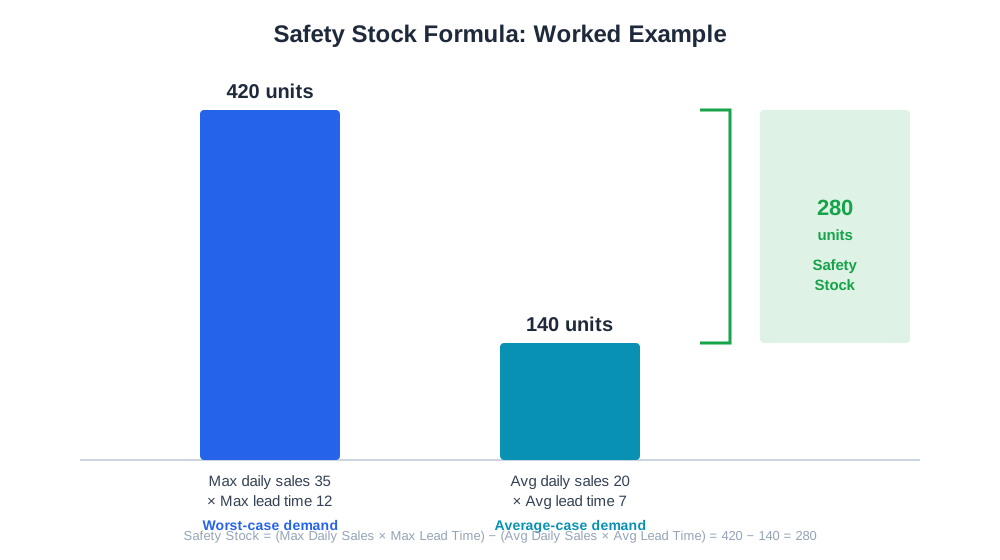
Safety Stock = (Maximum Daily Sales × Maximum Lead Time) − (Average Daily Sales × Average Lead Time)
Consider a product that sells an average of 20 units per day, but has spiked to 35 units per day during a busy week. Its supplier normally ships within 7 days, but has occasionally taken as long as 12 days. Plugging these into the formula: maximum daily sales (35) times maximum lead time (12) equals 420 units of potential demand during the worst-case wait. Average daily sales (20) times average lead time (7) equals 140 units of expected demand during a typical wait. The difference, 280 units, is the recommended safety stock — enough to cover the gap between the worst realistic case and the average case, without holding enough to cover every conceivable extreme.
More sophisticated versions of this calculation incorporate statistical measures of demand and lead time variability (standard deviations) rather than simple maximum and average values, which tends to produce a more precisely sized buffer, but the underlying logic is the same: safety stock should scale with how unpredictable a product’s demand and supply actually are, not be applied as a flat percentage across every SKU.

Ready to Monitor Your AI Visibility?
Track how AI chatbots mention your brand across ChatGPT, Perplexity, and other platforms.
Why Safety Stock Matters for E-commerce Brands
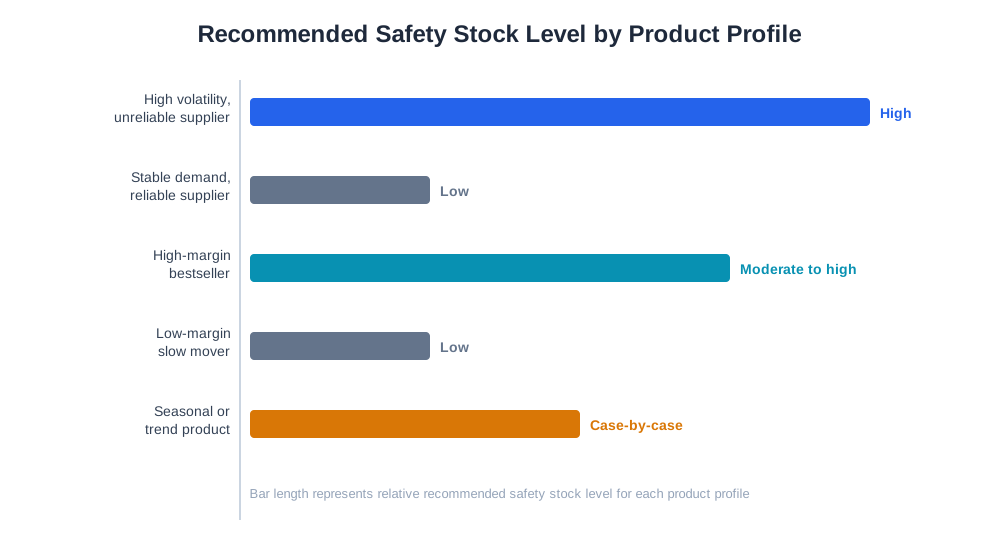
Getting safety stock right sits at the center of a tension every inventory-holding business faces. Too little safety stock, and a demand spike or a delayed shipment turns into a stockout — lost sales, frustrated customers, and in many cases a permanent loss of that sale to a competitor rather than a delayed one. Too much safety stock, and capital sits tied up in inventory that isn’t turning over, storage costs accumulate, and for perishable or trend-sensitive products, the extra stock risks becoming unsellable before it moves. The right level of safety stock is product-specific: a bestselling, high-margin item with a volatile supplier probably justifies a generous buffer, while a slow-moving, low-margin item with a reliable supplier probably doesn’t need much buffer at all.
| Product Profile | Recommended Safety Stock Level | Reasoning |
|---|---|---|
| High demand volatility, unreliable supplier | High | Both risk factors compound |
| Stable demand, reliable supplier | Low | Little uncertainty to buffer against |
| High-margin bestseller | Moderate to high | Stockout cost (lost sales) is severe |
| Low-margin slow mover | Low | Holding cost outweighs stockout risk |
| Seasonal or trend product | Case-by-case | Must weigh obsolescence risk against demand spikes |
Safety Stock and AI-Driven Commerce
As AI shopping assistants like ChatGPT Shopping and Perplexity Shopping increasingly check real-time product availability before recommending a purchase, a stockout doesn’t just cost a single sale — it can remove a product from consideration in an AI-mediated comparison entirely, sometimes in favor of a competitor that happened to be in stock at that moment. This raises the practical stakes of getting safety stock right for any product likely to be surfaced through AI shopping channels. AmICited’s eshop_get_replenishment tool supports this by analyzing a store’s actual sales velocity and current inventory levels to recommend reorder timing and quantities grounded in real historical demand, giving merchants a data-driven starting point for setting safety stock levels rather than relying on rough estimates that either overprotect slow movers or underprotect volatile bestsellers.
Stay Updated on AI Visibility Trends
Get the latest insights on AI mentions, brand monitoring, and optimization strategies.
Best Practices for Setting Safety Stock
- Calculate safety stock per product or product category rather than applying one flat rule across the catalog
- Weight safety stock more heavily toward high-margin, high-velocity products where stockout cost is highest
- Recalculate periodically as demand patterns shift with seasonality, promotions, or new customer growth
- Factor in actual supplier lead time variability, not just the quoted or average lead time
- Balance safety stock against holding costs and obsolescence risk, especially for perishable or trend-driven items
- Use real sales and inventory data rather than a subjective buffer percentage to size the calculation
Common Safety Stock Mistakes
A frequent mistake is applying a single safety stock percentage, like “always keep two weeks of extra stock,” across an entire catalog regardless of how each product actually behaves — this overprotects slow, predictable items while leaving genuinely volatile bestsellers underprotected. Another common issue is calculating safety stock once at launch and never revisiting it, even as a product’s demand pattern shifts significantly with seasonality or growth; a quarterly review against actual sales data usually catches this drift. Some businesses also underestimate supplier lead time variability, using the quoted lead time rather than the actual historical range including delays, which produces a safety stock buffer that looks adequate on paper but fails during a real supply disruption. Overcorrecting after a painful stockout is another common pattern — dramatically increasing safety stock across the board in reaction to one bad experience, which then ties up working capital in excess inventory that didn’t need the same treatment. Finally, treating safety stock in isolation from margin and holding cost data can lead to buffers that are technically safe but financially wasteful; safety stock decisions should always be checked against what holding the extra units actually costs relative to the stockout risk being avoided.