
What is Search Generative Experience (SGE)? Complete Guide for 2024
Learn what Search Generative Experience (SGE) is, how it works, and why monitoring your brand visibility in SGE results is critical for your digital presence.
10 min read
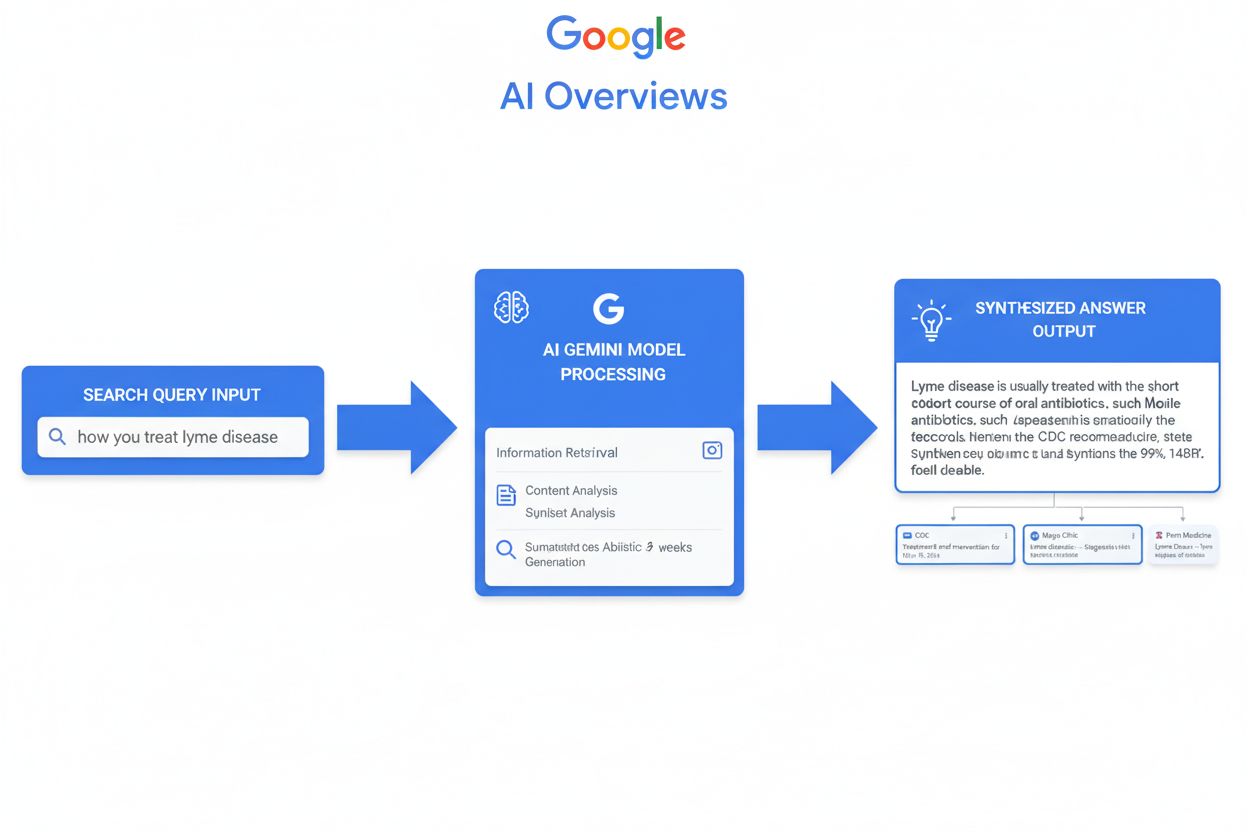
Search Generative Experience (SGE), now called Google AI Overviews, is Google’s AI-powered search feature that generates comprehensive, synthesized answers to user queries by combining information from multiple web sources. Powered by Google’s Gemini model, SGE delivers direct answers at the top of search results, reducing the need for users to click through to individual websites.
Search Generative Experience (SGE), now called Google AI Overviews, is Google's AI-powered search feature that generates comprehensive, synthesized answers to user queries by combining information from multiple web sources. Powered by Google's Gemini model, SGE delivers direct answers at the top of search results, reducing the need for users to click through to individual websites.
Search Generative Experience (SGE), now officially called Google AI Overviews, is Google’s AI-powered search feature that generates comprehensive, synthesized answers to user queries by combining information from multiple web sources. Launched experimentally in May 2023 and rolled out to all U.S. users in May 2024, SGE represents a fundamental shift in how search engines deliver information. Rather than returning a list of ranked links, AI Overviews use Google’s custom Gemini model to create direct, conversational answers that appear at the top of search results, often above traditional organic listings and paid advertisements. The feature synthesizes data from multiple authoritative sources, Google’s Knowledge Graph, and real-time information to provide users with immediate answers to complex questions. This technology fundamentally changes the search experience from link-finding to answer-getting, reducing the need for users to click through multiple websites to piece together information.
The development of Search Generative Experience represents the culmination of decades of search engine evolution. Google’s search algorithm has continuously evolved from simple keyword matching in the 1990s to sophisticated ranking systems like PageRank, Hummingbird, and RankBrain that understand user intent and semantic meaning. The introduction of featured snippets in 2014 marked the beginning of direct answer provision on search results pages, but these were limited to single-source extracts. SGE builds on this foundation by leveraging large language models (LLMs) to synthesize information across multiple sources, creating more comprehensive and nuanced answers. According to Google’s official announcement, the company has been testing generative AI capabilities in search since 2023, with billions of experimental uses before the full rollout. The transition from SGE to AI Overviews in May 2024 marked the shift from experimental feature to production-ready technology available to hundreds of millions of users. By late 2024, AI Overviews appeared in over 50% of all Google searches, demonstrating unprecedented adoption rates for a new search feature. This rapid expansion reflects both user acceptance and Google’s confidence in the technology’s reliability and value.
Search Generative Experience operates through a sophisticated multi-step process that begins the moment a user enters a search query. When a user types a query into Google Search, the system routes it through Google’s custom Gemini model, a multimodal large language model trained on vast amounts of text, images, and structured data. The Gemini model uses natural language processing (NLP) to understand the query’s intent, identifying key concepts, entities, and the user’s underlying information need. Unlike traditional search algorithms that match keywords to indexed pages, Gemini employs multi-step reasoning to break down complex queries into component parts and understand relationships between concepts. The model then queries Google’s index and Knowledge Graph to retrieve relevant information from multiple sources, prioritizing authoritative, high-quality content. The synthesis phase combines information from these diverse sources into a coherent, comprehensive answer that addresses the user’s query from multiple angles. The system applies real-time contextualization, incorporating current information, location data, and personalization signals to tailor answers to individual users. Finally, the AI Overview is formatted with citations linking back to source websites, allowing users to explore deeper if desired. This entire process happens in milliseconds, delivering results faster than traditional search while maintaining accuracy and source attribution.
| Feature | Search Generative Experience (SGE) | Traditional Google Search | ChatGPT Search | Perplexity AI |
|---|---|---|---|---|
| Answer Format | AI-synthesized summary with citations | Ranked list of links | Conversational with sources | Formatted answer with citations |
| Source Diversity | Multiple sources (avg. 5-28 per answer) | Individual page ranking | Broad web crawl | Curated sources |
| Citation Transparency | Explicit source links included | Links are the primary result | Sources provided separately | Inline citations |
| Conversational Follow-up | Limited (AI Overviews); Full (SGE) | Not available | Full conversation capability | Limited follow-up |
| Real-time Data | Yes, integrated | Yes, indexed | Yes, with limitations | Yes, real-time |
| Appearance on SERP | Top of page, above organic results | Primary content | Separate interface | Separate interface |
| User Intent Match | Informational (90%+) | All intent types | All intent types | Informational focus |
| Mobile Optimization | 81% of queries on mobile | Mobile-friendly | Mobile app available | Mobile-optimized |
| Geographic Availability | 100+ countries, 40+ languages | Global | Global | Global |
| Traffic Impact | Reduces CTR 61% for cited queries | Baseline | Diverts traffic from Google | Diverts traffic from Google |
The introduction of Search Generative Experience has fundamentally altered click-through rate (CTR) dynamics across Google Search. Research from Seer Interactive analyzing 3,119 informational queries across 42 organizations found that organic CTRs for AI Overview queries dropped from 1.76% to 0.61%—a 61% decline. Simultaneously, paid CTRs for the same queries fell from 19.7% to 6.34%—a 68% decrease. These dramatic reductions reflect the zero-click search phenomenon, where users find answers directly in AI Overviews without clicking through to websites. However, the impact is not uniformly negative for all brands. Brands cited in AI Overviews earn 35% more organic clicks and 91% more paid clicks compared to non-cited competitors, indicating that visibility in AI Overviews has become a critical ranking factor. Industry-specific impacts vary significantly: B2B technology queries show 70% AI Overview prevalence (up from 36%), while ecommerce queries have declined from 29% to just 4%, suggesting that transactional and commercial queries remain less affected by AI Overviews. Overall, 58% of Google searches now result in zero clicks, with AI Overviews contributing substantially to this trend. This shift has forced marketers and SEO professionals to reconsider success metrics, moving from traditional click-based KPIs to visibility and share-of-voice metrics that prioritize appearing in AI-generated answers.
To achieve visibility in Search Generative Experience and AI Overviews, content must meet specific quality and structural criteria that differ from traditional SEO optimization. AI Overviews favor comprehensive, authoritative content that synthesizes information from multiple angles, rather than thin, keyword-optimized pages. Research shows that 52% of sources mentioned in AI Overviews rank in the top 10 organic results, but 40% of cited sources would rank in positions 11-20 on traditional SERPs, indicating that AI systems value content quality and comprehensiveness over pure ranking position. Content must be well-structured with clear definitions, step-by-step explanations, and actionable insights that AI models can easily extract and synthesize. Longer, more detailed content performs better, with AI Overviews citing an average of 5-28 sources depending on answer length. E-E-A-T signals (Experience, Expertise, Authoritativeness, Trustworthiness) are critical, as AI models prioritize content from recognized authorities and trusted sources. Structured data markup, schema implementation, and semantic HTML help AI systems understand content context and relationships. Natural language and conversational tone perform better than keyword-stuffed content, as Gemini’s NLP systems understand semantic meaning rather than keyword density. Additionally, content addressing complex, multi-faceted queries with nuance and caveats is more likely to be cited, as AI Overviews excel at synthesizing information for sophisticated search intents.
While Google AI Overviews dominate the generative search landscape, other platforms have developed competing technologies that affect brand visibility differently. Microsoft’s Bing Deep Search integrates GPT-4 capabilities to provide AI-powered answers, though with different source selection algorithms than Google. ChatGPT Search, launched by OpenAI, provides conversational AI responses with source attribution but operates as a separate interface from traditional search. Perplexity AI focuses on providing formatted answers with inline citations, attracting users seeking transparent source attribution. Each platform’s citation algorithms differ significantly: Google AI Overviews pull from a broader range of sources (including positions 11-20 in organic results), while ChatGPT and Perplexity tend to favor high-authority domains. Reddit appears in 5.5% of Google AI Overviews (the highest single source), reflecting Google’s integration of user-generated content and community discussions. The competitive landscape means brands must optimize for multiple AI platforms simultaneously, as users increasingly distribute their searches across different AI-powered tools. Monitoring brand mentions across all major AI platforms has become essential for understanding true AI search visibility, as no single platform dominates user behavior completely. For organizations using AI monitoring platforms like AmICited, tracking appearances across Google AI Overviews, ChatGPT, Perplexity, Claude, and Bing provides comprehensive visibility into how AI systems represent brand authority and expertise.
The trajectory of Search Generative Experience and AI Overviews suggests continued expansion and integration into Google’s core search experience. Google has already expanded AI Overviews to over 100 countries and 40 languages, with plans for further geographic and linguistic expansion. The introduction of Google AI Mode in May 2025 represents a significant evolution, creating a dedicated interface for AI-powered search that pushes traditional links further down the page. Google’s testing of ads within AI Overviews signals monetization strategies that will shape the platform’s future, potentially creating new visibility opportunities for advertisers. Industry-specific adoption patterns suggest continued growth in B2B technology, insurance, and entertainment verticals, while ecommerce and local queries may remain less affected by AI Overviews. The competitive pressure from ChatGPT, Perplexity, and other AI search platforms is driving Google to enhance AI Overviews with more sophisticated capabilities, including video understanding, image generation, and deeper integration with Google’s ecosystem. Predictions suggest AI-powered search will account for 25% of all search traffic by 2026, with traditional organic search declining correspondingly. The definition of SEO success is fundamentally shifting from ranking metrics to visibility and citation metrics, requiring organizations to adopt new measurement frameworks. Brands that establish authority and trustworthiness now will benefit from self-reinforcing visibility cycles as AI systems increasingly cite established sources. The long-term implication is a search landscape where content quality, comprehensiveness, and authority matter more than ever, but where visibility depends on AI system selection rather than purely algorithmic ranking. For AI monitoring platforms and brand tracking tools, this evolution creates new opportunities to help organizations understand and optimize their presence in generative search engines and AI-powered answer systems.
Search Generative Experience (SGE) was Google's experimental testing phase launched in May 2023, featuring conversational follow-up questions and interactive capabilities. AI Overviews, which rolled out to all U.S. users in May 2024, is the production version that provides static AI-generated summaries without conversational follow-ups. While SGE included features like image generation and coding assistance, AI Overviews focus on delivering concise, cited answers at the top of search results. Both use Google's Gemini model but represent different stages of the same technology evolution.
Google's custom Gemini model processes search queries using advanced natural language processing and multi-step reasoning to understand user intent. The model synthesizes information from multiple authoritative web sources, Google's Knowledge Graph, and real-time data to generate comprehensive answers. Gemini's transformer neural network architecture enables it to handle complex, nuanced queries with multiple caveats and conditions, delivering more sophisticated results than traditional keyword-based search algorithms.
As of late 2024 and early 2025, AI Overviews appear in over 50% of all Google search queries, more than doubling from approximately 25% in August 2024. According to Advanced Web Ranking data, this represents a significant inflection point in search behavior. The feature has expanded to over 100 countries and 40 languages, with adoption continuing to accelerate, particularly for informational and complex queries.
AI Overviews have significantly reduced click-through rates (CTRs) for traditional organic search results. Studies show organic CTRs for AI Overview queries dropped 61% from 1.76% to 0.61%, while paid CTRs fell 68% from 19.7% to 6.34%. However, brands cited in AI Overviews earn 35% more organic clicks and 91% more paid clicks than those not cited. Some websites report 20-40% traffic declines, though the impact varies by industry, with ecommerce seeing minimal AI Overview presence while B2B technology queries show 70% AI Overview prevalence.
AI Overviews appear most frequently for informational queries (nearly 100% of AIO queries), particularly those with longer search terms—queries with eight or more words are 7x more likely to trigger an AI Overview. They rarely appear for commercial or transactional keywords (only 10% chance) and show up in just 7% of local queries. Technical, industry-specific, and complex terminology queries are 48% more likely to generate AI Overviews, while ecommerce queries have declined from 29% to just 4% AI Overview presence.
AI Overviews include citations linking back to source websites, with approximately 76% of citations coming from pages ranking in the top 10 organic results. However, 40% of sources cited would rank in positions 11-20 on traditional SERPs, indicating AI Overviews pull from a broader range of sources. Reddit appears in 5.5% of AI Overviews (the highest), followed by Quora (4%), NIH.gov (1.8%), and WebMD (1.5%). Google's own properties appear in approximately 43% of all AI-generated answers.
For platforms like AmICited that track brand appearances in AI responses, AI Overviews represent a critical new visibility metric. Being cited in an AI Overview signals authority and trustworthiness to both users and AI systems, creating a self-reinforcing cycle of visibility. Brands appearing in AI Overviews gain competitive advantage as these summaries become the primary interface between users and information. Monitoring AI Overview citations is now as important as tracking traditional search rankings, making AI citation tracking essential for understanding brand presence in the evolving search landscape.
Start tracking how AI chatbots mention your brand across ChatGPT, Perplexity, and other platforms. Get actionable insights to improve your AI presence.
Learn what Search Generative Experience (SGE) is, how it works, and why monitoring your brand visibility in SGE results is critical for your digital presence.
Learn what Google AI Overviews are, how they work, their impact on search traffic, and how to optimize your content to appear in AI-generated summaries.
Learn how to scale GEO efforts across AI platforms like ChatGPT, Perplexity, and Google AI Overviews. Discover the 12-step framework for maximizing brand visibi...