

Matching Content to Prompts: Optimization Based on Query Intent
Learn how to align your content with AI query intent to increase citations across ChatGPT, Perplexity, and Google AI. Master content-prompt matching strategies ...
8 min read
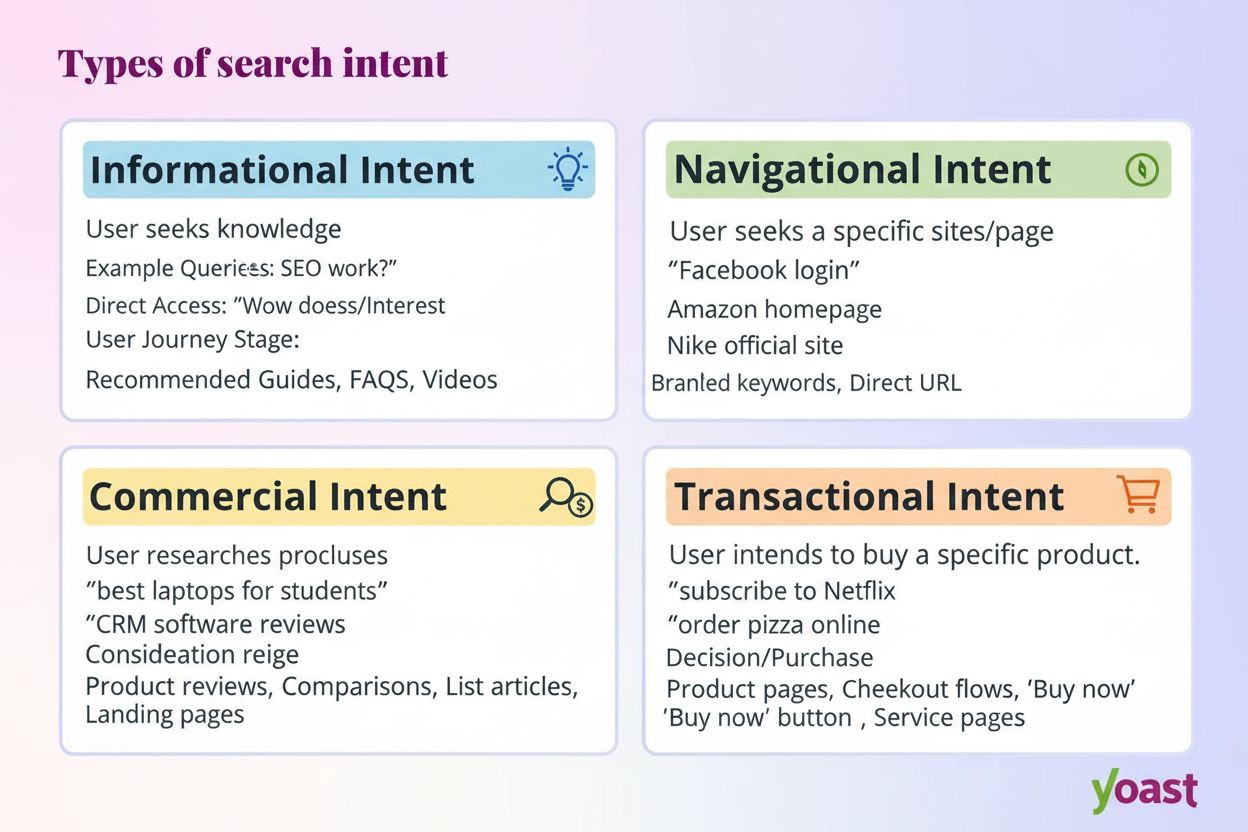
Search intent is the underlying purpose or goal behind a user’s search query, representing what they actually want to accomplish when entering terms into a search engine. It encompasses four primary types—informational, navigational, commercial, and transactional—each reflecting different stages of the user journey and requiring distinct content strategies for optimal search engine visibility.
Search intent is the underlying purpose or goal behind a user's search query, representing what they actually want to accomplish when entering terms into a search engine. It encompasses four primary types—informational, navigational, commercial, and transactional—each reflecting different stages of the user journey and requiring distinct content strategies for optimal search engine visibility.
Search intent, also known as user intent, audience intent, or query intent, is the fundamental purpose or goal behind a user’s search query. It represents what a person actually wants to accomplish when they type specific terms into a search engine. When someone enters a search query, they are implicitly asking a question or seeking to complete a task, and search intent is the answer to that underlying question. Understanding search intent is critical because it bridges the gap between what users search for and what they actually need to find. Google has made search intent a cornerstone of its ranking algorithm, recognizing that satisfying user intent is essential to maintaining user trust and engagement. The success of modern SEO, content marketing, and brand visibility—particularly in the emerging landscape of AI-powered search—depends fundamentally on aligning content with the specific intent behind each search query.
The concept of search intent has evolved significantly since the early days of search engines. In the 1990s and early 2000s, search engines primarily relied on keyword matching, returning results based on exact or partial matches of search terms without deeply understanding user intent. However, as search technology advanced and user behavior became more sophisticated, search engines began developing algorithms to interpret the meaning behind queries rather than simply matching keywords. Google’s introduction of semantic search and natural language processing marked a turning point, allowing the search engine to understand context, synonyms, and the relationships between concepts. By the 2010s, search intent had become a central pillar of SEO strategy, with industry experts recognizing that content creators needed to understand not just what keywords to target, but why users were searching for those keywords. Today, with the rise of AI-powered search platforms like ChatGPT, Perplexity, Google AI Overviews, and Claude, search intent has taken on new dimensions. Users are now phrasing queries as natural language prompts that often combine multiple intents, requiring content to be structured for both traditional search engines and AI extraction. According to recent data, approximately 30% of all search queries now trigger AI Overviews in the United States, fundamentally changing how brands must approach intent-based content optimization.
Understanding the four primary types of search intent is essential for developing an effective content strategy. Each type represents a distinct stage in the user journey and requires different content formats, structures, and optimization approaches.
Informational intent occurs when users search to learn something or gain knowledge about a topic. These queries typically begin with question words like “how,” “what,” “why,” or “when,” and represent high-funnel users who are in the awareness stage of their journey. Examples include “how to bake sourdough bread,” “what is blockchain,” or “best practices for remote work.” Users with informational intent are not yet ready to make a purchase; instead, they are seeking education, answers to questions, or general knowledge. Google frequently displays featured snippets, knowledge graphs, and educational content for informational queries. Content optimized for informational intent should be comprehensive, well-structured, and authoritative, often taking the form of blog posts, guides, tutorials, FAQs, or how-to articles.
Navigational intent describes searches where users are looking for a specific website, page, or location. These queries often include brand names, product names, or specific website references. Examples include “Facebook login,” “Yoast SEO,” “Amazon homepage,” or “McDonald’s near me.” Users with navigational intent already know what they’re looking for; they’re using the search engine as a shortcut rather than typing a full URL. Navigational queries are typically low-volume but high-value because they indicate strong brand awareness and user intent to engage with a specific entity. Ranking well for navigational queries is important for brand visibility, though it’s most effective when users are actually searching for your brand.
Commercial intent represents users who are researching products or services and comparing options before making a purchase decision. These queries often include modifiers like “best,” “top,” “review,” “compare,” or “alternatives.” Examples include “best running shoes 2025,” “Samsung vs LG refrigerator,” or “alternatives to Adobe Photoshop.” Users with commercial intent are in the mid-funnel stage, actively evaluating options but not yet ready to commit to a purchase. Content optimized for commercial intent should include comparisons, reviews, pros and cons, expert opinions, and detailed product information. This is a critical stage for building trust and influencing purchase decisions.
Transactional intent indicates that users are ready to take action—typically making a purchase, signing up for a service, or completing a download. These queries often include action-oriented words like “buy,” “order,” “subscribe,” “download,” or “coupon.” Examples include “buy iPhone 15 Pro,” “Netflix subscription,” or “download Photoshop.” Users with transactional intent are at the bottom of the funnel and represent the highest conversion potential. Content optimized for transactional intent should make the path to conversion as smooth as possible, with clear calls-to-action, detailed product descriptions, pricing information, and secure payment options prominently displayed.
| Intent Type | User Goal | Funnel Stage | Query Modifiers | Best Content Format | SERP Features | Optimization Focus |
|---|---|---|---|---|---|---|
| Informational | Learn about a topic or answer a question | High-funnel (Awareness) | How, what, why, when, guide, tips, best way | Blog posts, guides, tutorials, FAQs, how-to articles | Featured snippets, knowledge graphs, answer boxes | Comprehensive, authoritative, well-structured content |
| Navigational | Find a specific website or location | All stages | Brand name, product name, “near me,” login | Homepage, branded pages, location pages | Sitelinks, local pack, Google Business Profile | Brand visibility, technical SEO, business listings |
| Commercial | Research and compare products/services | Mid-funnel (Consideration) | Best, top, review, compare, alternatives, vs | Comparison guides, reviews, roundups, buying guides | Popular products, refine by, aggregator results | Detailed comparisons, expert opinions, trust signals |
| Transactional | Complete a purchase or action | Low-funnel (Decision) | Buy, order, subscribe, coupon, cheap, for sale | Product pages, landing pages, checkout pages | Shopping results, local pack, ads | Clear CTAs, pricing, security badges, reviews |
Search engines employ sophisticated algorithms to recognize and interpret search intent, moving far beyond simple keyword matching. Semantic search technology enables search engines to understand the meaning and context of queries, recognizing that different words can have the same meaning and that the same word can have multiple meanings depending on context. For example, a search for “Java” could refer to the programming language, the island, or coffee, and search engines use contextual signals to determine which meaning is most relevant. Google’s algorithms analyze numerous signals to determine intent, including the structure of the query, the words used, the user’s search history, their location, the device they’re using, and the time of day. Natural language processing (NLP) allows search engines to understand complex, multi-part queries that combine multiple intents. Additionally, search engines analyze the content that currently ranks for a query to understand what users expect to find, using this information to refine their understanding of intent. The introduction of BERT (Bidirectional Encoder Representations from Transformers) and other transformer-based models has significantly improved Google’s ability to understand nuanced language and context. These models can process entire sentences and understand how different words relate to each other, enabling more accurate intent recognition. As AI-powered search platforms have emerged, intent recognition has become even more sophisticated, with large language models capable of understanding complex, conversational prompts that combine multiple intents and contextual requirements.
Search intent is intrinsically linked to the user journey, with each intent type corresponding to a specific stage in the customer’s path to purchase or engagement. Understanding this relationship is crucial for developing a comprehensive content strategy that serves users at every stage. The awareness stage of the user journey typically involves informational searches, where potential customers are just beginning to recognize a problem or need. At this stage, users are searching for general information, educational content, and answers to broad questions. Content optimized for this stage should be educational, accessible, and focused on building awareness and establishing authority. The consideration stage involves commercial searches, where users have identified a specific problem or need and are now researching potential solutions. At this stage, users are comparing options, reading reviews, and evaluating different products or services. Content optimized for this stage should facilitate comparison, provide detailed information about features and benefits, and help users make informed decisions. The decision stage involves transactional searches, where users have narrowed their options and are ready to make a purchase or take action. At this stage, users are looking for specific products, pricing information, and ways to complete their transaction. Content optimized for this stage should remove friction from the conversion process and make it as easy as possible for users to take action. By aligning content with these stages and the corresponding search intents, marketers can create a cohesive strategy that guides users through their entire journey.
The emergence of AI-powered search platforms has fundamentally transformed how search intent operates and how brands must optimize for visibility. Platforms like ChatGPT, Perplexity, Google AI Overviews, and Claude are changing user behavior and search patterns in significant ways. Rather than entering short, keyword-based queries, users are now crafting longer, more conversational prompts that often combine multiple intents in a single request. For example, instead of searching “best budget laptops,” a user might prompt an AI system with “Compare three affordable laptops under $500 and recommend the best one for a college student who needs good battery life.” This represents a shift from traditional search intent to what some experts call prompt intent, where users are delegating tasks to AI systems rather than simply searching for information. The implications for content strategy are substantial. Content must now be structured in ways that AI systems can easily extract, understand, and cite. This means using clear headings, organized information architecture, and comprehensive coverage of related topics. Additionally, with AI traffic growing 165x faster than organic search traffic, brands must ensure their content is optimized not just for traditional search engines but for AI extraction and citation. Tools like AmICited help brands monitor how their content appears in AI-generated responses across multiple platforms, providing visibility into how search intent is being satisfied by AI systems. Understanding search intent in this new landscape requires recognizing that users may interact with multiple platforms—traditional search engines, AI chatbots, and hybrid platforms—and that content must be optimized for all of these touchpoints.
Accurately identifying search intent is a critical skill for SEO professionals and content marketers. There are several proven methods for determining the intent behind a keyword or query. SERP analysis is one of the most effective approaches, involving a detailed examination of the top-ranking results for a target keyword. By analyzing what types of content rank, what formats are used, and what SERP features appear, you can infer what Google believes users are looking for. For example, if the top results for a keyword are all blog posts with how-to structures, that indicates informational intent. If the results include product pages and shopping features, that suggests transactional intent. Query language analysis involves examining the specific words and phrases used in a search query to infer intent. Certain modifiers are strong indicators of intent: “how,” “what,” and “why” typically indicate informational intent; “best,” “top,” and “review” suggest commercial intent; “buy,” “order,” and “coupon” indicate transactional intent; and brand or product names suggest navigational intent. SERP features also provide valuable clues about intent. Featured snippets and knowledge graphs typically appear for informational queries; shopping results and local packs appear for transactional queries; and sitelinks often appear for navigational queries. Audience research and user surveys can provide direct insights into what users are actually looking for when they search for a particular term. By understanding your audience’s needs, pain points, and search behavior, you can better align your content with their intent. SEO tools like Semrush, Yoast SEO, and Ahrefs now include built-in intent classification features that automatically categorize keywords by intent type, making the analysis process faster and more accurate.
Successfully optimizing content for search intent requires a strategic, multi-faceted approach. First, match the content format to the intent type. For informational queries, create comprehensive guides, tutorials, and educational content. For commercial queries, develop comparison guides, reviews, and buying guides. For transactional queries, optimize product pages and landing pages with clear calls-to-action. For navigational queries, ensure your branded pages are well-optimized and easily accessible. Second, address the full scope of user needs by going beyond the explicit query to anticipate related questions and concerns. Use tools like “People Also Ask” and “People Also Search For” to identify related topics that users care about, and incorporate this information into your content. Third, structure content for both search engines and AI systems by using clear headings, organized information architecture, and comprehensive coverage of topics. This makes it easier for both traditional search algorithms and AI systems to understand and extract your content. Fourth, optimize title tags and meta descriptions to clearly communicate what your content offers and align with user intent. Fifth, build trust and authority through citations, expert author bios, industry accreditations, and links to reputable sources. Sixth, ensure technical SEO excellence by maintaining fast page load times, mobile responsiveness, and proper site structure. Finally, monitor and iterate by tracking your rankings for intent-based keywords, analyzing user behavior on your pages, and continuously refining your content based on performance data.
Search intent continues to evolve as technology advances and user behavior changes. Several emerging trends are shaping the future of how search intent will be understood and optimized. Prompt intent is becoming increasingly important as users interact with AI systems through natural language prompts rather than traditional keyword queries. This shift requires content creators to think about how their content will be extracted and presented by AI systems, not just how it will rank in traditional search results. Zero-click searches are growing, where users get their answers directly from search results or AI responses without clicking through to a website. This trend emphasizes the importance of optimizing for featured snippets, knowledge panels, and AI citations. Multimodal search is expanding, with users searching using images, voice, and video in addition to text. This requires content creators to optimize across multiple formats and modalities. Contextual and personalized intent is becoming more sophisticated, with search engines and AI systems using increasingly detailed information about user context, location, device, and history to interpret intent. Entity-based search is growing in importance, with search engines focusing on understanding entities (people, places, things, concepts) and their relationships rather than just keywords. This requires content creators to think about how their content relates to broader entities and concepts in their industry. Vertical search is becoming more prevalent, with specialized search engines and platforms (e.g., YouTube, Amazon, TikTok) becoming important discovery channels with their own intent dynamics. As these trends continue to develop, the ability to understand and optimize for search intent will remain a critical competitive advantage for brands and content creators.
For brands using platforms like AmICited to monitor their visibility across AI search engines, understanding search intent is essential. When users search with specific intents on platforms like ChatGPT, Perplexity, Google AI Overviews, and Claude, they’re looking for content that satisfies that intent. By optimizing your content for specific intent types, you increase the likelihood that your brand will be cited or referenced when AI systems generate responses to queries with those intents. For example, if you create comprehensive, authoritative content optimized for informational intent, your brand is more likely to be cited when users ask AI systems educational questions about your industry. If you create detailed product pages optimized for transactional intent, your brand is more likely to appear when users ask AI systems for product recommendations or purchasing guidance. Monitoring how your brand appears across different intent types and platforms provides valuable insights into your content strategy’s effectiveness. By tracking which intents drive the most visibility, which platforms cite your content most frequently, and how your visibility compares to competitors, you can refine your content strategy to maximize your presence in AI-generated responses. This data-driven approach to understanding search intent in the AI era enables brands to maintain and grow their visibility as search behavior continues to evolve.
The four primary types of search intent are: (1) Informational—users seeking to learn or gain knowledge about a topic; (2) Navigational—users looking for a specific website or page; (3) Commercial—users researching products or services before making a purchase decision; and (4) Transactional—users ready to complete an action like buying, subscribing, or downloading. Understanding these distinctions helps marketers create content that aligns with what users actually want to find.
Search intent directly influences SEO success because Google prioritizes content that matches what users are searching for. By understanding intent, you can create content in the right format (guides for informational, comparisons for commercial, product pages for transactional) that ranks higher and converts better. Approximately 30% of all search queries now trigger AI Overviews, making intent alignment even more critical for visibility across both traditional search and AI-powered platforms.
You can identify search intent by analyzing the SERP (Search Engine Results Page) to see what types of content rank, examining query language for intent indicators like 'how,' 'best,' 'buy,' or 'review,' and using SEO tools like Semrush or Yoast that automatically classify keywords by intent. Additionally, studying SERP features (featured snippets for informational, shopping results for transactional) provides clear signals about what users expect to find.
Search intent and keyword intent are often used interchangeably, but keyword intent specifically refers to the intent associated with a particular search term or keyword. Search intent is the broader concept encompassing the user's underlying goal. Both terms describe the same fundamental principle: understanding why someone is searching and what they hope to accomplish with their query.
Search intent is evolving as users shift from short keyword queries to longer, more natural prompts on AI platforms like ChatGPT, Perplexity, and Google AI Overviews. This shift is sometimes called 'prompt intent,' where users combine multiple intents in a single request (e.g., 'compare and recommend the best budget laptop for students'). Content must now be structured for both traditional search engines and AI extraction, requiring clearer organization and more comprehensive coverage of related topics.
Search intent is crucial for AI monitoring because understanding what users are searching for helps brands track how their content appears in AI-generated responses. With AI traffic growing 165x faster than organic search traffic, brands must optimize for intent-aligned content that AI systems will cite and reference. Tools like AmICited monitor how brands appear across AI platforms when users search with specific intents, helping companies maintain visibility in this new search landscape.
Yes, many keywords exhibit mixed intent, where a single search term can satisfy multiple user goals. For example, 'running shoes for beginners' combines informational intent (learning about running shoes) with commercial intent (comparing options). Google often displays diverse content types for mixed-intent queries, including guides, reviews, and product pages. Recognizing mixed intent helps you create comprehensive content that serves multiple user needs simultaneously.
Start tracking how AI chatbots mention your brand across ChatGPT, Perplexity, and other platforms. Get actionable insights to improve your AI presence.
Learn how to align your content with AI query intent to increase citations across ChatGPT, Perplexity, and Google AI. Master content-prompt matching strategies ...
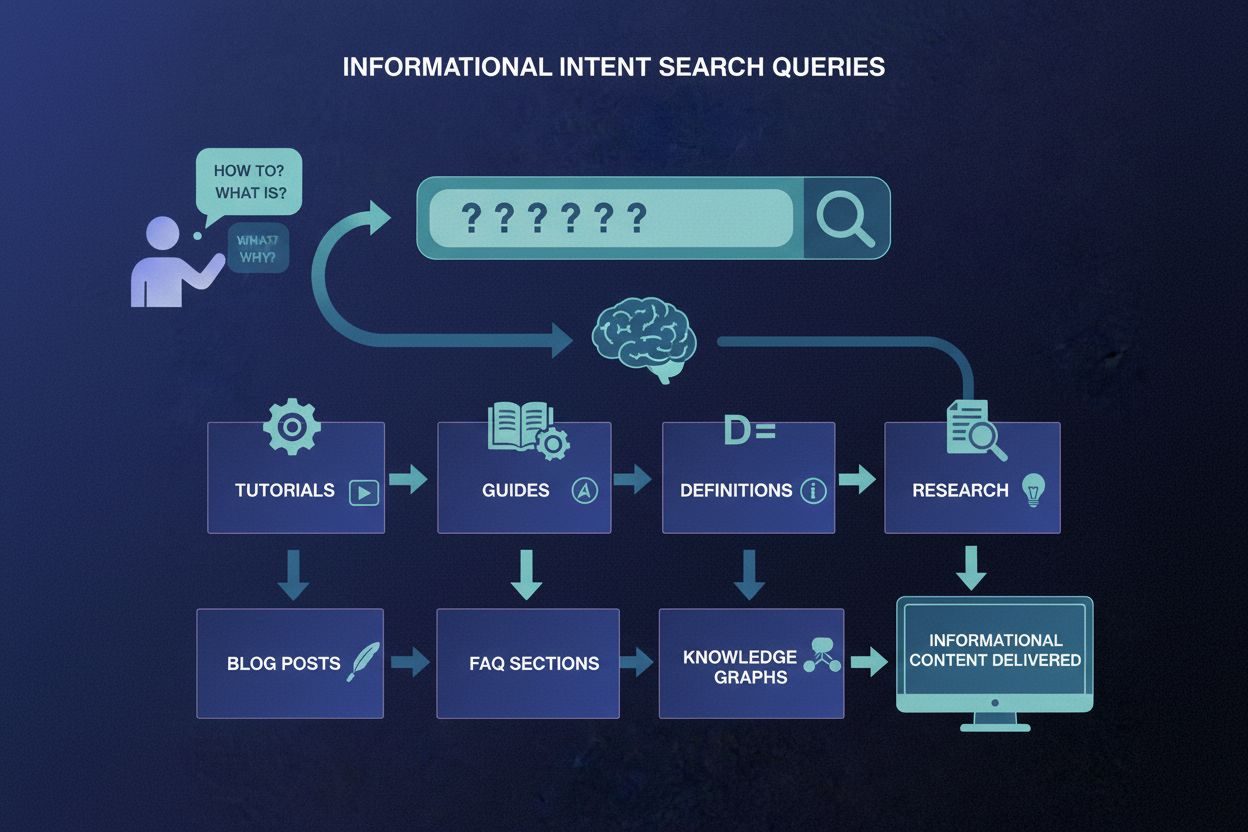
Informational intent is when users search for knowledge or answers. Learn how to optimize content for informational queries and understand its role in AI search...

Learn how to identify and optimize for search intent in AI search engines. Discover methods to classify user queries, analyze AI SERPs, and structure content fo...
Cookie Consent
We use cookies to enhance your browsing experience and analyze our traffic. See our privacy policy.