
AI Search Journey
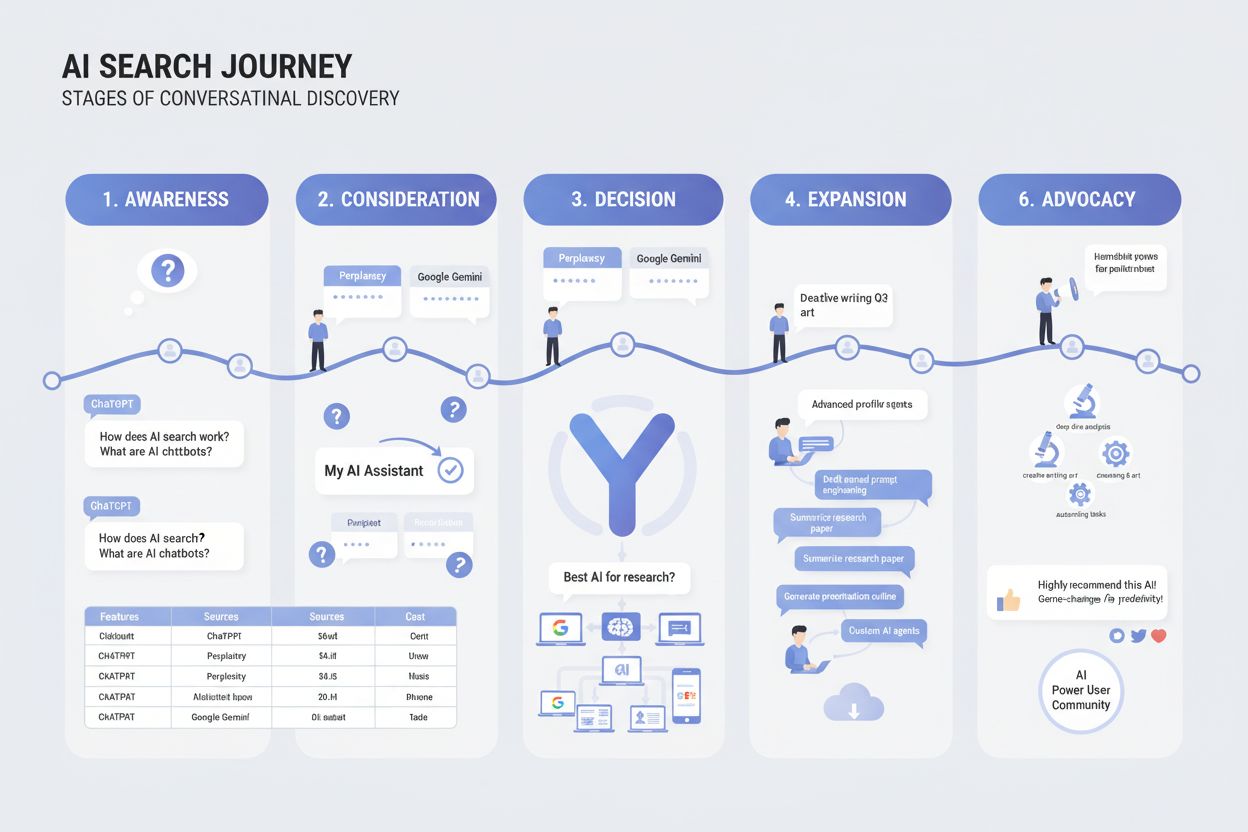
Understand the AI Search Journey—the multi-turn conversational path users take through AI search systems. Learn how awareness, consideration, decision, and adop...
16 min read
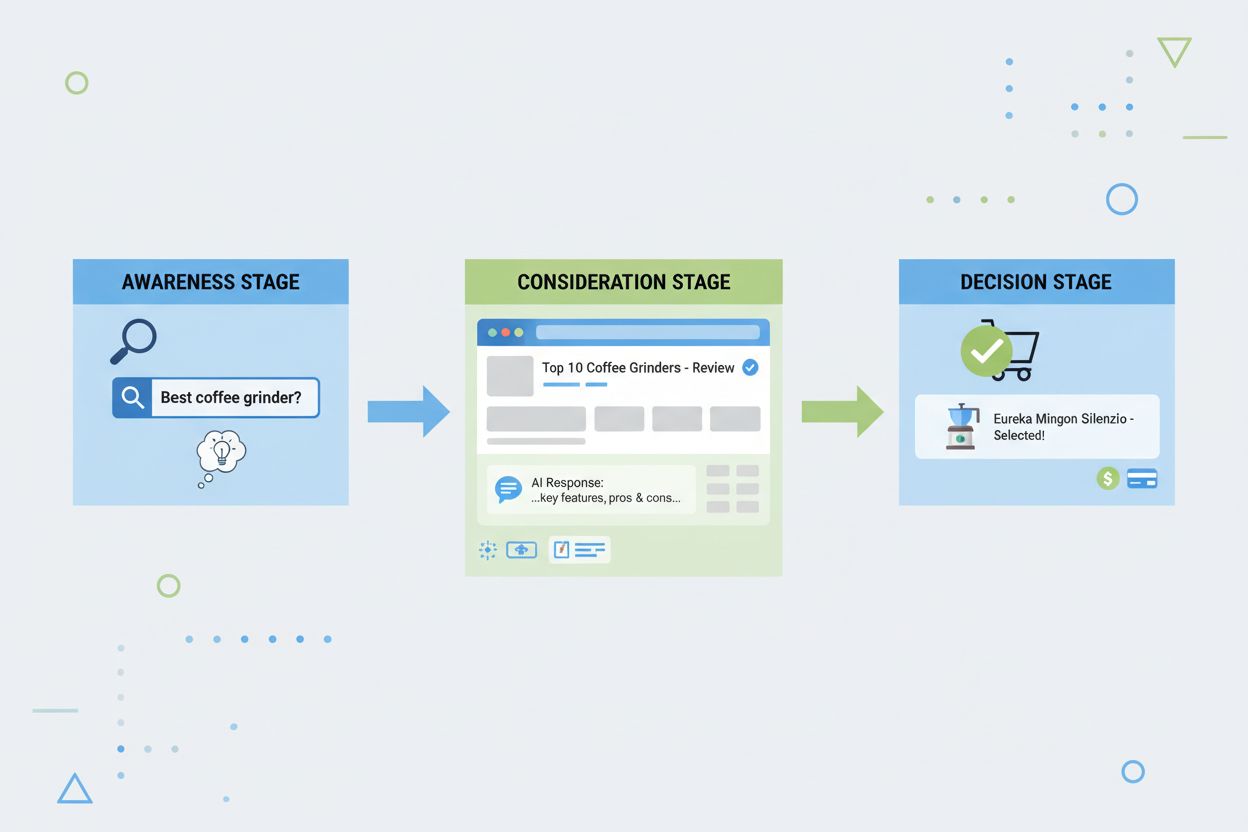
A search journey is the complete path a user takes through multiple search queries and interactions across search engines and AI platforms to find information, evaluate options, and make decisions. It encompasses all the steps from initial awareness of a problem through consideration of solutions to final decision-making.
A search journey is the complete path a user takes through multiple search queries and interactions across search engines and AI platforms to find information, evaluate options, and make decisions. It encompasses all the steps from initial awareness of a problem through consideration of solutions to final decision-making.
A search journey is the complete sequence of search queries and interactions a user undertakes when seeking information, evaluating options, or making purchasing decisions. Unlike a single search query, which represents just one moment in time, a search journey encompasses multiple searches conducted over hours, days, or even weeks as users progressively gather information and move through distinct stages of decision-making. The concept recognizes that modern users rarely find all the information they need from a single search result; instead, they navigate through multiple queries, platforms, and sources to build a comprehensive understanding before taking action. This fundamental shift in how people search has transformed the way brands must approach content strategy, visibility, and customer engagement in both traditional search engines and emerging AI-powered search platforms.
The search journey is typically divided into three distinct stages, each characterized by different user behaviors, search intent, and information needs. The awareness stage occurs when users first recognize they have a problem, need, or question and begin searching for general information about potential solutions. During this phase, searches tend to be broad and exploratory, such as “what is the best way to learn digital marketing?” or “how to improve website speed.” Users in the awareness stage are not yet ready to make a purchase; they are primarily seeking education and understanding. The consideration stage begins once users have gathered foundational knowledge and are now comparing different options, solutions, or providers. Searches become more specific and comparative, such as “HubSpot vs Marketo” or “best SEO tools for small businesses.” Here, users are actively evaluating alternatives and reading reviews, case studies, and detailed comparisons. Finally, the decision stage represents the moment when users have narrowed their choices and are ready to commit to a purchase or action. Searches become highly specific and transactional, such as “buy HubSpot” or “sign up for Semrush free trial.” Understanding these three stages is essential for brands because it allows them to create targeted content and ensure visibility at the precise moments when users are most receptive to their messaging.
The concept of search journeys gained prominence in 2018 when Google released an algorithm update that fundamentally changed how search results are delivered. Prior to this update, search engines treated each query in isolation, returning results based solely on that specific keyword without considering the user’s broader research context. Google’s innovation introduced the ability to analyze a user’s search history and predict what information they would likely need next, enabling the search engine to provide more contextual and personalized results. This represented a paradigm shift from query-based search to journey-based search, where the system understands not just what users are searching for in the moment, but where they are in their overall research process. The introduction of activity cards in Google Search further reinforced this approach, allowing users to resume their research journey and receive suggestions for what to explore next. As search has evolved, this journey-based approach has become increasingly sophisticated, with AI systems now capable of analyzing behavioral patterns, predicting user intent, and delivering highly personalized responses. The rise of generative AI search engines like ChatGPT, Perplexity, and Google AI Overviews has further accelerated the importance of understanding search journeys, as these platforms use advanced machine learning to track user interactions and provide increasingly contextual answers throughout the research process.
The distinction between a search journey and a traditional single-query search is fundamental to understanding modern user behavior and search engine optimization. In the traditional model, marketers focused on ranking for individual keywords, assuming that users would find all necessary information from a single search result. This approach treated each search query as an isolated event with no connection to previous or future searches. However, research and real-world behavior demonstrate that this model is fundamentally flawed. According to Google’s research on search journeys, users typically conduct multiple searches before making a decision, with the number and nature of searches varying significantly based on the complexity of the decision. For example, a user researching a major purchase like a laptop might conduct 15-20 searches over several weeks, starting with broad queries like “best laptops 2024” and progressing to highly specific queries like “Dell XPS 15 vs MacBook Pro M3 Max.” The search journey approach recognizes this reality and encourages brands to think about how their content can serve users at multiple points in their research process, rather than just capturing them at the moment of final decision. This shift has profound implications for content strategy, as it means brands must create a comprehensive ecosystem of content addressing different stages of the journey, not just optimize for high-intent, transactional keywords.
| Concept | Definition | Scope | User Intent | Timeline | Key Focus |
|---|---|---|---|---|---|
| Search Journey | Complete path through multiple queries across awareness, consideration, and decision stages | Multi-query, multi-stage | Evolves from informational to transactional | Days to weeks | Understanding user progression and providing content at each stage |
| Search Query | Single search term entered into a search engine at one moment in time | Single query | Specific to that moment | Seconds to minutes | Ranking for individual keywords |
| User Intent | The underlying goal or purpose behind a search query | Single query or journey | Informational, navigational, commercial, or transactional | Varies | Understanding what users want to accomplish |
| Customer Journey | Complete experience from awareness through advocacy, including all touchpoints | Multi-channel, multi-stage | Evolves through entire lifecycle | Months to years | Building relationships and loyalty across all interactions |
| Buyer Journey | Shorter version of customer journey focused on purchase decision | Pre-purchase to purchase | Awareness, consideration, decision | Days to weeks | Moving prospects toward conversion |
| Search Behavior | Patterns and habits in how users conduct searches | Aggregate patterns | Varies by user and context | Ongoing | Understanding population-level search trends |
AI search engines have revolutionized how search journey data is collected, analyzed, and utilized to deliver personalized results. Unlike traditional search engines that primarily rely on keyword matching and link analysis, AI-powered platforms like ChatGPT, Perplexity, and Google AI Overviews employ sophisticated machine learning algorithms to understand the broader context of a user’s research. These systems analyze multiple data points including previous search queries, time spent on pages, user interactions with content, and behavioral signals to construct a comprehensive profile of where each user is in their journey. Perplexity, for example, uses advanced natural language processing to understand not just what users are asking, but the implicit context and previous knowledge they’ve demonstrated through their search history. ChatGPT similarly maintains conversation history to understand the progression of a user’s inquiry and provide increasingly refined answers as the conversation evolves. This capability to track and understand search journeys gives AI platforms a significant advantage in delivering relevant, contextual responses. For brands, this means that visibility throughout the search journey—not just at the final decision point—has become critical. A brand that appears only in decision-stage results but is absent from awareness and consideration-stage responses will miss opportunities to build authority and influence user preferences before they reach the final decision point.
The awareness stage represents the beginning of the search journey, where users first recognize they have a problem, need, or question that requires information. During this stage, users are typically conducting broad, exploratory searches to understand the landscape of potential solutions. Search queries in the awareness stage tend to be general and educational, such as “what is SEO,” “how to start a blog,” or “benefits of cloud computing.” Users in this stage are not yet ready to make a purchase decision; they are primarily seeking to educate themselves and understand their options. According to research from seoClarity, approximately 78% of users begin their journey with informational searches designed to gather foundational knowledge. The awareness stage is critical for brand building because it represents the first opportunity to establish authority and credibility with potential customers. Brands that provide high-quality, educational content during this stage position themselves as trusted resources and increase the likelihood that users will consider them during later stages. Content optimized for the awareness stage typically includes comprehensive guides, educational blog posts, how-to articles, and explainer videos. The challenge for brands is ensuring their content appears in AI responses during this stage, as many users now turn to ChatGPT or Perplexity for initial research rather than traditional search engines.
The consideration stage begins once users have gathered foundational knowledge and are now actively evaluating different solutions, providers, or products. During this stage, search queries become more specific and comparative in nature, such as “HubSpot vs Marketo,” “best project management tools,” or “Shopify vs WooCommerce.” Users in the consideration stage are reading reviews, comparing features, analyzing pricing, and assessing the pros and cons of different options. Research indicates that users conduct an average of 8-12 searches during the consideration stage, making this a critical period for brand visibility. Content optimized for the consideration stage includes comparison articles, detailed product reviews, case studies, feature breakdowns, and customer testimonials. This stage is particularly important for AI search visibility because AI systems often synthesize information from multiple sources to provide comprehensive comparisons. A brand that has published authoritative comparison content is more likely to be cited and referenced in AI-generated responses during this stage. The consideration stage also represents an opportunity for brands to differentiate themselves by highlighting unique value propositions and addressing common objections or concerns that users have about competing solutions.
The decision stage represents the final phase of the search journey, where users have narrowed their choices and are ready to make a purchase or take action. Search queries during this stage are highly specific and transactional, such as “buy Dell XPS 15,” “sign up for Salesforce,” or “download HubSpot free CRM.” Users in the decision stage have already done their research and are primarily seeking to complete their purchase or action as efficiently as possible. According to Salesforce research, approximately 65% of users conduct at least one final search before making a purchase, often to verify pricing, check for promotions, or confirm product availability. Content optimized for the decision stage includes product pages, pricing pages, free trial offers, customer testimonials, and clear calls-to-action. While the decision stage represents the highest-intent searches, it is also the most competitive, as all brands are vying for the same users at this critical moment. Brands that have built authority and credibility during the awareness and consideration stages have a significant advantage during the decision stage, as users are more likely to choose providers they already know and trust. Additionally, ensuring visibility in AI responses during the decision stage is increasingly important, as users may ask AI systems like ChatGPT for final recommendations or verification before making a purchase.
The emergence of generative AI search engines has fundamentally transformed how search journeys operate and how brands must approach visibility. Traditional search engines like Google return a list of links that users must click through and evaluate individually, requiring users to actively navigate multiple pages to gather information. In contrast, AI search engines like Perplexity and ChatGPT synthesize information from multiple sources and present comprehensive answers directly to users, fundamentally changing the nature of the search journey. In this new paradigm, users may conduct fewer total searches because each AI-generated response is more comprehensive and contextual. However, the nature of the search journey has become more complex because users are now interacting with multiple platforms simultaneously. A user might start with a Google search, then turn to ChatGPT for a more detailed explanation, then check Perplexity for the latest information, and finally return to Google to find specific product pages. This multi-platform search journey means that brands must ensure visibility across multiple AI systems, not just traditional search engines. AmICited and similar AI monitoring platforms have emerged to address this challenge, allowing brands to track where their content appears across ChatGPT, Perplexity, Google AI Overviews, and Claude. Understanding how search journeys operate across these diverse platforms is essential for modern brands seeking to maintain visibility and influence user decisions.
Effectively monitoring and optimizing for search journeys requires tracking a comprehensive set of metrics and data points that reveal how users progress through different stages. Keyword clustering is one of the most important techniques, where related keywords are grouped by journey stage to understand the progression of user searches. For example, keywords like “what is email marketing,” “email marketing benefits,” and “email marketing basics” all belong to the awareness stage, while “best email marketing platforms” and “Mailchimp vs ConvertKit” belong to the consideration stage. Search volume trends for these keyword clusters reveal how many users are at each stage and whether interest is increasing or decreasing over time. Click-through rates (CTR) and time on page metrics indicate whether content is resonating with users at each stage. Content that attracts clicks but has a high bounce rate suggests a mismatch between user expectations and content delivery. Conversion rate tracking across the journey reveals which stages are most effective at moving users toward desired actions. Additionally, brands should monitor AI citation frequency, which measures how often their content is cited or referenced in AI-generated responses. This metric is particularly important for understanding visibility in the AI search landscape, as being cited in AI responses is a key driver of traffic and influence in the emerging search ecosystem.
The future of search journeys will be shaped by continued advances in artificial intelligence, personalization, and the integration of multiple search platforms. As AI search engines become more sophisticated, they will increasingly understand not just individual queries but the broader context of user needs, preferences, and decision-making processes. Predictive search capabilities will enable AI systems to anticipate what users will want to know next, potentially shortening search journeys by providing proactive recommendations before users even ask. The rise of conversational search, where users engage in multi-turn conversations with AI systems rather than entering discrete queries, will further blur the lines between individual searches and broader journeys. This shift will require brands to think about how their content can serve users in extended conversations, not just in response to single queries. Additionally, the increasing importance of first-party data and privacy-preserving personalization will change how search journeys are tracked and optimized. Brands will need to focus on building direct relationships with users and understanding their journeys through owned channels rather than relying solely on third-party data from search engines. The emergence of vertical AI search engines specialized for specific industries or use cases will create new opportunities for brands to establish authority and visibility within niche search journeys. Finally, the integration of voice search, visual search, and multimodal AI will expand the definition of search journeys beyond text-based queries, requiring brands to optimize content across multiple formats and modalities.
In an increasingly complex digital landscape where users interact with multiple search platforms and conduct extensive research before making decisions, understanding search journeys has become essential for brand success. The shift from query-based to journey-based thinking represents a fundamental change in how brands must approach content strategy, visibility, and customer engagement. By recognizing that users progress through distinct stages of awareness, consideration, and decision, brands can create targeted content that addresses user needs at each point in their research process. The emergence of AI search engines has amplified the importance of search journey understanding, as these platforms now synthesize information from multiple sources and provide increasingly personalized responses based on user behavior and context. Brands that fail to optimize for search journeys risk missing critical opportunities to build authority, influence user preferences, and ultimately drive conversions. Tools like AmICited enable brands to monitor their visibility throughout the search journey across multiple AI platforms, providing the data necessary to optimize strategy and ensure presence at every stage. As search continues to evolve, the brands that succeed will be those that understand not just individual queries but the complete journey users take from initial problem recognition through final decision-making.
The three primary stages are awareness (when users first recognize they have a problem or need), consideration (when they research and compare potential solutions), and decision (when they make a final choice). Each stage involves different types of search queries and user intent. Understanding these stages helps brands create targeted content that addresses user needs at each point in their journey.
A single search query is just one moment in time, while a search journey encompasses multiple queries over days or weeks as users progressively gather information. For example, a user might search 'best laptops' (awareness), then 'Dell XPS vs MacBook Pro' (consideration), and finally 'buy Dell XPS 15' (decision). Brands that understand the full journey can capture users at multiple touchpoints rather than just one.
As users increasingly turn to AI platforms like ChatGPT, Perplexity, and Google AI Overviews, understanding search journeys helps brands ensure their content appears throughout the user's research process. AI systems analyze search patterns and user behavior to provide contextual answers, making it critical for brands to be visible at each stage of the journey, not just for final purchase queries.
AI search engines use advanced algorithms and machine learning to analyze user search history, behavioral patterns, and contextual signals to understand where users are in their journey. They track previous searches, time spent on pages, and user interactions to predict what information users need next. This enables them to provide increasingly personalized and relevant responses across multiple queries.
User intent evolves throughout the search journey. In the awareness stage, intent is informational (learning about a topic). In consideration, intent becomes comparative (evaluating options). In the decision stage, intent turns transactional (ready to purchase). Recognizing how intent shifts across the journey helps marketers create appropriate content for each stage and improves their chances of conversion.
Brands should create content tailored to each stage: awareness content includes educational blog posts and guides, consideration content features comparisons and reviews, and decision content includes product pages and testimonials. By mapping content to journey stages and ensuring visibility across search platforms, brands can guide users smoothly from discovery to conversion while building authority and trust.
Key metrics include search volume trends for related keywords, click-through rates at different stages, time spent on pages, bounce rates, conversion rates, and user behavior patterns. Additionally, brands should monitor how their content appears in AI responses across platforms like ChatGPT and Perplexity, tracking citations and mentions throughout the user's research process.
Start tracking how AI chatbots mention your brand across ChatGPT, Perplexity, and other platforms. Get actionable insights to improve your AI presence.
Understand the AI Search Journey—the multi-turn conversational path users take through AI search systems. Learn how awareness, consideration, decision, and adop...
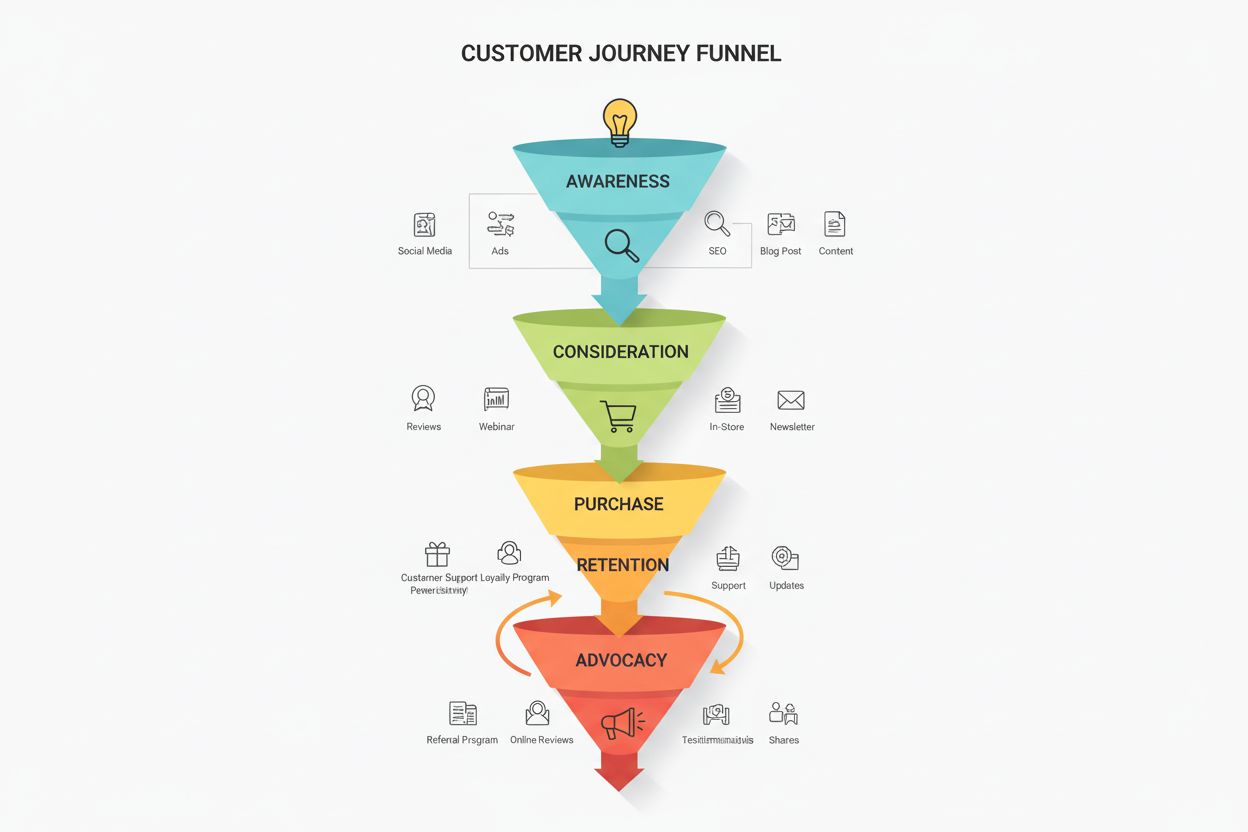
Learn what a customer journey is, explore its five key stages from awareness to advocacy, and discover how to map and optimize touchpoints for better customer e...

Explore how AI search transforms the buyer journey across ChatGPT, Perplexity, and Google AI. Learn the stages, platform differences, and strategies for visibil...