
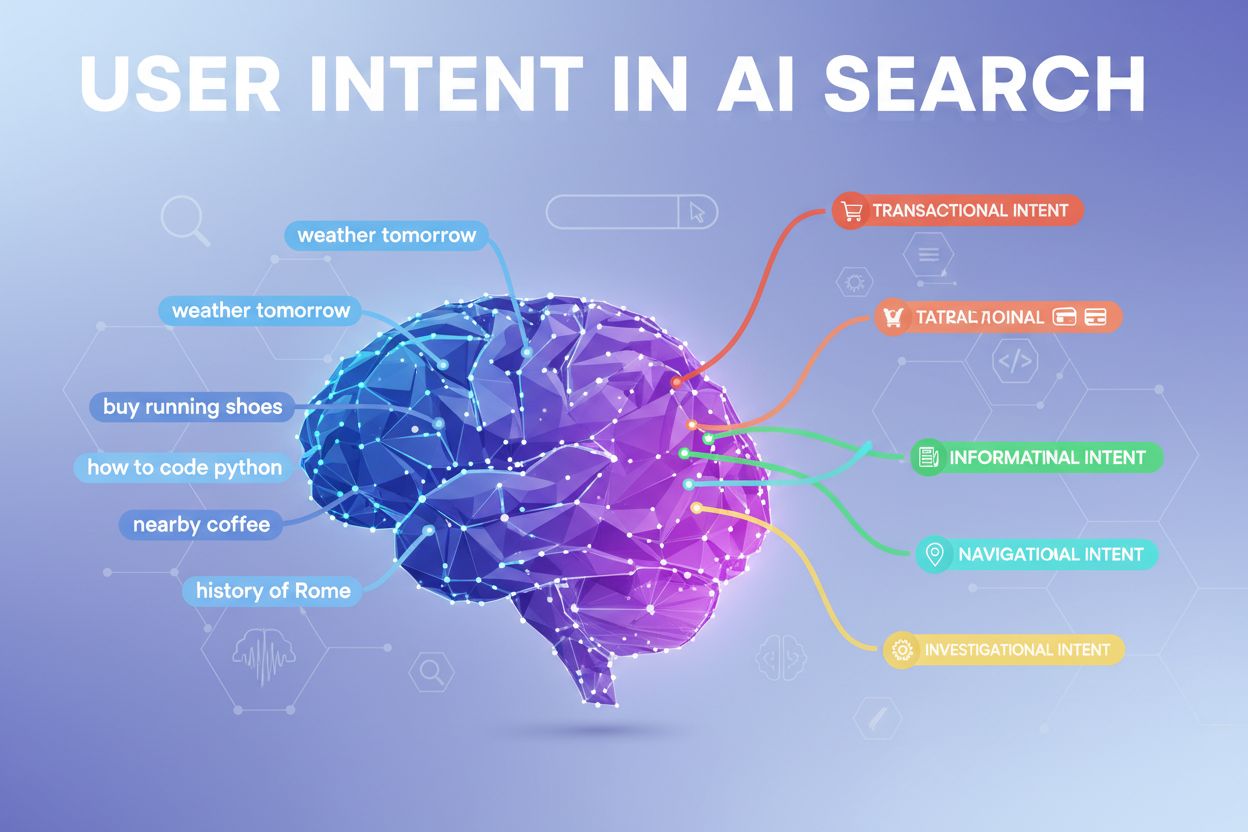
User Intent in AI Search: How LLMs Interpret Queries
Learn how large language models interpret user intent beyond keywords. Discover query expansion, semantic understanding, and how AI systems determine which cont...
9 min read
Search modifiers are specific words or phrases that change the scope, intent, or meaning of a search query, helping users and search engines understand what type of information, action, or outcome is being sought. These modifiers—such as ‘best,’ ‘how to,’ ‘buy,’ or ‘review’—signal the underlying intent behind a search and directly influence which results search engines and AI systems prioritize.
Search modifiers are specific words or phrases that change the scope, intent, or meaning of a search query, helping users and search engines understand what type of information, action, or outcome is being sought. These modifiers—such as 'best,' 'how to,' 'buy,' or 'review'—signal the underlying intent behind a search and directly influence which results search engines and AI systems prioritize.
A search modifier is a specific word, phrase, or linguistic element that changes the scope, intent, or meaning of a search query. When users include modifiers in their searches—such as “best,” “how to,” “review,” “buy,” or “alternatives”—they are signaling to search engines and AI systems what type of information, action, or outcome they seek. Search modifiers are not random additions to queries; they are deliberate linguistic signals that fundamentally alter how search engines interpret user intent and rank results. For example, searching for “coffee” returns general information about coffee, but searching for “best coffee makers” signals commercial intent and returns product comparisons and reviews. These modifiers have become increasingly important in the age of AI search, where platforms like ChatGPT, Perplexity, Google AI Overviews, and Claude analyze modifier patterns to determine which content to cite and how to structure their responses. Understanding search modifiers is essential for content creators, marketers, and brands seeking visibility across both traditional search engines and emerging AI search platforms.
Search modifiers emerged as a natural consequence of how humans communicate their needs through search queries. In the early days of search engines, users typed simple keywords like “restaurants” or “hotels,” and search engines returned broad results. However, as search technology evolved and user behavior became more sophisticated, people began adding descriptive words to refine their searches. Research from Minuttia and Yoast SEO indicates that approximately 23% of keywords in competitive niches include informational modifiers alone, demonstrating the widespread adoption of modifier-driven search behavior.
The formalization of search modifiers as a strategic SEO concept gained momentum in the mid-2010s when industry experts recognized that modifiers directly correlate with search intent classification. Google’s own Search Quality Evaluator Guidelines now explicitly reference intent categories—Know, Do, Website, and Visit-in-Person—which align directly with modifier patterns. Over 78% of enterprises now use AI-driven content monitoring tools that track modifier-based queries, according to industry reports, recognizing that modifiers are critical signals for understanding market demand and customer behavior.
The rise of semantic search and natural language processing further elevated the importance of modifiers. Search engines no longer simply match keywords; they analyze the entire query structure, including modifiers, to understand context and intent. This shift has made modifiers even more valuable for brand monitoring platforms like AmICited, which track how brands appear in AI responses across different modifier contexts. For instance, a brand mentioned in response to “best [category]” queries receives different visibility signals than mentions in “[brand] alternatives” queries.
Search modifiers function through both linguistic and algorithmic mechanisms. When a user types a query with a modifier, search engines and AI systems parse the query to identify the core topic and the modifier that contextualizes it. For example, in the query “best SEO tools for small business,” the core topic is “SEO tools,” but the modifiers “best” and “for small business” signal that the user wants a curated list of top-performing tools specifically suited to small businesses, not a general directory of all SEO tools.
Search engines use modifiers as intent signals through semantic analysis. Modern search algorithms, powered by machine learning models like BERT and MUM, analyze the relationships between words in a query to understand meaning beyond simple keyword matching. When Google’s algorithm encounters “how to write a blog post,” it recognizes that “how to” is an informational modifier indicating the user wants instructional content, not product pages or definitions. This semantic understanding allows search engines to rank tutorial content, step-by-step guides, and educational resources higher than product pages or commercial content.
AI search platforms like ChatGPT, Perplexity, and Google AI Overviews apply similar logic but with additional layers of sophistication. These systems analyze modifier patterns across millions of queries and training data to predict what type of response users expect. When Perplexity receives a query with “latest” or “2025,” it prioritizes recent sources and current information. When ChatGPT encounters “step-by-step,” it structures responses in sequential, numbered formats. This modifier-driven response generation means that brands appearing in content that matches modifier-driven intent are significantly more likely to be cited in AI responses.
| Concept | Definition | Purpose | Example | Impact on Results |
|---|---|---|---|---|
| Search Modifier | Words that change query intent and scope | Signal user intent to search engines | “best CRM software” | Filters results by intent type; prioritizes relevant content |
| Search Operator | Technical syntax commands for filtering | Refine search scope and result type | site:example.com, filetype:pdf | Narrows results to specific domains or file types |
| Keyword | Core topic or subject of a search | Identify main topic | “CRM software” | Returns all results related to the topic |
| Long-tail Keyword | Extended phrase with 3+ words | Target specific, less competitive queries | “best CRM software for small business” | Lower search volume but higher conversion intent |
| Search Intent | The underlying goal behind a query | Understand user motivation | Informational, commercial, transactional | Determines which content types rank highest |
| Entity | Specific person, place, brand, or concept | Establish semantic relationships | “Salesforce,” “HubSpot,” “Pipedrive” | Helps search engines understand context and relationships |
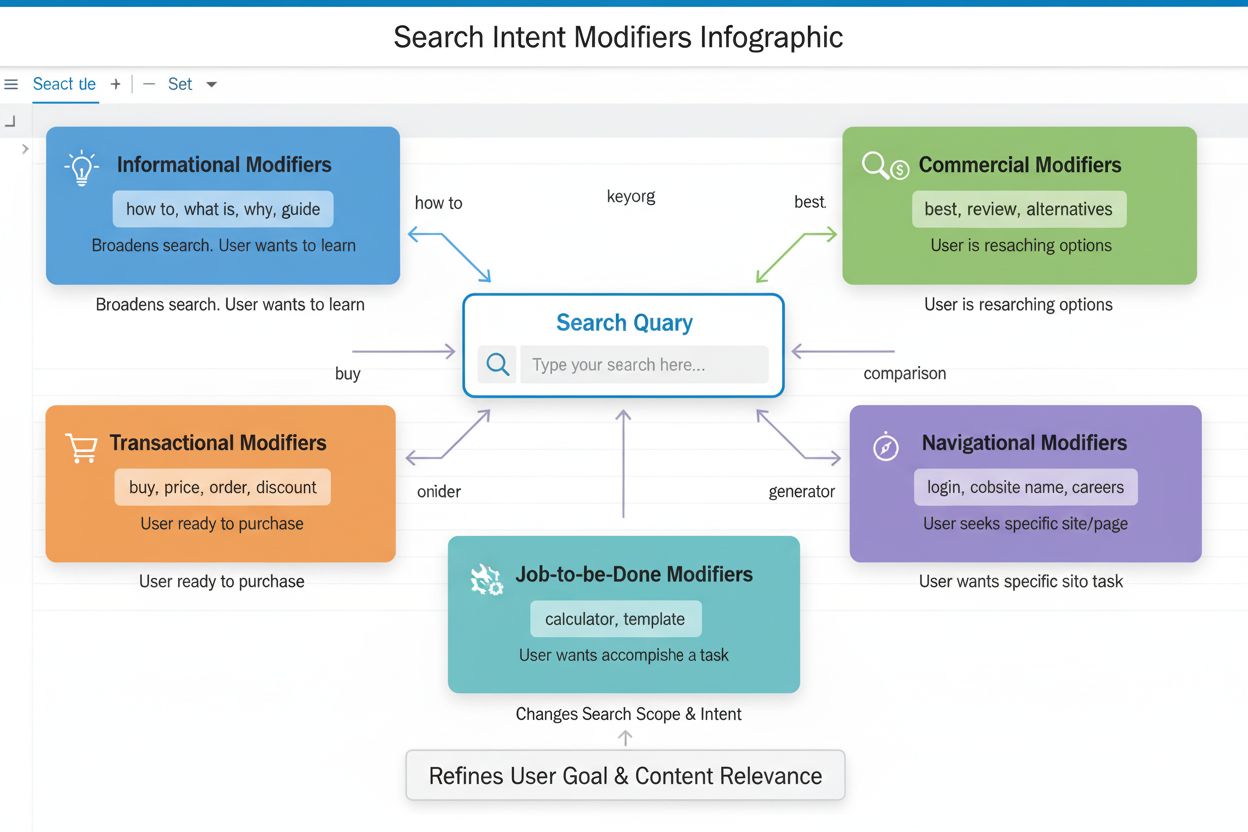
Search modifiers are organized into five primary categories, each signaling a distinct user intent. Understanding these categories is essential for content creators, marketers, and brands seeking to optimize for both traditional search and AI search visibility.
Informational Modifiers signal that users are seeking knowledge, answers, or explanations. Common informational modifiers include “how to,” “what is,” “why,” “when,” “where,” “examples,” and “guide.” Queries like “how to optimize for SEO” or “what is search intent” indicate users want educational content, tutorials, or definitions. Research from Yoast SEO shows that informational queries account for approximately 80% of all search volume, making them the largest category. However, informational queries typically have lower commercial value and higher competition. Content optimized for informational modifiers should prioritize clarity, comprehensiveness, and educational value.
Commercial Modifiers indicate that users are researching options before making a purchase decision. These modifiers include “best,” “top,” “review,” “comparison,” “alternatives,” “vs.,” “software,” “plugin,” and “app.” A query like “best project management software” signals commercial investigation intent—the user is comparing options but hasn’t yet committed to a purchase. According to Minuttia’s research, approximately 23% of keywords in competitive niches include commercial modifiers, and these queries typically have higher cost-per-click (CPC) values in paid search, indicating their commercial value. Content for commercial modifiers should include comparisons, pros and cons, expert opinions, and honest assessments.
Transactional Modifiers signal that users are ready to take action, typically making a purchase or signing up for a service. These modifiers include “buy,” “price,” “order,” “subscribe,” “download,” “coupon,” and “deal.” Queries like “buy iPhone 15 Pro” or “subscribe to Netflix” indicate the user has already decided what they want and is ready to complete a transaction. Transactional queries have the highest conversion rates but also the most competition and highest advertising costs. Content optimized for transactional modifiers should prioritize clear calls-to-action, product details, pricing information, and frictionless checkout experiences.
Navigational Modifiers indicate that users are trying to reach a specific website or page. These modifiers include “login,” “sign in,” “contact,” “hours,” “customer service,” and brand names themselves. Queries like “Facebook login” or “Amazon customer service” show that users already know where they want to go and are using search as a shortcut. Navigational queries are most relevant for established brands with significant search volume, as they indicate existing brand awareness. Content for navigational modifiers should ensure that branded pages, login portals, and contact information are easily accessible and well-optimized.
Job-to-be-Done Modifiers signal that users are seeking tools or resources to accomplish a specific task. These modifiers include “calculator,” “template,” “builder,” “generator,” “framework,” “checklist,” and “planner.” Queries like “mortgage calculator” or “content calendar template” indicate users want functional tools or resources, not just information. This category, identified by content strategists at Minuttia, represents a distinct intent that doesn’t fit neatly into traditional categories. Content for job-to-be-done modifiers should provide interactive tools, downloadable resources, or step-by-step frameworks.
The emergence of AI search platforms has fundamentally changed how search modifiers influence visibility and brand citations. Platforms like ChatGPT, Perplexity, Google AI Overviews, and Claude analyze search queries—including their modifiers—to determine which sources to cite and how to structure responses. This means that brands appearing in content that matches modifier-driven intent are significantly more likely to be cited in AI-generated answers.
When a user asks Perplexity “what are the best project management tools,” the AI system recognizes the “best” modifier and prioritizes content that provides comparisons, rankings, and expert recommendations. If your brand appears in high-quality comparison content, it’s more likely to be cited in the AI’s response. Similarly, when someone asks ChatGPT “how to implement SEO best practices,” the “how to” modifier signals that the AI should prioritize tutorial-style content and step-by-step guides. Brands mentioned in authoritative how-to content are more likely to appear in these responses.
AmICited’s monitoring platform tracks exactly these modifier-driven mentions across AI search platforms. By analyzing which modifiers drive brand visibility in AI responses, brands can understand their positioning and optimize their content strategy. For example, if a brand is frequently mentioned in “alternatives to [competitor]” queries but rarely in “best [category]” queries, it signals an opportunity to create more authoritative, comparison-focused content that positions the brand as a top-tier option rather than just an alternative.
Effective content strategy requires aligning content creation with modifier-driven intent. Here are essential practices for optimizing around search modifiers:
Conduct modifier-based keyword research: Use tools like Ahrefs, Semrush, or Wordtracker to identify which modifiers appear in high-volume searches within your niche. Prioritize modifiers that align with your business goals and content capabilities.
Create intent-matched content: For each modifier category, create content that explicitly addresses that intent. Informational modifiers require comprehensive guides; commercial modifiers require comparisons; transactional modifiers require product pages with clear CTAs.
Use modifiers in title tags and headings: Include relevant modifiers in your page titles, H1 tags, and section headings. This helps search engines and AI systems quickly identify the intent your content addresses.
Optimize for AI search visibility: Structure content with clear sections, bullet points, and comparison tables that AI systems can easily extract and cite. Include data, statistics, and expert quotes that AI models prioritize when generating responses.
Monitor competitor modifier usage: Analyze which modifiers competitors target and identify gaps in their coverage. This reveals opportunities to create content that addresses underserved modifier-driven intents.
Track modifier performance over time: Use analytics to monitor which modifier-driven queries drive traffic, conversions, and engagement. Double down on high-performing modifiers and adjust strategy for underperforming ones.
Align modifiers with customer journey stages: Map modifiers to different stages of the customer journey. Informational modifiers target awareness stage; commercial modifiers target consideration; transactional modifiers target decision stage.
For brands using platforms like AmICited, understanding search modifiers is critical for effective brand monitoring. Search modifiers reveal not just whether a brand is mentioned, but in what context and with what intent. A brand mentioned in response to “best [category]” queries receives different visibility signals than mentions in “[brand] vs. [competitor]” queries.
AmICited’s monitoring capabilities track modifier-driven mentions across ChatGPT, Perplexity, Google AI Overviews, and Claude. By analyzing which modifiers drive brand citations, brands can understand their competitive positioning. For example, if a brand is frequently cited in “affordable [category]” queries but rarely in “premium [category]” queries, it signals market positioning. If a brand appears in “how to use [category]” responses but not in “best [category]” responses, it indicates an opportunity to create more authoritative, comparison-focused content.
Modifier-based monitoring also reveals emerging opportunities and threats. If a competitor suddenly appears in “best [category]” queries where your brand previously dominated, it signals competitive pressure. If your brand starts appearing in “[brand] alternatives” queries, it indicates growing market awareness but potentially weaker positioning than competitors. By tracking these modifier-driven patterns, brands can make data-driven decisions about content strategy and competitive positioning.
Search modifiers are evolving as AI search platforms become more sophisticated. Traditional modifiers like “best” and “how to” will remain relevant, but new modifier patterns are emerging as users adapt to AI search interfaces. Users are increasingly using longer, more conversational queries with multiple modifiers, such as “compare the best affordable project management tools for remote teams” or “step-by-step guide to implementing SEO for e-commerce sites.”
AI systems are becoming better at understanding implicit modifiers and context. Users no longer need to explicitly state “best” or “review”—AI systems can infer intent from query structure and context. This means that modifier optimization will become increasingly sophisticated, requiring deeper understanding of semantic relationships and user intent patterns.
The rise of voice search and conversational AI is changing how modifiers appear in queries. Voice searches tend to be longer and more conversational, with modifiers embedded naturally within sentences rather than appearing as discrete keywords. This shift requires content creators to think beyond keyword optimization and focus on comprehensive, conversational content that addresses the full range of user intents and questions.
Multimodal search—combining text, images, video, and voice—will introduce new modifier patterns. As users search using images or voice, the nature of modifiers will evolve. Brands that understand and adapt to these emerging modifier patterns will maintain visibility advantage as search technology continues to evolve.
Search modifiers are far more than grammatical additions to queries; they are strategic signals that reveal user intent, influence search rankings, and determine brand visibility across search platforms. By understanding the five categories of search modifiers—informational, commercial, transactional, navigational, and job-to-be-done—marketers and content creators can align their strategies with actual user behavior and search engine algorithms.
In the age of AI search, search modifiers have become even more critical. Platforms like ChatGPT, Perplexity, and Google AI Overviews analyze modifier patterns to determine which sources to cite and how to structure responses. Brands that optimize their content around modifier-driven intent are significantly more likely to appear in AI-generated answers, which now influence a substantial portion of search traffic and user decision-making.
For brands using monitoring platforms like AmICited, tracking modifier-driven mentions provides actionable insights into competitive positioning, market opportunities, and content strategy effectiveness. By analyzing which modifiers drive brand visibility in AI responses, brands can make data-driven decisions about content creation, competitive positioning, and long-term search strategy. As search technology continues to evolve, mastery of search modifiers will remain a fundamental competitive advantage.
Search modifiers are words that change the intent or meaning of a query (like 'best,' 'how to,' 'review'), while search operators are technical commands that filter results (like 'site:', 'filetype:', or quotation marks). Modifiers are natural language elements that users include in their queries, whereas operators are specific syntax used to refine searches. Both affect search results, but modifiers influence intent interpretation while operators control result scope.
AI search systems analyze modifiers to understand user intent and deliver more relevant responses. When a user includes modifiers like 'best,' 'latest,' or 'step-by-step,' AI models recognize these signals and prioritize content that matches that specific intent. For example, 'best SEO tools 2025' triggers AI to surface comparison content and reviews, while 'how to optimize for SEO' prompts tutorial-style responses. This makes modifiers critical for brand visibility in AI-generated answers.
Yes, search modifiers are essential for brand monitoring platforms like AmICited. By tracking how brands appear in queries with specific modifiers—such as 'best [brand],' '[brand] review,' or '[brand] alternatives'—monitoring tools can identify where brands are mentioned in AI responses and understand the context of those mentions. This helps brands understand their positioning relative to competitors and optimize for AI visibility.
Search modifiers fall into five main categories: Informational (how to, what is, why, examples), Commercial (best, review, alternatives, comparison), Transactional (buy, price, order, subscribe), Navigational (login, contact, hours), and Job-to-be-Done (calculator, template, builder, framework). Each category signals a different user intent, and understanding these helps content creators and marketers align their content with what users are actually seeking.
Search modifiers are fundamental to modern keyword research. By identifying which modifiers appear in high-volume searches, marketers can understand demand patterns and create targeted content. For instance, if 'best CRM software' has higher search volume than just 'CRM software,' it signals commercial intent and opportunity for comparison content. Tools like Ahrefs and Semrush use modifier analysis to help marketers prioritize keywords and align content strategy with actual user behavior.
While the core concept of modifiers remains consistent across search engines, their interpretation and weighting may vary slightly. Google's algorithm is highly sophisticated at understanding modifier intent through semantic analysis, while Bing and other engines follow similar patterns but with different ranking algorithms. AI search platforms like Perplexity and ChatGPT also recognize modifiers but may prioritize different content types based on their training data and response generation models.
Businesses should analyze which modifiers their target audience uses and create content that explicitly addresses those intents. For example, if customers search 'best [product category],' create comprehensive comparison guides. If they search '[brand] vs competitors,' develop detailed competitive analysis content. By aligning content with modifier-driven intent, businesses increase the likelihood of appearing in AI-generated answers, which now influence a significant portion of search traffic.
Start tracking how AI chatbots mention your brand across ChatGPT, Perplexity, and other platforms. Get actionable insights to improve your AI presence.
Learn how large language models interpret user intent beyond keywords. Discover query expansion, semantic understanding, and how AI systems determine which cont...

Understand how conversational queries differ from traditional keywords. Learn why AI search engines prefer natural language questions and how this impacts brand...
Understand how conversational queries differ from traditional keyword queries. Learn why AI search engines prioritize natural language, user intent, and context...
Cookie Consent
We use cookies to enhance your browsing experience and analyze our traffic. See our privacy policy.