
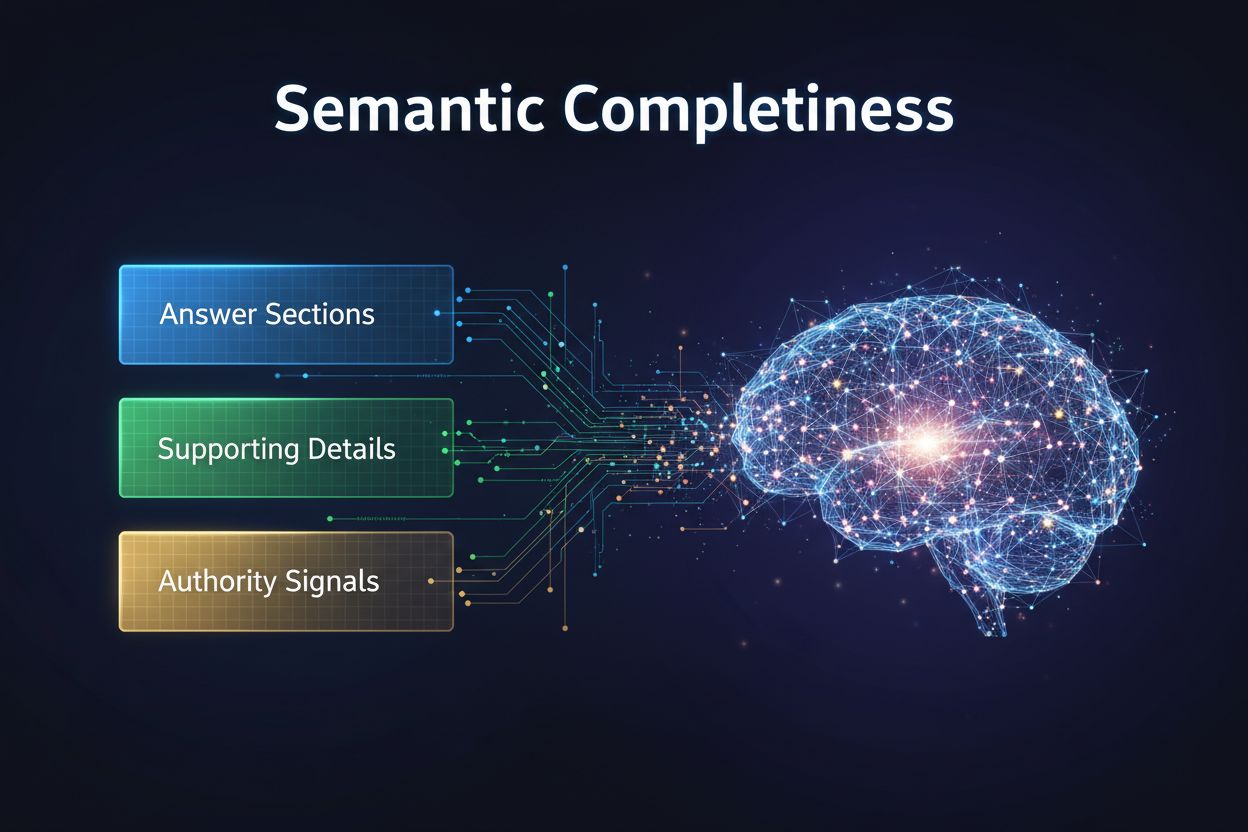
Semantic Completeness: Creating Self-Contained Answers for AI
Learn how semantic completeness creates self-contained answers that AI systems cite. Discover the 3 pillars of semantic completeness and implement GEO strategie...
12 min read

Content that fully addresses a topic’s key aspects, making it a comprehensive source for AI systems. Semantic completeness goes beyond keyword inclusion to ensure thorough topic coverage that demonstrates expertise and satisfies AI evaluation criteria. It encompasses all subtopics, related concepts, supporting evidence, and contextual information needed for complete understanding. This approach improves both AI citations and traditional search visibility.
Content that fully addresses a topic's key aspects, making it a comprehensive source for AI systems. Semantic completeness goes beyond keyword inclusion to ensure thorough topic coverage that demonstrates expertise and satisfies AI evaluation criteria. It encompasses all subtopics, related concepts, supporting evidence, and contextual information needed for complete understanding. This approach improves both AI citations and traditional search visibility.
Semantic Completeness is the degree to which content comprehensively addresses all key aspects, nuances, and related concepts of a given topic. Unlike simple keyword inclusion, semantic completeness focuses on delivering thorough topic coverage that explores the subject from multiple angles and perspectives. It means your content doesn’t just mention a topic—it fully explains it, including related concepts, definitions, examples, and contextual information. This approach ensures that both human readers and AI systems can understand the full scope and depth of your expertise on the subject.
AI systems evaluate content completeness by analyzing whether material addresses the full spectrum of a topic’s semantic landscape. When AI platforms like ChatGPT, Google’s AI Overviews, and Perplexity assess content, they look for comprehensive coverage that demonstrates genuine expertise rather than surface-level treatment. Semantic richness—the variety and depth of information presented—signals to AI systems that your content is authoritative and worthy of citation. Content that lacks completeness may be overlooked entirely, while semantically complete content is more likely to be selected, cited, and ranked prominently in AI-generated responses. This makes semantic completeness essential for AI search visibility and ensuring your content reaches audiences through answer engines.
Traditional SEO has long focused on keyword optimization and backlink profiles, but semantic completeness represents a fundamental shift in how content should be created and optimized. While traditional SEO asks “Are the right keywords present?” semantic completeness asks “Does this content fully explain the topic?” Traditional approaches often result in thin, keyword-stuffed content that satisfies search algorithms but fails to satisfy AI systems that prioritize content depth and comprehensive explanations. Semantic completeness goes beyond keyword density to evaluate whether your content provides genuine value through complete topic exploration.
| Aspect | Traditional SEO | Semantic Completeness |
|---|---|---|
| Focus | Keyword density and placement | Comprehensive topic coverage and semantic richness |
| Measurement | Keyword frequency, backlinks, CTR | Topic clustering, entity relationships, content depth |
| Content Structure | Keyword-optimized headings | Logical hierarchy addressing all topic aspects |
| AI Readiness | Limited consideration | Primary focus for AI system evaluation |
| User Intent | Keyword-based interpretation | Full contextual understanding and expertise demonstration |
Semantically complete content incorporates several critical components that work together to demonstrate expertise and satisfy AI evaluation criteria:
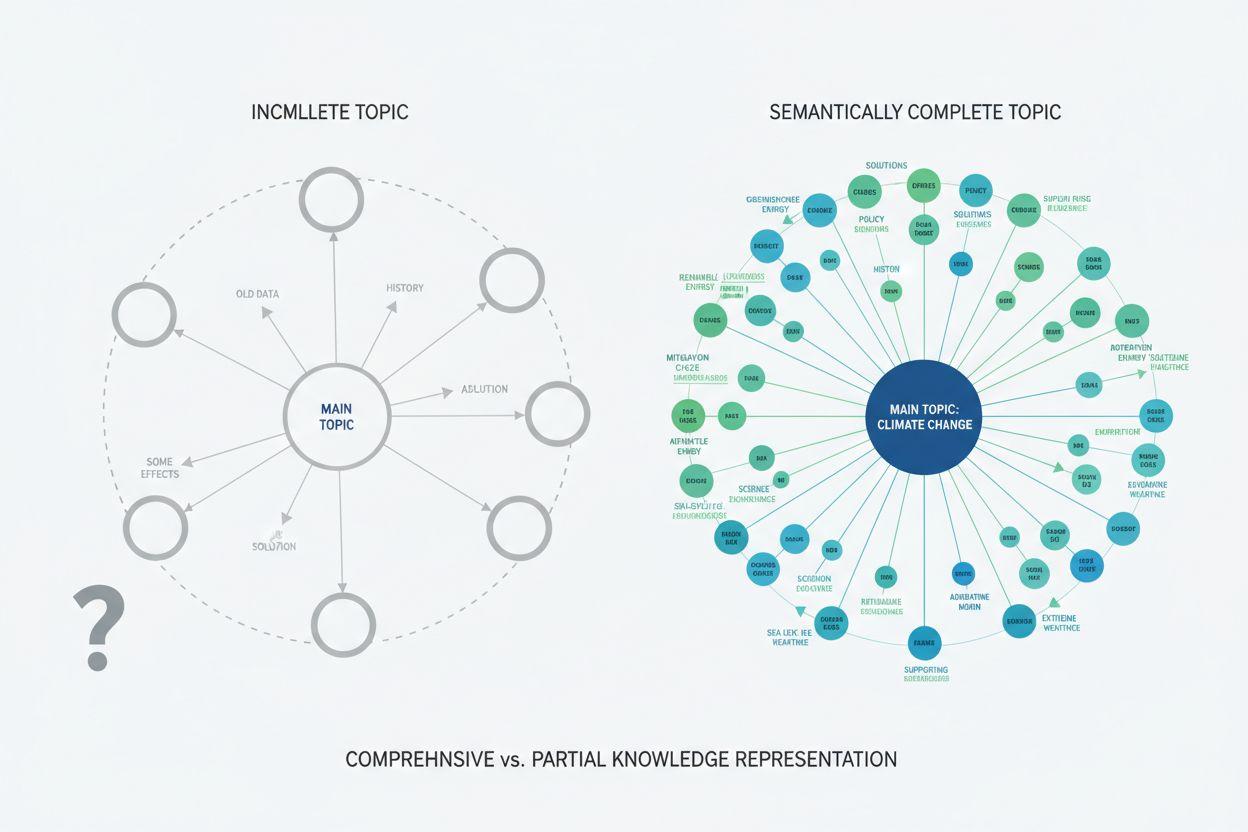
The structure of your content directly impacts its semantic completeness and how effectively AI systems can evaluate it. Implement a clear heading hierarchy that breaks your topic into logical sections, with H2s covering major subtopics and H3s addressing specific aspects within each section. Use content chunking—dividing information into digestible, well-organized sections—to improve both readability and AI comprehension. Each section should flow logically from foundational concepts to more advanced ideas, creating a coherent narrative structure that demonstrates complete topic mastery. Proper structure signals to AI systems that your content is authoritative and well-organized, increasing the likelihood of citation and inclusion in AI-generated responses.
Evaluating whether your content achieves semantic completeness requires analyzing multiple dimensions beyond simple word count. Content analysis tools can assess topic coverage by identifying which key concepts and subtopics your content addresses compared to competitor content and semantic databases. Look for signals such as the breadth of entity mentions, the depth of explanation for each concept, and the presence of semantic variations and related terminology. Tools that analyze content structure, heading hierarchy, and information flow can reveal gaps in your coverage. Regularly audit your content against comprehensive topic maps to ensure you’re addressing all critical aspects your audience and AI systems expect.
Semantic completeness is intrinsically connected to demonstrating E-E-A-T (Experience, Expertise, Authoritativeness, Trustworthiness) to both human readers and AI systems. Content that comprehensively covers a topic signals genuine expertise—you clearly understand the subject deeply enough to address all its dimensions. This comprehensive coverage builds authority by showing you’ve invested effort in thorough research and explanation rather than creating quick, shallow content. When AI systems evaluate your content for citation, they assess whether it demonstrates the kind of complete knowledge that warrants being featured in their responses. By prioritizing semantic completeness, you’re simultaneously strengthening your E-E-A-T signals, which improves both traditional search rankings and AI visibility.
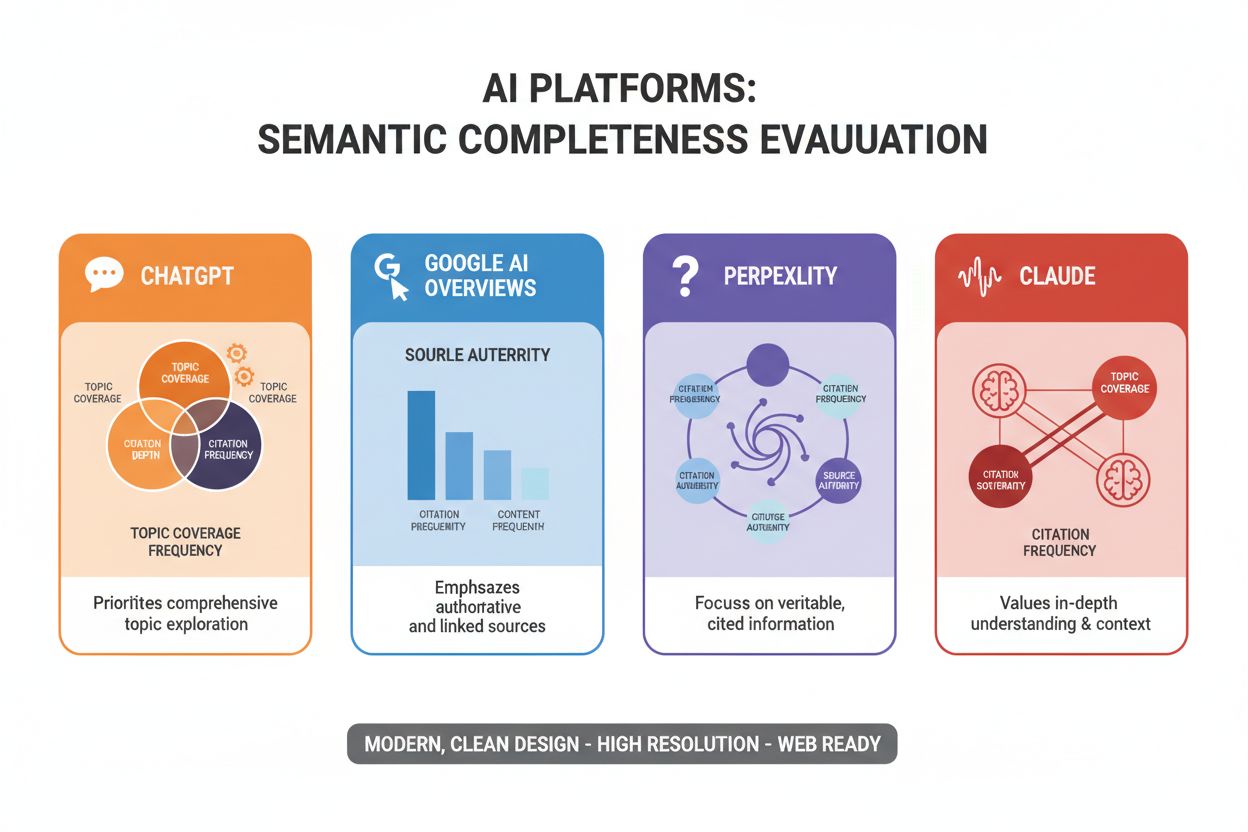
Different AI platforms evaluate semantic completeness through distinct methodologies and weighting systems. ChatGPT prioritizes content that provides comprehensive explanations and multiple perspectives on a topic, favoring sources that demonstrate thorough understanding. Google’s AI Overviews emphasize content that covers the full scope of user intent, pulling from sources that address various aspects of a query comprehensively. Perplexity values sources that provide clear, well-structured information with strong semantic relationships between concepts. Claude tends to favor content with strong logical flow and complete topic coverage that leaves no critical gaps in understanding. Understanding these platform-specific preferences helps you optimize your content to be recognized and cited across multiple AI systems, maximizing your AI citations and visibility.
Creating semantically complete content requires a systematic, research-driven approach that goes beyond traditional content creation. Begin with comprehensive topic research to identify all major subtopics, related concepts, and semantic variations your audience needs to understand. Create a content outline that maps the complete topic landscape, ensuring no critical aspects are overlooked. During the writing phase, provide thorough explanations for each concept, include relevant examples, and establish clear connections between related ideas. Structure your content with a logical hierarchy using proper heading tags and content chunking to improve both readability and AI comprehension. Finally, optimize for semantic richness by incorporating related terminology, entity mentions, and contextual information that demonstrates complete topic mastery. Review your finished content against your research to confirm all key aspects are adequately addressed.
Many content creators inadvertently undermine their semantic completeness by making common structural and strategic mistakes. Shallow topic coverage that skims the surface without providing depth fails to demonstrate expertise and leaves AI systems unable to fully understand your knowledge. Overlooking important subtopics or semantic variations creates gaps that AI systems recognize as incomplete coverage. Poor content structure with unclear hierarchies and weak logical flow makes it difficult for AI systems to parse relationships between concepts. Failing to include supporting evidence, examples, and definitions weakens your authority and leaves readers and AI systems with incomplete understanding. Neglecting to address related concepts and entity relationships isolates your content from the broader knowledge graph that AI systems use for evaluation.
Semantic completeness isn’t a one-time achievement—it requires ongoing maintenance to remain relevant and comprehensive as topics evolve. Establish a regular content audit schedule to identify areas where new information, emerging subtopics, or updated research should be incorporated. When new developments occur in your field, update existing content to reflect current understanding and maintain your position as a comprehensive resource. Monitor how AI systems cite your content and identify gaps where competitors’ content is being selected instead of yours, then address those gaps. Add new semantic variations and related concepts as language and understanding of your topic evolve. By treating semantic completeness as an ongoing process rather than a static goal, you ensure your content remains authoritative and continues to attract AI citations over time.
Several tools and platforms can help you evaluate and maintain semantic completeness across your content portfolio. AmICited.com stands out as the premier solution for AI citation monitoring, allowing you to track how AI systems like ChatGPT, Google AI Overviews, and Perplexity cite your content and identify opportunities to improve your semantic completeness based on actual AI evaluation. Content analysis platforms like Clearscope and MarketMuse provide topic modeling and gap analysis to reveal missing semantic elements. SEO tools such as Semrush and Ahrefs offer content audit features that assess topic coverage and structure. Natural language processing tools can analyze your content’s semantic richness and entity relationships. By combining these resources with regular manual review, you can systematically improve your content’s semantic completeness and maximize its visibility across AI systems.
Keyword density focuses on how often a keyword appears in content, while semantic completeness measures whether content thoroughly addresses all key aspects of a topic. Semantic completeness is about depth and breadth of coverage, not keyword repetition. It's a more sophisticated approach that aligns with how modern AI systems evaluate content quality.
AI systems are more likely to cite and reference content that comprehensively covers a topic. Semantically complete content demonstrates expertise and provides AI systems with reliable, thorough information to draw from. When your content appears in ChatGPT, Google AI Overviews, or Perplexity responses, it's often because it offers the most complete coverage of the topic.
While comprehensiveness is important, content should remain focused and relevant to user intent. Overly lengthy or tangential content can dilute the main message. The goal is complete coverage of relevant aspects, not unnecessary information. Quality and relevance should always guide your completeness efforts.
Review and update important content quarterly or when new information emerges in your field. Regular updates ensure your content remains current and maintains its completeness as topics evolve. Use tools like AmICited to monitor how AI systems cite your content and identify areas needing updates.
Yes, semantic completeness benefits both traditional SEO and AI search. Comprehensive content naturally attracts backlinks, improves user engagement, and signals expertise to all search systems. It's a rising tide that lifts all boats—better content performs well across all discovery channels.
Analyze competitor content, use content audit tools, check if you've addressed all subtopics and related concepts, and monitor how often your content appears in AI responses. Tools like AmICited.com can track AI citations and show you exactly how AI systems evaluate your content completeness.
No, the level of completeness needed varies by topic complexity and user intent. A simple how-to guide requires different completeness than a comprehensive industry analysis. Understanding your audience's needs and the topic's complexity helps determine the appropriate depth of coverage.
Semantic completeness demonstrates expertise by thoroughly covering a topic. This comprehensive coverage is a key signal of authoritativeness and trustworthiness, core components of E-E-A-T. When you address all aspects of a topic, you're showing the experience and expertise that builds trust with both users and AI systems.
Track how AI systems cite your content and identify opportunities to improve semantic completeness. Get real-time insights into your visibility across ChatGPT, Google AI Overviews, Perplexity, and Claude.
Learn how semantic completeness creates self-contained answers that AI systems cite. Discover the 3 pillars of semantic completeness and implement GEO strategie...

Learn what content comprehensiveness means for AI systems like ChatGPT, Perplexity, and Google AI Overviews. Discover how to create complete, self-contained ans...
Learn how to create comprehensive content optimized for AI systems, including depth requirements, structure best practices, and formatting guidelines for AI sea...
Cookie Consent
We use cookies to enhance your browsing experience and analyze our traffic. See our privacy policy.