

AI Sentiment Monitoring
Learn what AI sentiment monitoring is, why it matters for brand reputation, and how to track how ChatGPT, Perplexity, and Gemini characterize your brand. Essent...
7 min read
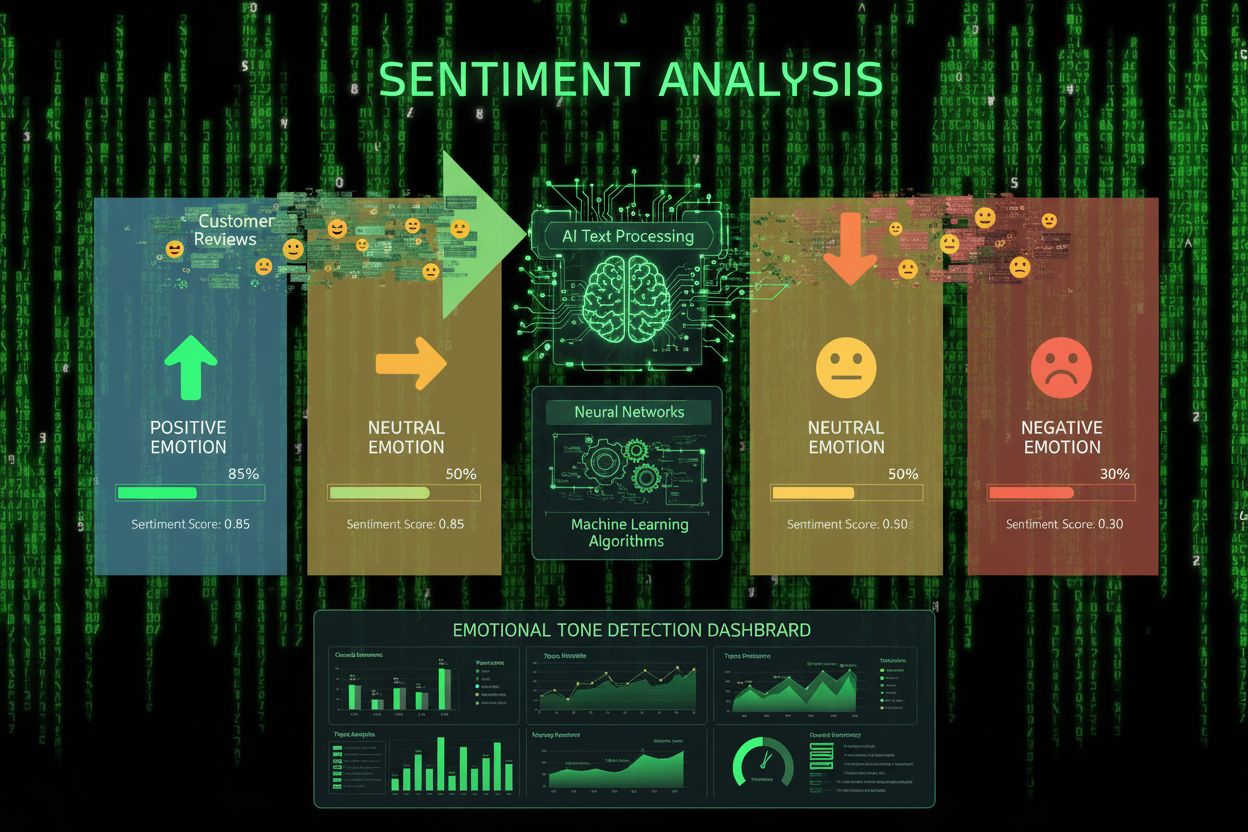
Sentiment analysis is the process of analyzing digital text to determine the emotional tone or opinion expressed within it, classifying content as positive, negative, or neutral. Using natural language processing (NLP) and machine learning algorithms, sentiment analysis automatically interprets customer emotions, brand perceptions, and public opinions from diverse sources including social media, reviews, emails, and AI-generated content.
Sentiment analysis is the process of analyzing digital text to determine the emotional tone or opinion expressed within it, classifying content as positive, negative, or neutral. Using natural language processing (NLP) and machine learning algorithms, sentiment analysis automatically interprets customer emotions, brand perceptions, and public opinions from diverse sources including social media, reviews, emails, and AI-generated content.
Sentiment analysis, also known as opinion mining, is the computational process of analyzing digital text to determine the emotional tone or sentiment expressed within it. This technique classifies content into categories such as positive, negative, or neutral, and can extend to more granular emotion detection including happiness, frustration, anger, or sadness. Sentiment analysis leverages natural language processing (NLP) and machine learning algorithms to automatically interpret human emotions, opinions, and attitudes from diverse textual sources. The primary goal is to transform unstructured text data into actionable insights that reveal how people genuinely feel about products, services, brands, or topics. In today’s AI-driven landscape, sentiment analysis has become indispensable for understanding brand perception not only in traditional channels but also in AI-generated responses from platforms like ChatGPT, Perplexity, Google AI Overviews, and Claude.
Sentiment analysis emerged as a formal research discipline in the early 2000s, initially driven by the need to automatically classify product reviews and customer feedback. Early approaches relied on rule-based systems that used predefined lexicons—dictionaries of words labeled as positive or negative—to classify text. These systems were interpretable and required minimal training data, but they struggled with context, sarcasm, and linguistic nuances. The evolution accelerated with the rise of machine learning, which enabled systems to learn sentiment patterns from labeled datasets rather than relying on manually crafted rules. Today, deep learning and transformer-based models like BERT, RoBERTa, and GPT have revolutionized sentiment analysis, achieving accuracy rates of 85-95% on complex datasets. The global sentiment analysis market was valued at $5.1 billion in 2024 and is projected to reach $11.4 billion by 2030, growing at a compound annual growth rate (CAGR) of 14.3%. This explosive growth reflects the critical importance of understanding customer emotions in an increasingly digital and AI-mediated world.
Sentiment analysis operates through a multi-stage pipeline that transforms raw text into emotional classifications. The first stage is preprocessing, where text is cleaned by removing HTML tags, special characters, and noise. Tokenization breaks sentences into individual words or phrases, while stop-word removal filters out common words like “the,” “and,” or “is” that don’t contribute meaningful sentiment information. Lemmatization or stemming converts words to their root forms—for example, “running,” “runs,” and “ran” all become “run”—ensuring the model recognizes variations of the same word. The second stage involves feature extraction, converting text into numerical representations that machine learning models can process. Common techniques include Bag of Words (counting word occurrences), TF-IDF (Term Frequency-Inverse Document Frequency, which weights important words), and word embeddings like Word2Vec or GloVe, which represent words as dense vectors capturing semantic meaning. The third stage applies a classification model—either rule-based, machine learning-based, or deep learning-based—to assign sentiment labels. Modern systems use neural networks, particularly recurrent neural networks (RNNs), long short-term memory (LSTM) networks, or transformer architectures, which excel at capturing context and long-range dependencies in text. Finally, post-processing aggregates sentiment scores across multiple sentences or aspects, producing final sentiment classifications and confidence scores.
| Aspect | Rule-Based Approach | Machine Learning Approach | Deep Learning Approach | Hybrid Approach |
|---|---|---|---|---|
| How It Works | Uses predefined lexicons and manual rules to classify sentiment | Trains algorithms on labeled data to learn sentiment patterns | Uses neural networks to capture context and semantic relationships | Combines rule-based and ML/DL methods for improved accuracy |
| Accuracy | 60-75% on simple text | 80-88% on diverse datasets | 85-95% on complex language | 88-93% with optimized integration |
| Training Data Required | Minimal; only lexicon creation | Moderate; requires labeled examples | Extensive; needs large diverse datasets | Moderate to extensive depending on configuration |
| Sarcasm Detection | Poor; misses context-dependent sarcasm | Moderate; learns from training examples | Strong; captures contextual nuances | Strong; combines pattern recognition with context |
| Scalability | Low; difficult to expand lexicons | High; scales well with computational resources | High; scales with GPU/TPU infrastructure | High; optimized for production environments |
| Multilingual Support | Limited; requires separate lexicons per language | Moderate; needs language-specific training data | Strong; transformer models support 100+ languages | Strong; leverages multilingual models |
| Implementation Complexity | Low; straightforward to implement | Moderate; requires ML expertise | High; requires deep learning expertise | High; requires integration of multiple systems |
| Real-Time Performance | Fast; minimal computational overhead | Moderate; depends on model complexity | Slower; computationally intensive | Moderate to fast; depends on configuration |
| Adaptability | Low; static rules require manual updates | Moderate; can retrain on new data | High; fine-tuning on domain-specific data | High; combines flexibility of both approaches |
Rule-based sentiment analysis represents the foundational approach, relying on sentiment lexicons—curated lists of words with assigned sentiment scores. For example, words like “excellent,” “wonderful,” and “love” receive positive scores (typically +1 to +10), while words like “terrible,” “awful,” and “hate” receive negative scores (-1 to -10). The system scans text for these keywords, sums their scores, and compares the total against predefined thresholds to classify overall sentiment. While straightforward and interpretable, this approach struggles with negation (e.g., “not bad” should be positive but contains a negative word), sarcasm (e.g., “Yeah, great job breaking my phone”), and context-dependent meanings (e.g., “sick” as slang for impressive). Machine learning approaches train algorithms like Naive Bayes, Support Vector Machines (SVM), or Random Forest on labeled datasets where each text sample is tagged with its correct sentiment. These models learn to identify patterns in word combinations, frequencies, and linguistic structures that correlate with sentiment. They perform significantly better than rule-based systems on diverse, real-world text but require substantial labeled training data and are often domain-specific—a model trained on product reviews may not perform well on social media posts. Deep learning approaches using neural networks represent the current state-of-the-art, particularly transformer-based models like BERT and GPT. These models learn hierarchical representations of language, capturing both local word relationships and global document context. They excel at understanding sarcasm, idioms, cultural references, and mixed sentiments within single texts. Hybrid approaches combine rule-based and machine learning methods, using lexicons for quick initial classification while applying neural networks to refine predictions and handle complex cases, balancing speed and accuracy.
In the context of AI monitoring and brand reputation management, sentiment analysis has become essential for understanding how brands appear in AI-generated responses. Platforms like AmICited track brand mentions across ChatGPT, Perplexity, Google AI Overviews, and Claude, analyzing not just whether a brand is mentioned but the emotional tone of those mentions. This is critical because AI responses directly influence user perception and purchasing decisions. For example, if an AI system describes a brand as “controversial” or “unreliable,” that negative sentiment shapes user attitudes even before they visit the brand’s website. Sentiment analysis enables companies to identify when their brand is characterized negatively in AI responses, understand the specific criticisms or concerns being highlighted, and develop strategies to improve their AI visibility and reputation. Additionally, sentiment analysis helps track how brand sentiment evolves over time in AI responses, revealing whether PR efforts, product improvements, or crisis management are effectively shifting perception. In social media monitoring, sentiment analysis identifies trending topics, emerging crises, and opportunities for engagement. When negative sentiment spikes around a brand, sentiment analysis tools can alert teams within minutes, enabling rapid response before issues escalate. In customer service, sentiment analysis prioritizes support tickets by emotional urgency—a frustrated customer receives faster attention than a neutral inquiry. In market research, sentiment analysis reveals which product features generate positive or negative reactions, informing product development and marketing strategies.
Despite significant advances, sentiment analysis faces persistent challenges that limit accuracy and applicability. Sarcasm and irony represent perhaps the most difficult challenge, as they require understanding context and speaker intent. A statement like “Oh wonderful, another meeting” uses positive words but expresses negative sentiment. Even humans struggle to detect sarcasm reliably, and AI systems trained on limited data frequently misclassify sarcastic statements. Negation presents another challenge—phrases like “not bad,” “not terrible,” or “not unimpressive” reverse sentiment polarity, and some systems fail to recognize these reversals, especially when negation spans multiple sentences. Multipolarity occurs when a single text expresses multiple, sometimes contradictory sentiments. A restaurant review might state, “The food was amazing, but the service was terrible.” Simple sentiment analysis might average these to neutral, missing the nuanced reality that customers have strong positive and negative opinions about different aspects. Emojis and slang introduce cultural and temporal variability—the meaning of emojis evolves, and slang varies across communities and regions. A system trained on formal English may misinterpret contemporary slang like “that slaps” (meaning excellent) or “no cap” (meaning no lie). Multilingual sentiment analysis faces compounded challenges, as sentiment expressions vary dramatically across languages and cultures. Idioms, cultural references, and linguistic structures don’t translate directly, and training data imbalances mean some languages receive far less attention than English. Domain-specific language creates additional complexity—medical terminology, legal jargon, or technical language may contain words that appear negative in general contexts but carry neutral or positive meanings in specialized domains.
The future of sentiment analysis is being shaped by several converging trends. Multimodal sentiment analysis is emerging, extending beyond text to analyze sentiment in images, videos, and audio. A brand might appear positively in text but negatively in accompanying images or tone of voice, and comprehensive sentiment analysis must capture this multimodal context. Emotion AI is advancing beyond simple positive/negative/neutral classifications to detect nuanced emotional states—distinguishing between different types of negative sentiment like frustration, anger, disappointment, or fear, each requiring different business responses. Real-time sentiment analysis is becoming standard, with systems processing social media streams, customer service interactions, and AI-generated content instantaneously, enabling immediate response to emerging issues. Contextual and cultural adaptation is improving, with models increasingly trained on diverse global datasets and fine-tuned for specific cultural contexts, reducing bias and improving accuracy across languages and regions. Integration with other AI systems is deepening—sentiment analysis is being combined with named entity recognition (NER) to identify which specific products or people are associated with sentiment, aspect extraction to understand which features drive sentiment, and causal inference to understand why sentiment changes. For companies monitoring AI visibility and brand reputation, these advances mean increasingly sophisticated understanding of how brands are perceived not just in traditional channels but in AI-generated responses. As large language models become more prevalent in search and information discovery, sentiment analysis of AI responses will become as critical as monitoring traditional media. Organizations that master sentiment analysis will gain competitive advantages in understanding customer emotions, anticipating market trends, managing crises, and optimizing their presence across both human and AI-mediated channels. The convergence of sentiment analysis with AI monitoring platforms like AmICited represents a new frontier in brand intelligence, enabling companies to understand and influence how AI systems describe and characterize their brands.
Sentiment analysis focuses specifically on identifying emotional tone and opinions in text, classifying content as positive, negative, or neutral. Semantic analysis, by contrast, aims to understand the actual meaning and relationships between words, concepts, and context. While sentiment analysis answers 'how does the author feel?', semantic analysis answers 'what does this text mean?' Both are NLP techniques, but they serve different purposes in understanding human language.
Modern AI sentiment analysis achieves approximately 85-95% accuracy depending on the complexity of language and context. Advanced machine learning models and transformer-based architectures like BERT significantly outperform rule-based systems. However, AI still struggles with sarcasm, cultural nuances, and mixed sentiments. Human review remains valuable for validation and refinement, but AI sentiment analysis scales to analyze millions of data points instantly, making it far more practical for real-time brand monitoring and large-scale analysis.
Detecting sarcasm and irony remains one of the most challenging aspects of sentiment analysis, even for advanced AI systems. Modern deep learning models trained on diverse datasets perform better than older rule-based approaches, but they still struggle with context-dependent sarcasm. For example, 'Great, another delayed shipment!' requires understanding context to recognize negative sentiment despite the positive word 'great'. Hybrid approaches combining rule-based methods with machine learning and continuous model refinement improve accuracy over time.
The primary types include fine-grained sentiment analysis (rating sentiment on scales like 1-5 stars), aspect-based sentiment analysis (analyzing sentiment toward specific product features), emotion detection (identifying specific emotions like joy, anger, or sadness), multilingual sentiment analysis (processing multiple languages), and intent-based sentiment analysis (understanding purchase intent or user motivation). Each type serves different business needs, from customer satisfaction measurement to competitive intelligence and campaign optimization.
Sentiment analysis is critical for monitoring how brands appear in AI-generated responses from platforms like ChatGPT, Perplexity, Google AI Overviews, and Claude. By analyzing the emotional tone of how AI systems describe brands, companies can understand their reputation in AI responses, identify negative characterizations, and track sentiment shifts over time. This is essential for AI visibility strategy, as sentiment in AI responses directly influences user perception and purchasing decisions.
Key preprocessing steps include text cleaning (removing HTML tags, special characters, and noise), tokenization (breaking text into individual words or phrases), stop-word removal (filtering common words like 'the' or 'and'), lemmatization or stemming (converting words to root forms), and handling emojis and slang. These steps standardize text data, reduce noise, and prepare it for feature extraction. Proper preprocessing significantly improves sentiment analysis accuracy by ensuring the model focuses on meaningful content rather than formatting variations.
Businesses leverage sentiment analysis to monitor customer feedback in real-time across social media, reviews, and support channels. By identifying negative sentiment patterns, companies can quickly address customer concerns, improve product features, and enhance service quality. Sentiment analysis also reveals what customers appreciate most, enabling companies to amplify those strengths in marketing and product development. Additionally, understanding sentiment helps personalize customer interactions and prioritize support resources toward high-impact issues.
Start tracking how AI chatbots mention your brand across ChatGPT, Perplexity, and other platforms. Get actionable insights to improve your AI presence.
Learn what AI sentiment monitoring is, why it matters for brand reputation, and how to track how ChatGPT, Perplexity, and Gemini characterize your brand. Essent...

Brand sentiment measures public perception of a brand through emotional analysis of customer feedback. Learn how AI-powered sentiment analysis tracks brand repu...
Learn how AI systems describe your brand versus competitors. Understand sentiment gaps, measurement methodology, and strategic implications for brand reputation...
Cookie Consent
We use cookies to enhance your browsing experience and analyze our traffic. See our privacy policy.