
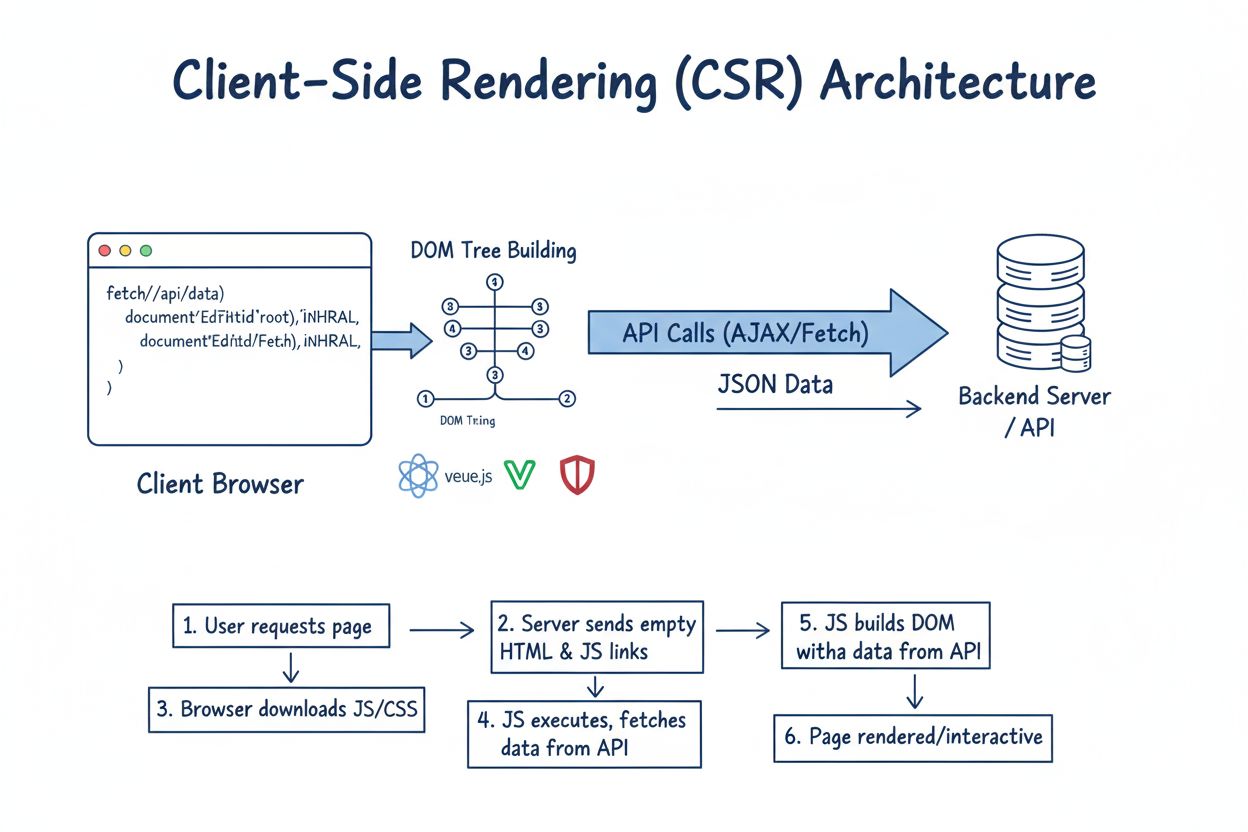
Client-Side Rendering (CSR)
Learn what Client-Side Rendering (CSR) is, how it works, its advantages and disadvantages, and its impact on SEO, AI indexing, and web application performance i...
13 min read
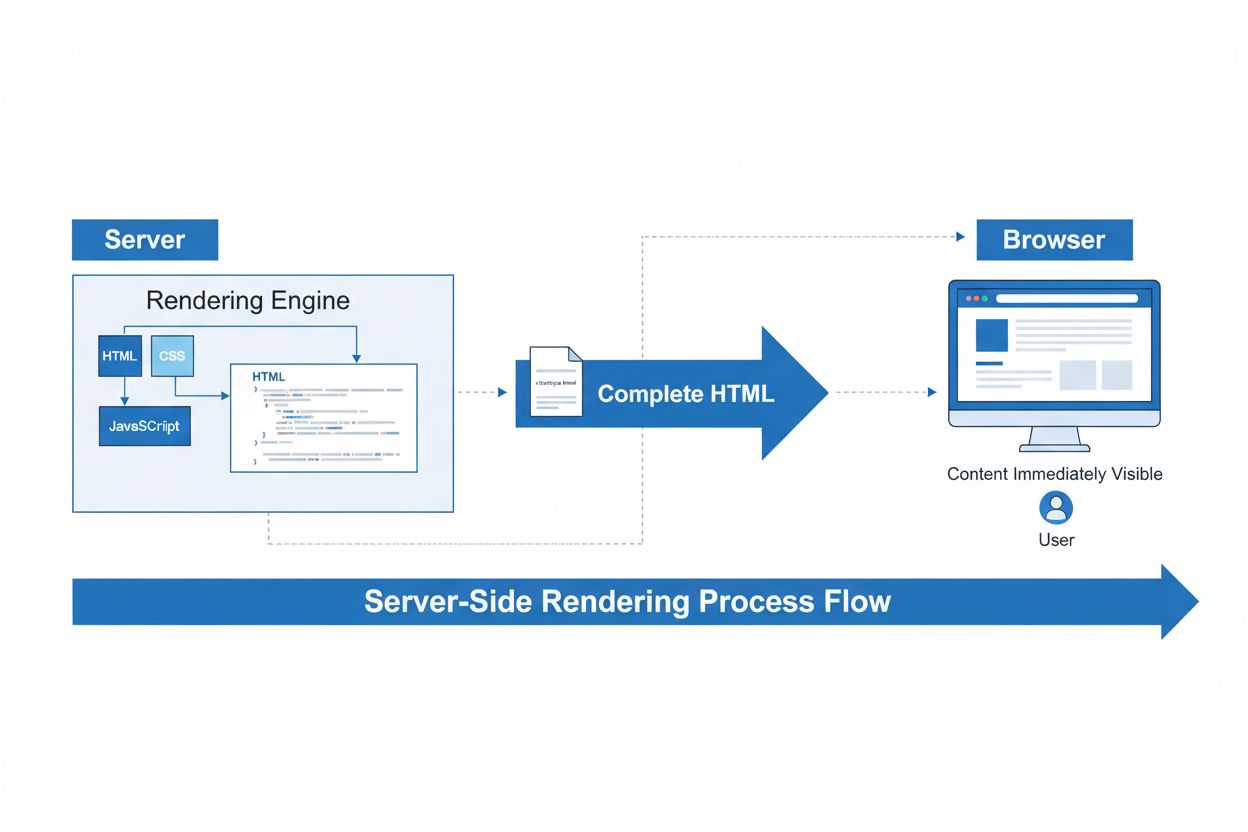
Server-Side Rendering (SSR) is a web development technique where the server generates the complete HTML content of a webpage and sends the fully-rendered page to the client’s browser, enabling faster initial page loads and improved search engine indexing. Unlike client-side rendering, SSR eliminates the need for browsers to download and execute JavaScript before displaying content, making pages immediately visible to users and AI crawlers.
Server-Side Rendering (SSR) is a web development technique where the server generates the complete HTML content of a webpage and sends the fully-rendered page to the client's browser, enabling faster initial page loads and improved search engine indexing. Unlike client-side rendering, SSR eliminates the need for browsers to download and execute JavaScript before displaying content, making pages immediately visible to users and AI crawlers.
Server-Side Rendering (SSR) is a web development technique where the server generates the complete HTML content of a webpage and sends the fully-rendered page directly to the client’s browser. Unlike traditional client-side rendering, which requires browsers to download JavaScript files and execute them to build the page, SSR delivers a complete, ready-to-display HTML document on the initial request. This fundamental approach to web rendering has become increasingly important in modern web development, particularly for applications prioritizing search engine optimization, fast initial page loads, and compatibility with AI crawlers and indexing systems. The server handles all rendering logic, data fetching, and HTML generation before the user’s browser receives anything, ensuring that content is immediately visible and indexable by search engines and AI systems alike.
Server-Side Rendering represents one of the oldest and most established methods of delivering web content, predating the modern JavaScript framework era by decades. In the early days of the web, SSR was the default approach—servers generated HTML dynamically for each request, and browsers simply displayed the result. However, with the rise of single-page applications (SPAs) and client-side JavaScript frameworks like React, Angular, and Vue.js in the 2010s, many developers shifted toward Client-Side Rendering (CSR), which moved rendering logic to the browser. This shift created significant SEO challenges, as search engine crawlers struggled to index JavaScript-rendered content. According to industry data, approximately 78% of enterprises now use AI-driven content monitoring tools to track their digital presence, highlighting the critical importance of ensuring content is properly indexed and discoverable. In response to CSR’s limitations, modern meta-frameworks like Next.js, Nuxt.js, and SvelteKit have revitalized SSR by combining server-side rendering with client-side interactivity through a process called hydration, creating a hybrid approach that leverages the benefits of both rendering strategies.
The Server-Side Rendering process follows a distinct sequence of steps that fundamentally differs from client-side rendering. When a user requests a webpage, the server receives the request and immediately begins processing. The server fetches any necessary data from databases or external APIs, executes the application logic, and generates the complete HTML markup including all content, styles, and structure. This fully-rendered HTML is then sent to the user’s browser as a single response. The browser receives this complete HTML document and can immediately display the page to the user without waiting for JavaScript downloads or execution. Simultaneously, the browser begins downloading the JavaScript files required for interactivity. Once the JavaScript loads and executes, a process called hydration occurs, where the framework attaches event listeners and interactive functionality to the already-rendered HTML. This two-phase approach means users see content instantly while the page becomes fully interactive in the background. Research indicates that this process reduces Time to First Byte (TTFB) by 100-300 milliseconds compared to client-side rendering, and significantly improves First Contentful Paint (FCP) metrics, which are critical ranking factors for search engines.
| Aspect | Server-Side Rendering (SSR) | Client-Side Rendering (CSR) |
|---|---|---|
| Rendering Location | Server generates complete HTML before sending to browser | Browser downloads skeleton HTML, then builds content with JavaScript |
| Initial Page Load Speed | Faster: user sees full content immediately | Slower: blank page or loader until JavaScript executes |
| SEO Performance | Excellent: HTML easily crawled and indexed by search engines | Poor/Fair: requires additional steps for proper indexing |
| Time to First Contentful Paint (FCP) | 1-2 seconds typical | 3-5 seconds typical for complex applications |
| Server Load | High: every request requires rendering HTML | Lower: server mainly serves static files |
| Interactivity | Good after hydration, but dynamic updates may require server calls | Excellent: all interactions handled client-side without server requests |
| JavaScript Bundle Size | Smaller: rendering code stays on server | Larger: all rendering logic sent to browser |
| Performance on Weak Devices | Excellent: minimal processing required on client | Poor: heavy JavaScript can slow older devices significantly |
| Development Complexity | Higher: requires server-side rendering setup and hydration logic | Lower for interactivity, but more complex for SEO optimization |
| Caching Strategy | Challenging: each page’s HTML differs based on user/data | Easier: static files cached on CDN |
| Social Media Sharing | Excellent: Open Graph meta tags properly indexed | Limited: requires special handling for preview generation |
| Typical Use Cases | Blogs, news sites, e-commerce, landing pages, content portals | Single-page applications, dashboards, real-time apps, social feeds |
| AI Crawler Compatibility | Excellent: AI systems immediately access rendered content | Fair: requires JavaScript execution for proper indexing |
Server-Side Rendering provides substantial advantages for search engine optimization, making it the preferred approach for content-heavy websites and applications where organic search visibility is critical. When search engine crawlers like Googlebot visit an SSR page, they receive fully-rendered HTML containing all content, metadata, and structured data immediately. This eliminates the need for crawlers to execute JavaScript, which can be resource-intensive and sometimes incomplete. According to Search Engine Journal, SSR is effective for boosting SEO performance because it indexes pages before they are loaded in the browser, improving crawl efficiency and ranking potential. The Open Graph Protocol and Twitter Cards metadata are properly rendered and available for social media crawlers, enabling rich preview cards when content is shared on platforms like Facebook, LinkedIn, and Twitter. Additionally, SSR enables proper implementation of schema markup and structured data, which help search engines understand page content and context. For e-commerce websites, SSR ensures that product pages, descriptions, and pricing information are immediately indexable, improving visibility in product search results. The combination of faster page load times and better indexability creates a compounding SEO benefit—Google’s Core Web Vitals algorithm rewards fast-loading pages, and SSR contributes to improved Largest Contentful Paint (LCP) and Cumulative Layout Shift (CLS) metrics.
Server-Side Rendering significantly impacts multiple web performance metrics that directly influence user experience and search engine rankings. The First Contentful Paint (FCP) metric, which measures when the first content becomes visible to users, is substantially faster with SSR because the server sends rendered content immediately rather than requiring JavaScript execution. Studies show that SSR can reduce FCP by 50-70% compared to client-side rendering for complex applications. The Time to Interactive (TTI) metric, which measures when a page becomes fully interactive, is improved through the hydration process—users see content immediately while interactivity loads in the background. Largest Contentful Paint (LCP), a critical Core Web Vitals metric, benefits from SSR’s faster initial content delivery. However, SSR introduces considerations around Time to First Byte (TTFB), which can increase if server processing is inefficient or server load is high. Modern SSR implementations address this through streaming SSR, introduced in React 18, which sends HTML to the browser in chunks as it’s generated rather than waiting for complete rendering. This approach significantly improves TTFB and perceived performance. Additionally, SSR enables better caching strategies at the server and CDN level, though cache invalidation becomes more complex when content varies per user or request.
In the emerging landscape of AI-powered search and generative AI systems, Server-Side Rendering has become increasingly important for content discoverability and citation. Platforms like Perplexity, ChatGPT, Google AI Overviews, and Claude rely on crawling and indexing web content to generate responses and citations. SSR pages are significantly more accessible to these AI crawlers because the fully-rendered HTML is immediately available without requiring JavaScript execution. Unlike traditional search engines that have invested heavily in JavaScript rendering capabilities, many AI crawlers prioritize efficiency and may not execute complex JavaScript, making SSR content more reliably discoverable. For organizations using platforms like AmICited to monitor brand mentions in AI-generated responses, SSR implementation ensures that content is properly indexed and attributed across AI systems. The presence of well-structured HTML, proper heading hierarchy, and semantic markup in SSR pages makes it easier for AI systems to understand content context and relevance. This is particularly important for knowledge graphs, fact-checking systems, and citation attribution in AI responses. As AI systems become increasingly important for content discovery and brand visibility, SSR represents a strategic advantage for ensuring your content appears in AI-generated answers and maintains proper attribution.
Modern Server-Side Rendering is implemented through specialized meta-frameworks that abstract away much of the complexity while providing powerful features. Next.js, built on React, is the most popular SSR framework with extensive adoption across the industry. It provides the getServerSideProps() function for server-side data fetching and rendering, automatic code splitting, and built-in optimization features. Nuxt.js offers similar capabilities for Vue.js applications, with features like automatic routing and middleware support. SvelteKit provides a lightweight SSR solution with excellent performance characteristics, while Angular Universal enables SSR for Angular applications. Remix focuses on web fundamentals and progressive enhancement, making it ideal for applications requiring robust server-side logic. Astro takes a unique approach by rendering components to static HTML by default and selectively hydrating interactive components. Qwik introduces resumability, allowing the browser to resume execution from where the server left off without re-executing code. These frameworks handle the complexity of hydration, data synchronization between server and client, and performance optimization automatically. According to recent data, React-based frameworks are used by over 1.3 million websites, with a significant portion leveraging SSR capabilities through Next.js and similar solutions.
getServerSideProps() in Next.js to avoid N+1 query problems and unnecessary API callsWhile Server-Side Rendering offers significant advantages, it introduces distinct challenges that developers must carefully consider. Server load and scalability represent the primary concern—every user request requires the server to render HTML, which consumes CPU and memory resources. During traffic spikes, this can create bottlenecks and slow response times. Development complexity increases substantially with SSR, requiring developers to understand both server-side and client-side rendering, manage hydration correctly, and handle edge cases where server and client state diverge. Caching becomes more difficult because each page’s HTML may differ based on user data, authentication status, or request parameters, making it challenging to cache effectively on CDNs. Compatibility issues can arise with third-party libraries that assume a browser environment or don’t support server-side execution. Cost implications are significant for high-traffic applications, as SSR requires more powerful servers or serverless infrastructure with higher computational costs. Delayed interactivity occurs when users see content immediately but must wait for JavaScript to download and hydrate before the page becomes interactive. Full page reloads may be necessary for certain interactions if not properly optimized, reducing the responsiveness compared to pure client-side applications. These trade-offs require careful evaluation based on specific project requirements, audience characteristics, and business priorities.
The landscape of Server-Side Rendering continues to evolve with emerging technologies and architectural patterns. React Server Components (RSC), introduced by the React team, represent a significant shift by allowing developers to render components on the server without sending associated JavaScript to the client, dramatically reducing client-side bundle sizes. This approach combines the benefits of SSR with improved performance and developer experience. Streaming SSR, now standard in React 18 and adopted by other frameworks, sends HTML to the browser in chunks as it’s generated, improving perceived performance and Time to First Byte. Edge computing is transforming SSR by enabling rendering at edge locations closer to users, reducing latency and improving global performance. Incremental Static Regeneration (ISR) and On-Demand Revalidation provide hybrid approaches that combine static generation with dynamic updates, offering the best of both worlds for many applications. AI integration is becoming increasingly important, with frameworks optimizing for AI crawler compatibility and ensuring content is properly discoverable by generative AI systems. The resurgence of SSR in 2024 reflects a broader industry recognition that server-side rendering, when properly implemented with modern frameworks and optimization techniques, provides superior performance, SEO, and user experience compared to pure client-side approaches. As AI systems become more central to content discovery and brand visibility, SSR’s advantages in ensuring proper indexing and attribution will likely drive continued adoption and innovation in this space.
Server-Side Rendering significantly improves SEO because search engine crawlers receive fully-rendered HTML content immediately, making it easy to index and understand page content without executing JavaScript. According to Search Engine Journal, SSR enables search engines to crawl pages before they load in the browser, improving visibility in search results. In contrast, Client-Side Rendering requires crawlers to execute JavaScript, which can delay or prevent proper indexing, particularly for complex applications.
Hydration is the process where JavaScript frameworks initialize interactive functionality on the client-side after the server has already rendered the HTML. The server sends a fully-rendered HTML page, and then the browser downloads and executes JavaScript to attach event listeners and enable interactivity. This two-step process allows users to see content immediately while the page becomes interactive in the background, combining the speed benefits of SSR with the interactivity of client-side rendering.
SSR delivers several key performance benefits: faster First Contentful Paint (FCP) since users see rendered content immediately, reduced Time to Interactive (TTI) for content-heavy pages, and better performance on slow network connections or older devices. Research shows that 83% of users expect websites to load in 3 seconds or less, and SSR helps meet this expectation by eliminating JavaScript download and execution delays on initial page load.
Use Server-Side Rendering for content-heavy websites like blogs, news sites, e-commerce platforms, and landing pages where SEO and initial load speed are critical priorities. SSR is ideal when your audience includes users with slow internet connections or older devices. However, for highly interactive applications like real-time dashboards, chat applications, or single-page applications requiring frequent dynamic updates, Client-Side Rendering may be more appropriate despite its SEO challenges.
The primary disadvantages of SSR include increased server load and costs, as the server must render HTML for every user request, making it resource-intensive during high traffic periods. SSR also introduces development complexity, potential compatibility issues with third-party libraries, and challenges with efficient caching since each page's HTML differs. Additionally, users must wait for JavaScript to download before the page becomes fully interactive, which can delay responsiveness compared to pre-rendered static content.
Server-Side Rendering is highly beneficial for AI crawler indexing because platforms like ChatGPT, Perplexity, Google AI Overviews, and Claude can immediately access and understand fully-rendered HTML content without executing JavaScript. This makes SSR pages more discoverable and citable in AI-generated responses. For platforms like AmICited that monitor brand mentions in AI responses, SSR ensures your content is properly indexed and attributed, improving visibility across AI search engines and generative AI systems.
Popular frameworks supporting SSR include Next.js (React-based), Nuxt.js (Vue-based), SvelteKit, Angular Universal, Remix, Astro, and Qwik. These meta-frameworks provide built-in SSR capabilities with features like automatic code splitting, data fetching on the server, and seamless hydration. Next.js is particularly popular, with over 1.3 million websites utilizing React-based frameworks as of 2024, many leveraging SSR for improved performance and SEO.
Start tracking how AI chatbots mention your brand across ChatGPT, Perplexity, and other platforms. Get actionable insights to improve your AI presence.
Learn what Client-Side Rendering (CSR) is, how it works, its advantages and disadvantages, and its impact on SEO, AI indexing, and web application performance i...

Learn how server-side rendering enables efficient AI processing, model deployment, and real-time inference for AI-powered applications and LLM workloads.
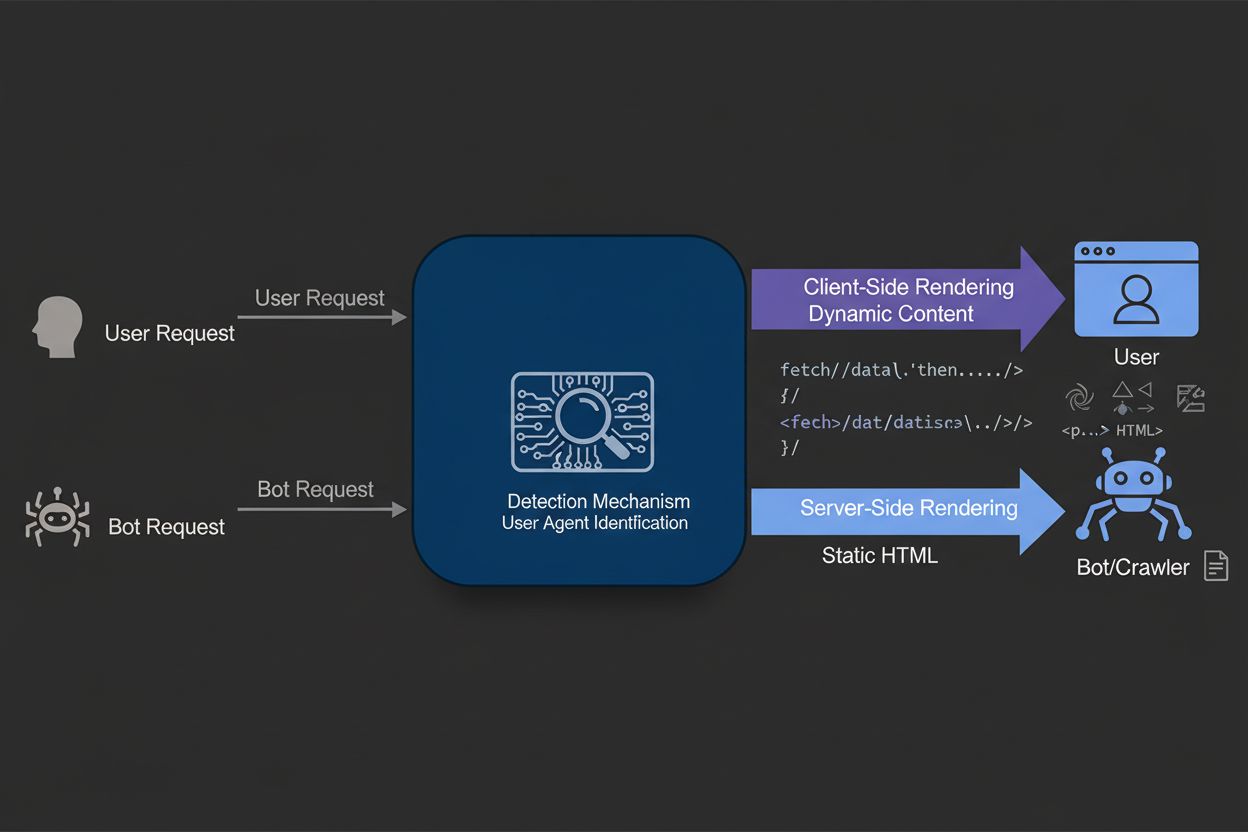
Dynamic rendering serves static HTML to search engine bots while delivering client-side rendered content to users. Learn how this technique improves SEO, crawl ...
Cookie Consent
We use cookies to enhance your browsing experience and analyze our traffic. See our privacy policy.