
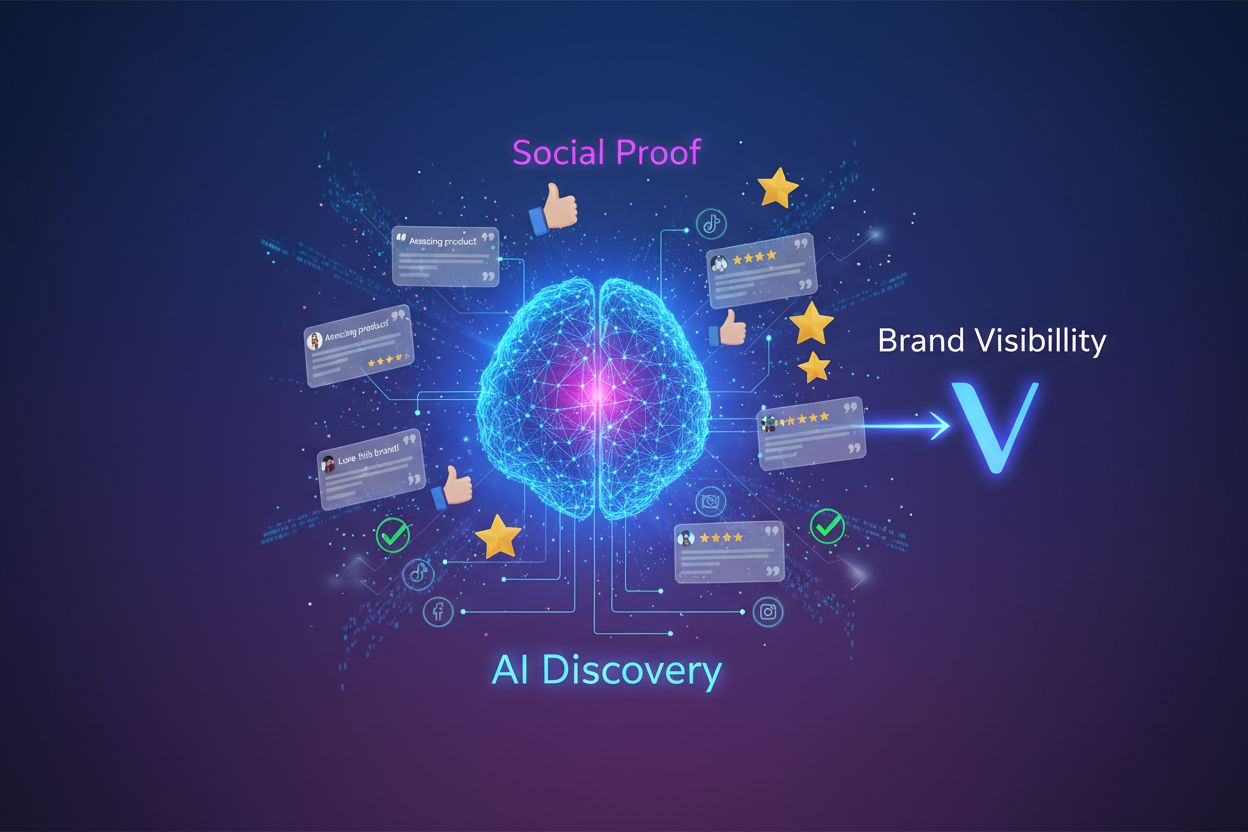
Social Proof Aggregation
Learn how social proof aggregation consolidates testimonials and endorsements across platforms to improve AI discovery, build trust, and increase conversions. E...
8 min read
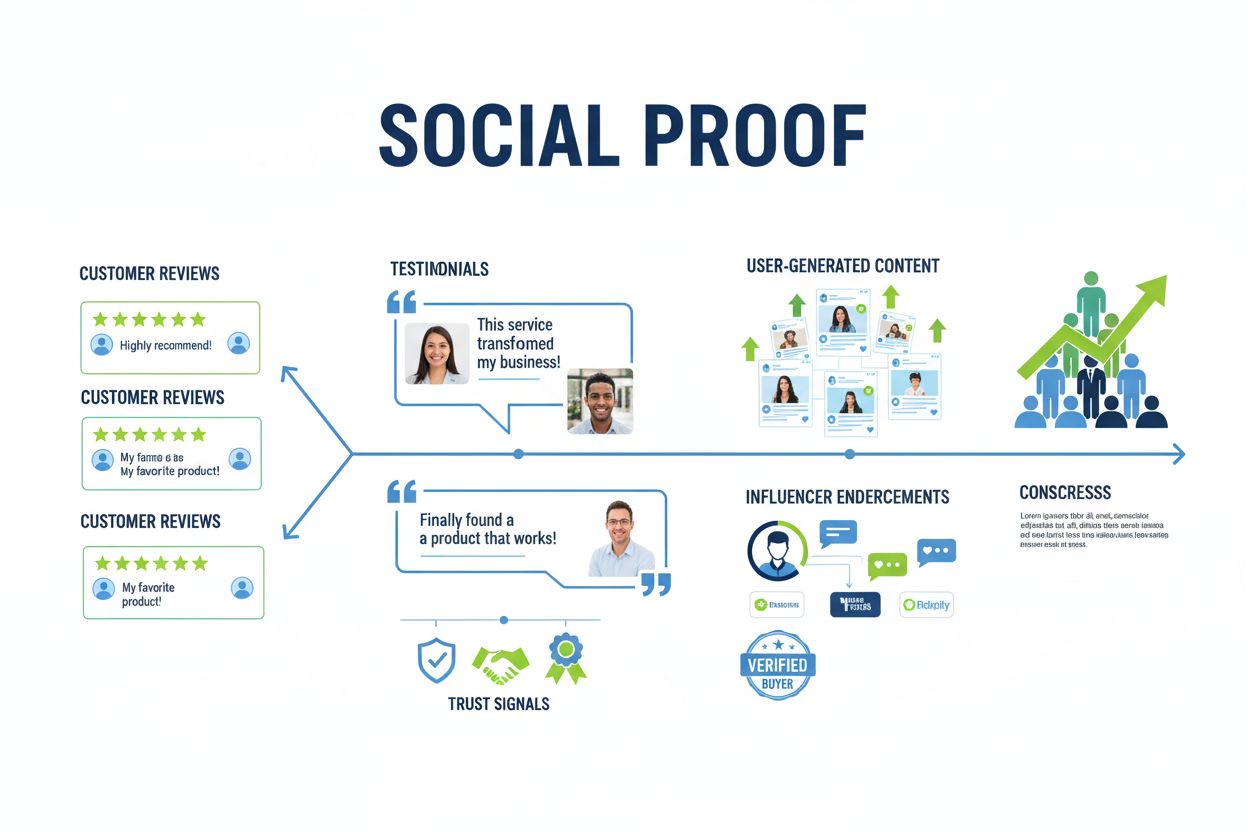
Social proof is a psychological phenomenon where people look to the actions and behaviors of others to determine their own decisions, especially in uncertain situations. In marketing and business contexts, it refers to evidence that other people have purchased, trusted, or validated a product, service, or brand, thereby building credibility and influencing purchasing decisions.
Social proof is a psychological phenomenon where people look to the actions and behaviors of others to determine their own decisions, especially in uncertain situations. In marketing and business contexts, it refers to evidence that other people have purchased, trusted, or validated a product, service, or brand, thereby building credibility and influencing purchasing decisions.
Social proof is a psychological phenomenon in which people look to the actions, behaviors, and opinions of others to determine how they should behave, especially in uncertain situations. In marketing and business contexts, social proof refers to evidence that other people have purchased, trusted, validated, or recommended a product, service, or brand. This evidence—whether in the form of customer reviews, testimonials, influencer endorsements, or trust badges—serves as a powerful trust signal that influences purchasing decisions and builds brand credibility. The concept was popularized by psychologist Robert Cialdini in his seminal work “Influence: The Psychology of Persuasion,” where he identified social proof as one of six universal principles of influence that shape human behavior. Social proof operates on the fundamental principle that what many people are doing or believing must be correct, making it one of the most effective psychological tools for building consumer confidence and driving conversions in digital marketing.
The psychological foundation of social proof rests on the human tendency to seek validation and conform to group behavior. When faced with uncertainty—such as deciding whether to purchase an unfamiliar product or trust an unknown brand—people naturally look to others for guidance. This behavior is deeply rooted in our evolutionary history; following the actions of the group often increased survival chances in uncertain environments. In modern consumer contexts, this instinct manifests as reliance on customer reviews, social media followers, and peer recommendations. Cialdini’s research demonstrates that people use the actions of others as a mental shortcut or heuristic to make decisions more efficiently. Rather than conducting extensive research or analysis, consumers can simply observe what others have chosen and assume that choice is correct. This cognitive shortcut is particularly powerful in situations where consumers lack expertise, face time pressure, or encounter ambiguous product information. The phenomenon is remarkably consistent across cultures and demographics, suggesting it’s a fundamental aspect of human psychology rather than a culturally specific behavior. Studies conducted in Beijing, China, for example, showed that labeling a restaurant dish as “most popular” increased orders by 13%, demonstrating that social proof influences consumer behavior globally regardless of cultural context.
The quantifiable impact of social proof on consumer decision-making is substantial and well-documented. According to Nielsen research, 92% of consumers trust earned media (such as word-of-mouth recommendations and online reviews) more than any other form of advertising, compared to only 58% who trust editorial content and significantly lower percentages for traditional paid advertising. When it comes to online shopping specifically, 97% of consumers read online reviews when browsing for local businesses, and 88% of shoppers say they’re likely to use a business that responds to all reviews. The conversion impact is equally impressive: displaying customer reviews can increase conversion rates by up to 270%, according to research from the Spiegel Research Center. Products with reviews achieve a 12.5% higher conversion rate than those without any reviews, and items rated 4 stars or above account for 94% of all purchases. Furthermore, sales-based social proof notifications boost website conversions by 98%, while showing customer reviews increases purchases by 67%. These statistics reveal that social proof isn’t merely a nice-to-have marketing element—it’s a fundamental driver of business growth. The data also shows that 72% of shoppers rate customer reviews as “extremely” or “very” important to their purchasing decisions, making reviews the third most important factor after product images and pricing. Additionally, 56% of shoppers have abandoned online sales specifically because of negative reviews, highlighting how powerfully social proof influences purchase completion.
Social proof manifests in numerous forms, each serving distinct purposes in building trust and influencing consumer behavior. Customer reviews and ratings represent the most common and recognizable form, with consumers reading an average of 10 online reviews before making a purchase decision. User-generated content (UGC) includes photos, videos, and testimonials created by actual customers, which research shows is 90% preferred by consumers over influencer content because it feels more authentic. Testimonials and case studies provide detailed narratives of customer success, with studies showing that including testimonials on landing pages can increase conversions by up to 34%. Influencer endorsements leverage the credibility and reach of trusted personalities, with 49% of consumers relying on influencer recommendations and 21% having recently purchased products based on influencer recommendations. Expert social proof involves endorsements from industry authorities or recognized experts, which 67% of consumers find particularly persuasive. Trust badges and certifications (such as security seals, industry certifications, or award badges) signal compliance with standards and build confidence, with 75% of online shoppers more likely to trust websites displaying trust badges. Popularity indicators such as “bestseller,” “trending,” or “most popular” labels leverage the bandwagon effect, with Amazon’s “Choice” badge boosting conversion rates by 25%. Social media metrics including follower counts, likes, and shares serve as social proof by demonstrating community size and engagement. Customer logos and partnerships showcase well-known clients or brand collaborations, building credibility through association. Finally, real-time purchase notifications and live visitor counters create urgency and demonstrate active demand by showing that others are currently buying or viewing products.
| Type of Social Proof | Primary Function | Best Used For | Conversion Impact | Authenticity Level |
|---|---|---|---|---|
| Customer Reviews & Ratings | Build trust through authentic feedback | E-commerce, SaaS, local services | +270% conversion lift | Very High |
| User-Generated Content (UGC) | Demonstrate real-world product usage | Social media, product pages | +166% conversion lift | Very High |
| Testimonials & Case Studies | Provide detailed success narratives | B2B, high-ticket items, services | +34% landing page lift | High |
| Influencer Endorsements | Leverage trusted personalities | Fashion, beauty, lifestyle | +20-40% brand trust lift | Medium-High |
| Expert Recommendations | Signal industry authority | Professional services, B2B | +67% consumer trust | High |
| Trust Badges & Certifications | Demonstrate compliance & security | E-commerce checkout, financial | +75% trust increase | High |
| Popularity Indicators | Create bandwagon effect | E-commerce, trending products | +25% conversion (Amazon Choice) | Medium |
| Social Media Metrics | Show community size & engagement | All industries | +19.4% purchase drivers | Medium |
| Customer Logos & Partnerships | Build credibility through association | B2B, SaaS, enterprise | +30-50% credibility lift | High |
| Real-Time Purchase Notifications | Create urgency & demonstrate demand | E-commerce, limited inventory | +98% conversion boost | Very High |
The mechanism through which social proof drives business results operates on multiple levels simultaneously. At the most fundamental level, social proof reduces perceived risk by providing evidence that others have successfully purchased or used a product without negative consequences. When a potential customer sees that thousands of others have bought a product and left positive reviews, the perceived risk of making a poor purchasing decision decreases significantly. This risk reduction is particularly important in e-commerce, where customers cannot physically inspect products before purchase. Second, social proof builds brand credibility and authority by demonstrating that the brand has satisfied customers and industry recognition. A brand with numerous positive reviews, industry awards, and customer testimonials is perceived as more established and trustworthy than a brand with no social proof. Third, social proof creates psychological pressure to conform, leveraging the human tendency to follow group behavior. When consumers see that many others have chosen a particular product or brand, they feel social pressure to make the same choice, fearing they might miss out or make an incorrect decision. This conformity pressure is particularly strong when the social proof comes from people similar to the consumer (similarity principle). Fourth, social proof accelerates decision-making by providing mental shortcuts that reduce the cognitive effort required to evaluate options. Rather than conducting extensive research, consumers can simply observe what others have chosen and assume that choice is optimal. Finally, social proof increases customer lifetime value by building long-term trust and loyalty. Customers who purchase based on strong social proof are more likely to become repeat customers and brand advocates, creating a virtuous cycle where satisfied customers generate more social proof for future customers.
In the emerging landscape of AI-powered search and content generation, social proof has taken on new strategic importance. Platforms like ChatGPT, Perplexity, Google AI Overviews, and Claude increasingly cite sources in their responses, and they tend to prioritize sources with strong social proof signals. When an AI system generates a response about a product, service, or brand, it’s more likely to cite sources that have high review counts, verified customer testimonials, industry recognition, and established credibility markers. This means that brands with robust social proof are more likely to be cited as authoritative sources in AI-generated responses, directly impacting their visibility in this new search paradigm. AmICited and similar AI monitoring platforms track how brands appear in AI responses across multiple platforms, making it possible to measure the impact of social proof on AI citation rates. Brands that actively build and maintain strong social proof—through collecting customer reviews, generating user-generated content, earning industry awards, and building partnerships—are positioning themselves for greater visibility in AI-generated content. This represents a fundamental shift in SEO strategy, where traditional search engine optimization must now be complemented by what experts call GEO (Generative Engine Optimization)—the practice of optimizing content and brand signals specifically for AI systems. The quality and quantity of social proof directly influences whether a brand will be cited as a trusted source by AI systems, making social proof collection and management a critical component of modern digital marketing strategy.
Successful social proof strategies require a systematic, multi-channel approach that goes beyond simply collecting reviews. First, actively solicit reviews and testimonials from satisfied customers across multiple platforms including Google, Trustpilot, industry-specific review sites, and your own website. Make the review process as frictionless as possible by sending follow-up emails with direct links to review pages. Second, respond to all reviews—both positive and negative—to demonstrate engagement and commitment to customer satisfaction. Research shows that 88% of consumers are more likely to shop with brands that respond to every review, compared to just 47% who shop with brands that don’t respond to any reviews. Third, showcase user-generated content by creating branded hashtags, running photo contests, and featuring customer photos and videos on your website and social media. UGC is particularly powerful because it’s created by real customers and feels more authentic than branded content. Fourth, display social proof prominently on high-impact pages including product pages, landing pages, homepages, and checkout pages. The placement and visibility of social proof significantly influence its effectiveness. Fifth, maintain quality over quantity by ensuring that your social proof is authentic and representative of genuine customer experiences. Mixed reviews (including 3-4 star ratings alongside 5-star reviews) are often more credible than exclusively positive reviews because they reflect real customer experiences. Sixth, monitor and measure the impact of social proof through conversion rate tracking, engagement metrics, traffic analysis, and customer feedback. Use A/B testing to determine which types and placements of social proof are most effective for your specific audience. Finally, integrate social proof across all marketing channels including email marketing, paid advertising, social media, and content marketing to create a cohesive trust-building narrative.
Social proof has evolved significantly from its early manifestations as simple word-of-mouth recommendations to a sophisticated, data-driven marketing discipline. In the early days of e-commerce, social proof was limited to basic customer testimonials and simple star ratings. As digital platforms matured, social proof expanded to include user-generated content, influencer endorsements, social media metrics, and real-time purchase notifications. The rise of mobile commerce and social media platforms like Instagram, TikTok, and YouTube has made visual social proof—particularly user-generated photos and videos—increasingly important. The emergence of AI-powered search and content generation has introduced a new dimension to social proof strategy, where brands must now optimize not just for human consumers but also for AI systems that cite sources based on credibility signals. Looking forward, social proof will likely become even more sophisticated and personalized. Artificial intelligence will enable brands to deliver customized social proof to individual consumers based on their preferences, demographics, and browsing history. For example, a consumer interested in eco-friendly products might see testimonials from environmentally conscious customers, while a budget-conscious shopper might see reviews emphasizing value for money. Additionally, as consumers become more skeptical of traditional advertising and influencer marketing, authentic, unfiltered social proof from real customers will become increasingly valuable. Blockchain technology may also play a role in verifying the authenticity of reviews and testimonials, addressing growing concerns about fake social proof. The integration of social proof with emerging technologies like augmented reality (AR) and virtual reality (VR) could create immersive social proof experiences where consumers can see products in use through customer-created AR filters or VR demonstrations. Finally, as privacy regulations tighten and third-party cookies disappear, brands will need to develop first-party social proof strategies that rely on direct customer relationships and owned channels rather than third-party review platforms.
While social proof is undeniably powerful, its use raises important ethical considerations that brands must navigate carefully. Fake social proof—including fabricated reviews, undisclosed paid testimonials, and inflated metrics—represents a significant ethical and legal concern. Beyond the obvious deception, fake social proof damages brand credibility when discovered, with 81% of consumers saying they wouldn’t buy from a brand again if they discovered fake reviews. Many jurisdictions have implemented regulations requiring disclosure of sponsored content and prohibiting fake reviews, making ethical social proof not just a moral imperative but a legal requirement. Brands must also be mindful of selection bias in social proof, where only the most satisfied (or most dissatisfied) customers leave reviews, creating a skewed representation of customer experiences. Encouraging a diverse range of customers to leave reviews—including those with mixed experiences—creates more credible and representative social proof. Additionally, brands should be transparent about how they collect, curate, and display social proof, avoiding manipulative practices like hiding negative reviews or cherry-picking only the most positive testimonials. The future of social proof will likely emphasize authenticity, transparency, and diversity. Consumers are becoming increasingly sophisticated at detecting fake or manipulated social proof, and they reward brands that demonstrate genuine commitment to customer satisfaction and honest representation of customer experiences. As AI systems become more prevalent in search and content generation, the importance of authentic social proof will only increase, since AI systems are being trained to identify and prioritize credible, authentic sources. Brands that build social proof strategies on a foundation of genuine customer satisfaction, transparent practices, and authentic representation will be best positioned to succeed in this evolving landscape.
Social proof is rooted in the human tendency to conform and seek validation from others, particularly in uncertain situations. Psychologist Robert Cialdini, who popularized the concept in his book 'Influence: The Psychology of Persuasion,' explains that people use the actions of others as a mental shortcut to determine correct behavior. When we see that many people are doing something or trusting a brand, our brains interpret this as evidence that the choice is correct, reducing uncertainty and lowering the cognitive load required to make decisions. This phenomenon is cross-cultural and appears consistently across different societies and demographics.
Research demonstrates that social proof has a significant impact on e-commerce conversions. According to studies by Spiegel Research Center, displaying customer reviews can increase conversion rates by up to 270%. Products with reviews have a 12.5% higher conversion rate than those without, and displaying user-generated content on product pages can increase conversions by up to 166%. Additionally, sales-based social proof notifications boost website conversions by 98%, while showing customer reviews increases purchases by 67%. These statistics underscore why businesses across industries prioritize collecting and displaying social proof.
The primary types of social proof include customer reviews and ratings, user-generated content (UGC), testimonials and case studies, influencer endorsements, expert recommendations, trust badges and certifications, customer logos and partnerships, popularity indicators (such as 'bestseller' or 'trending' labels), and social media mentions. Each type serves a different purpose: reviews build credibility through authentic customer experiences, UGC provides relatable real-world examples, influencer endorsements leverage trusted personalities, and trust badges signal compliance with industry standards. The most effective marketing strategies combine multiple types of social proof to create a comprehensive trust-building narrative.
In the context of AI-powered search and content monitoring platforms like AmICited, social proof becomes increasingly important for brand visibility and citation. When AI systems like ChatGPT, Perplexity, Google AI Overviews, and Claude generate responses, they often cite sources with strong social proof signals—high review counts, verified customer testimonials, and established credibility markers. Brands with robust social proof are more likely to be cited as authoritative sources by AI systems, making social proof a critical component of AI search engine optimization (GEO). Monitoring how your brand's social proof appears in AI-generated responses helps ensure your reputation is accurately represented across these emerging platforms.
According to Nielsen research, 92% of consumers trust earned media (such as word-of-mouth recommendations and online reviews) more than any other form of advertising. In contrast, 67% of people don't trust online banner ads and 64% don't trust social network ads. This trust differential exists because social proof comes from third-party sources—real customers sharing genuine experiences—rather than from the brand itself. Consumers perceive social proof as more authentic and unbiased because it's not directly controlled by the company trying to sell them something. This authenticity makes social proof exponentially more persuasive than branded marketing messages.
Effective social proof implementation requires a multi-channel approach. First, actively collect reviews and testimonials from satisfied customers across platforms like Google, Trustpilot, and industry-specific review sites. Second, encourage and showcase user-generated content by creating branded hashtags and featuring customer photos and videos. Third, display social proof prominently on key pages—product pages, landing pages, and homepages—where potential customers make decisions. Fourth, respond to all reviews (both positive and negative) to demonstrate engagement and build trust. Finally, continuously monitor and measure the impact of social proof through conversion rate tracking, engagement metrics, and customer feedback to optimize your strategy over time.
Authentic social proof comes from genuine customer experiences, verified reviews, and real user-generated content. Fake social proof includes fabricated reviews, paid testimonials that aren't disclosed, inflated customer counts, or manipulated ratings. Research shows that 56% of customers wouldn't buy from a brand if they suspected fake reviews, and 81% wouldn't buy from that brand again if they discovered deception. Beyond the ethical concerns, fake social proof damages long-term brand credibility and can result in legal consequences. Authentic social proof, even when it includes mixed reviews (3-4 stars alongside 5-star ratings), builds stronger, more sustainable trust because it reflects real customer experiences.
Start tracking how AI chatbots mention your brand across ChatGPT, Perplexity, and other platforms. Get actionable insights to improve your AI presence.
Learn how social proof aggregation consolidates testimonials and endorsements across platforms to improve AI discovery, build trust, and increase conversions. E...

Discover how social proof shapes AI recommendations and influences brand visibility. Learn why customer reviews are now critical training data for LLMs and how ...
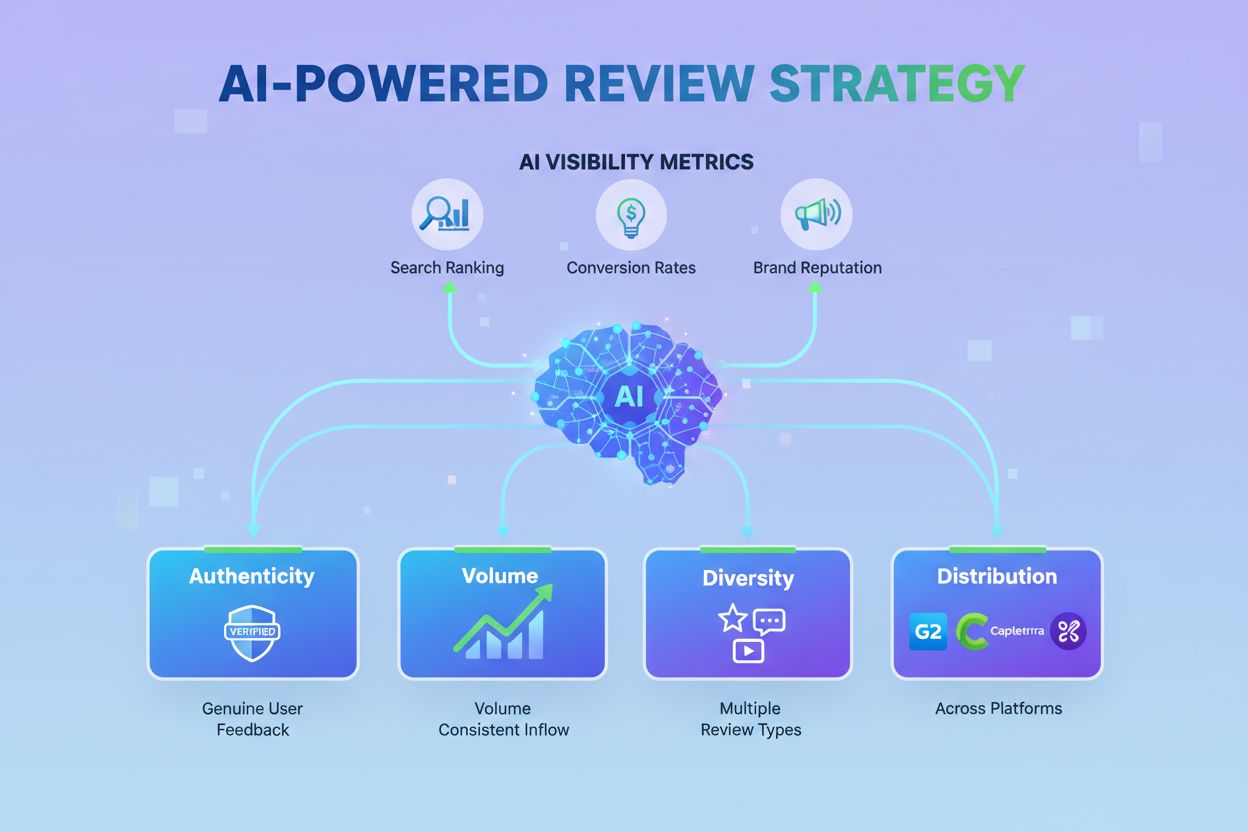
Learn how to manage reviews for maximum AI visibility. Discover the importance of authenticity, semantic diversity, and strategic distribution for LLM citations...
Cookie Consent
We use cookies to enhance your browsing experience and analyze our traffic. See our privacy policy.