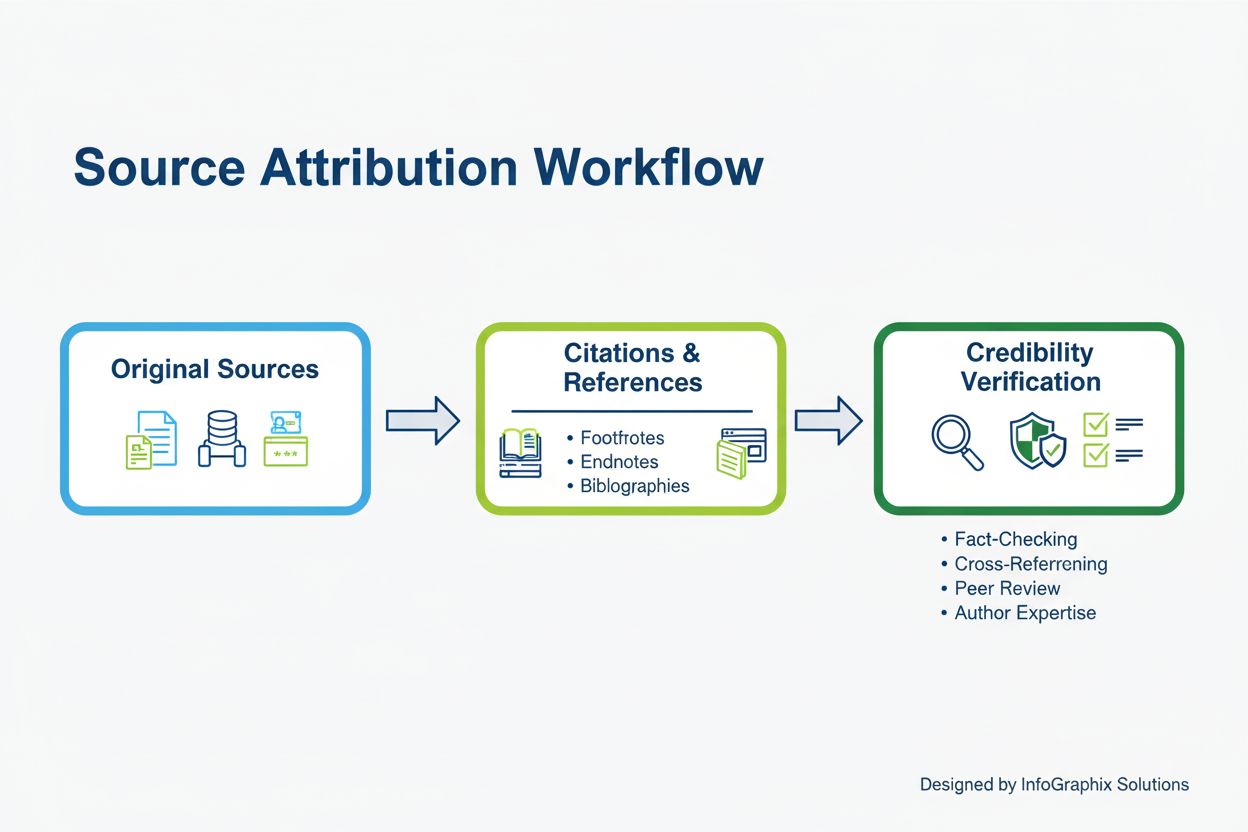
Definition of Source Attribution
Source attribution is the practice of identifying and crediting the original sources of information, ideas, data, or creative content used in published work. It represents a fundamental principle of ethical communication, intellectual honesty, and professional integrity across journalism, academia, marketing, and digital content creation. When you attribute a source, you explicitly acknowledge where facts, quotes, statistics, research findings, or concepts originated, providing readers and audiences with a transparent pathway to verify information and explore topics more deeply. In the context of modern AI-driven search environments, source attribution has evolved beyond traditional citation practices to become a critical visibility metric, determining whether brands and publishers receive recognition, traffic, and authority from AI platforms like ChatGPT, Perplexity, Google AI Overviews, and Claude. The distinction between attribution and citation is important: attribution focuses on crediting the source holder and acknowledging intellectual property, while citation follows specific formatting rules for academic or professional documentation.
Historical Context and Evolution of Source Attribution
The concept of source attribution has deep historical roots in scholarly and journalistic traditions. Academic institutions have long required proper attribution to prevent plagiarism and maintain intellectual rigor, with formal citation systems like APA, MLA, and Chicago style emerging in the 20th century to standardize attribution practices. Journalism established attribution as a cornerstone of credibility, with NPR, The New York Times, and other major news organizations developing rigorous attribution standards to build audience trust and accountability. The digital revolution transformed attribution practices significantly. As information became more accessible and shareable online, the challenge of tracing content to original sources became exponentially more complex. Content aggregation, social media sharing, and the proliferation of secondary sources created attribution challenges that traditional citation systems weren’t designed to address. According to research from the American Press Institute, approximately 68% of online content consumers value transparent sourcing and are more likely to trust brands that clearly attribute their information sources. The emergence of AI-generated content has created an entirely new dimension to source attribution, forcing platforms and content creators to reconsider how attribution works when algorithms synthesize information from multiple sources into coherent responses.
Ready to Monitor Your AI Visibility?
Track how AI chatbots mention your brand across ChatGPT, Perplexity, and other platforms.
Core Components of Effective Source Attribution
Effective source attribution requires several key elements working together to create transparency and credibility. The TASL framework (Title, Author, Source, License) provides a comprehensive approach recommended by Creative Commons and widely adopted across digital platforms. Title refers to the name of the work being cited, which helps audiences identify and locate the specific resource. Author identifies the creator or copyright holder, establishing who deserves credit and who holds intellectual property rights. Source provides the location where the work can be found, typically a URL or publication reference, enabling audiences to access original materials independently. License specifies the terms under which the work can be used, particularly important for content shared under Creative Commons or other open licenses. Beyond these core elements, effective attribution should include publication dates to establish recency and credibility, author credentials to signal expertise, and visible links to enable easy access. The format and presentation of attribution varies depending on the medium—written content uses in-text citations and reference lists, digital content benefits from hyperlinks and source panels, while multimedia requires attribution in descriptions, credits, or overlays. Research from the University of North Carolina Libraries indicates that comprehensive attribution including all TASL elements increases audience trust by approximately 45% compared to minimal attribution.
| Attribution Method | Platform Examples | Visibility | Traffic Generation | User Experience | Best For |
|---|
| Linked Citations | Perplexity, Google AI Overviews, Microsoft Copilot | High - numbered citations with URLs | Excellent - clickable links drive referral traffic | Clear and actionable | AI platforms with retrieval-augmented generation |
| Unlinked Mentions | ChatGPT (base), Claude | Medium - brand name visible but no link | None - awareness only | Conversational but limited | Training-based models without real-time search |
| Inline References | Academic papers, research reports | Medium - integrated into text | Minimal - requires manual search | Professional and formal | Scholarly and technical content |
| Source Panels | Perplexity, Google AI Mode | High - dedicated interface section | Good - organized and discoverable | Organized and scannable | Comprehensive source transparency |
| Implicit Attribution | Traditional LLMs, base ChatGPT | Low - no explicit acknowledgment | None - no direct attribution | Seamless but opaque | General knowledge synthesis |
| Footnotes/Endnotes | Traditional publishing, academic writing | Medium - requires reader navigation | None - offline or manual | Formal and detailed | Long-form written content |
Stay Updated on AI Visibility Trends
Get the latest insights on AI mentions, brand monitoring, and optimization strategies.
Technical Mechanisms of Source Attribution in AI Systems
The technical implementation of source attribution varies significantly across AI platforms based on their underlying architecture and data retrieval methods. Retrieval-augmented generation (RAG) systems like Perplexity and Google AI Overviews can provide explicit citations because they actively search the web for current information and know exactly which URLs they retrieved. These systems conduct what researchers call “query fan-out,” running multiple search queries around subtopics related to a user’s prompt, then synthesizing results into comprehensive answers while maintaining source references. The technical advantage of RAG systems is that they can track the provenance of information throughout the generation process, enabling them to cite specific sources with URLs and position information. In contrast, training-based systems like base ChatGPT and Claude rely on knowledge learned during training rather than real-time web retrieval. These models cannot cite specific sources because their knowledge synthesis obscures the original attribution—the model has internalized patterns from training data but doesn’t maintain explicit links to source documents. This architectural difference explains why some AI platforms provide rich attribution while others offer only implicit or no attribution. The emergence of ChatGPT with search and similar hybrid approaches represents an evolution toward better attribution by combining training-based models with retrieval capabilities. From a technical standpoint, implementing effective attribution requires clean HTML structure, fast page load speeds, mobile optimization, and structured data markup that helps AI systems understand and retrieve content reliably.
Business and Strategic Impact of Source Attribution
For brands, publishers, and content creators, source attribution has evolved from a compliance requirement into a strategic business asset. In traditional search environments, ranking position determined visibility—appearing on the first page of Google results meant traffic and authority. In AI-mediated search, source attribution becomes the primary visibility mechanism. When Perplexity cites your research or Google AI Overviews links to your product comparison, you receive third-party validation that influences how audiences perceive your authority and credibility. This shift has profound implications for content strategy and competitive positioning. According to Digiday’s 2025 research, approximately 78% of enterprises now track their brand mentions in AI-generated responses, recognizing that AI citation frequency correlates with brand awareness and influence. The competitive dynamics are stark: if your competitors receive citations on 60% of category-defining queries while you receive citations on only 20%, you face a significant visibility crisis. Citation tracking has become essential for understanding market positioning and identifying optimization opportunities. Beyond visibility, source attribution drives referral traffic from AI platforms, though current volumes remain modest compared to traditional search. However, as AI adoption accelerates and users increasingly rely on AI systems for information discovery, the traffic potential grows substantially. Publishers are also exploring monetization strategies around AI visibility, using citation data to demonstrate topical authority and influence when pitching partnerships or advertising opportunities to brands seeking credible placements.
Best Practices for Implementing Source Attribution
Implementing effective source attribution requires a systematic approach across content creation, publication, and monitoring processes. Content creators should establish clear sourcing practices by verifying information before publication, documenting sources during research, and maintaining detailed records of where facts and data originated. When writing, explicitly attribute claims to their sources using clear language like “According to [source],” “Research from [organization] found,” or “As reported by [publication].” For digital content, hyperlink source references to enable one-click access to original materials. Publishers should develop style guides specifying attribution requirements, train teams on proper attribution practices, and implement editorial workflows that verify attribution accuracy before publication. Technical implementation matters significantly—ensure your website has fast load speeds, mobile optimization, clean HTML structure, and structured data markup that helps AI systems discover and retrieve your content. Include publication dates, author credentials, and clear expertise signals that help AI systems assess credibility. Content structure should prioritize extractability—use clear headings, bulleted lists, comparison tables, and FAQ-style formatting that AI systems can easily parse and cite. Monitoring and optimization require tracking where your content appears in AI-generated responses, which platforms cite you, citation position and frequency, and whether citations include clickable links. Tools like AmICited enable systematic tracking of brand mentions across AI platforms, revealing patterns and optimization opportunities.
Key Aspects and Benefits of Source Attribution
- Credibility Enhancement: Proper attribution demonstrates thorough research and ethical practices, significantly increasing audience trust and brand authority
- Legal Protection: Correct attribution helps avoid copyright infringement claims, lawsuits, and financial penalties associated with intellectual property violations
- Transparency and Trust: Revealing sources allows audiences to verify information independently, building stronger relationships and fostering transparency
- Competitive Positioning: In AI environments, citation frequency and prominence determine visibility and influence relative to competitors
- Referral Traffic: Linked citations in AI platforms drive qualified traffic from users seeking authoritative sources
- Audience Value: Providing source links and references enables audiences to explore topics more deeply and access additional resources
- Relationship Building: Attributing sources demonstrates respect for other creators and professionals, strengthening collaborative opportunities
- SEO and Discoverability: Proper attribution with structured data markup improves content discoverability by search engines and AI systems
- Brand Authority: Being cited as a source by reputable platforms and AI systems establishes your organization as an authority in your field
- Ethical Compliance: Attribution aligns with ethical standards, professional codes of conduct, and increasingly, regulatory requirements around content transparency
Different AI platforms implement source attribution in distinctly different ways, creating varied visibility and traffic implications for brands. Perplexity represents the gold standard for attribution, displaying numbered citations with clickable links prominently positioned after generated responses. Users can easily access sources, and Perplexity’s interface design emphasizes source transparency. Being cited by Perplexity typically generates meaningful referral traffic and strong visibility signals. Google AI Overviews (formerly SGE) displays sources in dedicated panels below AI-generated answers, providing clear attribution with links. The positioning and prominence of citations in Google AI Overviews significantly impact click-through rates, with first-position sources receiving disproportionate traffic. ChatGPT with search provides citations but often in less prominent formats, and base ChatGPT provides no explicit attribution at all, instead synthesizing information without source acknowledgment. Claude similarly relies on training-based knowledge without real-time attribution. Microsoft Copilot offers footnote-style citations similar to Perplexity. Understanding these platform differences is critical for content strategy—optimizing for Perplexity requires different approaches than optimizing for ChatGPT. For Perplexity and Google AI Overviews, creating extractable, well-structured content with clear expertise signals increases citation probability. For training-based systems, establishing domain authority through backlinks, media coverage, and knowledge base presence influences whether your content was included in training data and how prominently it’s represented in model outputs.
Future Evolution and Strategic Outlook
Source attribution is undergoing fundamental transformation as AI systems become more sophisticated and prevalent in information discovery. The trajectory suggests several important developments. First, attribution standardization will likely emerge as industry bodies and platforms develop consistent frameworks for how AI systems should cite sources. Currently, the lack of standardization creates confusion and inconsistency—different platforms cite differently, making it difficult for organizations to optimize comprehensively. Second, attribution transparency will become increasingly important as regulators and users demand clearer understanding of how AI systems use and credit sources. The European Union’s AI Act and similar regulatory frameworks are beginning to require transparency around training data and source usage, which will drive more explicit attribution practices. Third, monetization of attribution will expand as publishers and creators develop business models around AI visibility. Rather than waiting for referral traffic to materialize, organizations will increasingly leverage citation data to demonstrate influence and negotiate partnerships, licensing deals, or advertising opportunities. Fourth, real-time attribution tracking will become standard practice, with tools like AmICited enabling organizations to monitor their brand mentions across AI platforms continuously, identify optimization opportunities, and respond to competitive threats. Fifth, attribution quality metrics will evolve beyond simple citation counting to measure citation prominence, position, link status, and traffic impact, providing more nuanced understanding of AI visibility value. Finally, content optimization for attribution will become as sophisticated as traditional SEO, with organizations developing specialized strategies to increase citation frequency and prominence across different AI platforms. The organizations that master source attribution in AI environments will gain significant competitive advantages in visibility, authority, and audience trust during this transformative period in information discovery.