
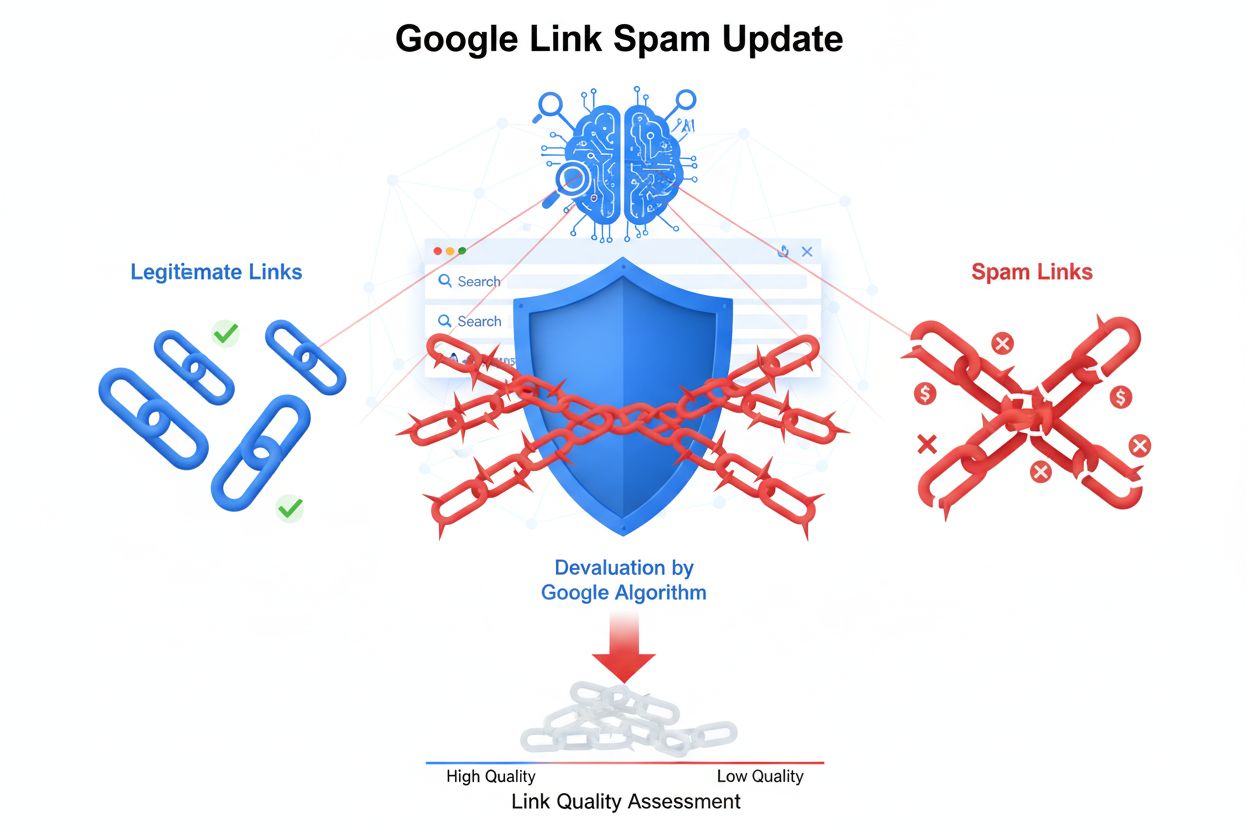
Link Spam Update
Learn about Google's Link Spam Update that devalues manipulative backlinks. Understand how SpamBrain detects link spam, impacts on SEO, and best practices for e...
9 min read

A Google Spam Update is a targeted algorithmic improvement to Google’s automated spam-detection systems designed to identify and demote low-quality, manipulative content that violates Google’s spam policies. These updates specifically target practices like expired domain abuse, scaled content abuse, and site reputation abuse to maintain search result quality.
A Google Spam Update is a targeted algorithmic improvement to Google's automated spam-detection systems designed to identify and demote low-quality, manipulative content that violates Google's spam policies. These updates specifically target practices like expired domain abuse, scaled content abuse, and site reputation abuse to maintain search result quality.
A Google Spam Update is a targeted algorithmic improvement to Google’s automated spam-detection systems designed to identify, demote, and remove low-quality, manipulative content that violates Google’s spam policies from search results. Unlike broad core updates that refine overall ranking systems, spam updates specifically target abusive practices such as expired domain abuse, scaled content abuse, and site reputation abuse. These updates represent Google’s ongoing effort to maintain search result quality by combating increasingly sophisticated spam tactics. Spam updates are announced on Google’s Search Status Dashboard and typically roll out over several days to a week, affecting sites that engage in manipulative SEO practices rather than those providing genuine value to users.
Google has been fighting search spam since its inception, but spam updates as formalized, announced improvements represent a more recent evolution in Google’s approach to quality control. Prior to 2021, Google primarily relied on continuous algorithmic refinements without specific announcements. The introduction of SpamBrain, Google’s AI-based spam-prevention system, marked a significant shift in how Google detects and combats spam at scale. In 2022, Google began formally announcing spam updates to provide transparency to webmasters and content creators about when improvements to spam detection were deployed. The March 2024 spam update represented a watershed moment, introducing three new spam policies that addressed emerging tactics Google had observed becoming increasingly prevalent. According to Google’s own data, approximately 40% of low-quality, unoriginal content was reduced in search results following the March 2024 update, demonstrating the substantial impact these targeted improvements have on search quality.
Expired domain abuse occurs when someone purchases an expired domain name and repurposes it primarily to manipulate search rankings by hosting low-quality or unoriginal content. The abuser hopes to benefit from the domain’s previous reputation and authority built over years or decades under its original owner. For example, a domain previously used by a medical authority site might be purchased and repurposed to host casino-related content, leveraging the domain’s historical trust signals. This practice is particularly deceptive because users may assume the content is related to the domain’s original purpose, creating confusion and eroding trust in search results. Expired domain abuse is not accidental—it represents a deliberate strategy to gain ranking advantages through domain history rather than content quality. Google’s enforcement of this policy has made it significantly riskier for bad actors to acquire and repurpose expired domains for spam purposes.
Scaled content abuse involves generating large quantities of pages or content primarily to manipulate search rankings rather than to provide genuine value to users. This practice has evolved significantly with the rise of AI-generated content, making it increasingly difficult to distinguish between legitimate automation and abusive scaling. The key distinction in Google’s policy is intent: content created at scale to boost rankings violates policies, whether produced through automation, human effort, or a combination of both. Scaled content abuse typically produces pages with little to no original value, often targeting popular search queries with generic, unhelpful responses. According to industry observations, this tactic has become more prevalent as AI tools have made content generation faster and cheaper. Google’s updated policy specifically addresses this evolution, allowing the company to take action on sophisticated scaled content creation methods that weren’t clearly covered by previous “automatically-generated content” policies.
Site reputation abuse occurs when third-party content is published on a trusted website without close oversight or involvement from the site owner, primarily to manipulate search rankings by exploiting the host site’s authority. Common examples include payday loan reviews on educational sites, sponsored content without clear disclosure, or affiliate content that doesn’t align with the site’s primary purpose. The critical factor is that the third-party content provides little value to the site’s regular audience and exists primarily to rank in search results. This practice is particularly insidious because it leverages the trust users and search engines have built for established sites. Google’s policy distinguishes between legitimate third-party content (like native advertising clearly labeled for readers) and abusive third-party content (like hidden affiliate links or unrelated sponsored content). The site reputation abuse policy took effect on May 5, 2024, giving site owners two months to audit and remove violating content.
| Spam Tactic | Definition | Primary Intent | Detection Method | Typical Impact |
|---|---|---|---|---|
| Expired Domain Abuse | Purchasing old domains to host low-quality content | Leverage domain history for rankings | Domain age analysis, content relevance checks | Significant ranking drops or delisting |
| Scaled Content Abuse | Mass-producing unoriginal content at scale | Manipulate rankings through volume | Content originality analysis, pattern detection | Widespread ranking losses across site |
| Site Reputation Abuse | Hosting third-party content without oversight | Exploit host site’s authority | Third-party content analysis, relevance checks | Partial or full site delisting |
| Automatically-Generated Content | Using automation to create content | Manipulate rankings through automation | Automation detection, quality assessment | Ranking penalties or removal |
| Keyword Stuffing | Excessive keyword repetition | Manipulate relevance signals | Keyword density analysis, NLP | Ranking penalties |
| Cloaking | Showing different content to search engines vs. users | Deceive search engines | User-agent detection, rendering analysis | Manual action and delisting |
Google’s spam detection systems operate on multiple levels, combining automated algorithms with machine learning and manual review. SpamBrain, the AI-based system at the core of spam detection, analyzes hundreds of signals to identify manipulative patterns. These signals include domain history and reputation, content originality and uniqueness, page-level quality metrics, user engagement patterns, and link profile analysis. The system learns continuously from new spam tactics, allowing it to adapt to emerging threats. When Google releases a spam update, it typically represents an improvement to one or more of these detection mechanisms. For instance, the March 2024 update enhanced Google’s ability to identify scaled content abuse by improving pattern recognition for mass-produced pages. The rollout period for spam updates typically lasts 7-30 days, during which the improved detection systems are gradually deployed across Google’s infrastructure. This phased approach allows Google to monitor for false positives and ensure the update functions as intended before full deployment.
Spam updates can have dramatic effects on website rankings, ranging from modest drops to complete delisting from search results. Sites that have engaged in expired domain abuse often experience immediate and severe ranking losses once the update identifies the manipulative practice. Scaled content abuse typically results in widespread ranking drops across affected pages, as Google’s systems identify and demote the low-quality content. Site reputation abuse may result in partial delisting, where only the offending third-party content is removed from rankings, or full site penalties if the abuse is extensive. According to Google’s own reporting, the March 2024 update reduced low-quality, unoriginal content in search results by 45%, demonstrating the substantial impact on the search landscape. For compliant sites, spam updates often result in ranking improvements as competing spam content is demoted. The volatility during and immediately after a spam update can be significant, with some sites experiencing fluctuations for several weeks as the algorithm fully stabilizes.
Sites affected by spam updates have several options for recovery. First, they should thoroughly audit their content against Google’s spam policies to identify violations. For expired domain abuse, the solution is straightforward: either redirect the domain to relevant content or abandon the manipulative strategy. For scaled content abuse, sites must reduce the volume of low-quality content and focus on creating original, valuable pages. For site reputation abuse, sites should either remove third-party content entirely or ensure it’s clearly labeled and closely overseen by the host site. After making corrections, sites should monitor their Search Console for manual actions or continued ranking issues. If a manual spam action is applied, site owners can submit a reconsideration request after making corrections. Recovery typically takes weeks to months, as Google’s systems need time to re-evaluate the site and determine that violations have been addressed. Importantly, if a site benefited from spam tactics (such as ranking boosts from spammy links), those ranking benefits cannot be regained even after corrections are made.
Google released three confirmed spam updates in 2024, representing a significant increase in spam-fighting activity. The March 2024 spam update introduced the three new spam policies and rolled out over approximately one month, completing on April 26, 2024. The June 2024 spam update began on June 20, 2024, and completed by June 27, 2024, representing a more typical one-week rollout period. The December 2024 spam update began on December 19, 2024, and completed on December 26, 2024, occurring just one day after the December core update completed. This frequency demonstrates Google’s commitment to combating spam as an ongoing priority. The timing of these updates varies, with some released during peak business periods and others during holiday seasons, suggesting Google prioritizes spam fighting regardless of external factors. Industry observers note that the increased frequency of spam updates reflects the growing sophistication and scale of spam tactics, particularly those leveraging AI-generated content.
While spam updates and core updates are distinct, they often work in concert to improve search quality. Core updates refine Google’s overall ranking systems to surface more helpful, relevant content, while spam updates specifically target and remove manipulative content. In 2024, Google released four core updates and three spam updates, demonstrating that both types of improvements are necessary for maintaining search quality. The March 2024 core update was particularly complex, involving changes to multiple core ranking systems alongside the introduction of new spam policies. Some observers note that spam updates may have a more immediate and visible impact on rankings than core updates, as they specifically target known violations rather than adjusting ranking factors across all content. However, the cumulative effect of both types of updates is substantial: the combination of the March 2024 core update and spam policies reduced low-quality content by 45% according to Google’s own measurements.
The future of spam updates will likely focus increasingly on AI-generated content and sophisticated automation tactics. As AI tools become more accessible and capable, Google’s spam detection systems must evolve to distinguish between helpful AI-generated content and manipulative spam. Google has indicated that its stance on AI content remains consistent: automation used to manipulate rankings is spam, while AI used to create genuinely helpful content is acceptable. Emerging spam tactics that may become targets for future spam updates include deepfakes in search results, coordinated inauthentic behavior across multiple sites, and increasingly sophisticated scaled content abuse using advanced language models. The introduction of Google AI Overviews and other AI-powered search features may also create new spam opportunities and require new detection methods. Industry experts predict that spam updates will become more frequent and more sophisticated as spam tactics evolve. Additionally, Google may expand its spam policies to address emerging practices not yet formally codified, similar to how the March 2024 update introduced three new policies addressing tactics that had become prevalent but weren’t explicitly covered by previous policies.
Webmasters and SEO professionals can track spam updates through several official channels. Google’s Search Status Dashboard provides real-time information about when spam updates begin and complete, along with brief descriptions of the update’s focus. Google Search Central Blog publishes detailed announcements about significant spam updates, explaining the new policies and providing guidance for affected sites. Search Console notifies site owners of manual spam actions and provides specific information about violations. Industry publications and SEO news sites also track and analyze spam updates, providing context and case studies about their impact. For organizations like AmICited that monitor brand mentions across AI search platforms, spam updates are particularly relevant because they affect which content appears in AI-generated responses. As AI search systems increasingly rely on Google’s index and ranking signals, spam updates indirectly influence what content AI systems cite and recommend to users.
Core Updates improve Google's overall ranking systems to surface more helpful content, while Spam Updates specifically target and demote content that violates Google's spam policies. Core Updates affect broad ranking factors across all content types, whereas Spam Updates focus on removing manipulative practices. Both can impact rankings, but Spam Updates are more targeted toward specific abusive tactics rather than general content quality improvements.
Google releases Spam Updates periodically throughout the year, typically several times annually. In 2024, Google released three confirmed Spam Updates (March, June, and December), in addition to four Core Updates. The frequency varies based on Google's detection of emerging spam tactics and the need to combat new manipulative practices in search results.
The March 2024 Spam Update introduced three new spam policies: Expired Domain Abuse (purchasing old domains to rank low-quality content), Scaled Content Abuse (generating large amounts of unoriginal content to manipulate rankings), and Site Reputation Abuse (hosting third-party content without oversight to exploit a site's authority). These policies address sophisticated spam tactics that had become increasingly prevalent in search results.
Yes, according to Google's spam policies, using automation including generative AI to create content primarily for manipulating search rankings is considered spam. However, AI-generated content itself is not inherently spam if it provides genuine value to users. The key distinction is the intent: content created to help people is acceptable, while content created at scale specifically to boost rankings violates Google's policies.
If your site experiences ranking drops after a Spam Update, review Google's spam policies to identify any violations. Common issues include expired domain abuse, scaled content creation, or hosting third-party content without proper oversight. Make necessary corrections to comply with policies, then monitor your Search Console for manual actions. If you receive a manual spam action, you can submit a reconsideration request after making corrections.
Google uses SpamBrain, an AI-based spam-prevention system, combined with automated detection systems and manual review to identify spam. Spam Updates improve these systems' ability to spot new types of spam and manipulative practices. Google analyzes factors like content originality, domain history, content scale, third-party involvement, and user intent to determine if content violates spam policies.
Spam Updates can cause significant ranking drops for sites violating spam policies, potentially removing them from search results entirely. Sites that comply with Google's spam policies typically see no negative impact. In some cases, compliant sites may see ranking improvements as spam content is demoted. The impact varies based on how extensively a site engaged in spam tactics and how quickly violations are corrected.
Start tracking how AI chatbots mention your brand across ChatGPT, Perplexity, and other platforms. Get actionable insights to improve your AI presence.
Learn about Google's Link Spam Update that devalues manipulative backlinks. Understand how SpamBrain detects link spam, impacts on SEO, and best practices for e...

Learn what Google Algorithm Updates are, how they work, and their impact on SEO. Understand core updates, spam updates, and ranking changes.

Learn about Google's Helpful Content Update: an algorithm system rewarding people-first content while demoting search-engine-first material. Understand E-E-A-T,...
Cookie Consent
We use cookies to enhance your browsing experience and analyze our traffic. See our privacy policy.