
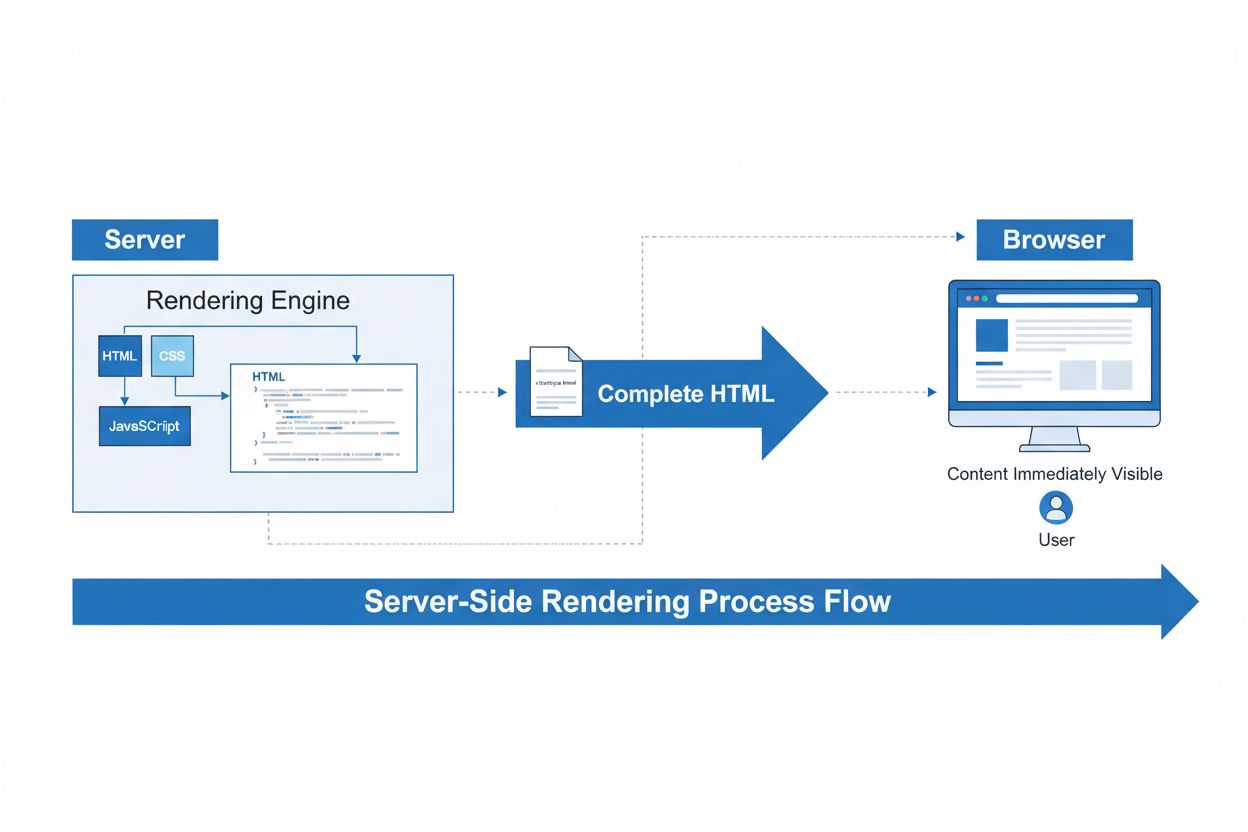
Server-Side Rendering (SSR)
Server-Side Rendering (SSR) is a web technique where servers render complete HTML pages before sending them to browsers. Learn how SSR improves SEO, page speed,...
11 min read
Static Site Generation (SSG) is a web development approach that pre-builds HTML pages at compile time rather than generating them on-demand for each user request. This method significantly improves website performance, security, and scalability by serving pre-rendered static files from a CDN or web server.
Static Site Generation (SSG) is a web development approach that pre-builds HTML pages at compile time rather than generating them on-demand for each user request. This method significantly improves website performance, security, and scalability by serving pre-rendered static files from a CDN or web server.
Static Site Generation (SSG) is a web development methodology that pre-builds complete HTML pages at compile time, before deployment to production servers. Unlike traditional dynamic websites that generate pages on-demand for each user request, SSG creates all website pages during the build process and stores them as static files ready for immediate delivery. This fundamental architectural difference transforms how websites are built, deployed, and served, resulting in dramatically improved performance, enhanced security, and reduced infrastructure costs. The static files generated by SSG consist of HTML, CSS, and JavaScript that require no server-side processing, making them ideal for content-driven websites, documentation, blogs, and marketing sites where content doesn’t change in real-time.
The concept of static websites predates the modern web, but Static Site Generation as a formalized development approach emerged in the early 2010s as developers sought alternatives to resource-intensive database-driven systems. Early tools like Jekyll, released by GitHub in 2008, pioneered the modern SSG movement by demonstrating that pre-built static sites could be both practical and powerful. The rise of JAMstack architecture in the mid-2010s—emphasizing JavaScript, APIs, and Markup—legitimized SSG as a core component of modern web development. According to a Netlify report, the adoption of SSG tools has increased by over 40% in recent years, reflecting growing recognition of their effectiveness. Today, major frameworks like Next.js, Gatsby, and Hugo have evolved SSG capabilities to support hybrid rendering strategies, combining static generation with dynamic features through Incremental Static Regeneration (ISR) and API integration. This evolution demonstrates that SSG is not a regression to outdated technology but rather a sophisticated, modern approach to web architecture that addresses contemporary performance and security demands.
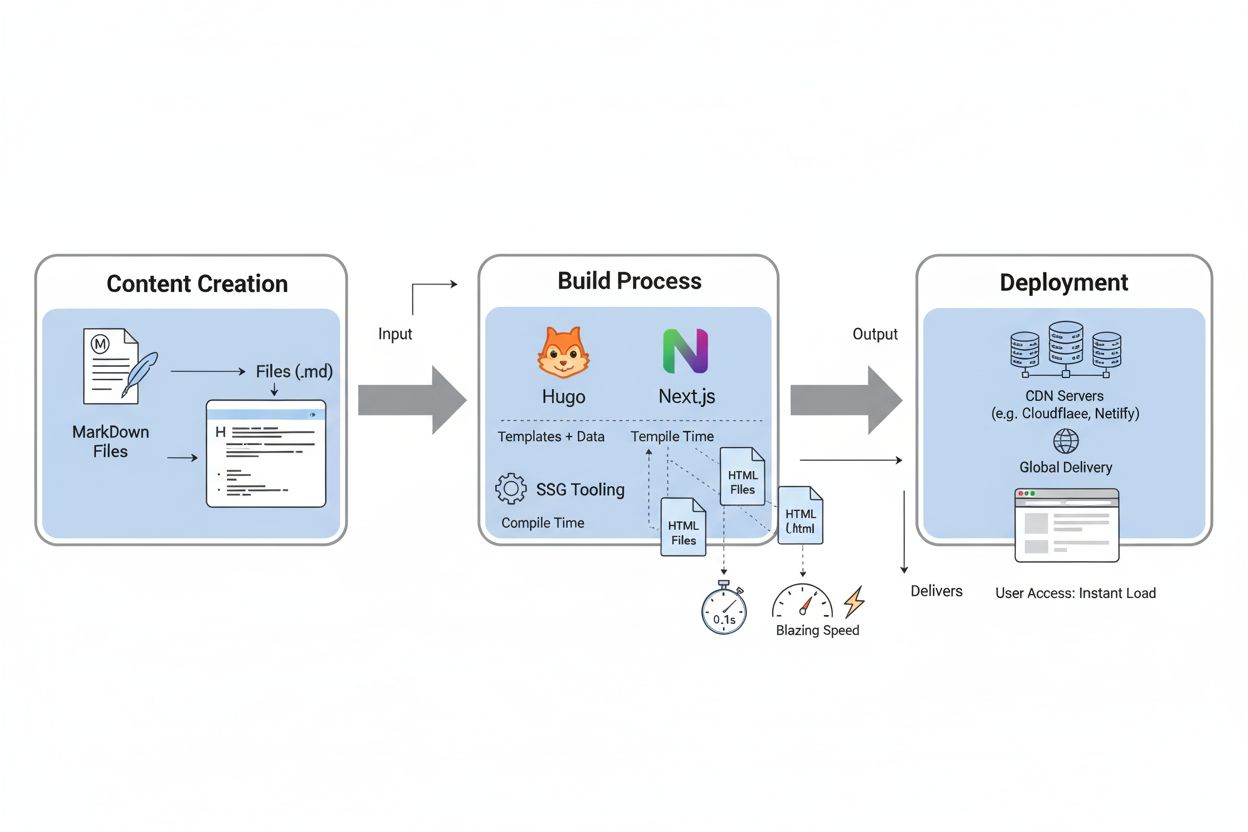
Static Site Generation operates through a three-stage workflow: content creation, build processing, and deployment. In the first stage, developers and content creators write content using simple, version-control-friendly formats like Markdown, JSON, or YAML, which are easier to manage than database entries. These content files are organized alongside template files that define how content should be displayed, including headers, footers, layouts, and styling. During the build process, the Static Site Generator tool (such as Hugo, Next.js, or Gatsby) reads all content files and templates, processes them through its compilation engine, and generates a complete set of pre-rendered HTML files. This compilation happens once, at build time, rather than repeatedly for each user request. The generator also processes CSS and JavaScript assets, optimizing them for production. Finally, these static files are deployed to a web server or Content Delivery Network (CDN), where they remain unchanged until the next build cycle. When users visit the website, they receive these pre-built HTML files instantly, with no server-side processing required. This architecture eliminates the traditional request-response cycle where servers must query databases, execute code, and render pages dynamically for each visitor.
The performance improvements delivered by Static Site Generation are among its most compelling advantages. Static sites load up to 10 times faster than dynamically generated pages because pre-built HTML files require no server-side processing, database queries, or rendering overhead. When a user requests a page, the server simply retrieves and serves the pre-built file, resulting in minimal latency. This speed advantage is amplified when static files are served through a Content Delivery Network (CDN), which caches copies of your site across geographically distributed servers worldwide. Users receive content from the server closest to their location, dramatically reducing network latency. Research shows that page load speed is a critical SEO ranking factor, with Google confirming that Core Web Vitals—including Largest Contentful Paint (LCP) and First Input Delay (FID)—directly impact search rankings. SSG sites naturally excel in these metrics because static files are inherently fast. Additionally, static sites reduce server load since no computation is required per request, allowing a single server to handle significantly more traffic than a dynamic site. This efficiency translates to lower hosting costs and better scalability. For users, faster load times improve engagement, reduce bounce rates, and enhance overall user experience—factors that correlate with higher conversion rates and better business outcomes.
| Aspect | Static Site Generation (SSG) | Dynamic Site Generation (DSG) | Server-Side Rendering (SSR) |
|---|---|---|---|
| Page Generation Timing | At build time, before deployment | On-demand for each request | On each user request |
| Performance | Extremely fast (10x faster) | Moderate, depends on server | Moderate, server-dependent |
| Server Load | Minimal, no processing required | High, database queries needed | High, rendering required |
| SEO Friendliness | Excellent, all HTML pre-rendered | Good, but slower crawling | Good, HTML available on load |
| Content Updates | Requires full rebuild and redeploy | Real-time updates possible | Real-time updates possible |
| Hosting Costs | Very low, CDN-friendly | Moderate to high | Moderate to high |
| Security | Excellent, no database exposure | Moderate, database vulnerable | Moderate, server-side code exposed |
| Best For | Blogs, docs, landing pages | E-commerce, real-time content | Dynamic dashboards, personalization |
| Scalability | Excellent, CDN-distributed | Limited by server capacity | Limited by server capacity |
| Build Time | Can be long for large sites | Instant per request | Instant per request |
Static Site Generation architecture fundamentally differs from traditional web application design by separating content from presentation at build time. The SSG build pipeline typically begins with a source directory containing content files, templates, and configuration. The generator reads these inputs, applies template rendering logic to combine content with layouts, processes asset optimization (minifying CSS and JavaScript), and outputs a complete public or dist directory containing all generated HTML files. Modern SSG tools like Next.js implement Incremental Static Regeneration (ISR), allowing developers to specify revalidation intervals for specific pages, enabling selective updates without full site rebuilds. This hybrid approach combines SSG’s performance benefits with dynamic content capabilities. Hugo, known for exceptional build speed, can generate thousands of pages in seconds due to its Go-based architecture and efficient templating engine. Gatsby leverages GraphQL to query content from various sources—headless CMSs, APIs, databases—and generates optimized React-based static sites. The deployment process for SSG sites is straightforward: simply upload the generated static files to a web server or CDN. This simplicity eliminates complex deployment pipelines, reducing deployment errors and enabling rapid iteration. Many developers use Git-based deployment workflows where pushing code to a repository automatically triggers builds and deployments through services like Netlify or Vercel, creating seamless continuous integration pipelines.
Static Site Generation provides superior security compared to dynamic websites by eliminating entire classes of vulnerabilities. Traditional dynamic sites expose server-side code, databases, and backend infrastructure to potential attacks, creating multiple attack vectors. SSG sites, consisting only of static HTML, CSS, and JavaScript files, have no backend server logic to exploit, no databases to breach, and no server-side code vulnerabilities. This dramatically reduces the attack surface. Common web vulnerabilities like SQL injection, cross-site scripting (XSS) from server-side code, and remote code execution are impossible in pure static sites because there’s no server-side processing. Additionally, static files can be served through CDNs with built-in DDoS protection, adding another security layer. Content delivered through CDNs benefits from global traffic filtering, rate limiting, and bot detection capabilities. For sites handling sensitive information or conducting transactions, SSG can be combined with serverless functions for specific dynamic operations, allowing developers to implement security best practices for only the components that require them. This targeted approach to dynamic functionality reduces the overall security footprint compared to fully dynamic sites. Organizations increasingly recognize that SSG’s security benefits make it ideal for public-facing content, documentation, and marketing sites where security is paramount.
Static Site Generation integrates seamlessly with headless CMS platforms, enabling non-technical content editors to manage website content without touching code. A headless CMS like Sanity, Contentful, Strapi, or Prismic provides a user-friendly interface for content creation and editing while exposing content through APIs. The SSG build process fetches content from these APIs, combines it with templates, and generates static pages. This architecture offers the best of both worlds: content editors enjoy familiar CMS interfaces, while developers benefit from SSG’s performance and security. When editors publish content, webhooks trigger automatic site rebuilds, ensuring published changes appear on the live site within minutes. This workflow eliminates the need for technical knowledge from content teams while maintaining the performance advantages of static generation. Git-based CMS solutions like Netlify CMS or Forestry provide another approach, storing content as files in Git repositories alongside code. This method appeals to development-focused teams comfortable with version control. The flexibility of SSG’s content integration means organizations can choose the content management approach that best fits their team’s workflow and technical expertise, whether that’s a traditional CMS interface, API-driven headless systems, or Git-based workflows.
Different Static Site Generator tools serve different use cases and technical preferences. Hugo, written in Go, is renowned for exceptional build speed, making it ideal for sites with thousands of pages. Its simple configuration and powerful templating make it popular for documentation and blogs. Next.js, built on React, appeals to JavaScript-focused teams and offers the most flexibility through its hybrid rendering capabilities, supporting SSG, SSR, and ISR within the same application. Gatsby provides a rich plugin ecosystem and GraphQL-based content querying, making it excellent for complex content sources and teams comfortable with React. Jekyll, the original modern SSG, remains popular for GitHub Pages integration and simple blogs. Astro represents a newer generation of SSG tools, emphasizing minimal JavaScript and component-based architecture. Eleventy (11ty) offers flexibility with multiple templating languages and minimal configuration overhead. The choice between these tools depends on team expertise, project complexity, content sources, and performance requirements. Organizations should evaluate tools based on build speed, plugin ecosystems, template language support, and community resources. Many teams find that Next.js and Hugo dominate enterprise adoption due to their maturity, performance, and extensive documentation.
The future of Static Site Generation is characterized by increasing sophistication and broader adoption across diverse use cases. Incremental Static Regeneration (ISR) represents a significant evolution, allowing selective page updates without full site rebuilds, addressing one of SSG’s traditional limitations. Edge computing is emerging as a complementary technology, enabling computation closer to users while maintaining static site benefits. Platforms like Vercel and Netlify are investing heavily in edge functions and middleware, allowing developers to add dynamic capabilities at the edge without traditional server infrastructure. AI-assisted content generation is beginning to integrate with SSG workflows, enabling automated content creation and optimization. The rise of hybrid rendering strategies means future SSG tools will increasingly blur lines between static and dynamic, allowing developers to choose the optimal rendering method per page or component. Performance monitoring and analytics are becoming more sophisticated, with tools providing detailed insights into build times, page performance, and user experience metrics. As web performance becomes increasingly critical for SEO and user satisfaction, SSG adoption will likely accelerate. Organizations are recognizing that SSG isn’t just for simple blogs but can power complex applications through strategic API integration and edge computing. The convergence of SSG with headless CMS, edge computing, and AI suggests that static site generation will remain central to modern web architecture for years to come, evolving to meet increasingly sophisticated requirements while maintaining its core performance and security advantages.
Static Site Generation (SSG) generates HTML pages at build time before deployment, while Server-Side Rendering (SSR) generates pages dynamically on each user request. SSG offers faster load times and better SEO since all content is pre-rendered, whereas SSR is better for highly dynamic content that changes frequently. Both are pre-rendered for SEO benefits, but SSG provides superior performance for static content.
SSG improves performance by pre-building all HTML pages during the build process, eliminating the need for server-side processing on each request. Pre-built pages load up to 10 times faster than dynamically generated pages because they're served as simple static files. These files can be cached globally through CDNs, delivering content from servers closest to users, resulting in dramatically reduced latency and faster page load times.
SSG is ideal for blogs, documentation sites, landing pages, portfolios, marketing websites, and knowledge bases where content doesn't change frequently. It's perfect for content-driven websites that prioritize performance and SEO. However, SSG is not suitable for real-time applications like dashboards, social media feeds, or e-commerce sites requiring constant inventory updates and personalized user experiences.
The most popular SSG tools include Hugo (known for speed), Next.js (React-based with flexibility), Gatsby (GraphQL-powered), Jekyll (Ruby-based), Astro (modern framework), and Eleventy (11ty). Each tool offers different strengths: Hugo excels in build speed, Next.js provides hybrid rendering options, and Gatsby offers rich plugin ecosystems. The choice depends on your tech stack, project requirements, and team expertise.
Yes, SSG can support dynamic features through APIs, JavaScript, and third-party services. While the HTML is static, you can add interactivity using client-side JavaScript, fetch data from APIs, or integrate serverless functions. Many modern SSG frameworks like Next.js support Incremental Static Regeneration (ISR), allowing selective page updates without rebuilding the entire site, combining static benefits with dynamic capabilities.
SSG significantly improves SEO because all HTML content is pre-rendered and immediately available to search engine crawlers on page load. This eliminates the need for JavaScript rendering, ensuring search engines can easily index content. Additionally, SSG sites load faster, which is a critical ranking factor. Pre-built pages also enable better structured data implementation and meta tag optimization, contributing to improved search visibility.
SSG limitations include longer build times for large sites with thousands of pages, inability to serve real-time personalized content, and the need for full site rebuilds when content changes. Non-technical users may struggle with deployment workflows, and complex dynamic features require additional API integrations. However, modern solutions like Incremental Static Regeneration and headless CMS integration are addressing many of these limitations.
Start tracking how AI chatbots mention your brand across ChatGPT, Perplexity, and other platforms. Get actionable insights to improve your AI presence.
Server-Side Rendering (SSR) is a web technique where servers render complete HTML pages before sending them to browsers. Learn how SSR improves SEO, page speed,...
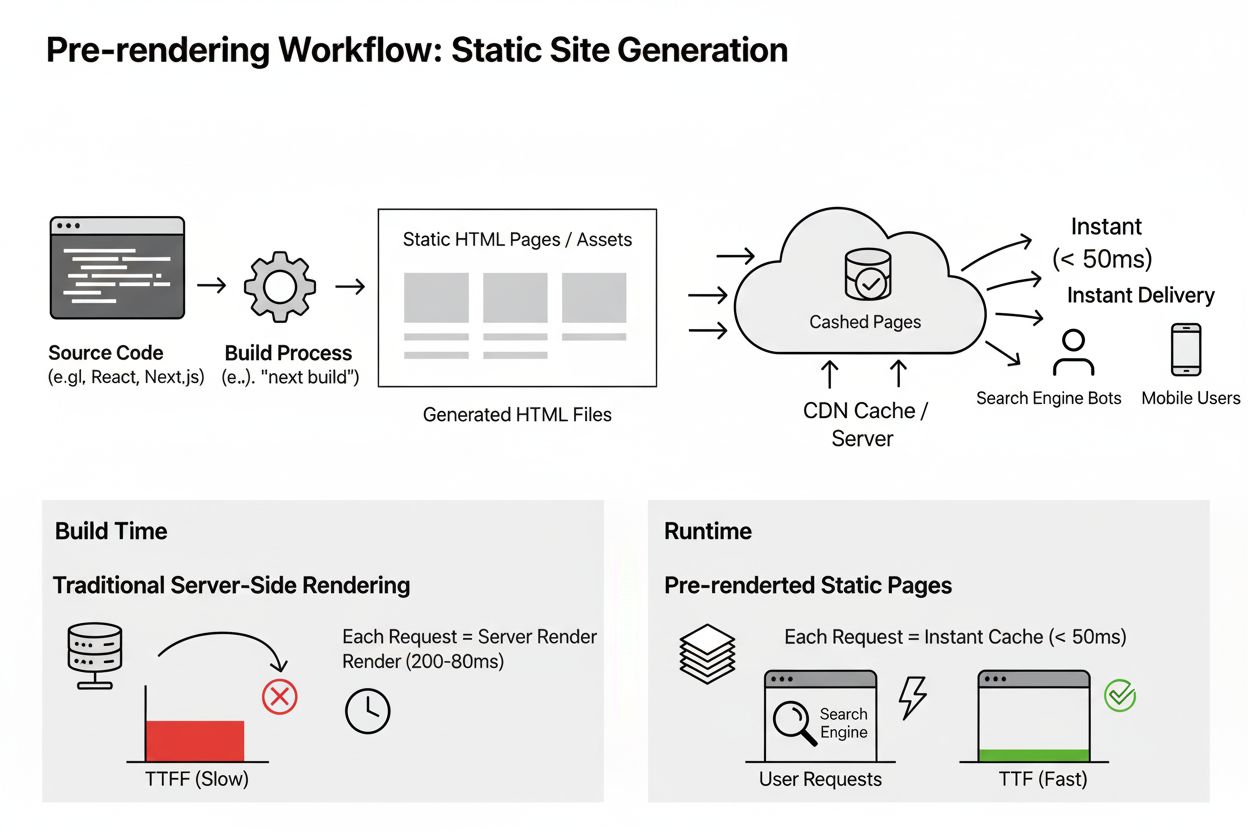
Pre-rendering generates static HTML pages at build time for instant delivery and improved SEO. Learn how this technique benefits AI indexing, performance, and s...
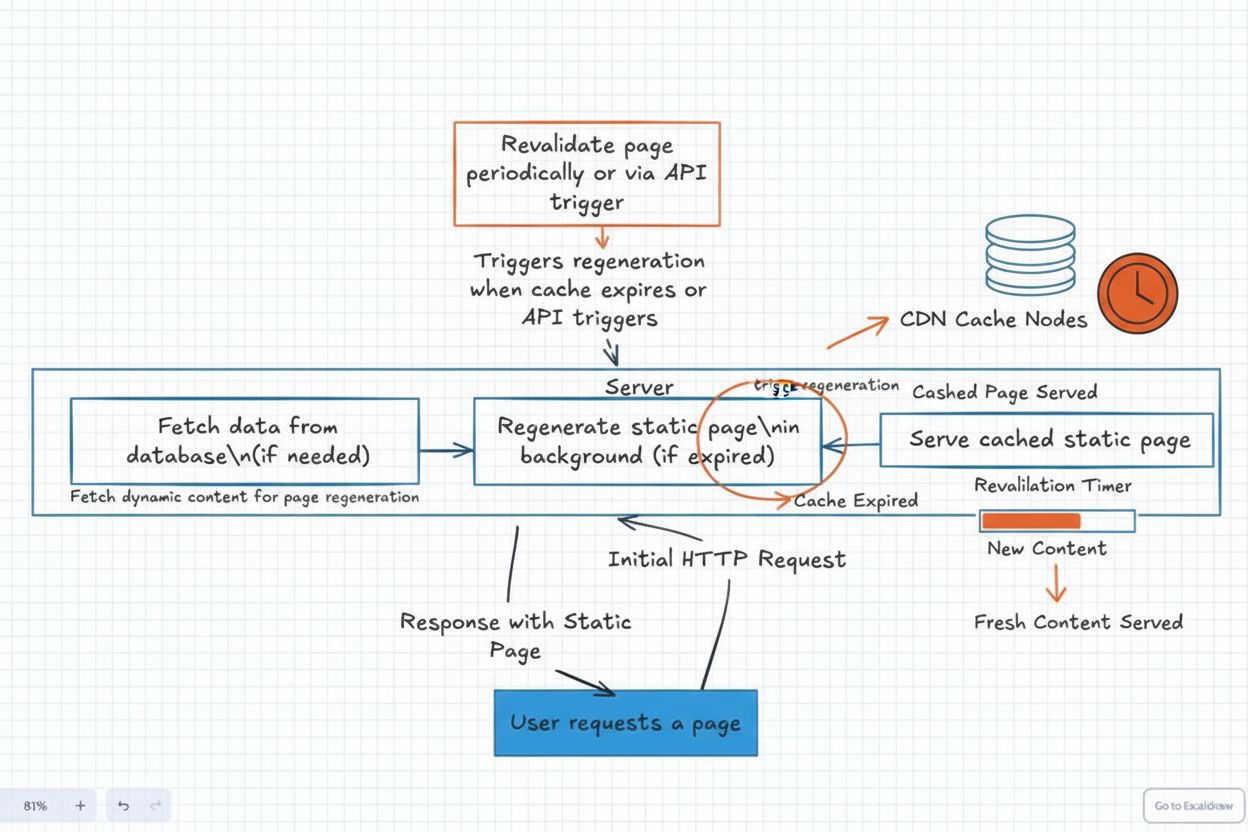
Learn what Incremental Static Regeneration (ISR) is, how it works, and why it's essential for modern web applications. Discover ISR's role in AI monitoring and ...
Cookie Consent
We use cookies to enhance your browsing experience and analyze our traffic. See our privacy policy.