


Schema Markup
Schema markup is standardized code that helps search engines understand content. Learn how structured data improves SEO, enables rich results, and supports AI s...
9 min read
Structured data is organized information formatted using standardized schemas (like JSON-LD, Microdata, or RDFa) that helps search engines and AI systems understand page content, enabling rich results and improved visibility in search and generative AI responses.
Structured data is organized information formatted using standardized schemas (like JSON-LD, Microdata, or RDFa) that helps search engines and AI systems understand page content, enabling rich results and improved visibility in search and generative AI responses.
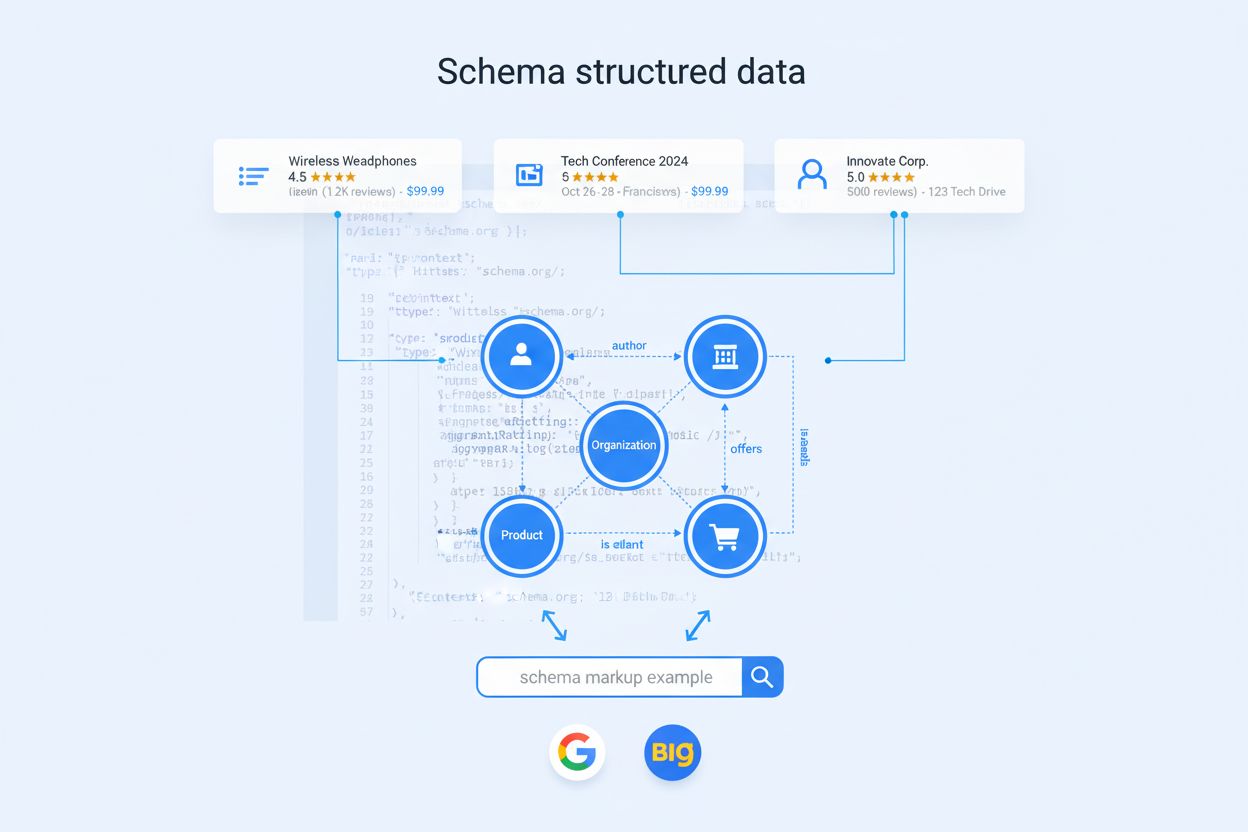
Structured data is a standardized format for organizing and presenting information on web pages in a way that search engines and artificial intelligence systems can easily understand and process. Unlike regular HTML content that humans read intuitively, structured data uses predefined schemas and vocabularies—most commonly from Schema.org—to explicitly label and categorize page elements. This markup tells search engines exactly what information appears on a page, whether it’s a recipe’s ingredients and cooking time, a product’s price and availability, an article’s author and publication date, or an event’s location and ticket information. By implementing structured data, website owners essentially provide search engines and AI systems with a machine-readable translation of their content, enabling these systems to understand context, relationships, and meaning without having to analyze and interpret raw text. This clarity becomes increasingly critical as search evolves from keyword matching toward semantic understanding and as AI-powered search engines become more prevalent in determining online visibility.
The concept of structured data for web content emerged from the need to standardize how information is presented across the internet. In 2011, Google, Bing, Yahoo!, and Yandex collaborated to create Schema.org, a shared vocabulary project that would provide a common language for marking up web content. This initiative addressed a fundamental challenge: search engines were spending enormous computational resources trying to understand what web pages were actually about, often making mistakes or missing important details. The original Schema.org vocabulary launched with 297 content types, but has since expanded to over 811 classes and thousands of properties, reflecting the growing complexity of web content and the increasing sophistication of search algorithms. The introduction of JSON-LD (JavaScript Object Notation for Linked Data) as a recommended format in 2014 significantly simplified implementation, allowing developers to add structured data without interleaving it with HTML content. According to 2024 data, RDFa maintains 66% presence across websites, JSON-LD reaches 41% adoption (growing 7% year-over-year), and Open Graph implementation stands at 64% (+5% YoY). This evolution reflects the industry’s recognition that structured data is no longer optional but essential for competitive visibility in both traditional search and emerging AI-powered search platforms.

Track how AI chatbots mention your brand across ChatGPT, Perplexity, and other platforms.
Structured data can be implemented using three primary formats, each with distinct advantages and use cases. JSON-LD (JavaScript Object Notation for Linked Data) is Google’s recommended format and has become the industry standard because it separates markup from HTML content, making it easier to maintain and less prone to errors. JSON-LD can be placed in either the <head> or <body> section of an HTML page and can be dynamically injected via JavaScript, which is particularly valuable for content management systems that don’t allow direct HTML editing. Microdata is an open-community HTML specification that nests structured data within HTML content using tag attributes, typically appearing in the <body> element. RDFa (Resource Description Framework in Attributes) is an HTML5 extension that introduces HTML tag attributes corresponding to user-visible content, commonly used in both <head> and <body> sections. While all three formats are equally valid for Google, JSON-LD has emerged as the preferred choice for most implementations because it’s the easiest to implement and maintain at scale, particularly for large websites with complex content structures. The choice of format often depends on your website’s technical setup, CMS capabilities, and development resources, but the underlying principle remains constant: providing explicit, machine-readable context about your content.
| Aspect | JSON-LD | Microdata | RDFa | Open Graph |
|---|---|---|---|---|
| Implementation Method | Separate <script> tag | HTML tag attributes | HTML tag attributes | Meta tags in <head> |
| Placement | Head or body | Body element | Head or body | Head only |
| Google Recommendation | ✓ Preferred | Supported | Supported | Not for search |
| Dynamic Injection | ✓ Yes | No | No | No |
| Ease of Maintenance | ✓ High | Medium | Medium | High |
| 2024 Adoption Rate | 41% (+7% YoY) | Included in RDFa | 66% (+3% YoY) | 64% (+5% YoY) |
| Primary Use Case | Search engines & AI | Search engines | Search engines | Social media |
| CMS Compatibility | ✓ Excellent | Good | Good | Excellent |
| Error Resistance | ✓ High | Medium | Medium | High |
| Rich Results Support | ✓ Full | Full | Full | Limited |
Get the latest insights on AI mentions, brand monitoring, and optimization strategies.
Search engines employ sophisticated crawling and indexing processes to extract and utilize structured data from web pages. When Googlebot or other search engine crawlers visit a page, they parse both the visible HTML content and any embedded structured data markup. The crawler identifies the schema type (such as Recipe, Product, or Article) and extracts the relevant properties defined in the markup. This information is then processed through Google’s understanding systems, which use structured data to build knowledge graphs—interconnected databases of entities and their relationships. For example, when a recipe page includes JSON-LD markup specifying ingredients, cooking time, and nutritional information, Google’s systems can immediately understand these elements without having to analyze the page’s text content. This explicit labeling saves computational resources and enables Google to display rich results—enhanced search listings that show additional information like star ratings, cooking time, or product prices directly in search results. The process becomes even more critical with AI-powered search systems like Google’s AI Overviews and third-party platforms like Perplexity and ChatGPT. These systems rely on structured data to understand content context and determine whether to include a source in their generated answers. Research indicates that over 72% of websites on Google’s first page use schema markup, and sites implementing structured data see 25-82% higher click-through rates in rich results compared to standard listings.
Structured data directly enables rich results—enhanced search listings that display additional information beyond the standard title, URL, and meta description. When properly implemented, structured data can trigger various rich result features including recipe cards showing cooking time and ratings, product snippets displaying prices and availability, event listings with dates and locations, and FAQ sections with direct answers. These rich results typically appear above traditional text results in search engine results pages (SERPs), often in carousel or featured position formats. Case studies demonstrate the tangible impact: Rotten Tomatoes added structured data to 100,000 unique pages and measured a 25% higher click-through rate for pages enhanced with structured data compared to pages without it. The Food Network converted 80% of their pages to enable search features and saw a 35% increase in visits. Nestlé measured that pages showing as rich results in search have an 82% higher click-through rate than non-rich result pages. These improvements occur because rich results are more visually prominent, provide more relevant information upfront, and are more mobile-friendly than standard listings. However, it’s important to note that Google does not guarantee rich results for all structured data implementations—the search engine must determine that the markup is valid, accurate, and relevant to the search query before displaying enhanced results.
The emergence of AI-powered search engines has fundamentally changed the importance of structured data in digital visibility strategy. Platforms like ChatGPT, Perplexity, Google’s AI Overviews, and Claude rely on structured data to understand content context and determine which sources to cite in their generated answers. Unlike traditional keyword-based search, AI systems prioritize semantic understanding and source credibility, making clear, well-organized structured data a critical signal. Research shows that search-enabled LLM models like Google’s Gemini use search results to ground their responses, meaning that structured data markup that influences rankings on Google and Bing can indirectly impact visibility in AI-powered search tools. When comparing search results across platforms for the same query, studies reveal significant overlap between Google’s rich results and sources cited by AI search engines—suggesting that structured data optimization for traditional search also benefits AI visibility. Additionally, structured data helps AI systems build knowledge graphs that connect entities and relationships across your site and the wider web. This semantic organization is essential for AI systems to accurately understand your content’s meaning and context, particularly important as AI search shifts from keyword matching toward intent-based, context-aware responses. Organizations implementing structured data across their sites are essentially future-proofing their visibility for both current and emerging search paradigms.
Effective structured data implementation requires attention to several critical best practices that ensure maximum benefit and avoid potential penalties. First, use the most specific schema type applicable to your content—for example, use “Recipe” rather than the broader “HowTo” for cooking instructions, as specificity helps search engines and AI systems properly categorize and display your content. Second, ensure accuracy and completeness—only mark up information that is actually visible to users on the page, and provide all required properties for your chosen schema type; incomplete or inaccurate markup can trigger warnings or prevent rich results. Third, validate your implementation using Google’s Rich Results Test tool before and after deployment to identify errors and ensure compliance with current requirements. Fourth, implement structured data consistently across all similar pages on your site rather than just a select few; this signals to search engines that the markup is intentional and systematic. Fifth, avoid overuse or irrelevant markup—applying schema types that don’t match your content or marking up invisible information can trigger manual penalties. Sixth, keep your markup updated as schema requirements evolve; Google regularly updates its documentation and may add new required or recommended properties. Finally, consider your content structure—organize your page with clear heading hierarchies (H1, H2, H3 tags), short focused paragraphs, and descriptive subheadings that signal content topics, as this semantic organization helps both search engines and AI systems understand relationships between concepts on your page.
“Adding structured data will directly improve my rankings.” Structured data is not a confirmed Google ranking factor on its own — it enables rich results, which tend to attract higher click-through rates, and that improved engagement is what indirectly supports visibility. A page can have flawless schema markup and still rank poorly if the underlying content and authority signals are weak. “Any schema type I add will produce a visible rich result.” Google supports over 30 structured data types, but implementing valid markup doesn’t guarantee a rich result will actually display — Google’s systems still decide whether the content, query, and markup combination qualifies, meaning some correctly implemented schema simply never triggers an enhanced listing. “JSON-LD, Microdata, and RDFa are interchangeable in practice.” All three are technically valid, but they aren’t equivalent in maintainability — Microdata and RDFa require markup interleaved directly within HTML tags, so any template change risks breaking the structured data, while JSON-LD sits in a separate script block that can be updated independently, which is why it has become the practical default for teams managing markup at scale. “Once implemented, structured data doesn’t need monitoring.” Schema requirements change as Google updates its documentation, and template changes elsewhere on the site can silently break markup without any visible symptom on the page itself — periodic validation through the Rich Results Test and Search Console’s Enhancements reports is necessary because broken schema often fails silently rather than throwing an obvious error.
Start tracking how AI chatbots mention your brand across ChatGPT, Perplexity, and other platforms. Get actionable insights to improve your AI presence.
Schema markup is standardized code that helps search engines understand content. Learn how structured data improves SEO, enables rich results, and supports AI s...

Learn how structured data and schema markup help AI systems understand, cite, and reference your content accurately. Complete guide to JSON-LD implementation fo...

Learn what Organization Schema is, how it works, and why it matters for SEO and AI search visibility. Complete guide to implementing structured data for company...
Cookie Consent
We use cookies to enhance your browsing experience and analyze our traffic. See our privacy policy.