

Readability Score for AI Search: How to Optimize Content for AI Answers
Learn what readability scores mean for AI search visibility. Discover how Flesch-Kincaid, sentence structure, and content formatting impact AI citations in Chat...
11 min read
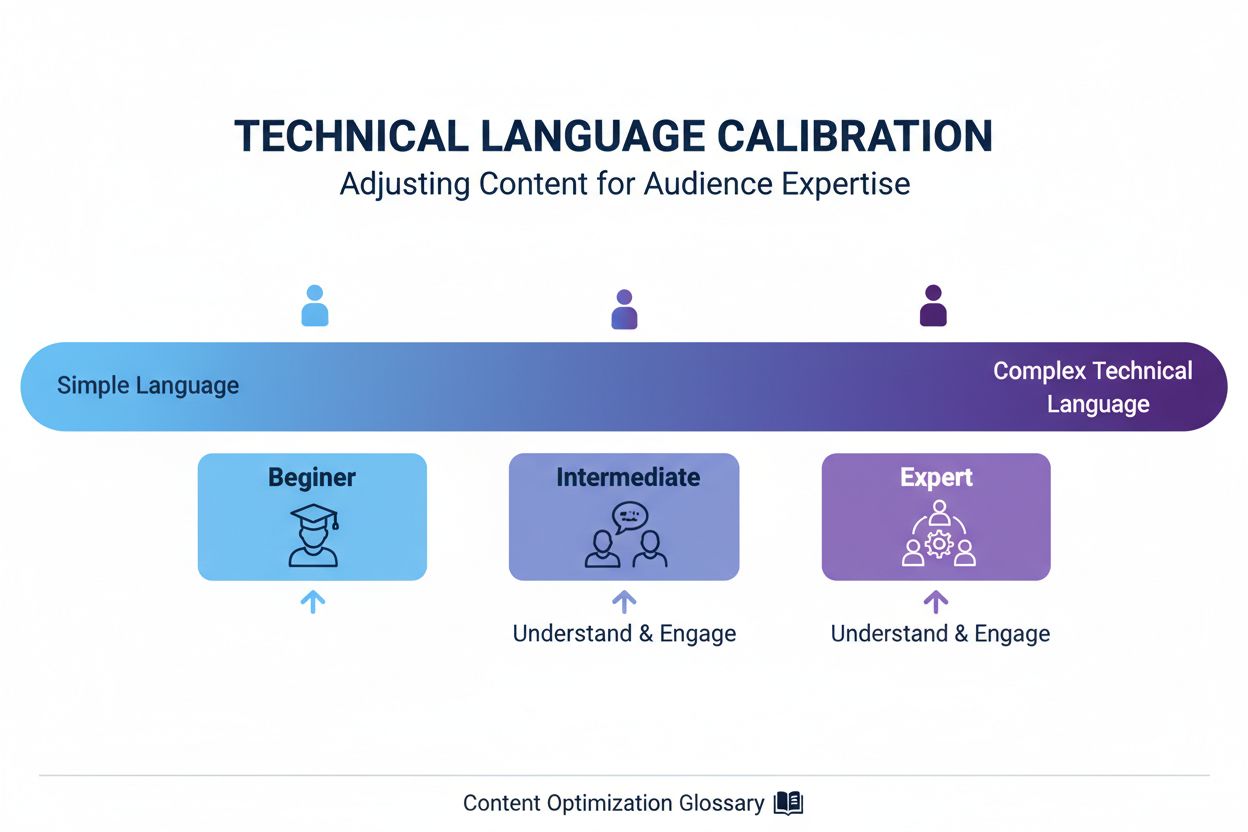
Technical language calibration is the strategic process of adjusting content complexity to match the expertise level of target audiences while ensuring optimal comprehension by both human readers and artificial intelligence systems. This practice balances technical accuracy with accessibility, ensuring messages resonate with intended readers regardless of background knowledge. In today’s AI-driven landscape, calibration has become essential for visibility in AI Overviews and AI-generated summaries. Proper calibration increases the likelihood of content being cited by AI systems like ChatGPT, Perplexity, and Google’s AI Overviews.
Technical language calibration is the strategic process of adjusting content complexity to match the expertise level of target audiences while ensuring optimal comprehension by both human readers and artificial intelligence systems. This practice balances technical accuracy with accessibility, ensuring messages resonate with intended readers regardless of background knowledge. In today's AI-driven landscape, calibration has become essential for visibility in AI Overviews and AI-generated summaries. Proper calibration increases the likelihood of content being cited by AI systems like ChatGPT, Perplexity, and Google's AI Overviews.
Technical language calibration is the strategic process of adjusting content complexity to match the expertise level of your target audience while ensuring optimal comprehension by both human readers and artificial intelligence systems. This practice involves carefully balancing technical accuracy with accessibility, ensuring that your message resonates with intended readers regardless of their background knowledge. In today’s AI-driven landscape, where content is processed by both humans and machine learning algorithms, calibration has become essential for visibility in AI Overviews, search results, and AI-generated summaries. By understanding and implementing proper language calibration, you ensure your content reaches broader audiences, improves engagement metrics, and increases the likelihood of being cited by AI systems like ChatGPT, Perplexity, and Google’s AI Overviews.
The importance of technical language calibration extends far beyond simple readability—it directly impacts how artificial intelligence systems process, understand, and cite your content. When AI models encounter well-calibrated content with clear structure and appropriate complexity levels, they can extract key information more efficiently, leading to higher citation rates in AI-generated answers. This visibility in AI search results has become a critical ranking factor, as more users rely on AI assistants for information discovery. Additionally, properly calibrated content improves traditional SEO performance by reducing bounce rates, increasing dwell time, and signaling to search engines that your content provides genuine value. Accessibility is another crucial benefit: content calibrated for different expertise levels ensures that non-native speakers, individuals with learning disabilities, and users with varying literacy levels can all benefit from your information.
| Audience Type | Language Level | AI Processing Impact |
|---|---|---|
| Technical Experts | Advanced terminology, detailed explanations, complex concepts | High precision extraction, better semantic understanding |
| Intermediate Users | Mixed vocabulary, contextual explanations, moderate complexity | Good extraction with some context needed |
| General Audience | Simple language, plain English, minimal jargon | Reliable extraction, clear summarization |
| Non-Native Speakers | Simple structure, short sentences, clear definitions | Improved comprehension, better translation compatibility |
Effective technical language calibration begins with a deep understanding of your audience’s expertise levels. Different reader segments require fundamentally different approaches to content presentation. Technical experts expect precision, industry-specific terminology, and detailed explanations that demonstrate your credibility within their field. They appreciate in-depth analysis, data-driven insights, and references to advanced concepts. Conversely, general audiences need simplified language, relatable examples, and clear explanations of why information matters to them. Intermediate users fall somewhere in between, possessing some technical knowledge but requiring context and bridging explanations to connect concepts. Non-native English speakers represent another critical segment, benefiting from shorter sentences, clear definitions, and straightforward structure that aids both comprehension and machine translation.
To properly assess your audience’s expertise level, consider these approaches:
Understanding and measuring readability is fundamental to effective language calibration. Several established metrics help quantify content complexity and guide optimization efforts. The Flesch-Kincaid Grade Level converts text complexity into a U.S. school grade equivalent—a score of 8 means an eighth-grade student can understand the content. For general audiences, aim for a grade level between 7-9. The Gunning Fog Index estimates the years of formal education required to understand text on first reading, with scores of 8-10 considered ideal for general readability. The SMOG Index focuses on polysyllabic words (three or more syllables) and is particularly useful for health communication and public information. The Flesch Reading Ease Score ranges from 0-100, with 60-70 representing “plain English” suitable for most adults.
Tools like Hemingway Editor, Grammarly, and Yoast SEO provide real-time readability feedback as you write. These platforms highlight complex sentences, excessive passive voice, and other clarity issues. When measuring your content, aim for these benchmarks: general blog posts should target a Flesch Reading Ease score of 60-70 and a Flesch-Kincaid Grade Level of 7-9; technical documentation can accommodate higher complexity (grade 10-12) for expert audiences; landing pages should prioritize accessibility with scores of 70+ and grade levels of 6-8.
Implementing effective language calibration requires systematic attention to multiple writing elements. The foundation of clear communication is sentence structure—keeping sentences under 20 words dramatically improves comprehension. Research shows that sentences with 8 words achieve 100% reader comprehension, while 25-word sentences drop to just 24% comprehension. Beyond length, vocabulary selection profoundly impacts accessibility. Replace complex words with simpler alternatives: use “use” instead of “utilize,” “help” instead of “facilitate,” “get” instead of “obtain.” Active voice consistently outperforms passive voice in both readability and AI comprehension. Instead of “The report was written by the team,” write “The team wrote the report.”
Follow these six practical strategies for optimal language calibration:
While human readability and AI comprehension overlap significantly, certain techniques specifically optimize content for artificial intelligence processing. AI systems process structured content far more efficiently than unstructured text. A dense paragraph of prose requires AI to infer relationships between concepts, while a properly formatted list with clear headings allows AI to extract information directly. Natural Language Processing (NLP) models—the technology powering AI comprehension—excel at identifying patterns in structured data. Headings (H2, H3) help AI identify topic boundaries and extract relevant sections. Bullet points and numbered lists allow AI to recognize discrete concepts and relationships. Tables enable AI to process comparative data and structured information more accurately than prose descriptions.
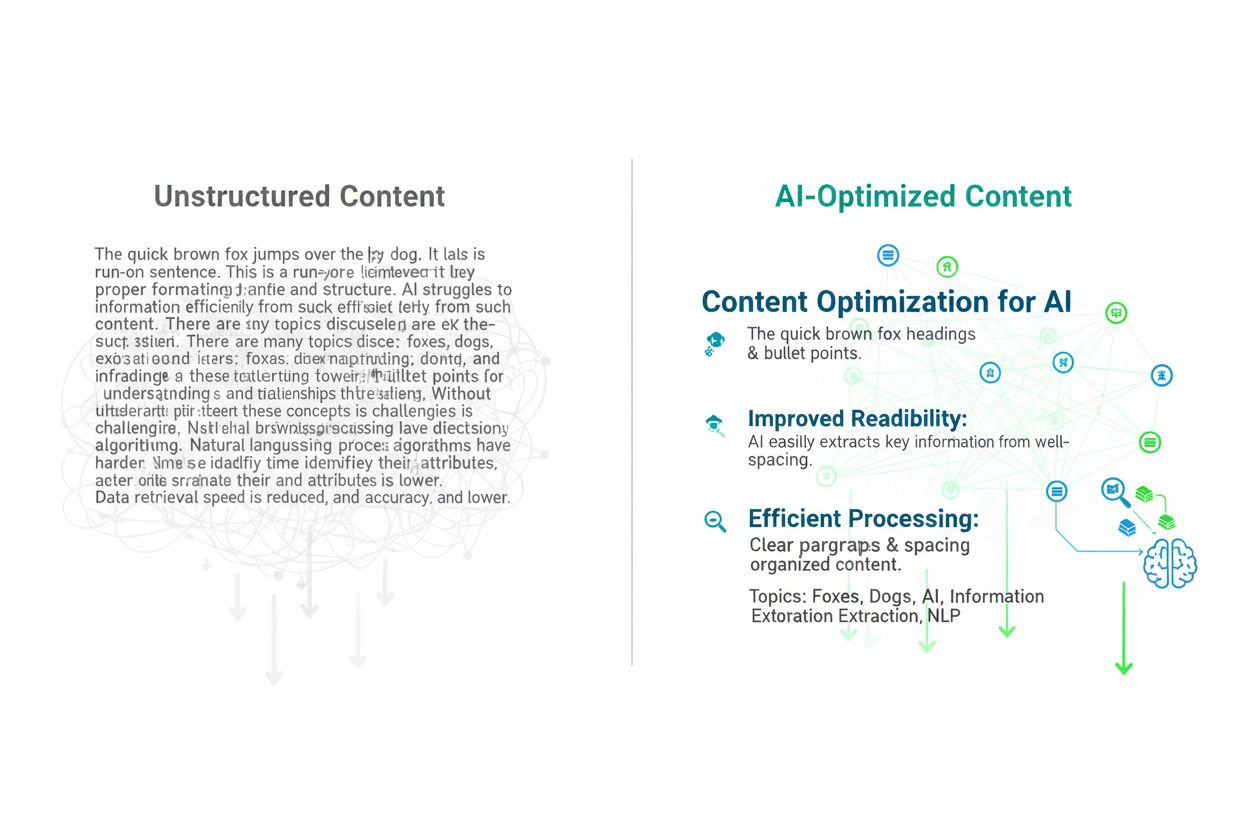
Schema markup and semantic HTML further enhance AI comprehension. Using proper heading hierarchy, semantic tags, and structured data formats (like FAQ schema or HowTo schema) signals to AI systems exactly what information is important and how concepts relate. Consider this example:
Before (Unstructured): “Technical language calibration involves adjusting content complexity to match audience expertise levels. This is important because different readers have different knowledge levels. You should use simple language for general audiences and more technical language for experts.”
After (AI-Optimized):
Even well-intentioned content creators often make calibration mistakes that reduce both readability and AI comprehension. Understanding these common pitfalls helps you avoid them in your own work.
| Wrong Approach | Right Approach |
|---|---|
| Oversimplifying for general audiences, losing important nuance | Simplify language while maintaining accuracy and depth |
| Using inconsistent terminology throughout content | Define key terms once, then use them consistently |
| Writing long, complex sentences with multiple clauses | Break complex ideas into short, clear sentences |
| Ignoring accessibility needs of non-native speakers | Use simple structure, define terms, avoid idioms |
| Burying key information in dense paragraphs | Lead with answers, use headings and lists for key points |
| Mixing formal and casual language inconsistently | Choose appropriate tone and maintain it throughout |
Numerous tools can assist with language calibration and readability optimization. Hemingway Editor highlights complex sentences, excessive adverbs, and passive voice in real-time, making it invaluable for identifying clarity issues. Grammarly provides comprehensive grammar, tone, and clarity feedback, with premium features including readability scoring. Yoast SEO integrates readability analysis directly into WordPress, offering actionable suggestions as you write. For AI-specific optimization, AmICited.com stands out as the leading platform for monitoring how AI systems cite and reference your content, providing insights into which content structures and complexity levels perform best in AI-generated answers and overviews.
FlowHunt.io offers complementary capabilities for AI content generation and automation, helping teams scale content production while maintaining quality. Implementation typically follows this workflow: write your first draft, run it through readability tools to identify complexity issues, revise based on feedback, test with target audience members, monitor performance metrics, and iterate based on results. For organizations serious about AI visibility, integrating AmICited.com into your content workflow provides direct feedback on how your calibration efforts impact AI citations and visibility.
Successful language calibration is not a one-time effort but an ongoing practice of testing, measuring, and refining. The most effective approach combines automated tools with human judgment. Automated readability tools catch obvious issues like sentence length and passive voice, but human reviewers ensure that simplification doesn’t sacrifice accuracy or lose important nuance. Testing with actual members of your target audience provides invaluable feedback that metrics alone cannot capture. Monitor how your content performs in AI-generated answers and summaries—this real-world feedback is more valuable than any readability score.
Key best practices for sustained success include:
The future of content optimization will increasingly emphasize personalization and dynamic content that adapts complexity based on individual reader characteristics. AI systems will become more sophisticated at understanding context and intent, requiring content creators to focus less on surface-level metrics and more on semantic clarity and information architecture. The organizations that master technical language calibration today will be best positioned to maintain visibility and engagement as AI continues to reshape how information is discovered and consumed.
Technical language calibration is the process of adjusting content complexity to match your audience's expertise level while ensuring AI comprehension. It matters because it improves readability, increases engagement, boosts SEO performance, and significantly increases the likelihood of your content being cited in AI-generated answers and overviews like Google's AI Overviews and Perplexity.
Start by identifying your primary audience segments and their expertise levels. Technical experts need industry terminology and detailed explanations, while general audiences require simple language and clear definitions. Use tools like surveys, user testing, and analytics to understand your audience. Monitor how different content complexity levels perform in engagement metrics and AI citations to refine your approach.
Simplifying content means using clear language and structure while maintaining accuracy and depth. Dumbing down means removing important information or nuance to make something artificially simple. Good calibration preserves the integrity of your message while making it accessible. You can explain complex concepts clearly without losing technical accuracy—it's about translation, not elimination.
AI systems process structured, clearly written content far more efficiently than dense, complex prose. Proper calibration—using short sentences, clear headings, bullet points, and active voice—helps AI extract key information accurately. This directly impacts how often your content is cited in AI-generated answers. Tools like AmICited.com help you monitor this impact and optimize accordingly.
For general audiences, target a Flesch Reading Ease score of 60-70 and a Flesch-Kincaid Grade Level of 7-9. Blog posts and landing pages should aim for 70+ and grade 6-8 for maximum accessibility. Technical documentation for expert audiences can accommodate higher complexity (grade 10-12). Use readability tools like Hemingway Editor or Grammarly to measure and track your scores.
While you can create a single piece of content, it's often more effective to create audience-specific versions. If you must use one version, write for your broadest audience and add optional deeper sections for experts. Use clear headings and structure so different readers can navigate to content matching their expertise level. This approach serves both general readers and experts while improving AI comprehension.
Properly calibrated content improves SEO through multiple mechanisms: reduced bounce rates (readers stay longer), increased dwell time (better engagement signals), improved click-through rates from search results, and higher likelihood of being featured in snippets and AI overviews. Search engines reward content that provides genuine value and good user experience, both of which are enhanced by proper language calibration.
Several tools assist with calibration: Hemingway Editor highlights complex sentences and passive voice; Grammarly provides comprehensive clarity feedback; Yoast SEO integrates readability analysis into WordPress; AmICited.com monitors how AI systems cite your content; FlowHunt.io helps with AI-powered content generation. Most effective is combining multiple tools with human judgment and real-world testing with your target audience.
Track how AI systems cite and reference your content. Get insights into which content structures and complexity levels perform best in AI-generated answers and overviews. Optimize your content strategy based on real AI citation data.
Learn what readability scores mean for AI search visibility. Discover how Flesch-Kincaid, sentence structure, and content formatting impact AI citations in Chat...
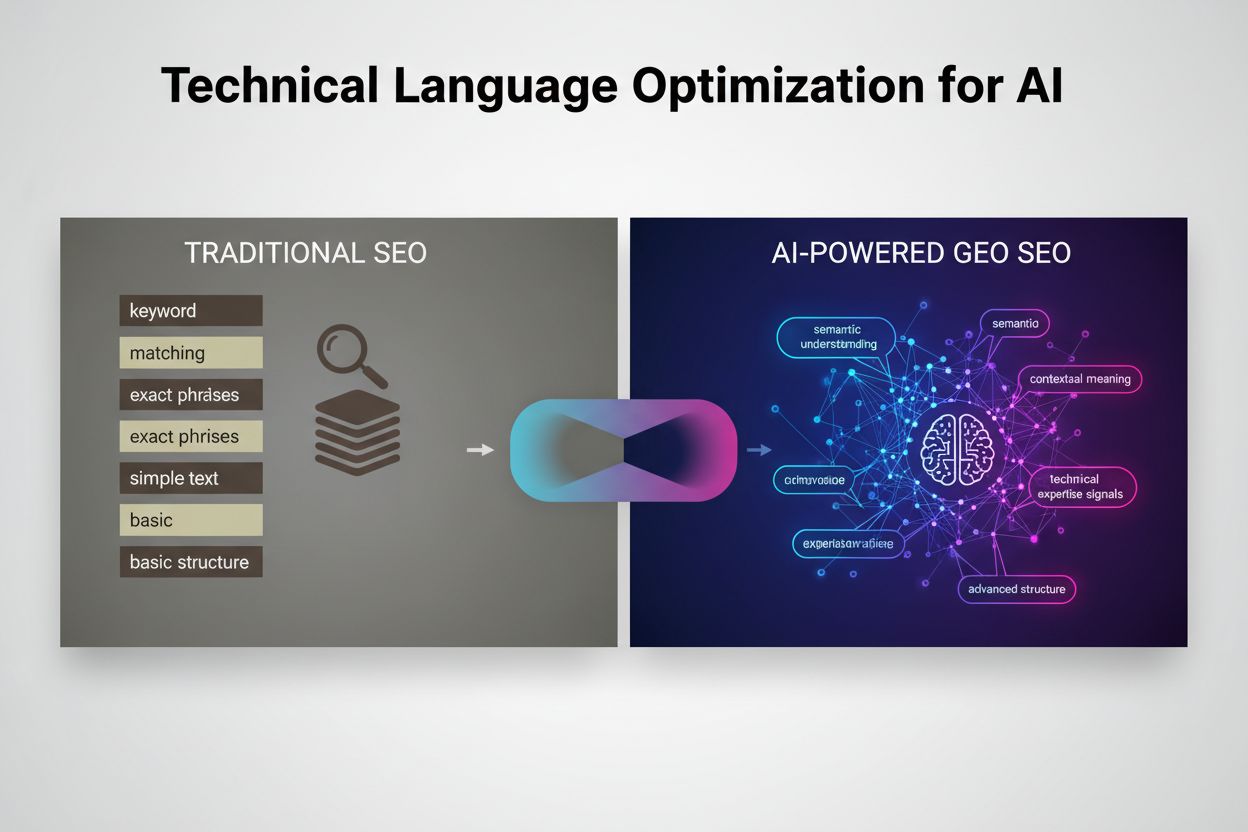
Master technical language optimization for GEO. Learn when and how to use industry terms to improve AI citations and search visibility with expert strategies.
Learn how content relevance scoring uses AI algorithms to measure how well content matches user queries and intent. Understand BM25, TF-IDF, and how search engi...