
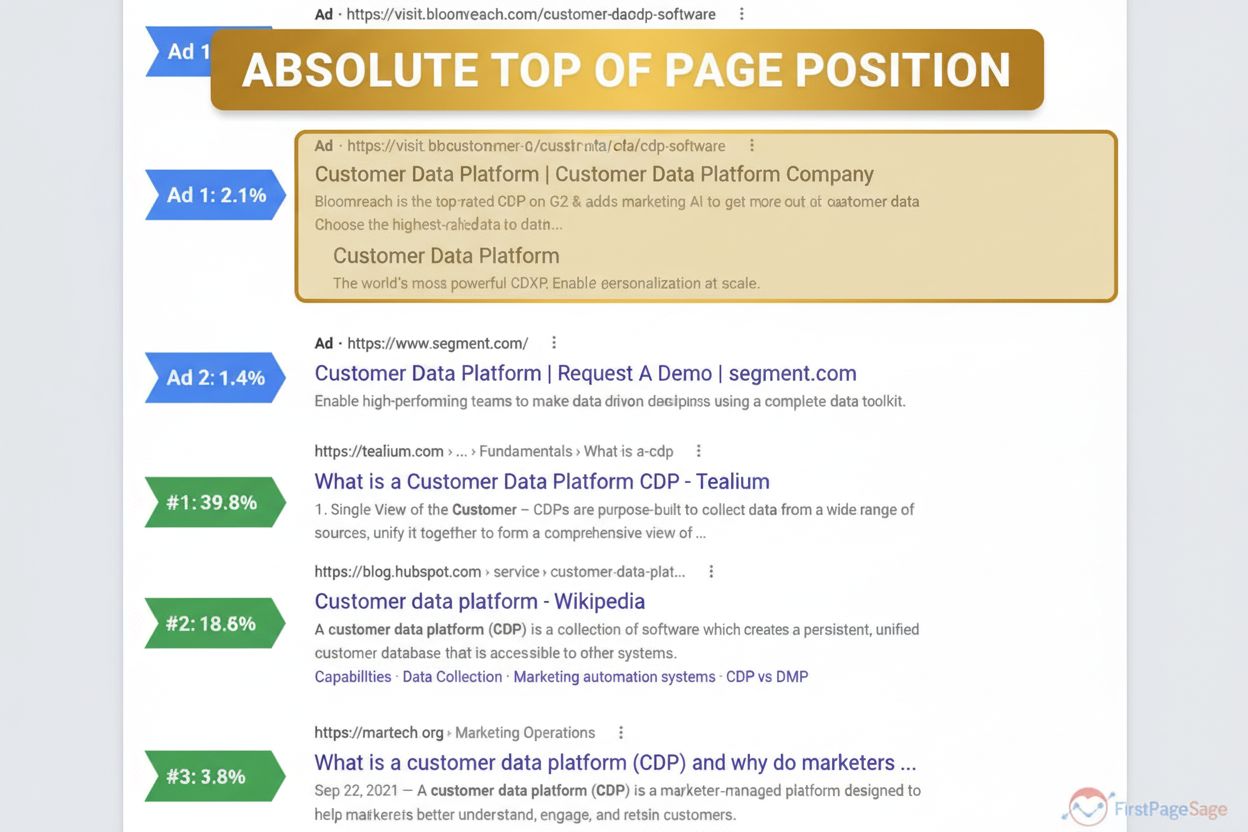
Absolute Top of Page
Absolute Top of Page (ATP) is the first ad position on Google Search results. Learn how this premium placement affects CTR, bidding strategies, and campaign per...
12 min read
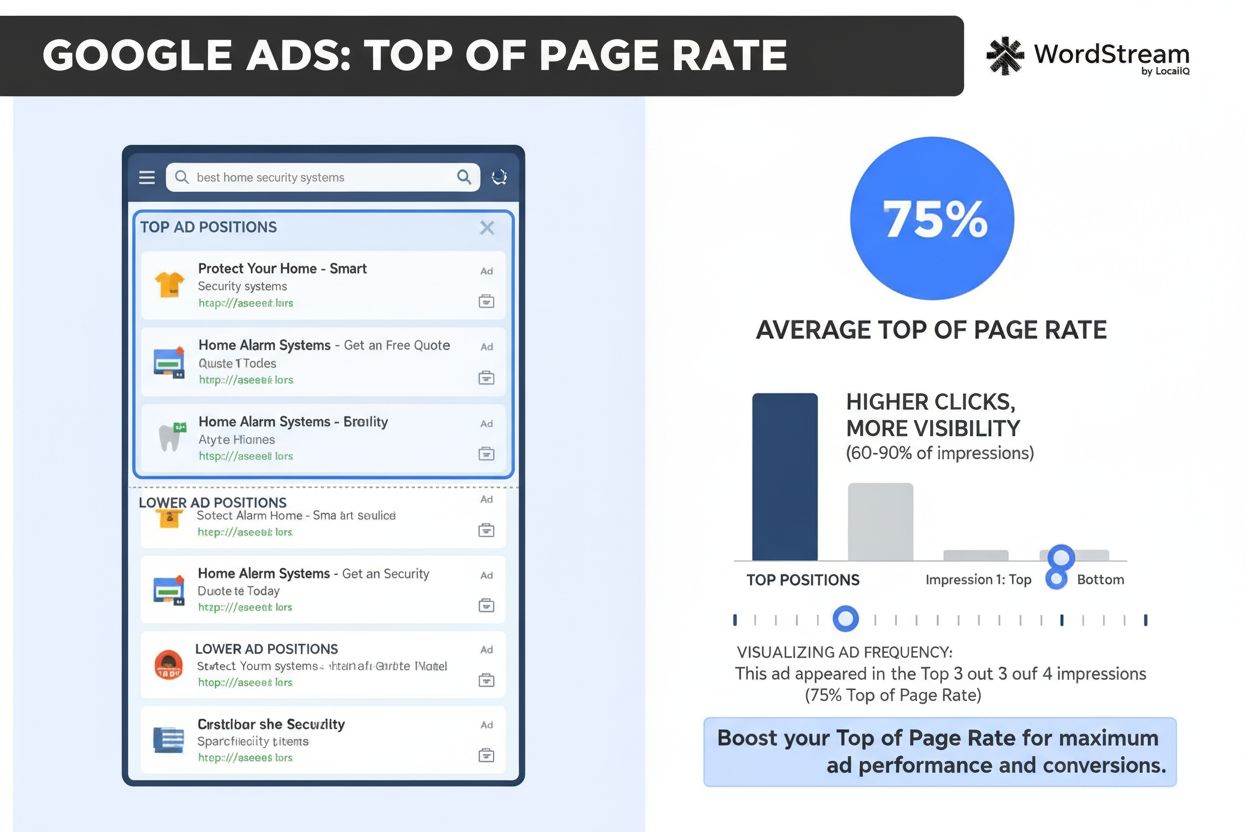
Top of Page Rate is a Google Ads prominence metric that measures the percentage of your ad impressions appearing in the top positions on search engine results pages (SERPs), above organic search results. This metric indicates how frequently your ads secure premium placement visibility compared to total impressions served.
Top of Page Rate is a Google Ads prominence metric that measures the percentage of your ad impressions appearing in the top positions on search engine results pages (SERPs), above organic search results. This metric indicates how frequently your ads secure premium placement visibility compared to total impressions served.
Top of Page Rate is a prominence metric in Google Ads that measures the percentage of your ad impressions appearing in the highest positions on search engine results pages (SERPs), specifically above organic search results. This metric quantifies how frequently your advertisements secure premium placement visibility relative to the total number of impressions your ads receive. When your ad appears in the top positions of a search results page, it receives significantly more user attention and engagement compared to ads positioned lower on the page. Top of Page Rate is distinct from other positioning metrics because it focuses specifically on the most valuable real estate on the SERP—the area where users’ eyes naturally gravitate first. Understanding and optimizing this metric is essential for advertisers seeking to maximize visibility, increase click-through rates, and improve overall campaign performance in competitive digital advertising environments.
The concept of ad placement prominence has evolved significantly since the early days of search advertising. When Google Ads (formerly Google AdWords) first launched, advertisers had limited visibility into where their ads appeared on search results pages. As the platform matured and competition intensified, Google introduced prominence metrics to help advertisers understand their ad positioning more clearly. Top of Page Rate emerged as a critical metric because research consistently demonstrated that ads appearing at the top of search results pages receive substantially higher click-through rates and generate more qualified traffic. According to industry data from 2025, the average click-through rate across all industries is 6.66%, but this varies dramatically based on ad position. Ads maintaining a Top of Page Rate above 80% typically experience CTRs that are 2-3 times higher than ads positioned in lower placements. This positioning advantage has become increasingly important as search results pages have become more crowded with both paid ads and organic results, making premium placement more competitive and valuable than ever before.
| Metric | Top of Page Rate | Absolute Top Rate | Impression Share | Average Position |
|---|---|---|---|---|
| Definition | % of impressions in top ad positions | % of impressions in first position only | % of eligible impressions received | Ranking order vs. competitors |
| Calculation | Impressions on top / Total impressions | Impressions on absolute top / Total impressions | Impressions received / Eligible impressions | Numerical position (1, 2, 3, etc.) |
| Focus | Placement visibility | Premium first position | Auction eligibility | Competitive ranking |
| Benchmark | 70-80%+ is strong | 35-50%+ is strong | 60%+ is good | Position 1-3 is ideal |
| Use Case | Measuring top placement frequency | Measuring first position dominance | Understanding lost opportunities | Tracking competitive position |
| Bidding Target | Can use Target Impression Share | Can use Target Impression Share | Can optimize for | Not directly targetable |
| Impact on CTR | High correlation | Very high correlation | Moderate correlation | High correlation |
The Top of Page Rate calculation in Google Ads follows a specific methodology that differs from how total impressions are counted in campaign reports. Google uses the formula: (Impressions on Top / Total Impressions) × 100% to derive this percentage. However, the critical distinction lies in how Google counts impressions for this metric. When calculating Top of Page Rate, Google counts only the most prominent impression for a given user search, meaning that if multiple ads from your account appear on the same search results page, only one impression is counted in both the numerator and denominator. This approach differs significantly from the impressions shown in your “Campaigns” table and other reporting surfaces, which reflect all impressions your ads received, even if multiple impressions were served on the same page for a single user search. This counting methodology ensures that Top of Page Rate accurately represents the frequency with which your ads appear in premium positions relative to your total eligible impressions. Understanding this distinction is crucial for properly interpreting your data and making informed optimization decisions. Additionally, Search partners do not distinguish between “top” versus “other” positions, so impressions from search partner placements are not included in Top of Page Rate calculations or location segmentation data.
Your Top of Page Rate is determined by multiple interconnected factors that collectively influence your ad’s position in the auction. The primary driver is your Ad Rank, which Google calculates using your bid amount, Quality Score, ad relevance, landing page experience, and the expected impact of ad extensions and ad formats. Your bid amount represents the maximum cost-per-click you’re willing to pay, and higher bids generally lead to better ad positions. However, bid amount alone doesn’t determine placement; Google also evaluates the quality and relevance of your ads and landing pages. Quality Score, which ranges from 1-10, reflects how relevant your ads and landing pages are to users’ search queries. A higher Quality Score can help you achieve better ad positions at lower costs, directly improving your Top of Page Rate. Beyond these core factors, contextual elements significantly impact your placement, including the user’s geographic location, device type (mobile vs. desktop), time of day, search query specificity, and overall market competition for your keywords. During peak competition periods or for highly competitive keywords, achieving a high Top of Page Rate requires more aggressive bidding or superior ad quality. Seasonal trends, industry events, and competitor activity also influence the competitive landscape and your ability to maintain top positions.
The business implications of Top of Page Rate extend far beyond a simple positioning metric. When your ads consistently appear in top positions, they generate significantly more visibility, which translates directly into increased traffic and better campaign performance metrics. A high Top of Page Rate creates a virtuous cycle: increased visibility leads to more clicks, more clicks generate more data for Google’s machine learning algorithms to optimize your bids and ad delivery, improved optimization leads to better ad relevance and higher Quality Scores, and higher Quality Scores enable you to achieve better positions at lower costs. According to 2025 Google Ads benchmarks, industries with strong Top of Page Rates above 80% consistently outperform those with lower rates across multiple metrics. For example, advertisers in the Shopping, Collectibles & Gifts category, which maintains an average click-through rate of 8.92%, benefit from premium placement visibility. Conversely, industries with lower Top of Page Rates due to increased competition, such as Beauty & Personal Care (which saw a 15.41% year-over-year CTR decrease), struggle to maintain visibility and must invest more heavily in optimization. The cost implications are substantial: while average cost-per-click increased 12.88% year-over-year across all industries in 2025, industries maintaining strong Top of Page Rates saw more manageable cost-per-lead increases (averaging 5.13% compared to 25% the previous year), demonstrating that premium placement efficiency can offset rising acquisition costs.
While Top of Page Rate is specific to Google Ads on traditional search results pages, the underlying principle of positioning frequency has become increasingly relevant in the context of AI search and generative engine optimization. Platforms like ChatGPT, Perplexity, Google AI Overviews, and Claude now determine which sources appear in their generated responses based on authority, relevance, and topical expertise—metrics that parallel the factors influencing Top of Page Rate in traditional search. AmICited monitors how frequently your brand appears in top positions within AI-generated responses across these platforms, providing insights analogous to Top of Page Rate for the AI search landscape. Just as a high Top of Page Rate in Google Ads indicates strong visibility and competitive positioning, a high citation frequency in AI search results signals that your content is being recognized as authoritative and trustworthy by large language models. The strategies for improving Top of Page Rate in Google Ads—such as enhancing Quality Score, improving ad relevance, and building topical authority—directly support your visibility in AI search results. For instance, strong E-E-A-T signals (Experience, Expertise, Authoritativeness, Trustworthiness) that improve your Quality Score in Google Ads also make your content more likely to be cited by AI systems. Understanding both traditional Top of Page Rate metrics and your brand’s positioning in AI search results provides a comprehensive view of your visibility across the entire search landscape.
Improving your Top of Page Rate requires a multifaceted approach addressing bid strategy, ad quality, and landing page experience. The most direct method is implementing Target Impression Share bidding, an automated strategy that allows you to set a target percentage for impressions you want to receive among top ads. By setting a target of 80% or higher, Google’s machine learning automatically adjusts your bids to help you achieve your goal while staying within budget constraints. However, aggressive bidding alone is insufficient; you must simultaneously optimize your Quality Score by ensuring tight alignment between your keywords, ad copy, and landing pages. Conduct thorough keyword research to identify high-intent, transactional terms that match your business offerings, then craft compelling ad copy that directly addresses user search intent. Your landing pages must deliver on the promises made in your ads, providing seamless user experiences with clear calls-to-action and relevant content. Implement ad extensions such as sitelinks, callouts, and structured snippets to increase ad real estate and improve click-through rates. Continuously monitor your campaign performance, analyzing which keywords and ad variations drive the best results, and reallocate budget toward high-performing segments. Test different bidding strategies to find the optimal balance between achieving top placement and maintaining profitable cost-per-lead metrics. Additionally, leverage Smart Bidding strategies like Target CPA (Cost Per Acquisition) to optimize for conversions while maintaining competitive positioning.
The definition and strategic importance of Top of Page Rate is evolving as the search landscape transforms. Google has continuously modified search results page layouts, introducing features like AI Overviews (formerly Search Generative Experience), multiple ads from the same brand in different positions, and increasingly sophisticated ad blending with organic results. These changes have made traditional Top of Page Rate metrics more complex to interpret, as the definition of “top of page” continues to shift. Looking forward, Top of Page Rate will likely become less relevant as a standalone metric as AI-powered search results increasingly replace traditional blue-link search results. However, the underlying principle—that positioning frequency and visibility matter—will remain critical. Advertisers will need to expand their monitoring beyond traditional Top of Page Rate to include visibility metrics across AI search platforms, voice search results, and other emerging search interfaces. The rise of Generative Engine Optimization (GEO) represents a parallel evolution, where brands must optimize for appearing in AI-generated responses rather than just traditional search rankings. Companies like AmICited are pioneering tools to measure brand appearance frequency in AI search results, creating new “Top of Page Rate” equivalents for the AI era. As search continues to evolve, successful advertisers will maintain expertise in both traditional Top of Page Rate optimization and emerging AI search visibility metrics, ensuring their brands remain visible across all search channels. The integration of first-party data, value-based bidding, and sophisticated audience targeting will become increasingly important for maintaining competitive Top of Page Rates as auction complexity grows and competition intensifies across all search platforms.
Top of Page Rate measures the percentage of impressions appearing anywhere among the top ads on a search results page, while Absolute Top Rate specifically measures impressions appearing as the very first ad position. Absolute Top Rate is a subset of Top of Page Rate. For example, if your Top of Page Rate is 80%, your Absolute Top Rate might be 35%, meaning 35% of impressions are in the absolute first position and 45% are in other top positions.
Industry benchmarks suggest that a Top of Page Rate above 70-80% is generally considered strong performance, though this varies by industry and competition level. According to 2025 Google Ads data, industries with high competition like Attorneys & Legal Services and Home & Home Improvement typically see lower rates due to increased bidding competition. Your target should align with your business goals and industry standards, but consistently maintaining above 60% indicates competitive ad positioning.
Top of Page Rate directly influences click-through rate (CTR) because ads positioned at the top of search results receive significantly more visibility and user attention. Research shows ads with top of page rates above 80% experience CTRs that are 2-3 times higher than ads in lower positions. Higher CTR typically leads to more qualified traffic and improved conversion rates, making Top of Page Rate a critical metric for overall campaign performance.
Your Top of Page Rate is primarily determined by your Ad Rank, which is calculated using your bid amount, Quality Score, ad relevance, landing page experience, and the expected impact of ad extensions. Additionally, contextual factors like user location, device type, time of search, and overall market competition influence your placement. Improving any of these components can help increase your Top of Page Rate.
Top of Page Rate is calculated using the formula: (Impressions on Top / Total Impressions) × 100%. Google counts only the most prominent impression per user search, meaning if multiple ads from your account appear on the same page, only one is counted in both the numerator and denominator. This differs from total impressions shown in campaign reports, which may include multiple impressions from the same advertiser on a single page.
Yes, you can use Top of Page Rate indirectly through Google Ads' Target Impression Share bidding strategy. This automated bidding approach allows you to set a target percentage for impressions you want to receive among top ads or in the absolute top position. Google's machine learning then automatically adjusts your bids to help you achieve your target impression share while staying within your budget constraints.
While Top of Page Rate is specific to Google Ads on traditional search results, the concept of positioning frequency extends to AI search platforms like ChatGPT, Perplexity, and Google AI Overviews. AmICited monitors how often your brand appears in top positions across AI-generated responses, similar to how Top of Page Rate measures ad prominence. Understanding both metrics helps brands maintain visibility across traditional and AI-powered search experiences.
Start tracking how AI chatbots mention your brand across ChatGPT, Perplexity, and other platforms. Get actionable insights to improve your AI presence.
Absolute Top of Page (ATP) is the first ad position on Google Search results. Learn how this premium placement affects CTR, bidding strategies, and campaign per...
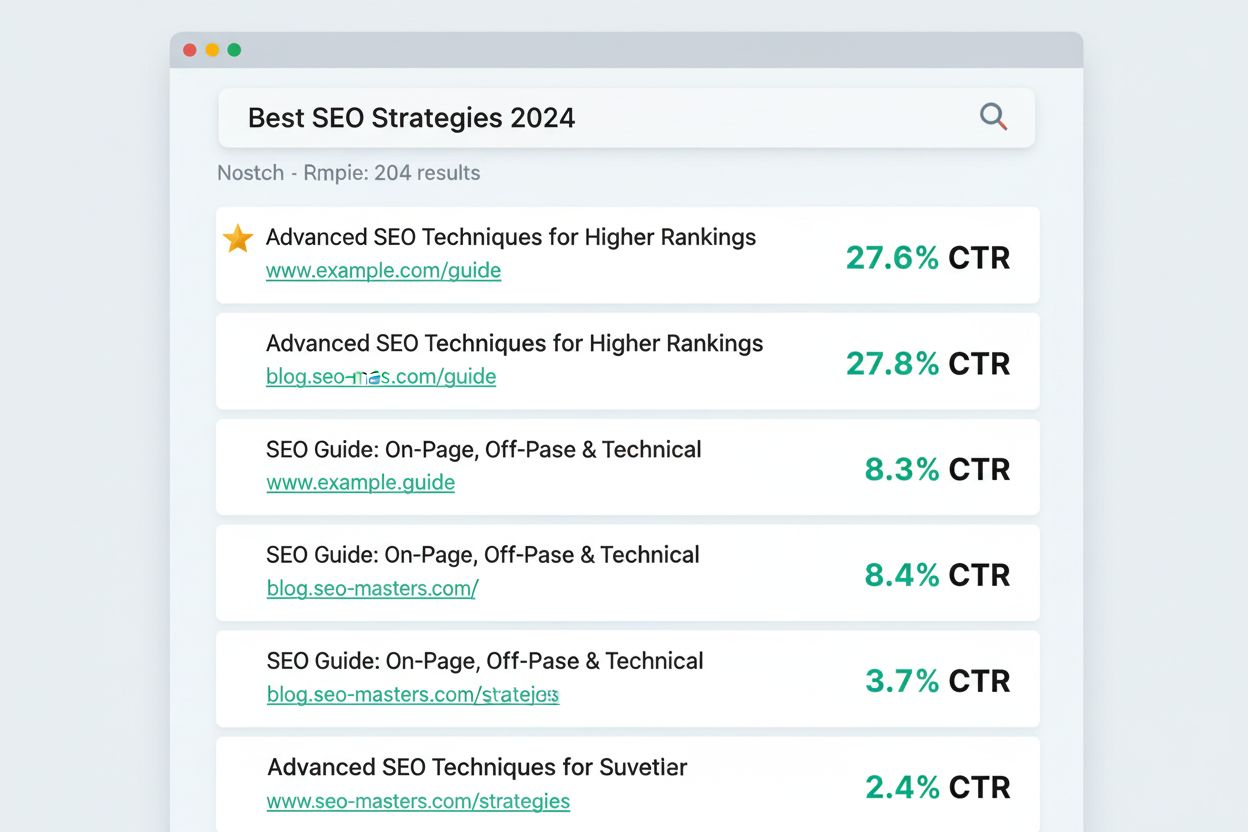
Ranking position is the location of a webpage in search results (1-10 on page 1). Position 1 gets 39.8% CTR. Learn how ranking position affects traffic and visi...
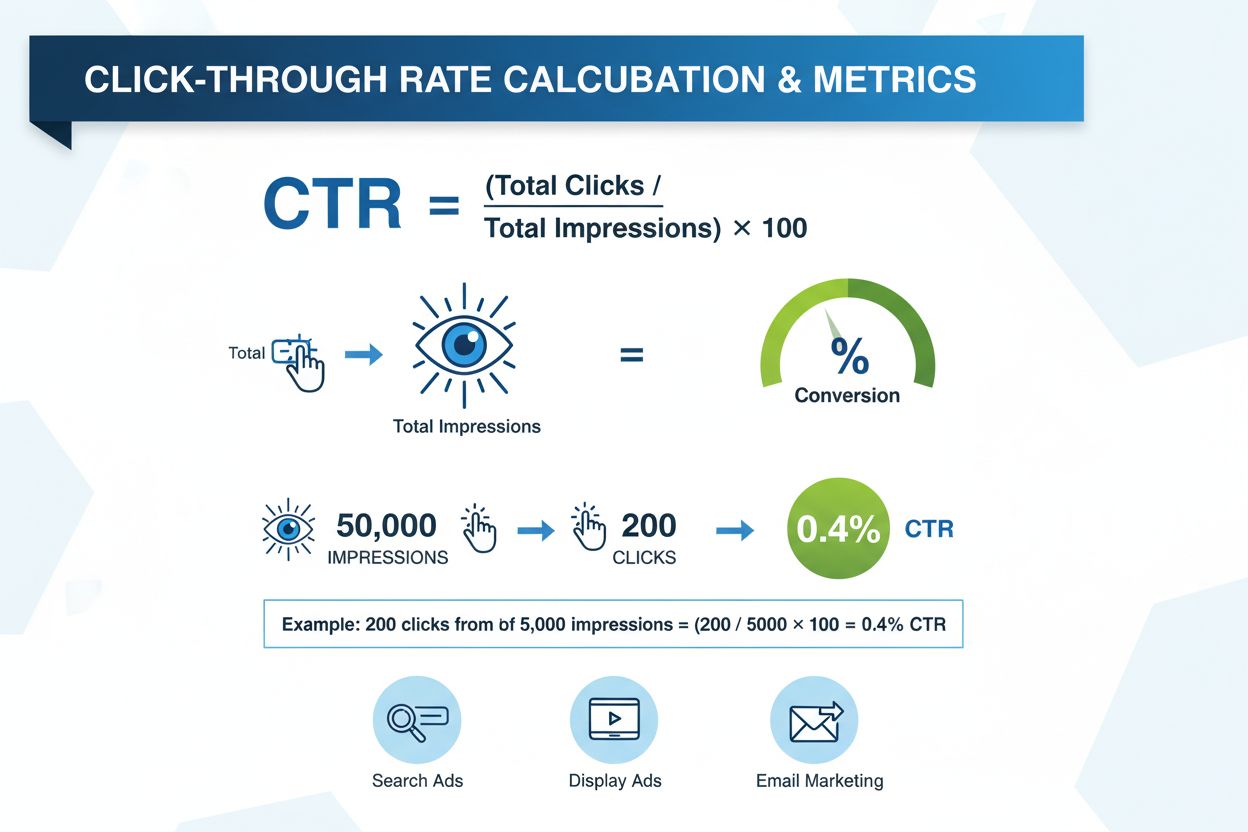
Learn what Click-Through Rate (CTR) is, how to calculate it, and why it matters for digital marketing. Discover CTR benchmarks, optimization strategies, and its...
Cookie Consent
We use cookies to enhance your browsing experience and analyze our traffic. See our privacy policy.