
What is a Topic Cluster for AI Visibility?
Learn how topic clusters help your brand appear in AI-generated answers. Discover how interconnected content improves visibility in ChatGPT, Perplexity, and oth...
8 min read
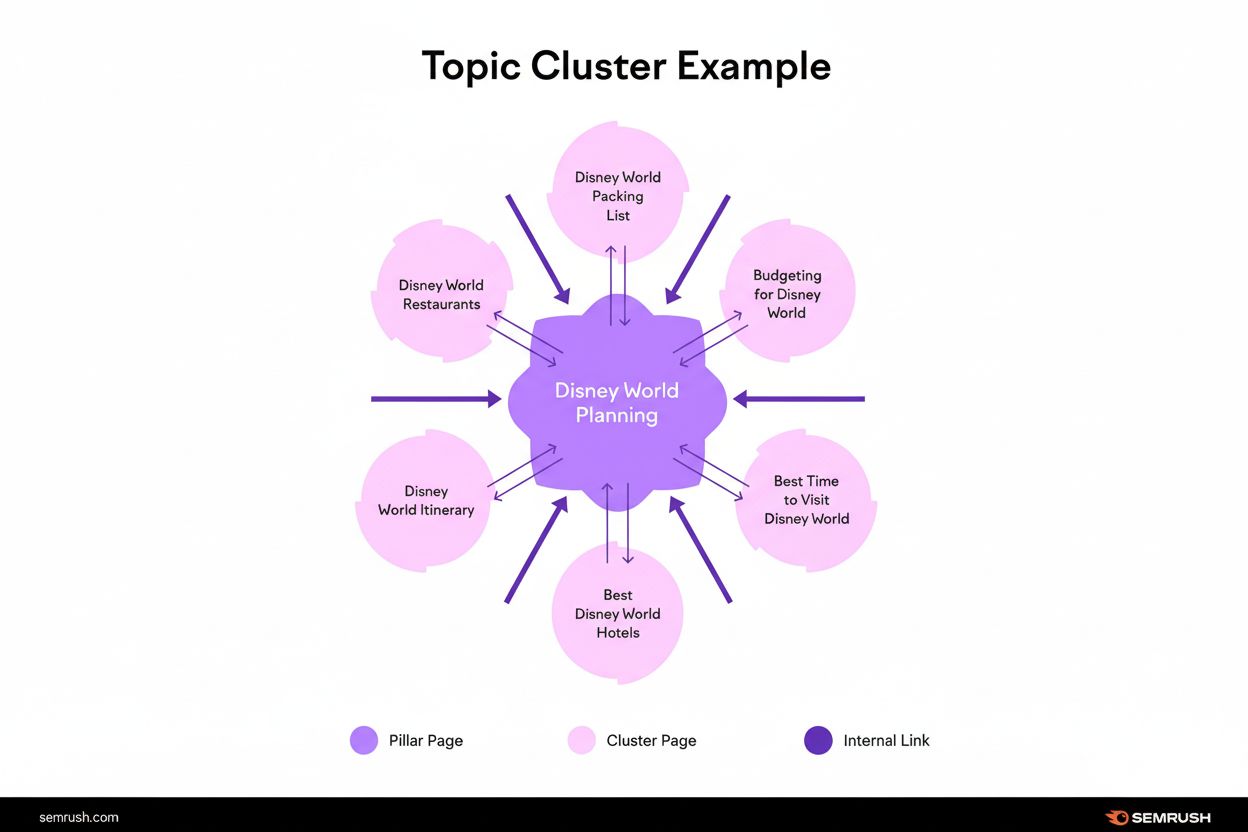
The Topic Cluster Model is a content strategy framework that organizes related web pages around a central pillar page, with cluster pages covering subtopics and linked through internal linking to establish topical authority and improve search engine rankings. This approach helps search engines and AI systems understand content relationships and signals expertise on specific subjects.
The Topic Cluster Model is a content strategy framework that organizes related web pages around a central pillar page, with cluster pages covering subtopics and linked through internal linking to establish topical authority and improve search engine rankings. This approach helps search engines and AI systems understand content relationships and signals expertise on specific subjects.
The Topic Cluster Model is a content organization strategy that structures website content around a central pillar page supported by multiple related cluster pages, all interconnected through strategic internal linking. This model represents a fundamental shift in how content marketers and SEO professionals approach content architecture, moving away from isolated keyword-focused pages toward a holistic, topic-based framework. The pillar page serves as the authoritative hub covering a broad topic comprehensively, while cluster pages explore specific subtopics in depth, each targeting related long-tail keywords and search queries. By establishing this interconnected structure, the Topic Cluster Model signals to search engines—and increasingly to AI systems like ChatGPT, Perplexity, and Google AI Overviews—that your website possesses deep expertise and topical authority on a subject matter.
The Topic Cluster Model emerged as a response to fundamental changes in how search engines interpret and rank content. Prior to 2013, search engines primarily focused on individual keywords, treating each page as an isolated entity competing for specific search terms. However, Google’s Hummingbird algorithm update in 2013 marked a pivotal shift toward semantic search and topic-based understanding. This update enabled Google to parse phrases rather than just keywords, recognizing that users search using natural language and expect results that understand context and intent. The subsequent RankBrain update in 2015 further accelerated this evolution by introducing machine learning capabilities that allowed Google to understand the relationships between different search queries and connect them to broader topics. These algorithmic changes forced content strategists to reconsider their approach, leading to the formalization of the Topic Cluster Model as a best practice. Research conducted by HubSpot’s Anum Hussain and Cambria Davies in 2016 provided empirical evidence that topic clusters improved search rankings, with their experiments showing that increased internal linking within clusters correlated directly with higher SERP placements and increased impressions. Today, the Topic Cluster Model has become industry standard, with over 72% of enterprise content marketing teams implementing some form of topic-based content organization to maintain competitive visibility in search results.
The Topic Cluster Model consists of three essential components working in concert: the pillar page, cluster pages, and internal linking structure. The pillar page functions as the authoritative cornerstone, typically ranging from 2,000 to 5,000+ words, providing a comprehensive overview of a broad topic without going into excessive depth on any single subtopic. This page is designed to rank for primary, high-volume keywords and establish topical authority. Cluster pages, by contrast, are typically 1,500 to 3,000 words and focus on specific aspects of the pillar topic, targeting long-tail keywords with lower search volume but higher intent. Each cluster page explores one particular angle or question related to the main topic, providing detailed, actionable information that complements the pillar page. The internal linking structure is the connective tissue that makes the model work: the pillar page links to all cluster pages, each cluster page links back to the pillar page using consistent anchor text, and cluster pages may link to each other when contextually relevant. This bidirectional linking pattern creates a semantic web that helps search engines understand content relationships and hierarchy. Additionally, the model often includes a table of contents on the pillar page, enabling users to navigate directly to cluster pages, which improves user experience and distributes link equity throughout the cluster.
| Aspect | Topic Cluster Model | Pillar Page Strategy | Hub and Spoke Model | Siloed Content Structure |
|---|---|---|---|---|
| Central Hub | Yes - pillar page | Yes - single comprehensive page | Yes - hub page | No - independent pages |
| Number of Pages | Multiple (10-30+) | Single page | Multiple (5-15) | Many isolated pages |
| Internal Linking | Bidirectional (hub ↔ spokes) | Minimal internal linking | Bidirectional (hub ↔ spokes) | Limited cross-linking |
| Content Depth | Distributed across pages | All on one page | Distributed across pages | Varies by page |
| SEO Focus | Topical authority | Keyword ranking | Topical authority | Individual keywords |
| User Experience | Navigation between related topics | Single-page deep dive | Navigation between related topics | Fragmented experience |
| AI Search Optimization | Excellent - shows expertise | Good - comprehensive coverage | Excellent - shows expertise | Poor - lacks coherence |
| Implementation Time | 3-6 months | 1-2 months | 2-4 months | Ongoing, unstructured |
| Best For | Broad topics with many subtopics | Specific, comprehensive topics | Medium-breadth topics | Legacy content sites |
The Topic Cluster Model operates through a carefully orchestrated system of content organization and linking that communicates topical relationships to both search engines and users. When a user or search engine crawler arrives at your pillar page, they encounter a comprehensive resource that introduces the main topic and provides navigation to deeper explorations. The pillar page typically includes a hyperlinked table of contents, allowing users to jump to specific sections or cluster pages covering subtopics they’re interested in. Each cluster page is optimized for a specific long-tail keyword or search query that falls within the broader topic umbrella, and includes contextual links back to the pillar page using keyword-rich anchor text. This anchor text is crucial—it tells search engines exactly what the linked page is about and reinforces the semantic relationship between pages. For example, if your pillar page is “Complete Guide to Content Marketing,” a cluster page on “Content Marketing Strategy” would link back to the pillar using anchor text like “content marketing strategy” or “learn more about content marketing strategy.” The internal linking structure creates what SEO professionals call semantic SEO, where the interconnected pages collectively signal to search engines that your website comprehensively covers a topic from multiple angles. Search engines use this information to build a mental model of your topical expertise, making it more likely that your pages will rank for related queries, even those you haven’t explicitly targeted. This is particularly important for AI systems like ChatGPT and Perplexity, which analyze content clusters to determine which sources demonstrate genuine expertise worthy of citation.
The Topic Cluster Model delivers measurable SEO benefits that extend beyond individual page rankings. First, it improves topical authority, which is increasingly central to Google’s ranking algorithm. By organizing content around topics rather than isolated keywords, you demonstrate to search engines that your website is a comprehensive resource on specific subjects. This topical authority becomes a ranking factor in itself—Google’s algorithm now evaluates websites for their depth of coverage on topics, not just their optimization for individual keywords. Second, the model increases keyword coverage and ranking opportunities. A single pillar page might target one primary keyword, but the entire cluster can rank for 50-100+ related keywords across all pages. Research from Conductor Academy shows that websites implementing topic clusters see an average 40-60% increase in keyword rankings within the first year. Third, the internal linking structure distributes link equity throughout the cluster, allowing link authority gained by any page to benefit the entire cluster. When an external website links to one of your cluster pages, that link equity flows to the pillar page through internal links, strengthening the pillar’s authority. Fourth, topic clusters improve crawlability and indexation. Search engine crawlers can more efficiently discover and understand all pages within a cluster because of the clear linking structure, ensuring that all your content gets properly indexed and evaluated. Finally, the model reduces keyword cannibalization, a common problem where multiple pages compete for the same keywords. By clearly defining which page targets which keyword and linking them appropriately, you eliminate internal competition and ensure the right page ranks for the right query.
As AI search platforms like ChatGPT, Perplexity, Google AI Overviews, and Claude become increasingly important for content discovery, the Topic Cluster Model has evolved from an SEO best practice to an essential strategy for Generative Engine Optimization (GEO). AI systems rely on different ranking signals than traditional search engines, with particular emphasis on topical authority, content comprehensiveness, and source credibility. When an AI system receives a user query, it searches for sources that demonstrate deep expertise on the topic, and topic clusters are precisely designed to signal this expertise. A well-structured topic cluster shows AI systems that your website has thoroughly explored a subject from multiple angles, making your content more likely to be selected for citation in AI responses. This is particularly relevant for platforms like AmICited, which tracks brand and domain mentions across AI search responses. Organizations using topic clusters report higher citation rates in AI search results because their content structure aligns with how AI systems evaluate source authority. Additionally, topic clusters improve the likelihood of appearing in AI Overviews (Google’s AI-generated summaries in search results), as these features prioritize sources that comprehensively cover topics. The semantic relationships established through internal linking in topic clusters help AI systems understand not just what your content says, but how different pieces of content relate to each other, enabling more nuanced and contextual citations.
Successfully implementing a Topic Cluster Model requires strategic planning and disciplined execution. The first step is topic selection and research, which involves identifying broad topics relevant to your business, audience, and competitive landscape. Use keyword research tools to validate that topics have sufficient search volume and user interest to warrant investment. The second step is pillar page creation, which should be comprehensive, well-structured, and optimized for your primary keyword. Pillar pages should include a table of contents, clear headings, and links to cluster pages. The third step is cluster page development, where you create 10-30 pages covering specific subtopics, each targeting long-tail keywords with clear search intent. Each cluster page should provide genuine value, answer specific user questions, and include contextual links back to the pillar page. The fourth step is internal linking optimization, ensuring bidirectional links between pillar and cluster pages using consistent, keyword-rich anchor text. The fifth step is ongoing maintenance and expansion, as topic clusters are not static—they require regular updates, new cluster pages as new subtopics emerge, and monitoring of performance metrics. One critical consideration is avoiding over-optimization, where excessive internal linking or keyword stuffing undermines content quality. Links should feel natural and add value for readers, not appear forced or manipulative. Another consideration is topic breadth balance—topics should be broad enough to support multiple cluster pages but focused enough to maintain coherence. A topic that’s too broad becomes unwieldy; one that’s too narrow doesn’t justify a cluster structure.
The Topic Cluster Model has proven effective across diverse industries and content types. E-commerce companies use topic clusters to establish authority on product categories, with pillar pages covering broad product types and cluster pages exploring specific products, features, and use cases. SaaS companies create clusters around core features or use cases, helping prospects understand how their software solves specific problems. Publishing and media companies use clusters to organize content by topic area, improving discoverability and establishing subject matter expertise. Healthcare and wellness brands use clusters to provide comprehensive information on health conditions, treatments, and wellness topics, which is particularly important given Google’s emphasis on E-E-A-T for health content. Financial services companies use clusters to cover complex topics like investment strategies, retirement planning, and tax optimization. The common thread across all these applications is that topic clusters work best when they align with genuine user needs and questions. Companies that start with user research—surveys, interviews, search query analysis—and build clusters around actual user problems see the best results. Conversely, companies that force artificial cluster structures around topics users don’t care about see minimal benefit.
The Topic Cluster Model is evolving in response to changes in search behavior and AI development. As voice search and conversational queries become more prevalent, topic clusters become increasingly important because they help search engines understand the natural language relationships between different ways of asking the same question. As AI search platforms mature and become primary discovery channels, topic clusters will become essential for visibility in these systems. The model is also evolving to incorporate multimedia content, with clusters now including videos, infographics, podcasts, and interactive content alongside written pages. Additionally, the concept of sub-clusters is emerging, where large topic clusters are subdivided into smaller clusters, creating a hierarchical structure that accommodates very broad topics. Looking forward, the Topic Cluster Model will likely become even more central to content strategy as search engines and AI systems continue to prioritize topical authority and comprehensive coverage. Organizations that invest in building robust topic clusters now will have significant competitive advantages as these systems mature. The model also aligns with emerging concepts like topical authority systems (which Google has implemented for news content) and entity-based SEO, where search engines evaluate websites based on their expertise with specific entities and topics rather than just keyword matching. For brands using platforms like AmICited to monitor AI citations, topic clusters represent a strategic investment in visibility across multiple discovery channels—traditional search, AI search, and emerging platforms.
A pillar page is a single, comprehensive page that covers a topic in-depth on one page, designed to keep readers on that page and rank for the main keyword. A Topic Cluster Model, by contrast, consists of a pillar page plus multiple cluster pages covering subtopics, all interconnected through internal links. The cluster model distributes content across multiple pages to establish broader topical authority, while a pillar page consolidates information into one resource. Both strategies improve SEO, but they serve different organizational purposes.
The Topic Cluster Model improves SEO rankings by signaling topical authority to search engines through internal linking structure. When cluster pages link back to the pillar page and the pillar page links to cluster pages, search engines recognize that your website comprehensively covers a topic. This interconnected structure helps search engines understand semantic relationships between content, improves crawlability, and distributes link equity across related pages. Research from HubSpot's experiments showed that websites implementing topic clusters experienced increased impressions and higher SERP placements as they expanded their internal linking.
Yes, the Topic Cluster Model is increasingly important for AI search visibility on platforms like ChatGPT, Perplexity, and Google AI Overviews. AI systems rely on topical authority and comprehensive content coverage to determine which sources to cite. By organizing content into topic clusters, you demonstrate deep expertise on specific subjects, making your content more likely to be selected by LLMs and AI search engines. This is particularly valuable for platforms like AmICited that track brand mentions across AI responses, as topic clusters increase the likelihood of your content being cited as an authoritative source.
A pillar page is the central hub of a topic cluster that provides a broad overview of a main topic. It typically covers the topic at a high level, linking to multiple cluster pages that dive deeper into specific subtopics. Pillar pages are designed to rank for primary, high-volume keywords and establish your website as an authority on the overall topic. They often include a table of contents for navigation and serve as the foundation for the entire cluster structure, with all cluster pages linking back to the pillar page.
There is no fixed number, but most effective topic clusters include 10-30 cluster pages per pillar page, depending on topic breadth and search volume. The key is ensuring each cluster page covers a distinct subtopic with sufficient search volume and user intent to warrant its own page. Start with 5-10 cluster pages covering the most important subtopics, then expand based on performance data and audience demand. Quality matters more than quantity—each cluster page should provide genuine value and target specific long-tail keywords related to the pillar topic.
The internal linking strategy for topic clusters should follow a bidirectional pattern: the pillar page links to all cluster pages, and each cluster page links back to the pillar page using consistent anchor text. Additionally, cluster pages can link to each other when relevant, but avoid excessive cross-linking that dilutes the cluster structure. Use keyword-rich anchor text that reinforces the topic relationship, and ensure links are contextual and add value for readers. This linking pattern helps search engines understand the hierarchy and relationships within your content cluster.
Results from topic clusters typically begin appearing within 3-6 months, though this varies based on domain authority, competition level, and content quality. Initial improvements often come from cluster pages ranking for long-tail keywords, which gradually increases overall topical authority. As your cluster expands and gains backlinks, the pillar page begins ranking for more competitive primary keywords. Consistent updates and expansion of cluster content accelerate results. Websites that actively maintain and expand their topic clusters see sustained ranking improvements over 12+ months.
Start tracking how AI chatbots mention your brand across ChatGPT, Perplexity, and other platforms. Get actionable insights to improve your AI presence.
Learn how topic clusters help your brand appear in AI-generated answers. Discover how interconnected content improves visibility in ChatGPT, Perplexity, and oth...
Learn what content clusters are, how they work, and why they're essential for SEO and AI search visibility. Discover pillar pages, internal linking strategies, ...
Community discussion on pillar pages and topic clusters for AI search visibility. Real experiences from content strategists on whether the traditional pillar mo...
Cookie Consent
We use cookies to enhance your browsing experience and analyze our traffic. See our privacy policy.