
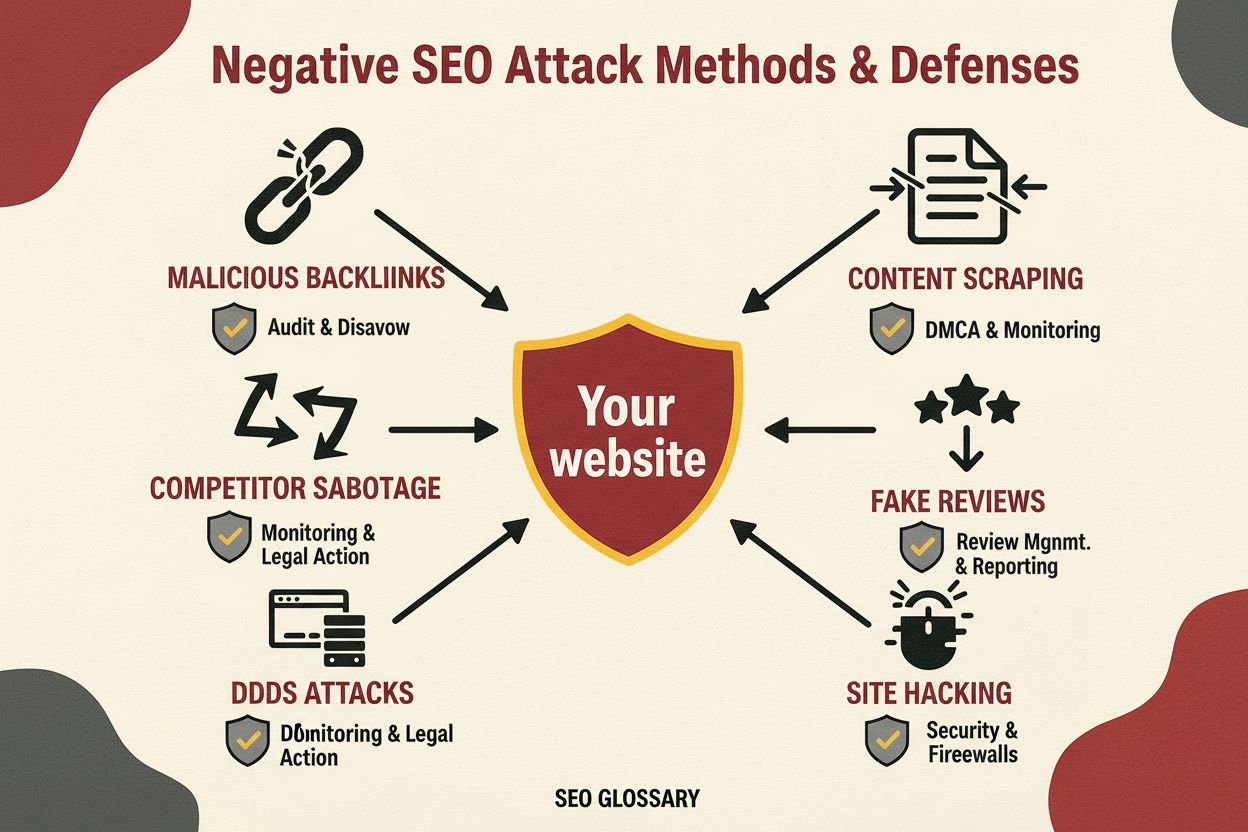
Negative SEO
Negative SEO is the practice of using unethical techniques to harm competitor rankings. Learn about attack tactics, detection methods, and how to protect your s...
13 min read
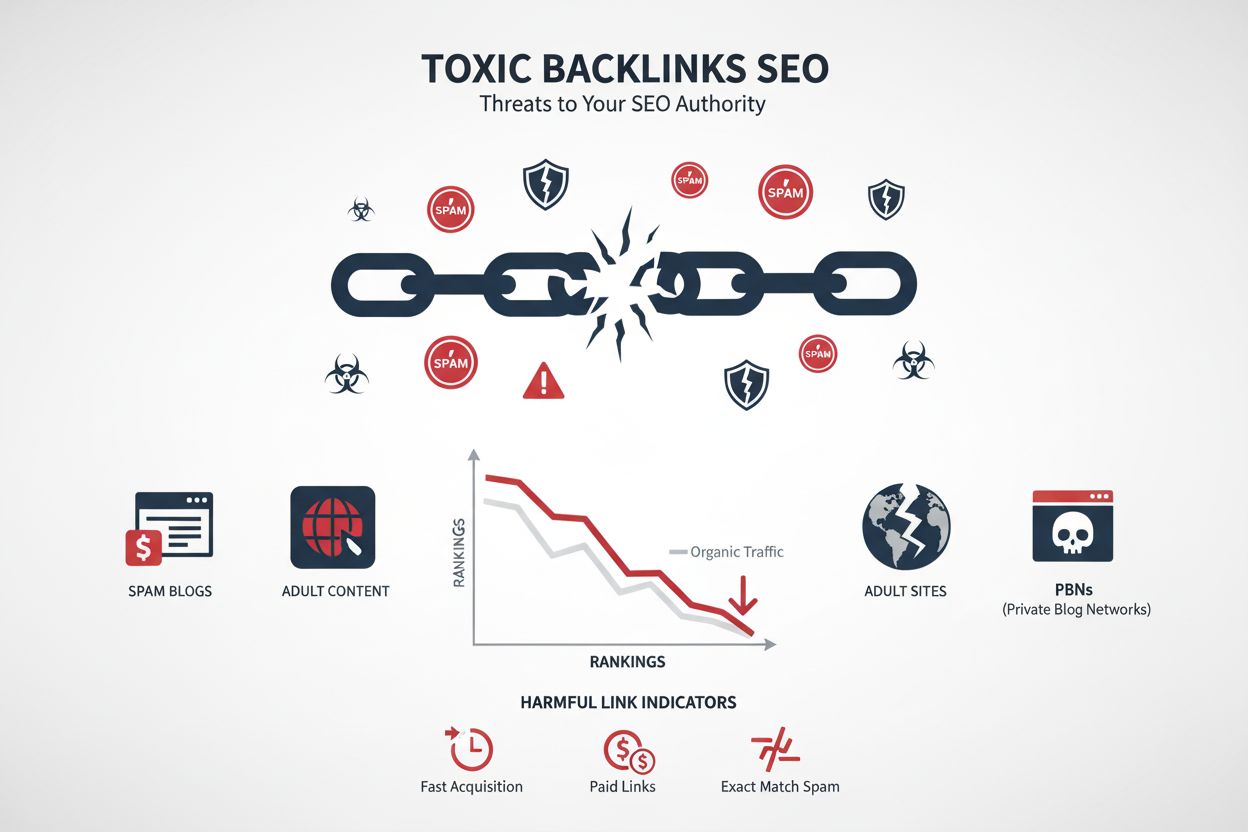
Toxic links are harmful backlinks from low-quality, spammy, or irrelevant websites that can negatively impact a website’s search engine rankings and online reputation. These links often violate Google’s Webmaster Guidelines and may result in manual penalties or algorithmic devaluation of a site’s authority.
Toxic links are harmful backlinks from low-quality, spammy, or irrelevant websites that can negatively impact a website's search engine rankings and online reputation. These links often violate Google's Webmaster Guidelines and may result in manual penalties or algorithmic devaluation of a site's authority.
Toxic links, also known as harmful backlinks or bad backlinks, are inbound links from external websites that can negatively impact a website’s search engine rankings and online reputation. These links often violate Google’s Webmaster Guidelines and are typically characterized by their origin from low-quality, spammy, irrelevant, or malicious sources. According to Google’s official spam policies, any links intended to manipulate PageRank or a site’s ranking in search results may be considered part of a link scheme and a violation of search engine guidelines. Toxic links differ fundamentally from high-quality backlinks in that they provide no genuine editorial value, lack contextual relevance, and often result from manipulative SEO tactics rather than natural, earned mentions. When search engines identify a website with a high concentration of toxic links, they may penalize it by lowering its search rankings, devaluing its authority, or in severe cases, removing it from search results entirely.
The concept of toxic links gained prominence following Google’s Penguin algorithm update in 2012, which fundamentally changed how search engines evaluate backlink quality. Before Penguin, the prevailing SEO philosophy emphasized quantity over quality—websites with the most backlinks typically ranked highest, regardless of link source or relevance. This approach led to widespread manipulation through link farms, paid link schemes, and other black-hat tactics that flooded the internet with low-quality links. The Penguin update introduced sophisticated algorithms designed to identify and penalize unnatural linking patterns, shifting the SEO landscape toward quality-focused link building. This algorithmic shift marked the beginning of the modern era of toxic link identification and removal. Today, Google’s algorithms continue to evolve, with the company releasing multiple link spam updates to combat increasingly sophisticated manipulation attempts. Research indicates that over 78% of enterprises now use AI-driven content monitoring tools to track their backlink profiles and identify potentially harmful links before they impact rankings.
Toxic links damage SEO performance through multiple mechanisms that directly and indirectly affect search visibility. When a website accumulates a significant number of toxic backlinks, search engines interpret this as a signal of low trustworthiness and potential manipulation. The primary harm occurs through authority dilution, where toxic links fail to pass positive authority signals and instead create noise in a site’s link profile. According to research from Backlinko, the number one result in Google has an average of 3.8 times more backlinks than positions #2-#10, but this statistic emphasizes quality over quantity—a site with fewer high-quality links typically outranks a site with many toxic links. Ranking drops represent the most visible consequence, with affected websites experiencing significant decreases in organic search visibility. In documented case studies, websites with millions of backlinks have seen traffic plummet from tens of thousands of monthly visitors to zero within months due to toxic link accumulation. Beyond rankings, toxic links damage domain authority and brand reputation, as search engines associate your site with low-quality or spammy content. The algorithmic devaluation process means that even if a site isn’t manually penalized, its toxic links are simply ignored, providing no SEO benefit while potentially signaling poor judgment in link acquisition practices.
Understanding where toxic links originate is crucial for prevention and remediation. The most prevalent sources include paid link schemes, where websites exchange money for follow links without proper nofollow attributes, violating Google’s explicit guidelines. Link farms represent another major source—networks of websites created solely to link to each other for SEO manipulation purposes. Low-quality directories that lack editorial standards and accept any submission also generate toxic links, as do private blog networks (PBNs), which are groups of websites owned by the same entity specifically designed to supply links to target sites. Comment spam on blogs and forums, reciprocal link exchanges, and automated link-building bots constitute additional common sources. Research shows that approximately 80% of small businesses affected by toxic backlinks experience a noticeable decrease in their online visibility and organic search traffic. Toxic links typically exhibit specific characteristics: they come from domains with low authority scores, use overly optimized or irrelevant anchor text, appear in unnatural contexts, originate from geographically irrelevant locations, and often lack contextual relevance to the receiving website’s content. Negative SEO attacks represent a malicious source where competitors intentionally build spammy links to a site hoping to trigger penalties, though Google’s algorithms have become increasingly effective at identifying and ignoring these artificial patterns.
| Characteristic | Toxic Links | High-Quality Backlinks |
|---|---|---|
| Source Domain Authority | Low (typically 0-30 DA) | High (typically 40+ DA) |
| Content Relevance | Irrelevant or tangentially related | Highly relevant and contextual |
| Anchor Text | Over-optimized, exact match keywords | Natural, varied, contextually appropriate |
| Link Placement | Comment sections, footers, sidebars | Within main content, editorial context |
| Acquisition Method | Paid, automated, manipulative | Earned through quality content |
| Compliance | Violates Google guidelines | Follows all search engine guidelines |
| Impact on Rankings | Negative or neutral (ignored) | Positive, increases authority |
| Domain Diversity | Often from same network or low-quality sites | From diverse, authoritative sources |
| User Experience | Detracts from user value | Enhances user experience and credibility |
| Long-term Sustainability | Unsustainable, high penalty risk | Sustainable, builds lasting authority |
Search engines employ sophisticated algorithms to identify and evaluate toxic links through analysis of multiple data points and patterns. Google’s systems examine domain authority metrics, analyzing the linking domain’s overall trustworthiness, age, history of compliance with guidelines, and previous penalties. The algorithm evaluates anchor text patterns, flagging links with excessive keyword optimization or unnatural repetition of exact-match keywords as potential manipulation attempts. Link velocity analysis detects sudden spikes in backlink acquisition, which often indicate artificial link building rather than natural growth. Contextual relevance assessment determines whether the linking page’s content logically connects to the receiving page, with irrelevant links receiving lower weight or being flagged as suspicious. IP address clustering identifies networks of websites linking to each other, a hallmark of link farms and PBNs. The system also analyzes user behavior signals, examining whether traffic from the referring domain appears natural or artificially generated. Historical link patterns are evaluated, with Google noting whether a domain has previously engaged in link manipulation or received penalties. Modern algorithms incorporate machine learning models trained on millions of examples of natural vs. unnatural linking patterns, enabling increasingly accurate identification of toxic links. Tools like Semrush’s Backlink Audit analyze over 45 different toxicity markers to assign each link a toxicity score from 0-100, with scores above 60 indicating potentially harmful links requiring attention.
Toxic links can harm websites through two distinct mechanisms: manual penalties and algorithmic devaluation. A manual penalty occurs when Google’s webspam team manually reviews a website and determines that it has engaged in systematic link manipulation or other guideline violations. When a manual penalty is applied, the site receives a notification in Google Search Console under “Manual Actions,” and the site owner must remove or disavow the toxic links and submit a reconsideration request for review. Manual penalties typically result in more severe ranking drops and require explicit action to recover. Algorithmic devaluation, by contrast, happens automatically when Google’s algorithms detect patterns of unnatural linking without human intervention. In algorithmic devaluation, the toxic links are simply ignored or devalued rather than triggering an explicit penalty notification. While algorithmic devaluation may seem less severe, it can still significantly impact rankings and is often harder to diagnose because there’s no clear notification. According to Google’s John Mueller, most toxic backlinks fall into the algorithmic devaluation category—they simply don’t help your site and are ignored by search engines. However, the distinction matters for recovery strategy: manual penalties require explicit reconsideration requests, while algorithmic devaluation typically improves as you build a stronger backlink profile with high-quality links.
Identifying toxic links requires a combination of automated tools and manual analysis. Google Search Console provides a free starting point, showing which sites link to your website through the “Links” section. Users can export this data and manually review each linking domain for quality indicators. However, manual review of thousands of links is impractical for most websites. Third-party SEO tools like Semrush, Ahrefs, Moz, and SE Ranking automate toxic link identification by analyzing multiple factors and assigning toxicity scores. These tools examine domain authority, citation flow, trust flow, page authority, and other metrics to flag potentially harmful links. When using these tools, focus on links with toxicity scores above 60, which are typically considered dangerous. Examine the anchor text used in the link—money anchor text (exact keyword matches) and compound anchor text (brand + keyword) are more likely to be toxic. Check the referring domain’s relevance to your industry; links from completely unrelated niches are suspicious. Investigate the link placement on the referring page; links in comment sections, footers, or sidebars are more likely to be toxic than those in main content. Review the domain’s history for previous penalties or spam indicators. Look for unnatural link velocity, where a domain suddenly acquires thousands of backlinks in a short period. Assess whether the referring page has quality content or appears to be a low-quality directory or link farm. Most importantly, export your backlink data so you can sort and analyze it thoroughly before taking removal action.
Once toxic links are identified, the removal process follows a strategic sequence. Step one involves attempting natural removal by contacting the website owner and requesting that they remove the link or add a nofollow attribute. This approach is preferable because it permanently eliminates the toxic link’s presence. When contacting website owners, be polite, specific about the link location, and explain why removal is necessary. Many website owners are unaware their sites contain spam links and will cooperate with removal requests. Step two, if removal efforts fail after several weeks, involves using Google’s Disavow Tool to tell Google to ignore specific backlinks. However, Google explicitly warns against overusing the disavow tool, as it can sometimes create unintended consequences. According to Google’s Gary Illyes, disavows often do more harm than good if used incorrectly. The disavow process requires creating a text file listing the domains or URLs you want Google to ignore, then uploading it through Google Search Console. If you have a manual penalty for unnatural links, you must also submit a reconsideration request after disavowing toxic links, explaining the steps you’ve taken to clean up your link profile. Recovery typically takes 2-4 weeks for Google to process your disavow file, though full ranking recovery may take several months. Throughout this process, focus on building high-quality backlinks from relevant, authoritative sources to strengthen your overall link profile and accelerate recovery.
The definition and detection of toxic links continues to evolve as search engines become more sophisticated and the SEO landscape changes. Artificial intelligence and machine learning are increasingly central to toxic link identification, with algorithms becoming better at understanding context, intent, and natural linking patterns. Future developments will likely include more nuanced evaluation of link quality based on user engagement signals, content quality assessment, and semantic relevance analysis. As AI search platforms like ChatGPT, Perplexity, and Google AI Overviews gain prominence, the concept of toxic links may expand beyond traditional search rankings to include influence on AI-generated responses. These AI systems rely on web content and backlink patterns to determine source credibility and authority, meaning toxic links could indirectly affect how often your content is cited in AI responses. Organizations like AmICited are pioneering tools to monitor brand mentions across AI platforms, recognizing that link quality and domain authority increasingly influence visibility in generative search results. The future of toxic link management will likely involve monitoring not just traditional search rankings but also AI citation frequency and visibility. Search engines are also becoming more aggressive in penalizing link manipulation, with Google releasing multiple link spam updates annually. The industry trend suggests that white-hat link building focused on earning natural, relevant backlinks will become increasingly essential, while any form of link manipulation will face harsher penalties. Websites that proactively maintain clean backlink profiles and focus on content quality will be better positioned to maintain visibility across both traditional search and emerging AI search platforms.
Regular backlinks are links from reputable, relevant websites that pass authority and trust to your site, improving rankings. Toxic links come from low-quality, spammy, or irrelevant sources and either get ignored by search engines or actively harm your rankings. The key difference lies in the source domain's authority, relevance, and compliance with search engine guidelines. Regular backlinks follow natural linking patterns, while toxic links often result from manipulative SEO tactics like link farms or paid link schemes.
Yes, toxic links can trigger both manual and algorithmic penalties from Google. A manual penalty occurs when Google's webspam team identifies excessive unnatural links and applies a direct action to your site. Algorithmic penalties happen when Google's algorithms detect patterns of toxic linking and automatically devalue your site's rankings. According to research, sites with high volumes of toxic backlinks experience significant ranking drops, with some losing up to 80% of their organic visibility.
You can identify toxic links using SEO tools like Semrush, Ahrefs, Moz, or Google Search Console. These tools analyze your backlink profile and assign toxicity scores to each link based on factors like domain authority, relevance, anchor text patterns, and compliance with guidelines. Links with scores above 60 are typically considered toxic. Manual review involves checking the linking domain's quality, content relevance, and whether the link appears in unnatural contexts like comment spam or link farms.
Google recommends attempting to remove toxic links manually before using the disavow tool. Contact the website owner and request removal or ask them to add a nofollow attribute. Only use the disavow tool as a last resort when removal efforts fail, as disavowing can sometimes create unintended consequences. According to Google's Gary Illyes, disavows often do more harm than good if used incorrectly. Focus on removal first, then disavow only the most harmful links you cannot remove.
Common sources include paid link schemes, link farms, low-quality directories, private blog networks (PBNs), comment spam, reciprocal link exchanges, and negative SEO attacks from competitors. Other sources include automated link-building bots, widgets with embedded links, and irrelevant directory submissions. Research shows that approximately 80% of small businesses affected by toxic backlinks received them from these sources, often without realizing the links were harmful to their SEO performance.
Recovery time varies depending on the severity of the penalty and how quickly you address it. After removing or disavowing toxic links and submitting a reconsideration request, Google typically takes 2-4 weeks to process your request. However, full recovery of rankings can take several months as Google re-evaluates your site's authority and trustworthiness. Rebuilding your backlink profile with high-quality links accelerates recovery. Some sites see improvements within weeks, while others may take 3-6 months for complete recovery.
Yes, this practice is called negative SEO or 'Google bowling.' Competitors can build spammy backlinks to your site hoping to trigger a penalty. However, Google's John Mueller stated that these attacks rarely harm well-maintained sites because Google's algorithms are sophisticated enough to identify unnatural linking patterns. Building a strong backlink profile with high-quality links makes your site more resilient to negative SEO attacks. If you suspect an attack, monitor your backlink profile regularly and disavow suspicious links.
Start tracking how AI chatbots mention your brand across ChatGPT, Perplexity, and other platforms. Get actionable insights to improve your AI presence.
Negative SEO is the practice of using unethical techniques to harm competitor rankings. Learn about attack tactics, detection methods, and how to protect your s...
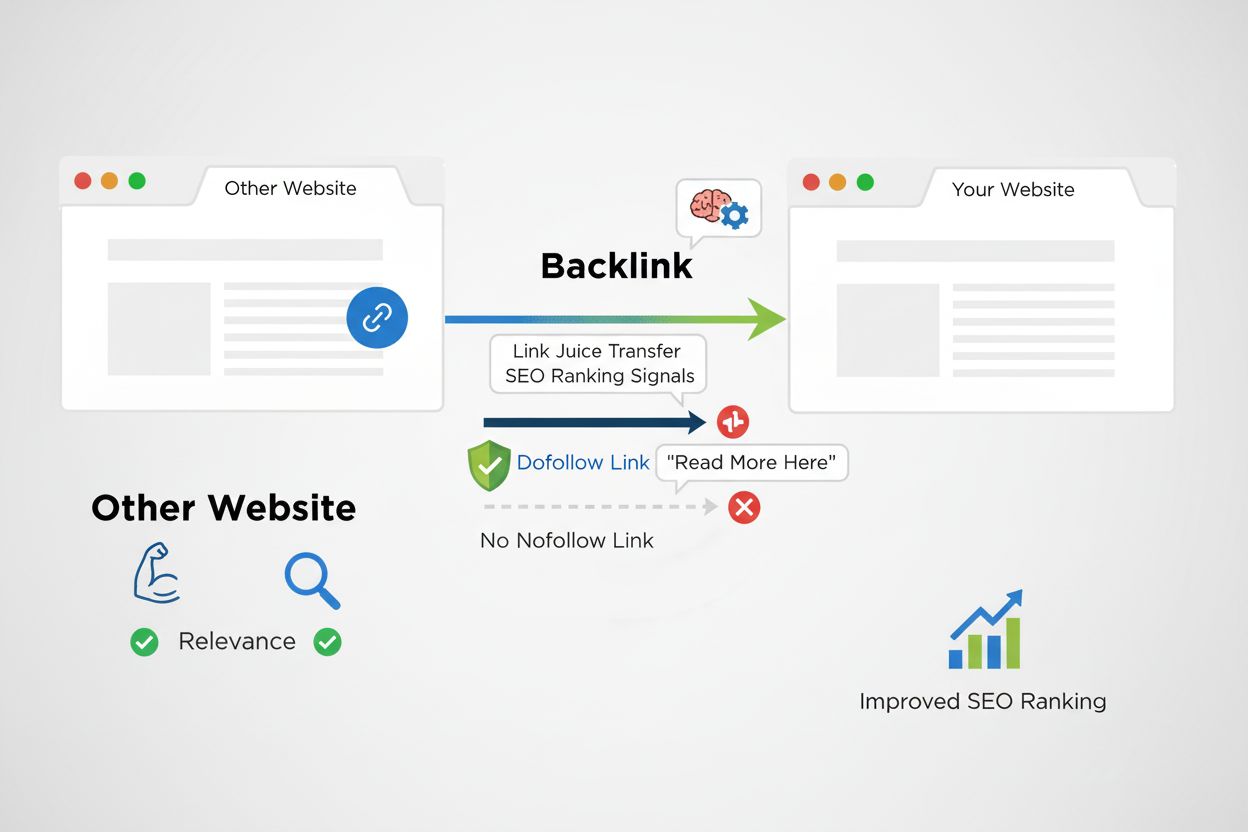
Learn what backlinks are, why they matter for SEO, and how they influence search rankings. Comprehensive guide to backlink quality, types, and monitoring for AI...
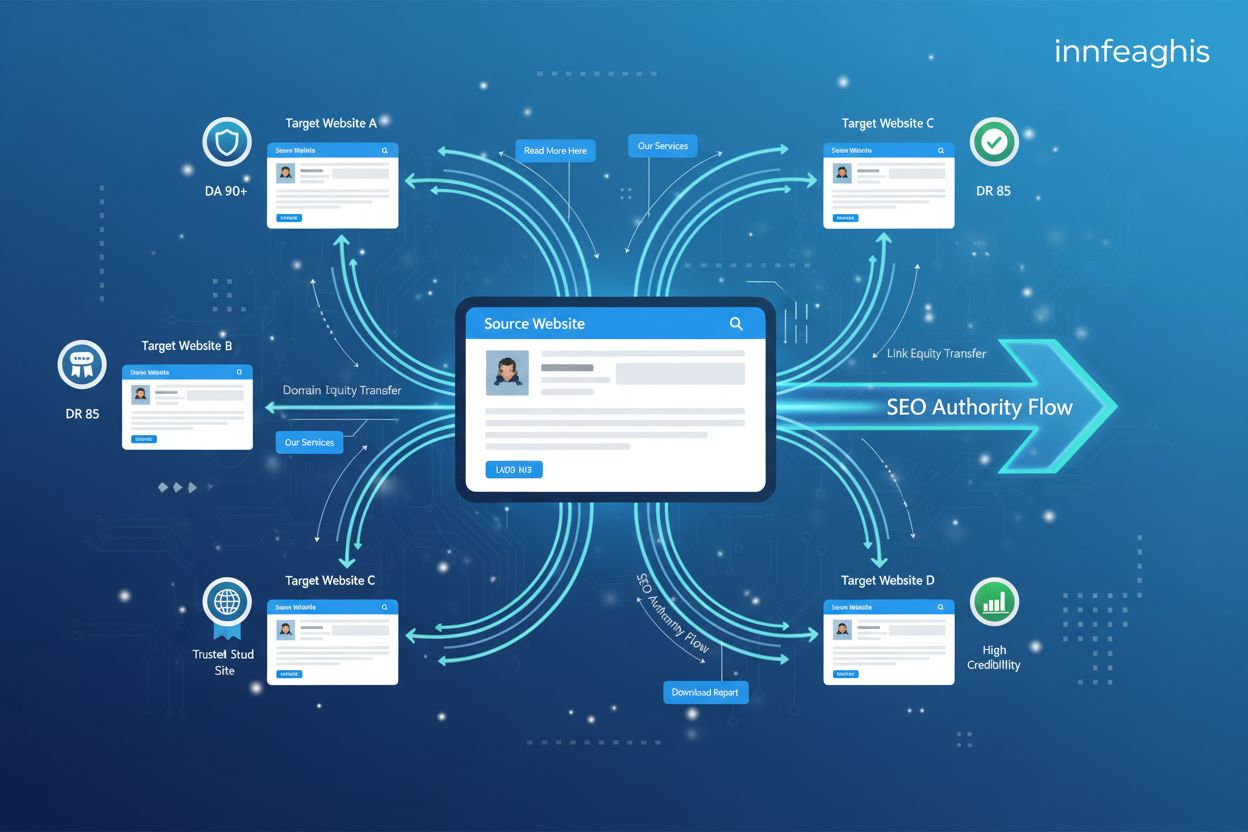
External linking explained: hyperlinks to other websites that improve credibility, user experience, and SEO. Learn best practices for outbound links and their r...