
Brand Mention
Learn what brand mentions are, why they matter for SEO and AI visibility, and how they differ from citations. Discover how unlinked brand references influence s...
12 min read
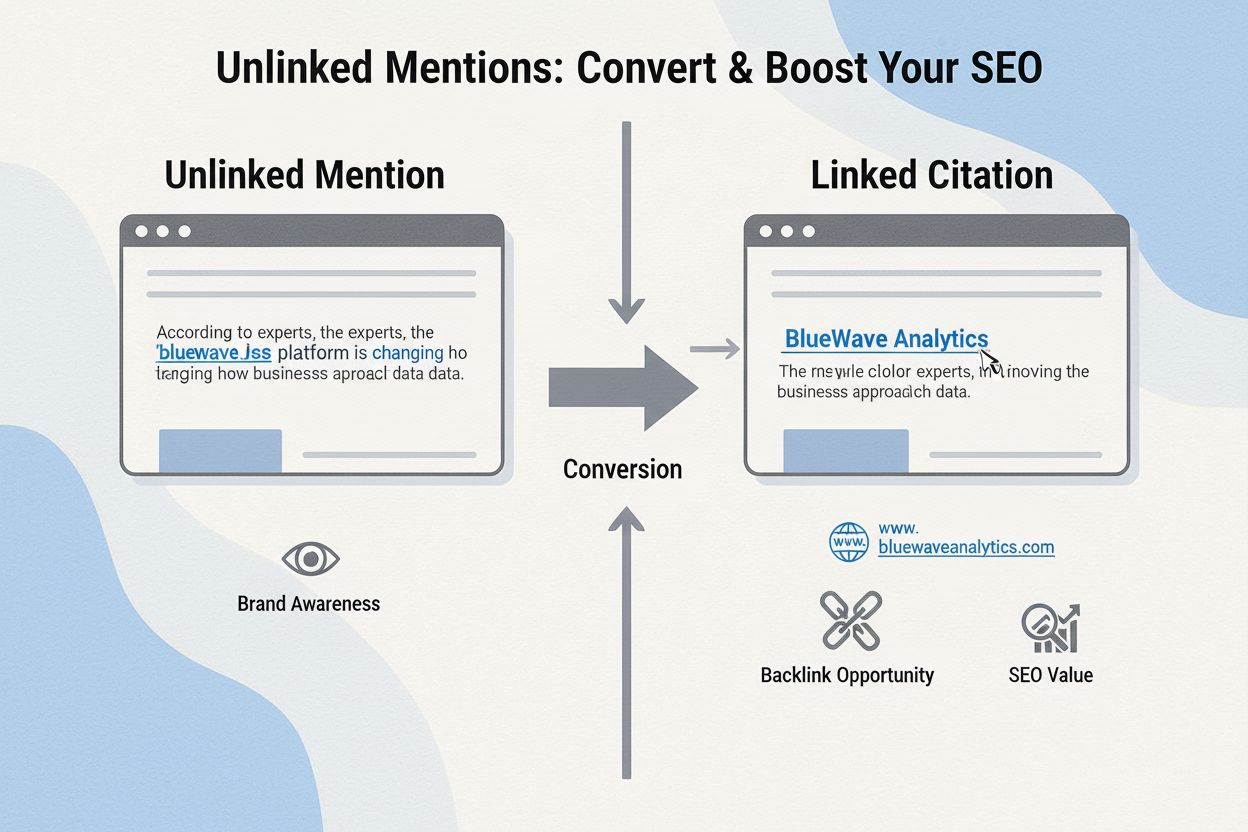
An unlinked brand mention is a reference to a brand, product, or company name in online content that does not include a hyperlink back to the brand’s website. These mentions signal brand awareness and authority but do not directly pass link equity, though they increasingly influence AI visibility and can be converted into backlinks through outreach.
An unlinked brand mention is a reference to a brand, product, or company name in online content that does not include a hyperlink back to the brand's website. These mentions signal brand awareness and authority but do not directly pass link equity, though they increasingly influence AI visibility and can be converted into backlinks through outreach.
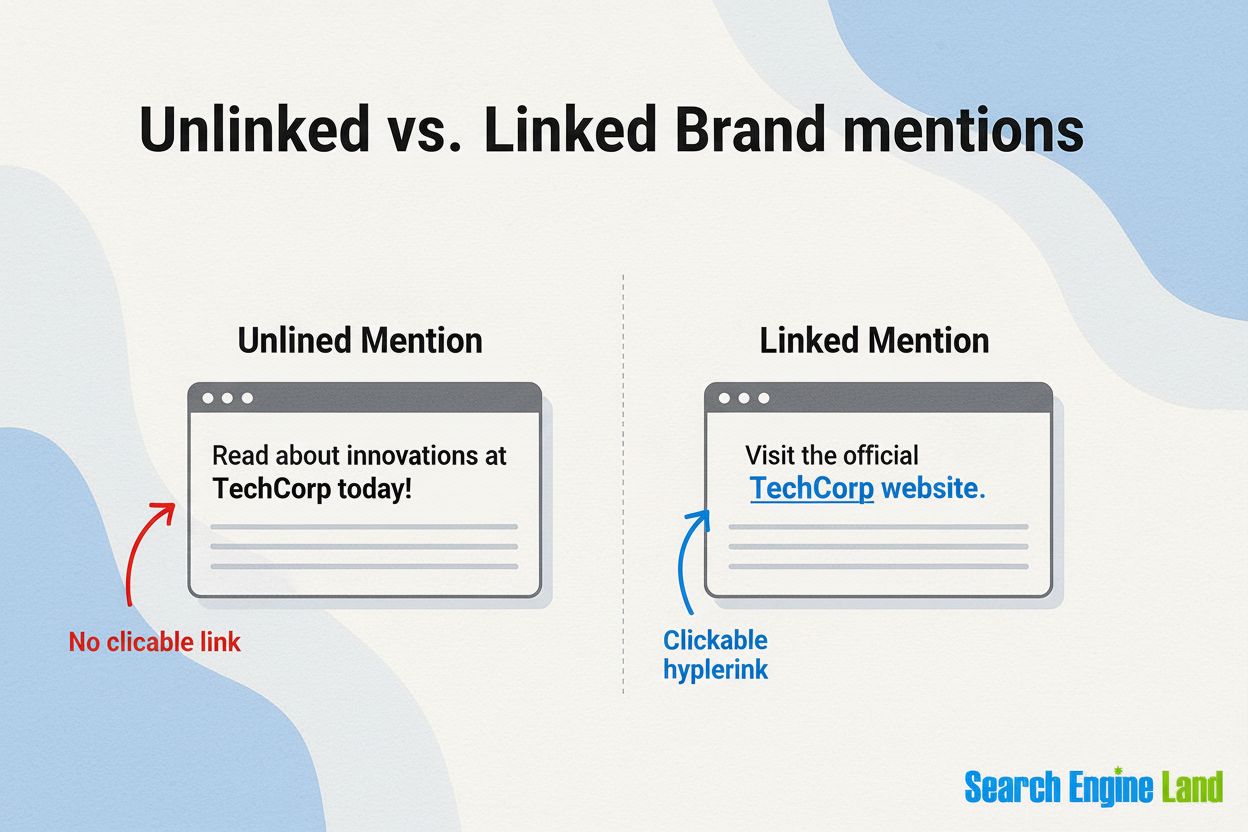
An unlinked brand mention is a reference to a brand, product, company name, or related entity in online content that does not include a hyperlink directing back to the brand’s website. These mentions signal brand awareness and establish contextual relevance within industry conversations, but they do not directly pass link equity or referral traffic. Unlinked brand mentions have evolved from being considered merely informational signals to becoming critical indicators of brand authority in both traditional search engine optimization and emerging AI-powered search systems. Unlike linked mentions, which provide measurable SEO benefits through domain authority transfer and click-through traffic, unlinked mentions operate as implicit endorsements that search engines and large language models increasingly recognize as authoritative signals. The distinction between linked and unlinked mentions has become particularly important as the digital landscape expands beyond traditional search engines to include AI platforms like ChatGPT, Perplexity, Google AI Overviews, and Claude, where brand mentions—whether linked or not—directly influence how often and how prominently a brand appears in AI-generated responses.
The concept of brand mentions in SEO has evolved significantly since the early days of search engine optimization. Initially, search engines like Google relied almost exclusively on backlinks as the primary signal of website authority and relevance. However, as the internet matured and linking practices became more sophisticated (and sometimes manipulated), search engines began recognizing that brand mentions without links could also indicate authority and trustworthiness. In 2022, Google’s John Mueller confirmed that unlinked mentions don’t pass the same SEO value as traditional links, yet emphasized that they remain valuable for brand awareness and recognition. This nuanced position reflects a broader shift in how search engines evaluate authority—moving from a purely link-centric model to a more holistic approach that considers entity recognition, brand popularity, and contextual relevance. The rise of digital PR as a distinct discipline has further elevated the importance of unlinked mentions, as PR professionals recognized that earning media coverage and industry mentions—whether linked or not—builds brand credibility that translates into improved search visibility. According to recent industry data, approximately 78% of enterprises now use AI-driven content monitoring tools to track brand mentions across multiple channels, indicating the growing recognition of mentions as a critical business metric beyond traditional SEO.
| Aspect | Linked Mention | Unlinked Mention |
|---|---|---|
| Definition | Brand reference with a clickable hyperlink to your website | Brand reference without a hyperlink |
| Link Equity | Passes domain authority and link equity to your site | Does not pass link equity directly |
| Referral Traffic | Generates direct traffic from readers clicking the link | No direct referral traffic from the mention itself |
| SEO Impact (Traditional) | Improves domain authority and keyword rankings | Supports entity recognition and brand authority signals |
| AI Visibility Impact | Cited as a source in LLM responses | Influences brand popularity and mention frequency in AI |
| Conversion Potential | Already optimized; limited improvement opportunity | Can be converted to linked mentions through outreach |
| Effort to Obtain | Requires more persuasion and relationship building | Often easier to secure through PR and content marketing |
| Authority Source | High-authority sites often selective about linking | High-authority sites more willing to mention without linking |
| Tracking Difficulty | Easier to track with backlink tools | Requires brand monitoring and content analysis tools |
| Strategic Value | Immediate SEO benefit; builds link profile | Long-term brand building; foundation for link conversion |
While unlinked brand mentions do not directly transfer link equity in the traditional sense, they contribute to SEO success through multiple indirect mechanisms. Search engines use mentions as signals of entity recognition—the ability to understand what a brand represents, what topics it’s associated with, and how authoritative it is within its industry. When a reputable website mentions your brand in the context of discussing industry solutions, best practices, or competitive analysis, search engines interpret this as validation of your brand’s relevance and expertise. This entity recognition becomes particularly important for branded search queries and knowledge graph optimization, where search engines need to understand the relationship between your brand and various topics. Additionally, unlinked mentions contribute to what SEO professionals call implied links—references that function as endorsements even without explicit hyperlinks. Google’s own documentation on the Panda algorithm update acknowledges that search engines can recognize and value these implied links. The cumulative effect of multiple unlinked mentions from authoritative sources creates a stronger brand signal that can improve rankings for branded keywords and related topic clusters. Research from Semrush’s AI Visibility Index demonstrates that brands with consistent, high-quality mentions across the web—regardless of whether those mentions include links—show improved visibility in search results and AI responses.
The emergence of large language models and AI-powered search has fundamentally changed how unlinked brand mentions should be evaluated. Unlike traditional search engines that rely heavily on link-based authority metrics, LLMs determine which sources to cite based on content quality, relevance, and brand popularity—essentially, how often a brand is mentioned and searched for across the web. According to the AI Visibility Index, citations and mentions by LLMs are determined by the content you post and the extent to which people talk about your brand, with no mention of link volumes or domain authority scores. This represents a paradigm shift where unlinked mentions may carry equal or greater weight than traditional backlinks. Research by Kevin Indig confirmed a strong correlation between brand popularity (measured by mentions and searches) and how frequently a brand appears in AI-generated responses. Notably, Semrush’s study on AI search impact found that nearly 9 out of 10 webpages cited by ChatGPT appear outside the top 20 results in standard organic search, indicating that AI systems use entirely different ranking signals than traditional search engines. For brands, this means that investing in earning unlinked mentions from authoritative sources—through PR, thought leadership, industry participation, and content marketing—directly influences AI visibility. A brand like Zapier demonstrates this principle: it ranks #1 in B2B SaaS for citations in AI responses but only #44 for traditional link-based metrics, proving that rich, frequently-mentioned content drives AI visibility more effectively than link volume.
The strategic value of unlinked brand mentions lies largely in their conversion potential. When a website mentions your brand without linking, you have a unique opportunity to reach out and request that the mention be converted to a link. This approach is considered one of the most effective link-building tactics because the author has already demonstrated familiarity with your brand and content—they’ve already done the research and decided your brand is worth mentioning. This dramatically increases the likelihood of a positive response compared to cold outreach for links. Advanced SEOs prioritize unlinked mention outreach because it offers several distinct advantages: first, sites that mention your brand clearly see value in your content, products, or expertise, making them more receptive to adding a link; second, these mentions often appear on high-authority sites that are selective about linking, making them particularly valuable; third, converting mentions builds genuine relationships with journalists, industry experts, and publications that can lead to ongoing coverage; and fourth, unlinked mention outreach is scalable—as your brand grows, you naturally accumulate more mentions that can be systematically converted. Research indicates that approximately 30% of brand mentions discovered through comprehensive content analysis are unlinked, representing significant untapped link-building potential for most organizations. The conversion process typically involves identifying the mention, evaluating the page’s authority and relevance, finding the appropriate contact, and sending a personalized outreach email explaining how adding a link would benefit readers.
Successfully leveraging unlinked brand mentions requires a systematic approach to identification and prioritization. Multiple methods exist for discovering unlinked mentions: brand monitoring tools like Semrush’s Brand Monitoring or Ahrefs’ Content Explorer can search for your brand name across millions of web pages; Google search operators using queries like "brandname" -site:yourdomain.com can reveal mentions across the indexed web; Google Alerts provide automated notifications of new mentions; reverse image searches identify stolen or unattributed images; and domain name typo analysis uncovers misspelled links that should point to your site. Once discovered, not all unlinked mentions warrant outreach—prioritization is essential. Key evaluation criteria include: the authority and relevance of the source (using metrics like Domain Authority or Authority Score); the placement and context of the mention within the content (editorial mentions carry more weight than sidebar references); the conversion and traffic potential (does the page’s audience align with your target customers?); content freshness (recent mentions are easier to convert); author relationship potential (does this author regularly cover your industry?); and page traffic and visibility (does the page rank for relevant keywords or appear in AI responses?). By systematically evaluating these factors, brands can focus their limited outreach resources on the highest-value opportunities, maximizing the return on their link-building efforts.
For platforms like AmICited that specialize in tracking brand appearances in AI responses, unlinked brand mentions represent a critical metric for understanding true brand visibility. While traditional SEO tools focus on backlinks and search rankings, AmICited monitors where brands appear in responses from ChatGPT, Perplexity, Google AI Overviews, and Claude—capturing both linked citations and unlinked mentions. This distinction is crucial because AI systems often cite sources without providing clickable links, instead simply naming the brand or source within the response text. Understanding the volume and quality of unlinked mentions in AI responses helps brands assess their authority in their industry and identify gaps in their visibility strategy. A brand might discover, for example, that it’s frequently mentioned in AI responses about its product category but rarely cited as a source, indicating a need for more authoritative, citable content. Conversely, high citation rates combined with lower mention rates might suggest that while the brand is recognized as authoritative, it’s not achieving sufficient brand awareness. By tracking both metrics, brands can develop more sophisticated visibility strategies that address both traditional SEO and emerging AI search dynamics. The integration of unlinked mention tracking into comprehensive AI monitoring platforms represents the evolution of brand visibility measurement beyond simple link counting.
Earning unlinked brand mentions requires a proactive, multi-channel approach that extends beyond traditional link-building tactics. Digital PR and thought leadership remain among the most effective methods—contributing expert commentary to industry publications, publishing original research, and participating in industry events naturally generates mentions from journalists and industry observers. Content marketing that addresses industry pain points and provides genuine value increases the likelihood that other websites will reference your brand as a solution or resource. Social media engagement amplifies brand visibility and encourages organic mentions as customers and industry peers discuss your brand in their networks. Community participation in forums, industry groups, and professional associations builds relationships that often result in mentions. When converting unlinked mentions to links, personalized outreach is essential—generic link-building emails have low success rates, while emails that reference the specific mention, explain why a link would benefit readers, and offer additional value (such as pointing out other improvements to the article) achieve significantly higher conversion rates. Timing matters—reaching out soon after publication, when the content is fresh in the author’s mind, increases responsiveness. Relationship building should be viewed as a long-term investment; authors who frequently cover your industry are worth cultivating as ongoing sources of coverage. Finally, quality over quantity ensures that your outreach efforts focus on mentions from authoritative, relevant sources rather than attempting to convert every possible mention.
The future importance of unlinked brand mentions is likely to increase as search continues to evolve. According to industry forecasts, 60% of Fortune 500 CMOs expect to prioritize LLM brand mentions over traditional SEO by 2026, reflecting the growing recognition that AI visibility depends more on brand mentions than on traditional link metrics. This shift suggests that the distinction between linked and unlinked mentions will become less relevant—what will matter most is whether your brand is being mentioned at all, and in what context. As AI systems become more sophisticated in understanding entity relationships and brand authority, the quality and frequency of mentions (linked or not) will likely become the primary determinant of visibility. This evolution favors brands that invest in genuine authority building, thought leadership, and industry participation over those that focus narrowly on link acquisition. The integration of brand mention tracking into mainstream SEO and marketing tools indicates that monitoring and optimizing for mentions is becoming as fundamental as keyword research and technical SEO. For brands, this means developing comprehensive mention strategies that span traditional PR, digital PR, content marketing, social media, and community engagement—recognizing that every mention, whether linked or not, contributes to long-term brand authority and visibility across both traditional search and AI platforms. The brands that recognize this shift early and adapt their strategies accordingly will likely achieve superior visibility in the AI-driven search landscape of the coming years.
Yes, unlinked brand mentions do have SEO value, though differently than linked mentions. Search engines like Google recognize brand mentions without links as signals of authority and brand relevance. According to Google's Search Quality Rating Guidelines, independent reputation information about a website can be as important as links. Additionally, search engines can identify 'implied links' where a brand is referenced as a credible source, even without an explicit hyperlink.
Unlinked brand mentions significantly influence how often your brand appears in AI-generated responses from platforms like ChatGPT, Perplexity, and Google AI Overviews. Research shows that LLM citations are determined more by content quality and brand popularity (how often people mention and search for your brand) than by traditional link metrics. According to the AI Visibility Index, brands with rich, frequently-mentioned content rank higher in AI responses regardless of domain authority scores.
A linked mention includes a hyperlink that directs readers to your website, passing link equity and referral traffic. An unlinked mention references your brand by name but contains no clickable link. While both signal brand authority, linked mentions provide additional SEO benefits through link equity and direct traffic, whereas unlinked mentions primarily influence brand recognition and AI visibility. Unlinked mentions represent conversion opportunities—they can often be transformed into linked mentions through outreach.
Converting unlinked mentions to backlinks is considered low-hanging fruit in link building because the author has already demonstrated familiarity with your brand by mentioning it. This makes them more receptive to adding a link. Additionally, unlinked mentions often appear on high-authority sites that are selective about linking, making them valuable opportunities. Research shows that approximately 30% of brand mentions found through content analysis are unlinked, representing significant untapped link-building potential for most brands.
Unlinked brand mentions extend beyond just your company name. They include references to product names (like 'iPhone' for Apple), service names, brand slogans, company representatives' names, event names, and even copyrighted images or designs used without attribution. Any unique identifier associated with your brand that appears in online content without a link back to your site qualifies as an unlinked mention. This broader definition means brands have multiple opportunities to find and convert mentions into links.
Multiple methods exist for finding unlinked mentions: use brand monitoring tools like Semrush's Brand Monitoring or Ahrefs' Content Explorer to search for your brand name across the web; employ Google search operators like 'intext:brandname -site:yourdomain.com'; set up Google Alerts for automatic notifications; check backlinks to your social media profiles; perform reverse image searches for stolen content; and monitor domain name misspellings. Tools like Screaming Frog can then filter results to identify which mentions lack links back to your site.
Unlinked mentions contribute to brand authority by establishing your company as a recognized entity in your industry. When reputable websites mention your brand contextually, they're essentially vouching for your expertise and relevance, even without a link. This builds what search engines call 'entity recognition'—the ability for search engines to understand what your brand represents and how it relates to industry topics. Over time, consistent unlinked mentions from authoritative sources strengthen your brand's perceived authority in search results and AI systems.
Start tracking how AI chatbots mention your brand across ChatGPT, Perplexity, and other platforms. Get actionable insights to improve your AI presence.
Learn what brand mentions are, why they matter for SEO and AI visibility, and how they differ from citations. Discover how unlinked brand references influence s...
Discover how web mentions and third-party references influence AI citations. Learn why LLMs prioritize brand mentions over backlinks and strategies to increase ...
Learn what nofollow links are, how they differ from dofollow links, their impact on SEO and AI search visibility, and when to use them in your link strategy.