

What is an AI Visibility Score and How Does It Measure Brand Presence?
Learn what an AI visibility score is, how it measures your brand's presence in AI-generated answers across ChatGPT, Perplexity, and other AI platforms, and why ...
11 min read
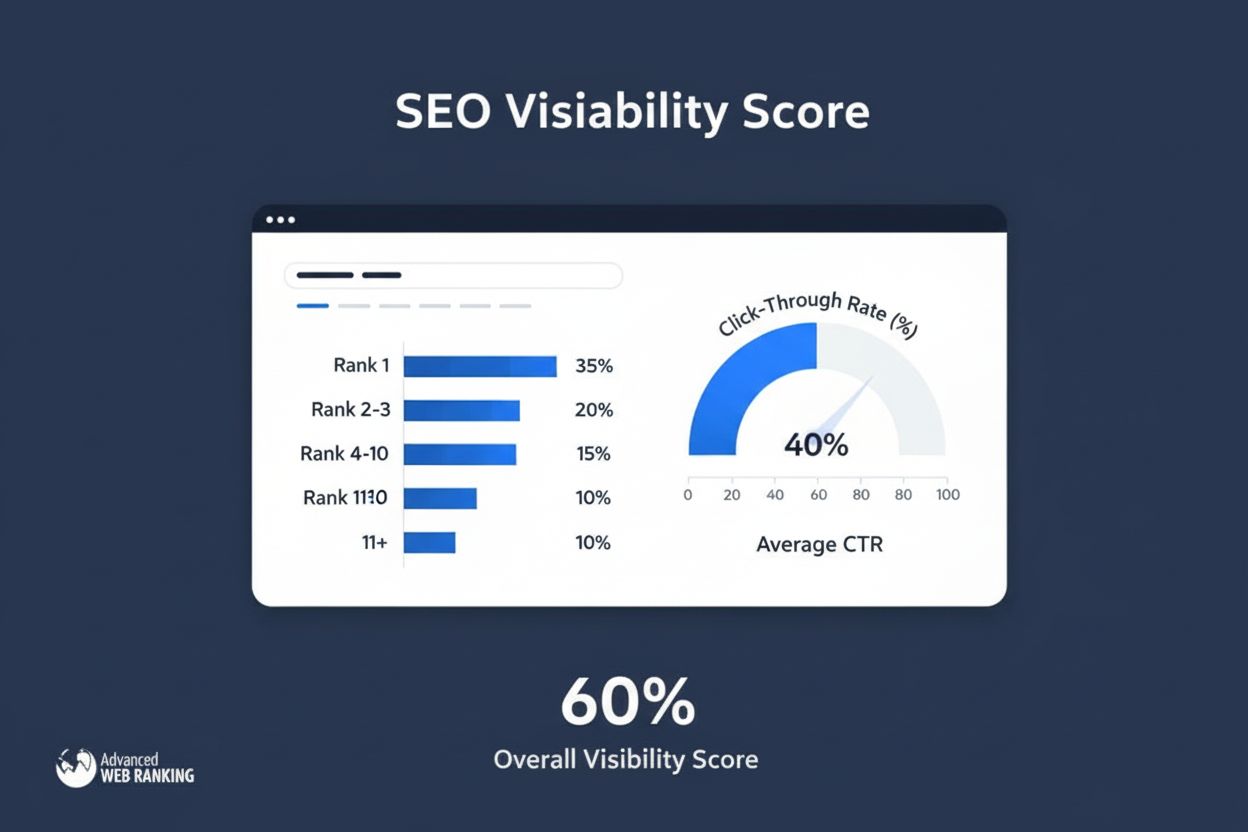
A visibility score is a metric that measures a website’s search presence by calculating the estimated percentage of clicks a domain receives based on its organic ranking positions across tracked keywords. It combines ranking positions with click-through rate (CTR) data to provide a comprehensive view of overall search engine visibility rather than focusing on individual keyword rankings.
A visibility score is a metric that measures a website's search presence by calculating the estimated percentage of clicks a domain receives based on its organic ranking positions across tracked keywords. It combines ranking positions with click-through rate (CTR) data to provide a comprehensive view of overall search engine visibility rather than focusing on individual keyword rankings.
Visibility Score is a quantitative metric that measures how prominently a website appears in search engine results by calculating the estimated percentage of clicks a domain receives based on its organic ranking positions across all tracked keywords. Rather than simply measuring where a website ranks for individual keywords, visibility score provides a holistic view of overall search presence by weighting each ranking position according to its estimated click-through rate (CTR). This metric has become fundamental to modern SEO reporting and is now expanding into AI search visibility monitoring as platforms like ChatGPT, Perplexity, and Claude reshape how users discover brands. The visibility score transforms raw ranking data into actionable insights that directly correlate with search traffic potential, making it one of the most important performance indicators for digital marketers and SEO professionals.
The visibility score concept emerged from the recognition that not all ranking positions generate equal traffic value. A website ranking first for a high-volume keyword generates substantially more clicks than one ranking tenth for the same term. Traditional metrics like average ranking position fail to capture this reality because they treat all positions equally. Visibility score solves this problem by applying estimated click-through rates to each ranking position, then aggregating these values across your entire keyword portfolio. According to research from Backlinko analyzing over 5 million Google search results, the first position in Google search results receives approximately 35% of all clicks, while the third position receives only 18.6%. This variance in CTR by position is the foundation upon which visibility score calculations rest. By understanding that visibility is not uniform across rankings, SEO professionals can better prioritize optimization efforts and communicate the true impact of their work to stakeholders.
The calculation of visibility score follows a standardized methodology used by major SEO platforms including Semrush, Moz, and Advanced Web Ranking. The process begins by collecting all ranking positions for every keyword in your tracking campaign. For each ranking position, the tool applies an estimated click-through rate based on historical data and industry benchmarks. These CTR values are then multiplied by the search volume for each keyword to estimate the number of clicks your domain would receive. All estimated clicks are summed together and divided by the total potential clicks available across all tracked keywords, resulting in a percentage score ranging from 0% to 100%. For example, if you rank first for a keyword with 1,000 monthly searches (approximately 35% CTR = 350 estimated clicks) and tenth for another keyword with 500 searches (approximately 5% CTR = 25 estimated clicks), your combined estimated clicks would be 375 out of a potential 1,500 clicks, yielding a visibility score of 25%. This methodology ensures that high-volume keywords and top rankings have proportionally greater impact on your overall score, reflecting their actual contribution to search traffic.
| Metric | Definition | Calculation Method | Best For | Limitations |
|---|---|---|---|---|
| Visibility Score | Estimated percentage of clicks from organic rankings | CTR × Search Volume across all keywords | Overall search presence and trend analysis | Relies on estimated CTR and search volume data |
| Average Ranking Position | Mean ranking position across tracked keywords | Sum of all positions ÷ number of keywords | Quick position overview | Doesn’t account for search volume or CTR differences |
| Organic Traffic (GA4) | Actual sessions from organic search | Direct measurement from analytics | Real traffic validation | Affected by non-SEO factors like seasonality |
| Click Potential | Estimated clicks available for tracked keywords | Search Volume × Average CTR for position | Opportunity identification | Doesn’t reflect actual ranking performance |
| Domain Authority | Overall site authority score | Backlink profile analysis | Long-term ranking potential | Doesn’t measure current search visibility |
| Share of Voice | Your visibility vs. competitors | Your visibility ÷ (Your + Competitors’ visibility) | Competitive benchmarking | Requires competitor tracking setup |
The accuracy of visibility score depends heavily on the click-through rate curves used in calculations. Different SEO tools employ different CTR models based on their proprietary research or third-party data. Semrush’s visibility score uses CTR data derived from millions of search queries, while Moz’s search visibility metric incorporates click data from their own research. Advanced Web Ranking employs a pixel-based visibility measurement that accounts for how far down the search results page your listing appears, recognizing that SERP features like featured snippets, knowledge panels, and ads significantly impact actual visibility. These variations mean that the same website can have different visibility scores across different tools. The most reliable approach is to choose one tool and track your visibility score consistently over time, using it as an internal benchmark rather than comparing scores across platforms. Understanding your chosen tool’s methodology is essential for proper interpretation—some tools weight by search volume while others use points-based systems that don’t account for keyword difficulty or search demand.
The concept of visibility score is evolving as search behavior shifts toward AI-powered platforms. In traditional SEO, visibility score measures ranking positions in Google’s organic results, where users see a list of websites and choose which to click. However, AI search engines like ChatGPT, Perplexity, Claude, and Google AI Overviews operate differently—they synthesize information from multiple sources and present a single generated answer, often citing only a few sources. This fundamental difference means that traditional visibility score metrics no longer capture the full picture of search presence. A new form of visibility score is emerging for AI search, measuring how frequently your brand is mentioned, cited, or recommended in AI-generated responses. According to research from Search Engine Land, 58% of consumers have replaced traditional search engines with generative AI tools for product recommendations, making AI visibility score increasingly critical. Brands must now track both traditional visibility scores and AI visibility scores to understand their complete search presence. AmICited and similar platforms now monitor visibility scores across ChatGPT, Perplexity, Claude, Gemini, and Google AI Overviews, providing a comprehensive view of where brands appear across the entire search ecosystem.
Many SEO professionals focus on achieving top-three rankings for specific keywords, but visibility score provides a more strategic perspective. A website might rank first for ten low-volume keywords and tenth for one high-volume keyword—the individual rankings look mixed, but the visibility score accurately reflects that the high-volume ranking generates far more traffic potential. This metric helps teams understand the true impact of their SEO efforts and allocate resources more effectively. According to Moz research, websites should aim for a visibility score between 35-45% for non-branded keywords, as this represents realistic click-through rates for top-ranking positions. The advantage of tracking visibility score is that it automatically accounts for changes in search volume, algorithm updates, and competitive dynamics. When your visibility score drops, it could indicate ranking declines, reduced search volume for your keywords, or increased competition—all valuable insights that individual ranking data alone cannot provide. This comprehensive view makes visibility score essential for communicating SEO value to stakeholders and making data-driven optimization decisions.
Visibility score naturally fluctuates due to various factors, and understanding these fluctuations is crucial for proper interpretation. A sudden drop in visibility score could result from algorithm updates, technical issues, ranking declines, or changes to your keyword tracking dataset. According to Advanced Web Ranking’s analysis of visibility changes, the most common causes include canonical tag errors, robots.txt blocking, noindex tags, site speed issues, and internal linking changes. When investigating visibility score drops, start by checking Google Search Console for crawl errors and indexation issues. Next, verify that your website’s technical SEO is sound—check for accidental noindex tags, robots.txt restrictions, and Core Web Vitals compliance. If technical issues aren’t the cause, analyze your ranking changes using your SEO tool’s rank tracking feature to identify which keywords lost positions. Algorithm updates often cause visibility fluctuations; tools like MozCast, Semrush Sensor, and Accuranker Grump help identify when major updates occur. Finally, consider competitive factors—your visibility score might decline not because your rankings fell, but because competitors improved their rankings for high-volume keywords. Understanding the root cause of visibility score changes enables targeted optimization efforts and prevents wasted resources on irrelevant fixes.
The expansion of search beyond Google has created new dimensions for visibility score measurement. While traditional visibility score focuses on Google organic results, modern digital marketing requires tracking visibility across multiple platforms. AI visibility score measures brand mentions and citations in ChatGPT, Perplexity, Claude, Gemini, and Google AI Overviews. Each platform has different data sources, retrieval methods, and citation patterns. According to research from Search Engine Land, Google AI Overviews cite retailers only 4% of the time, while ChatGPT cites them 36% of the time—a dramatic difference that shows how platform-specific visibility scores can be. YouTube visibility is another critical dimension, as video content increasingly appears in search results. Local search visibility requires tracking Google Business Profile prominence and local pack rankings. Social media platforms like TikTok and Reddit now influence search visibility as users increasingly search these platforms directly. A comprehensive visibility score strategy requires monitoring presence across all these channels, not just traditional Google organic search. AmICited and similar platforms now provide unified dashboards that track visibility scores across multiple search channels, giving brands a complete picture of their search presence in the modern, fragmented search landscape.
Improving your visibility score requires a strategic, multi-faceted approach that addresses both technical and content factors. Start by conducting keyword research to identify high-volume, achievable keywords that align with your business goals. Focus on long-tail keywords with lower competition, as these are easier to rank for and can quickly improve your visibility score. Create comprehensive, high-quality content that thoroughly addresses search intent for your target keywords. Optimize your title tags and meta descriptions to improve click-through rates from search results—even if your ranking position doesn’t change, improving CTR directly increases your visibility score. Build high-quality backlinks from relevant, authoritative websites in your industry, as link authority is a primary ranking factor. Ensure your website is mobile-friendly and meets Core Web Vitals standards, as Google now uses these as ranking signals. Implement proper internal linking to distribute authority to important pages and establish clear site structure. Monitor your visibility score weekly and investigate significant changes to identify optimization opportunities or technical issues. Label your keywords by topic or business objective so you can track visibility scores for specific keyword clusters over time. Finally, benchmark your visibility score against direct competitors to identify gaps and opportunities where you can gain market share in search results.
As artificial intelligence reshapes search behavior, the definition and measurement of visibility score continues to evolve. Traditional visibility score metrics based on ranking positions and CTR will remain important for Google and traditional search engines, but AI visibility score is becoming equally critical. The shift from ranked lists to synthesized answers means that appearing in search results is no longer sufficient—brands must be cited as authoritative sources in AI-generated responses. This requires a different optimization approach focused on fact density, structured data, entity authority, and semantic relevance rather than keyword optimization alone. Research from Princeton University and Georgia Tech suggests that adding citations and quotes to content boosts AI visibility by over 40%, indicating that AI visibility scores reward authoritative, well-sourced content. As AI search platforms continue to evolve and gain market share, brands will need to track multiple visibility score metrics simultaneously—traditional search visibility, AI visibility scores across different platforms, and emerging metrics for new search interfaces. The tools and methodologies for measuring visibility score will continue to advance, incorporating real-time data, multimodal search (images, video, voice), and location-based variations. Organizations that understand and optimize for both traditional and AI visibility scores will maintain competitive advantage as search continues to fragment across multiple platforms and interfaces.
While average ranking position treats all keywords equally regardless of search volume or CTR potential, visibility score weights rankings by their estimated click-through rates. A website ranking first for one keyword and 100th for another has a much higher visibility score than one ranking 50th for both keywords, because the first-position ranking generates significantly more clicks. This makes visibility score a more accurate reflection of actual search traffic potential than average position alone.
Industry experts recommend targeting a visibility score between 35-45% for non-branded keywords, as this represents the average click-through rate for top-ranking positions. However, the ideal score depends on your industry, competition level, and keyword mix. Rather than focusing on an absolute number, it's more valuable to track your visibility score over time and benchmark it against direct competitors to measure relative performance and progress.
Adding new keywords to your tracking campaign can lower your overall visibility score because new keywords typically rank lower than your established keywords. To avoid this confusion, label your keywords when you add them so you can compare visibility for specific keyword clusters over time. This allows you to measure the true impact of your SEO efforts without the artificial fluctuations caused by changing your keyword dataset.
Theoretically, a visibility score of 100% would mean your domain ranks in the first position for every single keyword you're tracking, which is virtually impossible in real-world scenarios. In practice, even the most dominant websites rarely achieve visibility scores above the mid-40s for non-branded keywords. A score of 100% would only be realistic if you were tracking exclusively branded keywords where your brand has complete market dominance.
Visibility score estimates potential traffic based on ranking positions and CTR data, but actual traffic depends on many additional factors including search volume trends, user behavior changes, seasonality, and whether users actually click through to your site. A high visibility score indicates strong ranking potential, but doesn't guarantee traffic increases if search demand for your keywords is declining or if your click-through rates are lower than industry averages.
Major SEO tools like Semrush, Moz, and Advanced Web Ranking all calculate visibility score using percentage-based methodologies that consider search volume and CTR, but they may use different CTR curves and data sources. Some tools use points-based systems, while others use pixel-based measurements that account for SERP features. It's important to understand your chosen tool's methodology and use it consistently for benchmarking rather than comparing scores across different platforms.
Most SEO professionals recommend monitoring visibility score at least weekly to catch significant changes early, though daily tracking is common for competitive industries. Weekly monitoring allows you to identify trends and correlate visibility changes with algorithm updates, content changes, or competitive activity. However, visibility scores naturally fluctuate, so looking at monthly or quarterly trends is often more meaningful than obsessing over daily changes.
Start tracking how AI chatbots mention your brand across ChatGPT, Perplexity, and other platforms. Get actionable insights to improve your AI presence.
Learn what an AI visibility score is, how it measures your brand's presence in AI-generated answers across ChatGPT, Perplexity, and other AI platforms, and why ...

Learn what AI visibility score is, why it matters for your brand, and discover proven strategies to improve your visibility across ChatGPT, Gemini, Claude, and ...
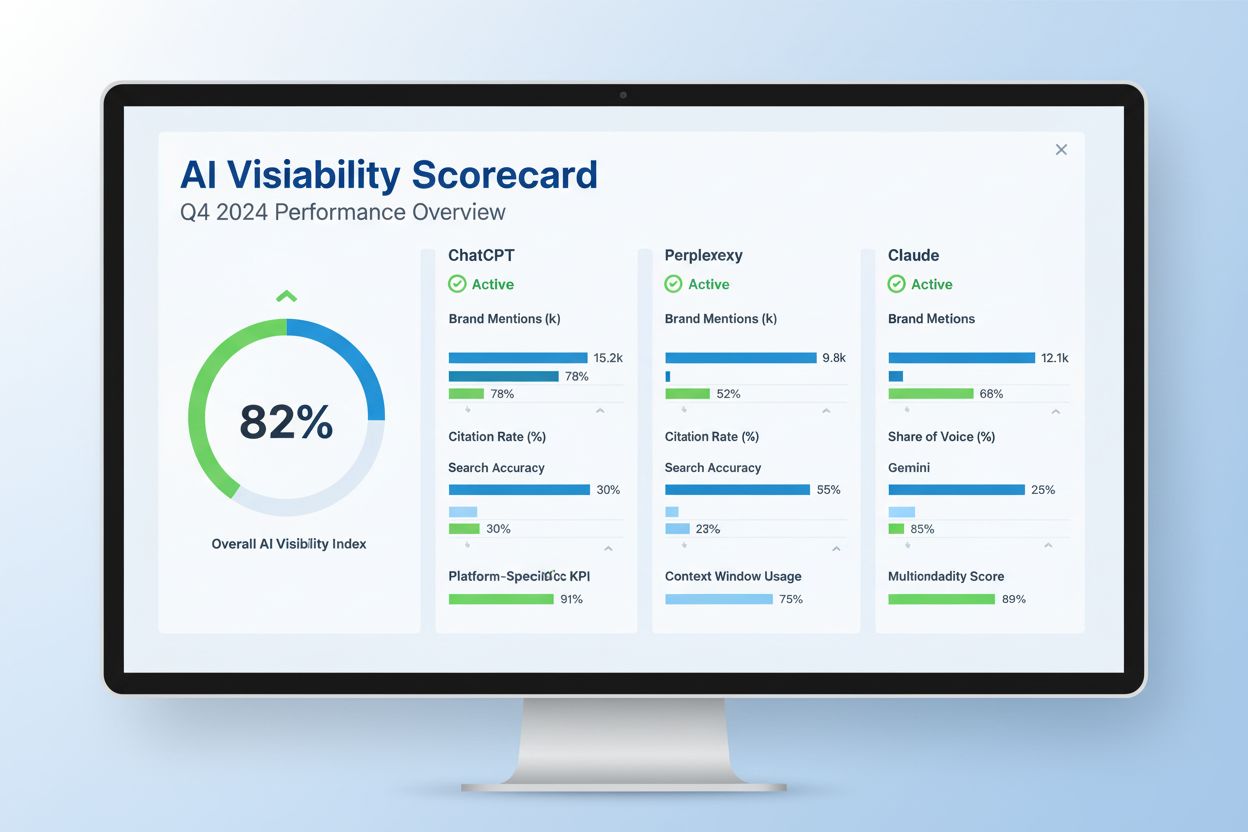
Learn what an AI Visibility Score is and how it measures your brand's presence across ChatGPT, Perplexity, Claude, and other AI platforms. Essential metric for ...