

Voice-First AI Optimization
Learn what voice-first AI optimization is and how to optimize your brand for voice assistants, smart speakers, and conversational AI. Discover strategies for fe...
8 min read
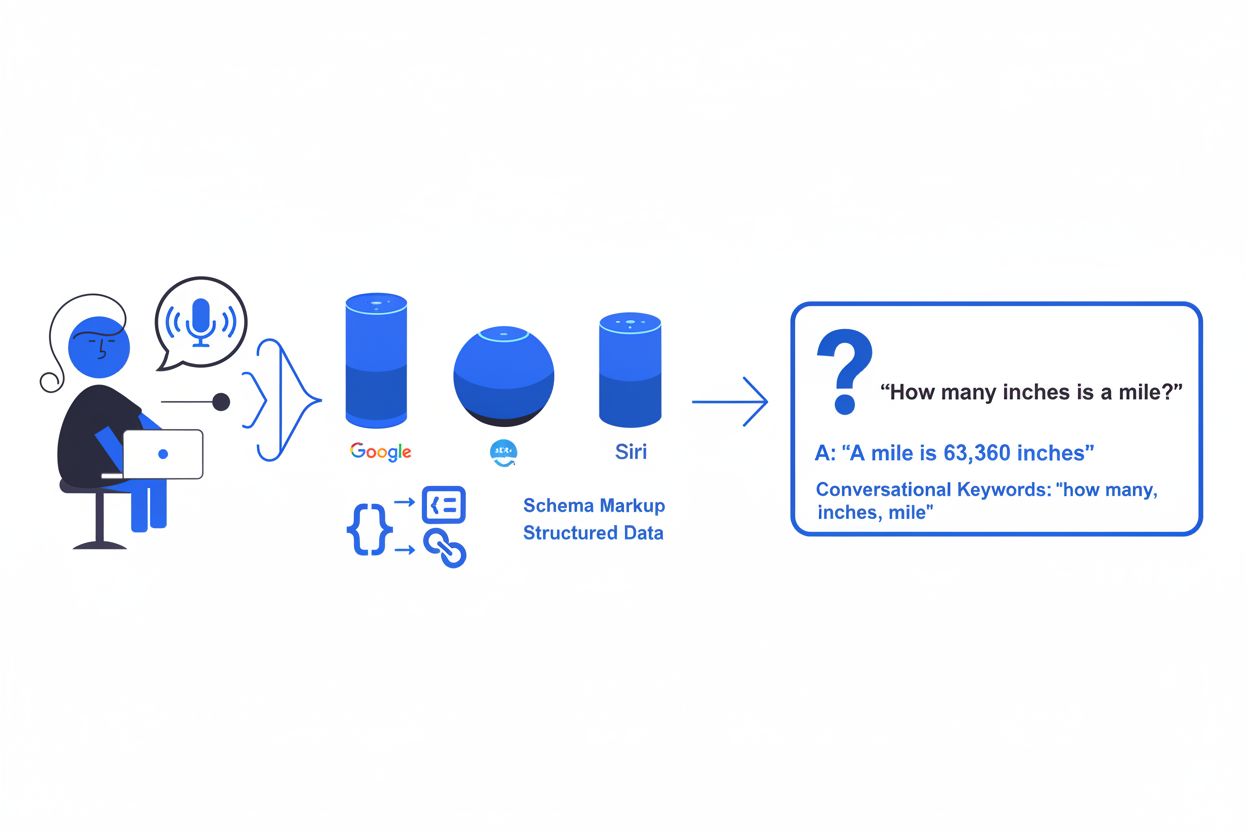
Voice Search Optimization (VSO) is the process of optimizing website content and technical infrastructure to rank higher in voice-activated search results from devices like smart speakers, smartphones, and voice assistants. It involves targeting conversational, long-tail keywords and ensuring content appears in featured snippets, which voice assistants prioritize when delivering answers to users.
Voice Search Optimization (VSO) is the process of optimizing website content and technical infrastructure to rank higher in voice-activated search results from devices like smart speakers, smartphones, and voice assistants. It involves targeting conversational, long-tail keywords and ensuring content appears in featured snippets, which voice assistants prioritize when delivering answers to users.
Voice Search Optimization (VSO) is the strategic process of tailoring website content, technical infrastructure, and metadata to rank higher in voice-activated search results. Unlike traditional text-based search engine optimization, voice search optimization focuses on how users naturally speak when interacting with voice assistants like Google Assistant, Amazon Alexa, Apple Siri, and Microsoft Cortana. The primary goal is to ensure your content appears as the answer when users ask questions aloud to their devices. This emerging discipline combines traditional SEO principles with voice-specific strategies, recognizing that voice queries are fundamentally different from typed searches in structure, intent, and delivery mechanism. As of 2025, approximately 20.5% of people worldwide actively use voice search, representing nearly 1 in 5 individuals globally, with this figure continuing to climb steadily.
Voice search technology has evolved dramatically since its inception, transforming from a novelty feature to an essential component of digital strategy. The proliferation of smart speakers has been a primary driver of this growth, with 98 million smart speaker users in the United States as of 2024. Beyond smart speakers, voice search is now accessible through smartphones (56% of users), smart TVs (34%), cars (29%), computers (24%), tablets (24%), and household appliances (12%). This widespread adoption reflects a fundamental shift in consumer behavior, particularly among younger demographics. 57% of voice command users employ this feature daily, and research indicates that voice search is projected to grow at a compound annual growth rate (CAGR) of 23.8% from 2024 to 2030. The market opportunity is substantial, with voice search generating over $24 billion in revenue in 2023 and projections suggesting it could reach $112.5 billion by 2033. This explosive growth underscores why businesses cannot afford to ignore voice search optimization in their digital marketing strategies.
The distinction between voice search and text-based search extends far beyond the input method. Voice searches are characteristically longer and more conversational, reflecting how people naturally speak. A user might type “best Italian restaurant NYC” but ask a voice assistant “What’s the best Italian restaurant in New York City that’s open now?” This conversational nature means voice search optimization requires targeting long-tail keywords that mirror everyday speech patterns. Voice searches also demonstrate stronger local intent, with 76% of voice queries containing ’near me’ or location-based terms. The search intent behind voice queries is often more specific and contextual, as users are typically seeking immediate answers to pressing questions. Additionally, voice assistants return only one primary answer rather than a list of results, making ranking in the top positions exponentially more valuable. The average voice search result contains only 29 words, emphasizing the need for concise, direct answers. Voice searches also load significantly faster, with the average voice search result page loading in 4.6 seconds, compared to standard web pages that may take considerably longer.
| Aspect | Voice Search Optimization | Traditional Text SEO | Local SEO |
|---|---|---|---|
| Query Type | Conversational, question-based, long-tail | Short-tail, keyword-focused | Location-specific, “near me” queries |
| Average Query Length | 5-10+ words | 1-3 words | 3-5 words with location |
| Primary Ranking Factor | Featured snippets (40.7% of results) | Backlinks and domain authority | Google Business Profile accuracy |
| Content Format | FAQ pages, direct answers, bullet points | Blog posts, pillar pages | Local business listings, reviews |
| Device Focus | Smart speakers, smartphones | Desktop and mobile | Mobile and local devices |
| Search Intent | Immediate answers, local services | Information, navigation, commercial | Find nearby businesses/services |
| Page Load Speed | Critical (under 5 seconds) | Important (under 3 seconds) | Important for mobile experience |
| Schema Markup | LocalBusiness, FAQ, Speakable | General schema types | LocalBusiness, Organization |
| Result Delivery | Single answer read aloud | List of 10+ results | Map pack + local listings |
| Optimization Timeline | Ongoing, voice-specific adjustments | Continuous, broader approach | Regular updates to business info |
Voice search optimization relies on sophisticated technical infrastructure that enables devices to understand and respond to spoken queries. The process begins with automatic speech recognition (ASR) technology, which converts voice signals into text that search engines can process. Once converted to text, the query undergoes natural language processing (NLP), allowing search engines to understand context, intent, and semantic meaning beyond simple keyword matching. This is why conversational keywords and natural language are so critical—search engines must comprehend the meaning behind what users are asking. Structured data markup, particularly schema markup, plays a vital role by helping search engines extract and understand specific information from your website. Implementing LocalBusiness schema, FAQ schema, Product schema, and Speakable schema enables voice assistants to pull relevant information more effectively. Mobile optimization is non-negotiable, as most voice searches occur on mobile devices. Page speed directly impacts voice search rankings, with faster-loading pages receiving preference from search algorithms. Additionally, HTTPS security, mobile-first indexing, and crawlability are foundational technical elements that support voice search visibility.
Featured snippets, commonly referred to as position zero, are the most critical ranking factor for voice search optimization. Research shows that 40.7% of all voice search answers are pulled from featured snippets, making them the primary target for voice search strategies. Featured snippets appear at the top of Google search results and contain concise, direct answers to user queries. Voice assistants prioritize these snippets because they provide ready-made answers that can be read aloud to users. To capture featured snippets, content must be structured strategically with clear headings, bullet points, numbered lists, and direct answers to common questions. The ideal featured snippet answer is 40-50 words, providing enough detail without overwhelming the listener. FAQ pages are particularly effective for voice search because they naturally structure content as questions and answers. When optimizing for featured snippets, focus on answering the “who, what, where, when, why, and how” questions your audience asks. Content that ranks in the top three organic search results has significantly higher chances of being selected as a voice search answer, emphasizing the importance of strong foundational SEO alongside voice-specific optimization.
Local SEO and voice search optimization are deeply intertwined, with local search representing the dominant use case for voice queries. More than half of voice searches have local intent, with users frequently asking for nearby restaurants, shops, services, and directions. This local focus makes Google Business Profile optimization absolutely essential for voice search success. Your business information must be accurate and complete, including your business name, address, phone number (NAP), hours of operation, website URL, and service areas. Customer reviews play an increasingly important role, as voice assistants consider review ratings and content when selecting which business to recommend. Creating location-specific content pages for each business location helps voice assistants understand your service areas and improves visibility for hyper-local queries. Incorporating local keywords naturally throughout your website, particularly in headings and body content, signals relevance to voice search algorithms. Schema markup for local businesses enables search engines to extract structured information about your location, hours, and services. Businesses that excel at local voice search optimization capture foot traffic and same-day visits more effectively, as voice searchers are typically in immediate need of services or products.
Creating voice-friendly content requires a fundamental shift in how you approach writing and content structure. Conversational language is paramount—content should sound natural when read aloud by a voice assistant, avoiding robotic phrasing and technical jargon. Long-tail keywords should be woven naturally into your content, reflecting how people actually speak rather than how they type. Question-based content performs exceptionally well, as voice searches are inherently question-driven. Creating comprehensive FAQ pages that address common customer questions provides an ideal format for voice search optimization. Each answer should be direct and concise, typically 1-2 sentences, written at approximately a 9th-grade reading level for maximum clarity. Bullet points and numbered lists break up content into scannable, voice-friendly formats. Structuring your content with clear H2 headings helps search engines understand your content hierarchy and identify relevant sections for voice search answers. Local keywords should be incorporated naturally, particularly phrases like “near me,” neighborhood names, and landmarks. The goal is to create content that simultaneously serves human readers and voice assistants, providing value to both audiences while optimizing for search visibility.
Successful voice search optimization requires a systematic approach combining multiple strategies. First, conduct a voice search audit by testing your website using actual voice assistants—ask questions related to your business and analyze what results appear. This reveals gaps in your optimization efforts and identifies opportunities for improvement. Keyword research should focus on identifying conversational keywords and question-based queries using tools like AnswerThePublic, AlsoAsked, and SE Ranking. Implement schema markup across your website, prioritizing LocalBusiness, FAQ, Product, and Speakable schemas. Optimize your Google Business Profile with complete, accurate information and encourage customers to leave reviews. Improve page speed by compressing images, minifying code, implementing caching, and optimizing your hosting. Create FAQ pages that directly answer common customer questions in voice-friendly formats. Ensure your website is mobile-optimized with responsive design and fast load times. Monitor your performance by tracking featured snippet appearances, long-tail keyword rankings, local search visibility, and mobile traffic increases. Regularly test your content with voice assistants to ensure it’s being selected as answers to relevant queries.
As voice search becomes increasingly important for brand visibility, monitoring your presence across voice assistants and AI search platforms has become essential. AI monitoring platforms like AmICited, Otterly.ai, and SE Ranking’s AI Tracking enable businesses to track where their brand appears in voice search results across Google Assistant, Alexa, Siri, Perplexity, ChatGPT, and other voice-enabled platforms. These tools provide insights into how your content ranks for voice queries, which voice assistants prioritize your content, and how competitors are performing in voice search results. Understanding your brand visibility across voice platforms helps you identify optimization opportunities and track the effectiveness of your voice search optimization efforts. AI monitoring reveals which keywords trigger your brand mentions, how often your content appears in voice search results, and whether your optimization strategies are driving visibility. This data is particularly valuable for businesses with strong local presence or those targeting specific voice assistant user bases. By monitoring your voice search performance alongside traditional SEO metrics, you gain a comprehensive understanding of your overall search visibility and can make data-driven decisions about your optimization strategy.
The landscape of voice search optimization continues to evolve rapidly, driven by advances in artificial intelligence and natural language processing. Voice commerce is emerging as a significant opportunity, with the global voice search market projected to reach $151.39 billion in 2025, growing at a CAGR of 29.6%. Voice shopping capabilities are expanding across platforms, with 22% of voice assistant owners already making purchases through voice commands. Multilingual voice search is becoming increasingly important as voice technology goes global, requiring businesses to optimize content in multiple languages with culturally appropriate conversational patterns. Voice + visual hybrid results are becoming more common with devices like Google Nest Hub and Amazon Echo Show, requiring optimization for both audio and visual content delivery. Sentiment analysis and emotionally intelligent responses are being integrated into voice assistants, potentially influencing which content is selected as answers. Privacy-first approaches are gaining importance, with users increasingly concerned about data collection by voice devices. Industry-specific voice applications are expanding into healthcare, finance, automotive, and smart home sectors, creating specialized optimization opportunities. Businesses that stay ahead of these trends by continuously updating their voice search optimization strategies will maintain competitive advantages in the evolving search landscape.
Measuring voice search optimization success presents unique challenges because most analytics platforms cannot directly distinguish between voice and text searches. However, several proxy metrics provide valuable insights into voice search performance. Featured snippet appearances are a primary indicator, as voice assistants pull from these positions 40.7% of the time. Tracking long-tail keyword rankings, particularly question-based queries, reveals whether your voice optimization efforts are working. Local search performance metrics, including “near me” rankings and Google Business Profile visibility, indicate success in local voice search. Mobile traffic increases often correlate with voice search success, as most voice searches occur on mobile devices. Page load speed metrics should be monitored to ensure your content meets voice assistant requirements. Review ratings and volume impact local voice search visibility, making review management a trackable success metric. Using Google Search Console, you can identify question-based queries driving traffic to your site, indicating voice search success. AI monitoring platforms provide direct visibility into how often your brand appears in voice search results across different platforms. By tracking these interconnected metrics, you can assess the effectiveness of your voice search optimization strategy and make informed adjustments to improve performance.
Voice searches are typically longer, more conversational, and phrased as complete questions compared to typed searches. For example, a user might type 'best Italian restaurant NYC' but ask voice assistants 'What's the best Italian restaurant in New York City?' Voice searches also have stronger local intent, with 76% of voice queries containing 'near me' or location-based terms. Additionally, voice assistants prioritize featured snippets and direct answers, often returning only one result rather than a list of options.
Featured snippets, also called 'position zero,' are critical for voice search success because voice assistants pull answers from these boxes approximately 40.7% of the time. Voice assistants like Google Assistant, Alexa, and Siri use featured snippets to provide direct, concise answers to user queries. To capture featured snippets, content should be structured with clear headings, bullet points, numbered lists, and direct answers to common questions in 40-50 words. Ranking in the top three organic search results significantly increases the likelihood of being selected as a voice search answer.
Local SEO is crucial for voice search because 76% of voice searches have local intent, with users frequently searching for 'near me' businesses and services. Voice searchers often look for restaurants, shops, doctors, and other local services while on-the-go. Optimizing your Google Business Profile with accurate name, address, phone number (NAP) information, business hours, and customer reviews directly impacts your visibility in local voice search results. Businesses that master local voice search optimization capture foot traffic and same-day visits more effectively than competitors.
Conversational keywords are long-tail phrases that mirror natural speech patterns and question-based queries. Instead of 'coffee near me,' a conversational keyword might be 'Where can I find the best coffee shop near me?' Tools like AnswerThePublic, AlsoAsked, and SE Ranking's Keyword Research Tool help identify these question-based queries by showing common questions users ask in your industry. Conversational keywords typically account for 70% of all search queries and are less competitive to rank for, making them valuable for voice search optimization strategies.
Page speed is critical for voice search optimization because voice searchers expect quick answers. The average voice search result page loads in less than 5 seconds, which is significantly faster than the average web page. Google prioritizes fast-loading pages in its ranking algorithm, and voice assistants are more likely to select content from high-performing websites. Optimizing images, minifying code, implementing browser caching, and upgrading hosting can improve page load times and increase your chances of ranking for voice search queries.
Schema markup is structured data code that helps search engines understand your website content better. For voice search, schema markup is essential because it enables search engines to extract specific information like business hours, location, pricing, and product details. Implementing LocalBusiness, Restaurant, Product, and FAQ schema markup helps voice assistants provide accurate, detailed answers to user queries. Google's speakable schema markup specifically indicates which parts of your content are optimized for audio playback, further improving voice search visibility.
Monitoring voice search visibility is challenging because most analytics tools cannot distinguish between voice and text searches. However, you can track related metrics like featured snippet appearances, long-tail keyword rankings, local search performance, and mobile traffic increases. Tools like SE Ranking's AI Tracking, Nightwatch, and Otterly.ai help monitor your brand's visibility across voice assistants and AI search platforms like Google Assistant, Alexa, Siri, and Perplexity. Conducting regular voice searches for your business keywords and analyzing top-ranking results provides valuable insights into your voice search performance.
Start tracking how AI chatbots mention your brand across ChatGPT, Perplexity, and other platforms. Get actionable insights to improve your AI presence.
Learn what voice-first AI optimization is and how to optimize your brand for voice assistants, smart speakers, and conversational AI. Discover strategies for fe...

Learn proven strategies to optimize your website for voice search and AI-powered search engines. Master conversational keywords, featured snippets, local SEO, a...

Learn voice commerce optimization strategies for Alexa, Google Assistant, and Siri. Optimize product content for voice search and increase visibility in voice s...