


- White label SEO is a reselling model: a specialist provider does the SEO work, and an agency sells it to its clients under the agency’s own brand.
- The agency owns the client relationship, strategy and reports, and the provider bills it at a wholesale rate. The markup has to cover account management and reporting time, so the real margin is thinner than it looks.
- Ask where every link comes from before you resell. Private blog networks and bought links can lift rankings, then sink them after a spam update, and the client blames the agency.
- Many white label packages still cover classic SEO only, while clients now ask about ChatGPT, Perplexity and Google AI Overviews.
Where AmICited fits
AmICited is not a white label provider. Agencies use it to track AI visibility for several client domains in one workspace, comparing share of voice by domain and AI engine, and give each client limited access through workspace roles.
See multi-domain management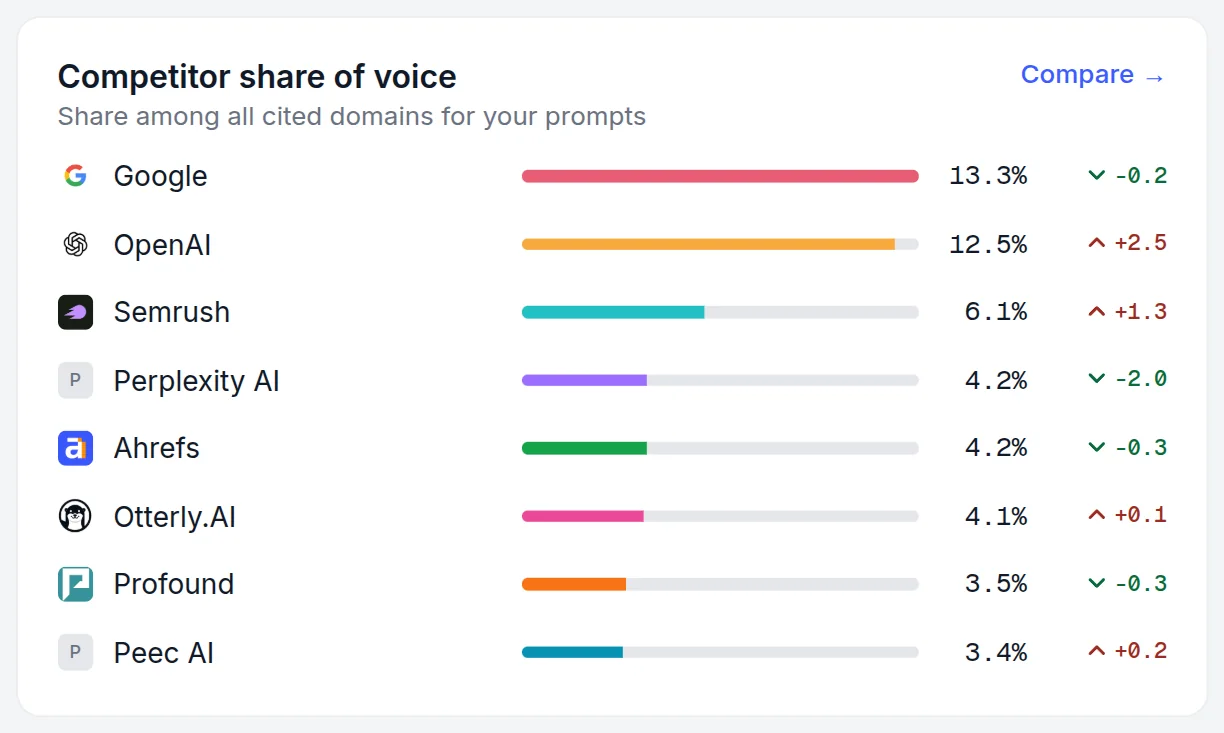
What Is White Label SEO?
White label SEO is a reselling model. A specialist provider does SEO work, and an agency sells that work to its own clients as if it were done in-house. The deliverables, reports and communication carry the agency’s brand, not the provider’s. The general idea is the same as any white label product, where one company makes something and another sells it under its own name.
Who uses it: marketing agencies that sell web design, paid ads or social media and want to add SEO without hiring a team, web developers who get asked for SEO by their clients, and SEO agencies that need extra capacity for specific tasks such as content or local SEO. Providers range from freelancers to companies with hundreds of staff and a fixed menu of packages.
How White Label SEO Works
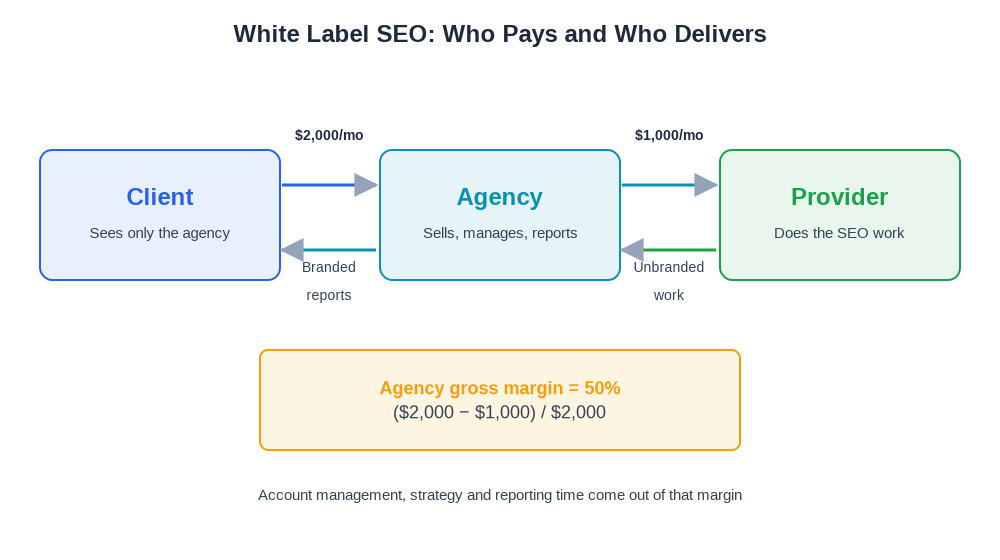
The arrangement has three parties:
- The client (a business that wants better search visibility) signs with the agency and pays the agency.
- The agency sells the service, owns the relationship, sets strategy and sends reports.
- The provider does the work behind the scenes and bills the agency at a wholesale rate.
The scope can be narrow or broad. Some agencies buy only one service, such as content writing, technical audits or link building. Others buy a full package covering keyword research, on-page fixes, content and monthly reports.
The money works like any reseller margin. Here is a simple example. The provider charges the agency $1,000 a month for a local SEO package. The agency sells it to the client for $2,000 a month.
- Agency gross profit: $2,000 − $1,000 = $1,000 a month
- Agency gross margin: $1,000 ÷ $2,000 = 50%
That $1,000 is not all profit. It has to pay for account management, strategy calls, reporting time and any extra work the agency does itself. If the agency spends 10 hours a month on the account, the effective margin is much thinner than it looks.
White Label SEO vs In-House vs Outsourcing
White label is one of several ways an agency can offer SEO. The right one depends on how much SEO work you sell and how much control you need.
| Option | Who does the work | Client sees | Pros | Cons |
|---|---|---|---|---|
| White label SEO | External provider | Only your agency brand | Fast to launch, no hiring, scalable | Less control over quality and methods |
| In-house SEO team | Your own staff | Your agency brand | Full control, deeper expertise | Hiring cost, needs steady client volume |
| Referral partnership | Partner agency | The partner’s brand | No delivery risk, referral fee | You lose the client relationship |
| Freelance subcontractors | Individual specialists | Usually your brand | Flexible, often cheaper | Availability and consistency vary |
Many agencies start with white label SEO, then bring the most profitable or strategic parts in-house once they have enough clients to keep a specialist busy.
What White Label SEO Packages Usually Include
Providers package their work in different ways, but most offers combine some of these:
- Technical audits: crawl reports, indexing checks, site speed and fix lists.
- On-page optimization: title tags, meta descriptions, headings and internal links.
- Content: blog posts, landing pages and product or service descriptions.
- Link building: outreach, guest posts and digital PR, which is where quality varies most.
- Local SEO: Google Business Profile updates, citations and review management.
- Reporting: monthly reports with the agency’s logo, or raw data the agency formats itself.
Read the deliverables list line by line. “10 links a month” tells you nothing until you know where those links come from.
White Label SEO and AI Search
Clients now ask agencies about visibility in ChatGPT, Perplexity, Gemini and Google AI Overviews, not just Google rankings. Many white label packages still cover classic SEO tasks only. If you resell SEO, check whether the provider can report on AI citations and mentions, or whether you need to measure that yourself.
AmICited is an AI search visibility platform rather than a white label provider. Agencies can track several client domains in one workspace with Multi-Domain Management, and give clients limited access through workspace roles and permissions.

Stay Updated on AI Visibility Trends
Get the latest insights on AI mentions, brand monitoring, and optimization strategies.
Best Practices for White Label SEO
- Get a full written list of the provider’s methods, especially for link building, before you sell their work.
- Order a test project for your own site or a friendly client before reselling at scale.
- Agree on turnaround times, revision rounds and who answers technical questions.
- Keep strategy and client communication in-house. That is where your value and your markup come from.
- Use a consistent SEO reporting format that shows outcomes such as traffic and conversions, not just task lists.
- Sign a contract that covers confidentiality, non-solicitation of your clients and what happens to work in progress if you part ways.
Common White Label SEO Mistakes
The most damaging mistake is reselling a provider that relies on private blog networks or bought links. Rankings may rise at first, then fall after a spam update or manual action, and the client blames your agency. Ask where every link comes from.
Agencies also underprice. They add a thin markup, then discover that client calls and reporting eat the margin. Another mistake is promising results the provider never committed to, such as a guaranteed number one ranking. Finally, some agencies pass along generic reports without reading them, so they cannot explain the numbers when the client asks.