


Win-Back Campaign
A win-back campaign is a targeted marketing effort aimed at re-engaging customers who have stopped purchasing from a brand, typically triggered once a customer crosses a defined period of inactivity. It usually combines an incentive (discount, exclusive offer, or reminder of new products) with messaging tailored to why the customer may have drifted away. Win-back campaigns are distinct from general retention marketing in that they target customers already showing signs of churn, not the active customer base.
Definition of Win-Back Campaign
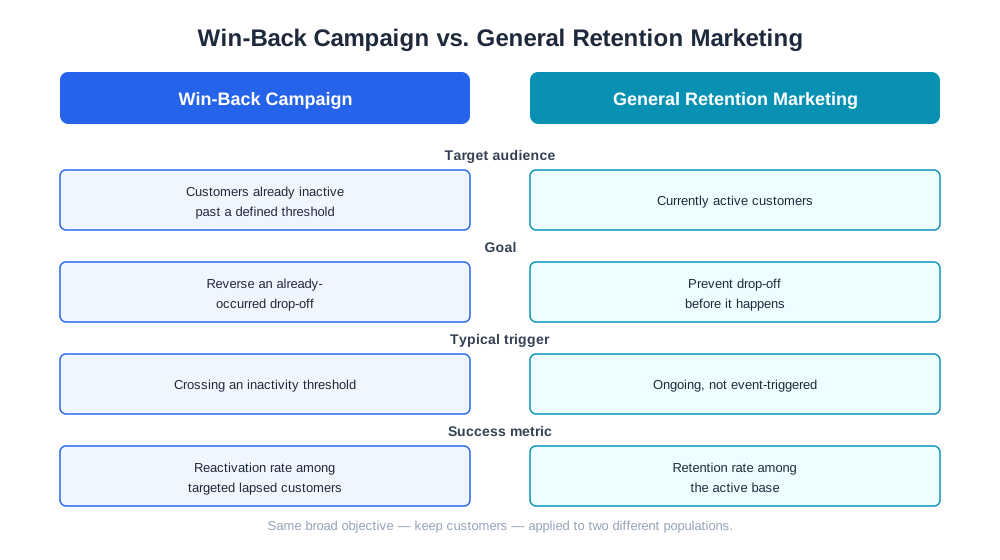
A win-back campaign is a marketing effort specifically targeted at customers who used to purchase from a brand but have stopped, aimed at prompting them to return. It differs from general retention marketing, which targets the active customer base to prevent churn before it happens, by instead targeting customers who have already crossed into inactivity — the goal isn’t to prevent the drop-off but to reverse it after the fact. A win-back campaign typically combines two elements: messaging that re-establishes relevance (reminding a lapsed customer what the brand offers, showcasing new products, or acknowledging the gap directly) and an incentive designed to lower the barrier to a return purchase, such as a discount, free shipping offer, or early access to something new. The effectiveness of a win-back campaign depends heavily on correctly identifying which customers are actually worth targeting and why they likely stopped purchasing in the first place, rather than sending a single generic offer to every lapsed account.
How Win-Back Campaigns Work
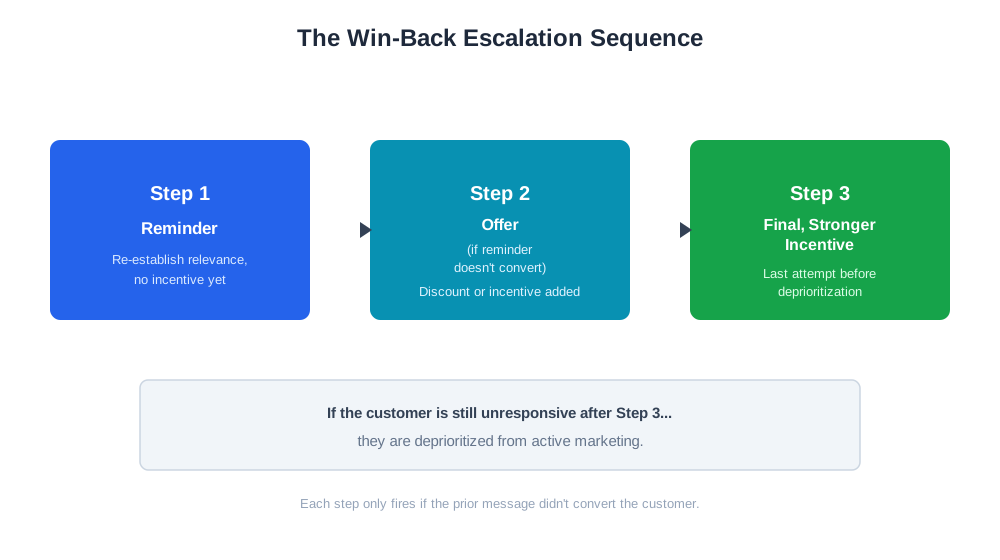
The process starts with defining what “churned” or “at risk” means for a given business, since the right inactivity threshold varies enormously by purchase cycle — a consumable subscription brand might flag a customer as at-risk after 30-45 days without an order, while a furniture retailer’s meaningful inactivity threshold is naturally measured in years. Once a threshold is set, customers who cross it are segmented, ideally by their prior value and purchase pattern rather than treated as a single undifferentiated group. A previously high-value, frequent customer who just lapsed represents a different opportunity than a low-value customer who ordered once, years ago, and never returned — the first is a stronger candidate for a meaningful, personalized win-back effort, while the second may not justify much beyond a low-cost, automated reminder. Campaigns are then usually delivered over a short sequence rather than a single email — an initial reminder, followed by an offer if the first message doesn’t convert, followed by a final, often more aggressive incentive as a last attempt before the customer is deprioritized from active marketing.

Ready to Monitor Your AI Visibility?
Track how AI chatbots mention your brand across ChatGPT, Perplexity, and other platforms.
Why Win-Back Campaigns Matter for Ecommerce Brands
Acquiring a new customer is almost always more expensive than reactivating a former one, since a past customer already has some familiarity with the brand and, in most cases, was satisfied enough with a prior purchase to be worth re-engaging. This makes win-back campaigns one of the more cost-efficient levers available to a maturing ecommerce business, particularly as a customer base ages and the pool of previously active, now-inactive customers grows. Beyond the direct revenue recovered, monitoring how customers move into the at-risk or churned bucket over time also serves as an early warning system — a sudden increase in customers crossing the churn threshold in a given month may point to a broader problem (a price increase, a product quality issue, a shipping delay) worth investigating beyond just the marketing response.
Win-Back Campaign vs. General Retention Marketing
| Aspect | Win-Back Campaign | General Retention Marketing |
|---|---|---|
| Target audience | Customers already inactive past a defined threshold | Currently active customers |
| Goal | Reverse an already-occurred drop-off | Prevent drop-off before it happens |
| Typical trigger | Crossing an inactivity threshold | Ongoing, not event-triggered |
| Common tactics | Reactivation discount, “we miss you” messaging | Loyalty rewards, personalized recommendations |
| Success metric | Reactivation rate among targeted lapsed customers | Retention rate among the active base |
Stay Updated on AI Visibility Trends
Get the latest insights on AI mentions, brand monitoring, and optimization strategies.
Win-Back Campaigns and AI-Driven Commerce
As customer data platforms and marketing automation tools increasingly use AI to time and personalize outreach, win-back campaigns have become a common testing ground for automated triggers — a customer’s segment transition into an “at risk” or “churned” bucket can now fire a tailored message automatically, without a marketer manually pulling and reviewing an export each month. The quality of this automation depends entirely on how accurately and promptly the underlying segmentation identifies the transition in the first place. AmICited’s eshop_get_segment_transitions tool is built for exactly this purpose, tracking which customers are moving into or out of a churned bucket over time so a win-back campaign can be triggered against a live, current list rather than a static export that’s already stale by the time it’s used.
Best Practices for Win-Back Campaigns
- Set the inactivity threshold based on your store’s actual purchase cycle, not an arbitrary or industry-average number
- Segment lapsed customers by prior value before deciding how much incentive to offer each group
- Use a short, escalating sequence (reminder, then offer, then final incentive) rather than a single one-shot email
- Track reactivation rate specifically for win-back recipients, separate from your general email campaign metrics
- Investigate spikes in customers entering the churned segment as a potential signal of a broader product or service issue, not just a marketing opportunity
- Exclude customers who churned due to a negative experience (a complaint, a return dispute) from generic win-back sequences, and address those cases separately