

YMYL Topics in AI Search: Complete Guide for Brand Monitoring
Learn what YMYL topics are in AI search, how they impact your brand visibility in ChatGPT, Perplexity, and Google AI Overviews, and why monitoring them matters ...
10 min read
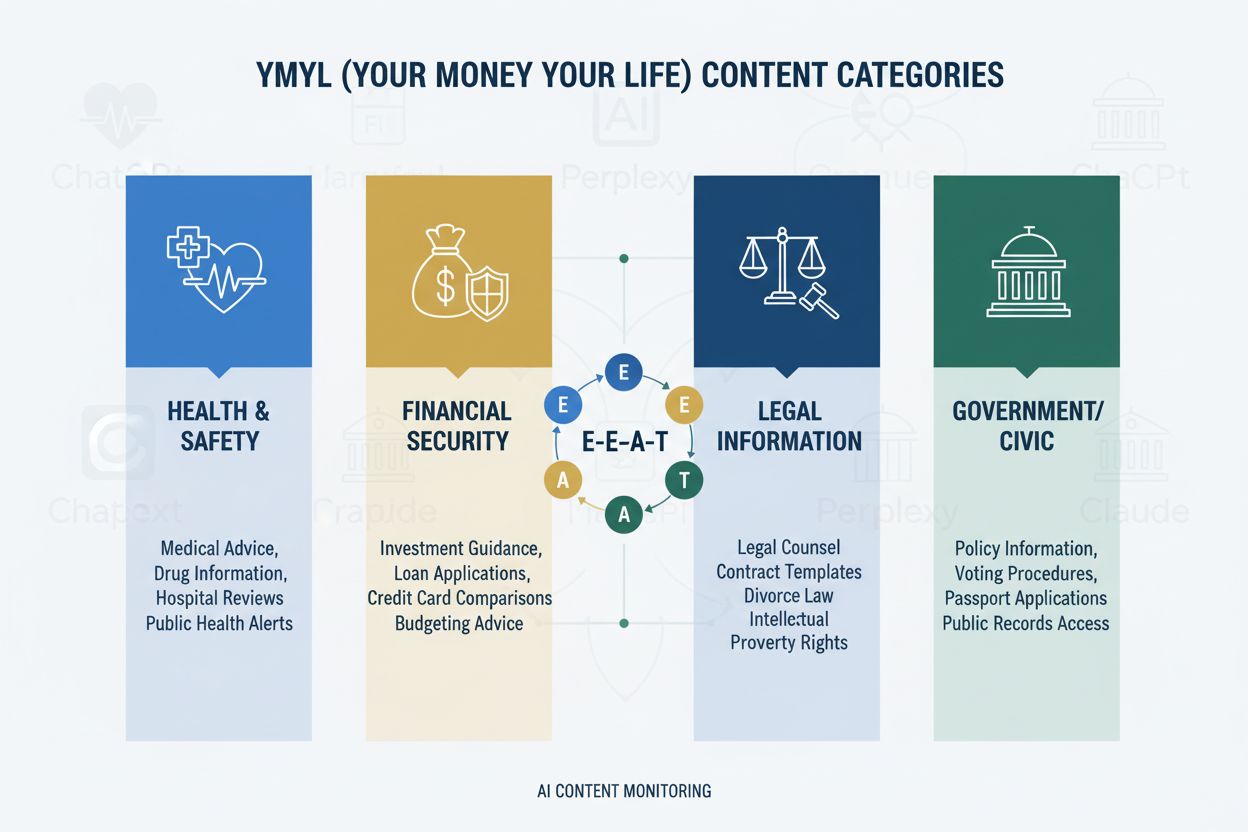
YMYL (Your Money Your Life) refers to web content that could significantly impact a person’s health, financial stability, safety, or well-being. Google applies stricter E-E-A-T standards to YMYL content to ensure accuracy and trustworthiness, making it critical for AI citation eligibility across platforms like ChatGPT, Perplexity, and Claude.
YMYL (Your Money Your Life) refers to web content that could significantly impact a person's health, financial stability, safety, or well-being. Google applies stricter E-E-A-T standards to YMYL content to ensure accuracy and trustworthiness, making it critical for AI citation eligibility across platforms like ChatGPT, Perplexity, and Claude.
YMYL stands for “Your Money or Your Life,” a classification system created by Google to identify web content that could significantly impact a person’s health, financial stability, safety, or overall well-being. Introduced in Google’s Search Quality Rater Guidelines in 2013, YMYL has become one of the most critical concepts in modern SEO and AI visibility strategy. The term encompasses any content that, if inaccurate or misleading, could negatively affect an individual’s life decisions or societal welfare. This includes everything from medical advice and financial guidance to legal information and government policy explanations. YMYL content is subject to stricter evaluation standards than other types of web pages, requiring demonstrable expertise, authoritativeness, and trustworthiness—collectively known as E-E-A-T. Understanding YMYL is essential not only for traditional search engine optimization but also for achieving visibility in AI-powered search platforms like ChatGPT, Perplexity, Google AI Overviews, and Claude, where citation eligibility depends heavily on content quality and authority signals.
When Google first introduced YMYL in 2013, the concept was relatively narrow, focusing primarily on financial and health-related content. Over the past decade, the definition has expanded significantly to encompass a broader range of topics that could impact individual or societal well-being. The evolution reflects Google’s growing recognition that search results influence real-world decisions with lasting consequences. In 2018, the “Medic” algorithm update demonstrated the importance of YMYL standards by disproportionately affecting health and wellness websites, signaling that Google was intensifying its scrutiny of medical content. By 2022, Google formally introduced the Experience component to E-A-T, creating E-E-A-T, acknowledging that first-hand experience with a topic adds credibility beyond traditional expertise credentials. Today, YMYL standards have become even more stringent as AI systems like ChatGPT and Perplexity rely on Google’s quality signals to determine which sources to cite. Research indicates that approximately 78% of enterprises now use AI-driven content monitoring tools to track their brand visibility across AI platforms, reflecting the critical importance of maintaining YMYL compliance for AI citation eligibility.
Google identifies four primary categories of YMYL content, each with distinct characteristics and requirements. Health and Safety content includes medical advice, treatment information, wellness guidance, fitness instructions, nutrition information, and any content related to physical or mental health conditions. This category is particularly sensitive because incorrect health information can directly harm individuals. Financial Security content encompasses investment advice, banking information, insurance guidance, tax preparation, credit management, cryptocurrency information, and any content affecting long-term financial stability. Financial YMYL content must be accurate because poor financial decisions can have decades-long consequences. Legal Information and Services include content about criminal defense, civil liability, housing law, family law, wills and estates, and medical directives. Legal YMYL content requires particular care because incorrect legal information can result in serious legal consequences and financial penalties. Government and Civic Information covers voting procedures, public policy explanations, social services information, legislation details, and government official conduct. This category ensures that citizens have access to accurate information necessary for informed civic participation. Additionally, News and Current Events can qualify as YMYL when reporting on extreme weather, natural disasters, infrastructure failures, public unrest, crime, consumer safety, economic developments, or health announcements that could affect public safety or financial decisions.
| Aspect | YMYL Content | Non-YMYL Content |
|---|---|---|
| Quality Standards | Highest E-E-A-T requirements; strict fact-checking mandatory | Standard quality guidelines; basic accuracy expected |
| Author Credentials | Expert credentials essential; professional qualifications required | Helpful but not required; general knowledge acceptable |
| Source Citations | Multiple authoritative sources required; peer-reviewed preferred | Optional; general references acceptable |
| Fact-Checking Process | Rigorous, documented review process required | Basic review sufficient |
| Update Frequency | Regular updates with latest information critical | Updates helpful but not mandatory |
| Search Quality Rater Scrutiny | Highest level of scrutiny; lowest ratings for inaccuracy | Standard evaluation process |
| AI Citation Eligibility | Requires strong E-E-A-T for AI platform inclusion | Lower barrier to AI citation |
| Legal/Regulatory Risk | High risk of regulatory action for false claims | Minimal regulatory risk |
| Ranking Volatility | High volatility during algorithm updates | Lower volatility; more stable rankings |
| Recovery Time | Longer recovery period after ranking penalties | Faster recovery from ranking issues |
The relationship between E-E-A-T and YMYL is fundamental to understanding modern content quality standards. Google explicitly states that trust is the most important element of E-E-A-T, particularly for YMYL content. Without trustworthiness, even content demonstrating experience, expertise, and authoritativeness will receive low quality ratings. Experience refers to first-hand involvement with the topic—a doctor writing about medical treatments, an investor discussing investment strategies, or a lawyer explaining legal procedures. Expertise encompasses formal credentials, education, professional certifications, and demonstrated knowledge through consistent, accurate content production. Authoritativeness is established through external recognition: citations from other authoritative sources, industry awards, professional affiliations, media mentions, and reputation as a go-to resource in the field. Trustworthiness requires transparency about authorship, clear contact information, accurate and verifiable information, disclosure of conflicts of interest, secure website infrastructure, and alignment with expert consensus. For YMYL content specifically, Google’s Search Quality Raters evaluate whether content aligns with established medical guidelines, financial regulations, legal standards, and government policies. Content that contradicts expert consensus or lacks proper sourcing receives the lowest quality ratings, which eventually translates to ranking penalties and reduced AI visibility.
The emergence of AI-powered search platforms has fundamentally changed the importance of YMYL standards. ChatGPT, Perplexity, Google AI Overviews, and Claude all rely on quality signals similar to Google’s E-E-A-T framework when selecting sources to cite in their responses. Research shows that 52% of AI Overview sources come from the top 10 search results, meaning that traditional SEO performance directly influences AI citation eligibility. However, AI systems apply additional scrutiny to YMYL content, often requiring explicit author credentials and source attribution before including information in generated responses. For example, when a user asks ChatGPT about investment strategies or medical treatments, the AI system prioritizes responses that cite authoritative financial institutions, peer-reviewed medical journals, or recognized experts. YMYL content without clear credentials or from unknown sources is less likely to be selected for citation, even if it ranks well in traditional search results. This creates a dual optimization challenge: content must rank well in Google search while simultaneously meeting the stricter citation standards of AI systems. AmICited and similar AI monitoring platforms track where YMYL content appears across these AI systems, providing visibility into citation patterns and helping content creators understand their AI visibility beyond traditional search metrics.
Health and Medical Content represents one of the most heavily scrutinized YMYL categories. This includes symptom checkers, treatment recommendations, medication information, surgical procedure explanations, mental health guidance, fitness instructions, nutrition advice, and wellness information. Medical YMYL content must be reviewed by qualified healthcare professionals, cite peer-reviewed research, and align with established medical guidelines from organizations like the FDA, CDC, or WHO. Even well-intentioned health content can cause harm if it contains inaccuracies or encourages unsafe practices. Financial Services and Investment Content encompasses banking information, investment advice, retirement planning, tax guidance, insurance explanations, cryptocurrency information, and credit management. Financial YMYL content must comply with regulations like the Gramm-Leach-Bliley Act and Securities and Exchange Commission guidelines. Content creators must disclose conflicts of interest, avoid making unsupported claims about investment returns, and ensure all financial information is current and accurate. Legal Information and Services include explanations of laws, legal procedures, contract templates, and guidance on legal issues. Legal YMYL content must be reviewed by qualified attorneys, clearly state that it is not legal advice, and encourage readers to consult with licensed attorneys for specific situations. Government and Civic Information provides details about voting procedures, public benefits, legislation, and government services. This content must be accurate, current, and aligned with official government sources. News and Current Events that could impact public safety or financial decisions—such as reports on extreme weather, economic developments, or health emergencies—also qualify as YMYL and require rapid, accurate reporting.
Creating successful YMYL content requires adherence to several critical principles that go beyond standard SEO practices. Accuracy and Fact-Checking must be non-negotiable; every claim should be verifiable and supported by authoritative sources. Implementing a documented fact-checking process, ideally involving subject matter experts, demonstrates commitment to accuracy. Author Transparency is essential; YMYL pages should clearly identify the author, provide biographical information establishing credentials, and link to author profiles or professional affiliations. Source Attribution requires citing authoritative sources, preferably peer-reviewed research, government data, or recognized industry standards. Conflict of Interest Disclosure means clearly stating any financial relationships, sponsorships, or affiliations that could bias the content. Regular Updates ensure that YMYL content reflects the latest information, guidelines, and research. Professional Review involves having qualified experts review content before publication and periodically thereafter. Contact Information should be easily accessible, allowing readers to report errors or ask questions. Secure Infrastructure requires HTTPS encryption, regular security updates, and protection of user data. These principles collectively demonstrate the high standards Google and AI systems expect from YMYL content creators.
YMYL content has historically been disproportionately affected by Google’s major algorithm updates. The August 2018 “Medic” update, for example, significantly impacted health and wellness websites, with many established sites experiencing dramatic ranking drops. This update signaled that Google was intensifying its focus on E-E-A-T standards for health-related YMYL content. Subsequent core updates in 2019, 2020, 2021, and beyond have continued to emphasize YMYL quality standards, with sites lacking strong E-E-A-T signals experiencing volatility. The June 2025 core update again demonstrated the vulnerability of YMYL sites, with some experiencing significant ranking fluctuations. These patterns suggest that Google’s algorithms are becoming increasingly sophisticated at identifying and rewarding high-quality YMYL content while penalizing low-quality alternatives. The introduction of AI Overviews has added another layer of complexity, as Google now evaluates not just ranking eligibility but also citation eligibility for AI-generated responses. This means that YMYL content must meet even higher standards to achieve visibility across both traditional search and AI platforms. Content creators should expect that YMYL pages will experience more ranking volatility than non-YMYL content and should be prepared to invest in continuous quality improvements and E-E-A-T signal strengthening.
The rise of AI-powered search and content generation has created new challenges for YMYL content visibility. Traditional SEO metrics like search rankings and organic traffic no longer tell the complete story. AI monitoring platforms like AmICited now track where YMYL content appears in responses from ChatGPT, Perplexity, Google AI Overviews, and Claude. These platforms measure citation frequency, identify which YMYL pages are being cited, and track visibility trends across multiple AI systems. This data is critical for understanding whether YMYL content is achieving the authority and trustworthiness signals necessary for AI citation. For example, a YMYL page might rank in the top 10 for a keyword but receive zero citations in AI Overviews, indicating that the content lacks sufficient E-E-A-T signals for AI systems to confidently cite it. Conversely, some YMYL pages achieve high AI citation rates despite lower traditional search rankings, suggesting that AI systems are identifying quality signals beyond traditional SEO metrics. By monitoring YMYL content across AI platforms, content creators can identify gaps in their E-E-A-T strategy and make targeted improvements. This dual-channel visibility approach—tracking both search rankings and AI citations—is becoming essential for YMYL content success in 2025 and beyond.
The future of YMYL standards will be shaped by the continued evolution of AI-powered search and content generation. As AI systems become more sophisticated at evaluating content quality, YMYL standards will likely become even more stringent. Google’s continued investment in AI Overviews suggests that traditional search rankings will become less important relative to AI citation eligibility. This shift means that YMYL content creators must prioritize E-E-A-T signals that AI systems can reliably identify and evaluate. We can expect to see increased emphasis on structured data markup, which makes author credentials and source attribution machine-readable. Professional certifications and credentials will likely become more important as AI systems learn to verify author qualifications. Transparency about content creation processes, including any use of AI assistance, will become increasingly critical. Additionally, as AI systems expand beyond Google to include ChatGPT, Claude, Perplexity, and other platforms, YMYL content will need to meet quality standards across multiple AI systems simultaneously. Content creators who invest in strong E-E-A-T signals now will be best positioned to maintain visibility as search and discovery mechanisms continue to evolve. The integration of AI monitoring platforms into content strategy will become standard practice, allowing creators to track YMYL visibility across multiple channels and optimize accordingly.
YMYL content directly impacts a person's health, finances, safety, or well-being, requiring stricter E-E-A-T standards and more rigorous fact-checking. Non-YMYL content, such as entertainment reviews or sports reporting, has lower quality thresholds. Google's Search Quality Raters apply significantly more scrutiny to YMYL pages, and low-quality YMYL content is more likely to be demoted in search results and AI citations.
Yes, YMYL content is heavily scrutinized by AI systems for citation eligibility. Research shows that 52% of AI Overview sources come from the top 10 search results, and AI platforms prioritize content with strong E-E-A-T signals. YMYL pages with weak credentials or inaccurate information are less likely to be cited by AI systems, directly impacting visibility across generative search platforms.
Google identifies four primary YMYL categories: Health & Safety (medical advice, wellness, physical safety), Financial Security (investment guidance, banking, insurance), Legal Information (legal advice, contracts, compliance), and Government & Civic Information (voting, public policy, social services). Content within these categories must meet the highest E-E-A-T standards to rank well and be cited by AI systems.
E-E-A-T (Experience, Expertise, Authoritativeness, Trustworthiness) is Google's quality framework specifically applied to YMYL content. Trust is the most critical element for YMYL pages. Content must demonstrate clear author credentials, cite authoritative sources, provide transparent information about the creator, and maintain factual accuracy. Weak E-E-A-T signals on YMYL pages result in lower rankings and reduced AI citation rates.
Small websites can rank for YMYL content if they demonstrate strong E-E-A-T signals, particularly expertise and trustworthiness. However, they face higher barriers than larger, established sites. Small YMYL sites should focus on niche expertise, transparent author credentials, comprehensive fact-checking, and building authority through citations from reputable sources and industry recognition.
Inaccurate or misleading YMYL content receives the lowest quality rating from Google's Search Quality Raters, leading to significant ranking penalties and reduced AI visibility. Beyond search consequences, publishing false YMYL content can result in legal liability, regulatory fines, and reputational damage. For example, the FTC has pursued enforcement actions against sites making unsupported health and financial claims.
AI monitoring platforms like AmICited track where YMYL content appears in AI responses from ChatGPT, Perplexity, Google AI Overviews, and Claude. These platforms monitor citation patterns, measure visibility across AI systems, and identify which YMYL pages are being cited. This data helps content creators understand their AI visibility and optimize for citation eligibility across multiple generative search platforms.
Start tracking how AI chatbots mention your brand across ChatGPT, Perplexity, and other platforms. Get actionable insights to improve your AI presence.
Learn what YMYL topics are in AI search, how they impact your brand visibility in ChatGPT, Perplexity, and Google AI Overviews, and why monitoring them matters ...

Learn how AI platforms like ChatGPT, Perplexity, and Google AI Overviews evaluate financial content. Understand YMYL requirements, E-E-A-T standards, and compli...
Learn how to optimize Your Money or Your Life (YMYL) content for AI search engines like ChatGPT, Perplexity, and Google's AI Overviews. Master E-E-A-T signals, ...
Cookie Consent
We use cookies to enhance your browsing experience and analyze our traffic. See our privacy policy.