
The Rise of Zero-Click Search: What It Means for Your Brand Visibility
Learn how zero-click searches and AI answers are reshaping brand visibility. Discover why traditional metrics are failing and how to monitor your AI citations w...
10 min read
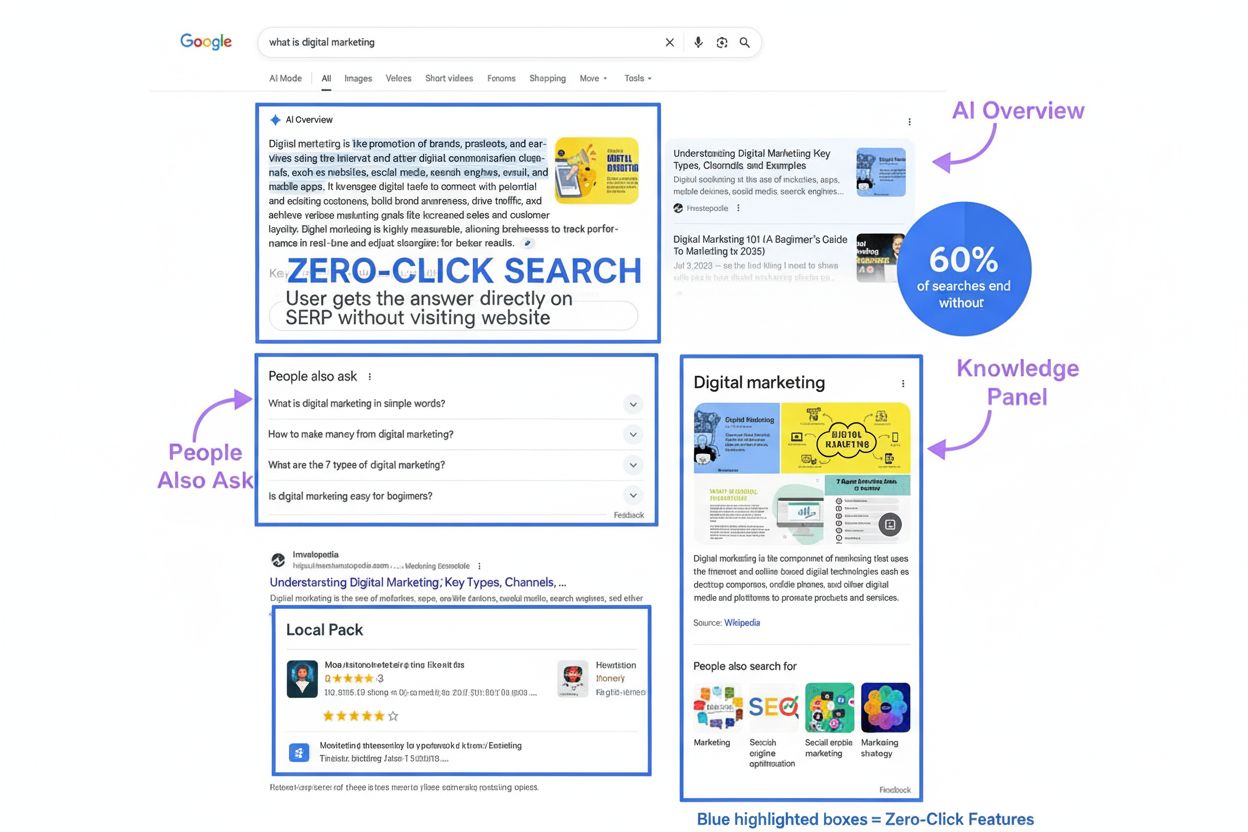
A zero-click search occurs when users find their answer directly on the search engine results page (SERP) without clicking through to any external website. These searches are powered by AI Overviews, featured snippets, knowledge panels, and other SERP features that deliver complete answers instantly.
A zero-click search occurs when users find their answer directly on the search engine results page (SERP) without clicking through to any external website. These searches are powered by AI Overviews, featured snippets, knowledge panels, and other SERP features that deliver complete answers instantly.
Zero-click search is a search query where users find their answer directly on the search engine results page (SERP) without clicking through to any external website. Rather than following a traditional search journey—entering a query, scanning results, and clicking a link—users now receive complete answers through AI Overviews, featured snippets, knowledge panels, People Also Ask boxes, and other SERP features that deliver information instantly. This fundamental shift in search behavior represents one of the most significant changes in digital marketing and SEO since the rise of mobile search. The term “zero-click” doesn’t mean zero engagement; instead, it reflects a structural change in where answers are delivered and how users consume information online.
The prevalence of zero-click searches has grown dramatically with the expansion of artificial intelligence in search. According to SparkToro’s 2024 research, 58.5% of U.S. Google searches and 59.7% of EU searches ended without any click to external websites. By 2025, this figure has climbed to approximately 60% globally, with mobile searches reaching as high as 77%. This means that out of every 1,000 searches performed in the United States, only 360 clicks reach the open web. The remaining searches conclude their journey entirely within Google’s ecosystem, with users finding what they need directly on the results page. This transformation has profound implications for website traffic, brand visibility, and how organizations must approach search engine optimization in the AI era.
The concept of zero-click searches is not entirely new, but its scale and impact have accelerated dramatically. The foundation for zero-click behavior was laid years ago with the introduction of featured snippets in 2014, which pulled concise answers directly from web pages and displayed them prominently at the top of search results. Google’s Knowledge Graph, launched in 2012, further contributed to this trend by displaying entity-based information—facts about people, places, organizations, and concepts—without requiring users to visit external sites. These early SERP features established the principle that search engines could satisfy user intent directly on the results page.
Between 2020 and 2023, zero-click behavior remained relatively stable at around 64-70% of searches, driven primarily by featured snippets, knowledge panels, and instant answer boxes for factual queries. However, the landscape shifted dramatically in 2024 with the widespread rollout of Google’s AI Overviews (formerly known as Search Generative Experience). When AI Overviews launched in May 2024, the impact on click-through rates was immediate and measurable. Ars Technica reported a 40% average CTR decline on informational and research-intent keywords once AI Overview summaries appeared. By March 2025, AI Overviews were appearing in 13.14% of U.S. desktop searches, double the January 2025 figure of 6.49%. This exponential growth demonstrates how rapidly AI-powered search features are reshaping user behavior and search dynamics.
The evolution of zero-click searches reflects a broader industry trend toward keeping users within search ecosystems rather than directing them outward. Platforms like Perplexity AI, ChatGPT Search, Google’s AI Mode, and Claude have further accelerated this shift by providing conversational, AI-generated answers that synthesize information from multiple sources. These platforms cite their sources but don’t require users to click through to access the information they need. The result is a fundamental restructuring of how information flows online, with search engines and AI platforms increasingly serving as the destination rather than the gateway to information.
| SERP Feature | Description | Zero-Click Rate | Primary Use Case | Impact on Traffic |
|---|---|---|---|---|
| AI Overviews | AI-generated summaries synthesizing multiple sources into conversational responses | 83% | Informational, how-to, research queries | Very High (40% CTR decline) |
| Featured Snippets | Concise pulled answers displayed in a box at top of results | 60% | Definitions, quick facts, lists | High |
| Knowledge Panels | Entity-based information cards showing facts about people, places, organizations | 90% | Navigational, entity-based queries | Very High |
| People Also Ask (PAA) | Expandable FAQ-style boxes showing related questions with inline answers | 70-80% | Question-based, exploratory queries | High |
| Direct Answer Boxes | Instant responses for factual queries (weather, time, conversions, calculations) | 100% | Utility queries, factual lookups | Extreme |
| Local Pack | Maps and business listings for location-based searches | 70-85% | Local intent, “near me” searches | Very High |
| Image/Video Carousels | Visual content displayed directly on SERP | 65-75% | Visual search intent | High |
This comparison reveals that AI Overviews and Knowledge Panels represent the most significant threats to traditional organic traffic, with zero-click rates exceeding 80%. Direct answer boxes achieve 100% zero-click rates because they completely satisfy user intent without any need for external information. Featured snippets, while still driving significant zero-click behavior at 60%, remain slightly more likely to generate clicks than AI-powered features, possibly because users seek additional context or verification from the original source.
AI Overviews have become the primary driver of zero-click search behavior in 2025, fundamentally changing how search results are presented and consumed. Unlike traditional featured snippets that pull a single answer from one source, AI Overviews synthesize information from multiple authoritative sources into comprehensive, multi-paragraph responses that address user queries with depth and nuance. These summaries include citations, visual elements, and sometimes interactive components, all displayed directly on the SERP before any traditional organic results.
The growth trajectory of AI Overviews has been remarkable. When Google began rolling out AI Overviews in May 2024, they appeared on a limited set of queries. By January 2025, they were triggering on 6.49% of U.S. desktop searches. Within just two months, by March 2025, this figure had doubled to 13.14%, indicating aggressive expansion across query types. Semrush’s research suggests that longer, conversational, or question-style queries (8+ words) trigger AI Overviews far more frequently than shorter, transactional queries. This pattern indicates that informational content creators face the most significant zero-click challenges, as their target audience increasingly receives answers directly from AI summaries.
The impact of AI Overviews on click-through rates has been substantial and well-documented. When an AI Overview appears for a query, the average CTR drops by approximately 34.5% to 40%, according to multiple studies. This decline occurs even for pages ranking in the top positions, as users find the AI-generated summary sufficient for their needs. However, the relationship between AI Overviews and traffic is more nuanced than simple traffic loss. Brands that appear in AI Overviews gain significant visibility and credibility, as their content is being read and cited by millions of users who never visit their websites. This represents a fundamental shift in how visibility and authority are measured in the search landscape.
The mechanics of zero-click searches operate through several distinct SERP features, each designed to deliver specific types of information directly to users. Featured snippets, the oldest zero-click feature, extract concise answers (typically 40-60 words) from web pages and display them in a highlighted box above traditional organic results. These snippets are particularly effective for definition queries, list-based questions, and step-by-step instructions. While featured snippets drive zero-click behavior, they also include a blue link to the source, making them slightly more likely to generate clicks than AI Overviews.
Knowledge panels represent another critical zero-click mechanism, displaying structured entity information pulled from Google’s Knowledge Graph. When users search for a person, organization, location, or concept, a knowledge panel appears on the right side of the SERP (or above results on mobile) showing key facts, images, and related entities. These panels achieve approximately 90% zero-click rates because they comprehensively answer entity-based queries. For example, searching “CEO of Microsoft” displays Satya Nadella’s information, title, and company details without requiring a click. Knowledge panels are particularly powerful because they’re populated from structured data and authoritative sources, making them difficult for individual websites to compete with.
People Also Ask (PAA) boxes have evolved into sophisticated micro-FAQ engines that dynamically expand based on user behavior and query context. These boxes display related questions with inline answers, allowing users to explore related topics without leaving the SERP. According to Briskon’s 2025 research, PAA boxes appear in approximately 75% of mobile and desktop searches, with even higher prevalence (92%) for informational queries. Users typically expand multiple questions per session, satisfying their curiosity entirely within the search results. The expandable nature of PAA means that even when users click to expand a question, they’re still engaging with zero-click behavior if they don’t visit an external website.
Direct answer boxes represent the most extreme form of zero-click search, achieving 100% zero-click rates because they completely satisfy user intent without any external reference. These boxes handle utility-based queries like weather forecasts, currency conversions, unit conversions, time zone displays, and mathematical calculations. When a user searches “100 USD to EUR,” Google displays a live currency converter with real-time exchange rates. When searching “weather in New York,” an interactive weather widget appears. These tools eliminate any need to visit external websites, making them the purest form of zero-click search.
The rise of zero-click searches presents a complex challenge for digital marketers and SEO professionals. On the surface, the statistics appear alarming: 60% of searches generate no external clicks, meaning that the majority of search traffic never reaches websites. For publishers, news organizations, and content creators who have historically relied on organic search traffic, this represents a significant threat to their business models. However, the impact is more nuanced than simple traffic loss, and understanding this nuance is critical for developing effective strategies in the zero-click era.
The most immediate impact of zero-click searches is on organic traffic metrics. Websites that previously ranked in top positions for informational queries now receive fewer visits, even when their rankings remain unchanged. This phenomenon has been documented across multiple industries and website types. For example, news publishers have reported that while their content appears in AI Overviews and featured snippets, their referral traffic from search has declined significantly. HubSpot and NerdWallet, two major publishers, have both publicly shared that their organic search traffic has declined while their overall revenue has increased, suggesting that zero-click visibility still drives business value through brand awareness and authority building.
The second major impact is on attribution and analytics. When users find answers in AI Overviews or featured snippets without visiting websites, companies lose visibility into user behavior and intent. Analytics platforms capture less data about what users are searching for, what questions they’re asking, and what information they’re consuming. This creates a “blind spot” in understanding customer journeys and search behavior. Users may see a brand’s content in an AI Overview, develop trust in that brand, and later make a purchase through a direct visit or branded search, but the original zero-click interaction never appears in analytics. This makes it difficult to measure the true ROI of SEO efforts and content creation.
However, zero-click searches also create new opportunities for brand visibility and authority building. When a brand’s content appears in an AI Overview, it’s being read by millions of users who may never visit the website but who are forming impressions about the brand’s expertise and credibility. This visibility translates into brand awareness, trust, and preference. Research from MarTech and other sources indicates that brands appearing frequently in AI Overviews and featured snippets experience increased branded search volume, higher brand recall, and improved conversion rates, even without direct traffic from zero-click interactions. The key insight is that visibility has been redefined: it no longer means clicks, but rather presence and citation within the answers users are reading.
The zero-click phenomenon extends beyond Google’s search results to encompass a broader ecosystem of AI-powered search and answer platforms. ChatGPT, which has grown to over 400 million weekly active users, operates as a conversational AI that synthesizes information from its training data and web sources into comprehensive responses. When users ask ChatGPT questions, they receive answers directly within the chat interface, with citations to sources but no requirement to click through. Similarly, Perplexity AI has positioned itself as an “answer engine” that provides detailed, sourced responses to user queries in a conversational format. These platforms cite their sources, making them valuable for brand visibility, but users rarely click through to external websites.
Google’s AI Mode (part of Google Search’s experimental features) represents Google’s most aggressive push toward zero-click search. AI Mode provides conversational, multi-turn interactions where users can ask follow-up questions and receive increasingly refined answers, all without leaving Google’s interface. This feature is particularly powerful because it combines Google’s search dominance with conversational AI capabilities, creating a compelling user experience that reduces the need for external websites. Claude, Anthropic’s AI assistant, similarly provides comprehensive answers to user queries with citations but without requiring clicks.
For brands and content creators, the challenge is that visibility across these platforms requires different optimization approaches than traditional SEO. While Google’s AI Overviews pull from indexed web content, ChatGPT and Claude rely on training data and web access, meaning that content must be discoverable and trustworthy across multiple platforms. Perplexity AI actively crawls the web and cites sources, making it more similar to Google in terms of content discovery. The common thread across all these platforms is that brand visibility depends on being cited as a credible source, not on driving clicks. This represents a fundamental shift from traditional SEO’s focus on rankings and traffic to what some call Generative Engine Optimization (GEO) or Answer Engine Optimization (AEO).
Succeeding in a zero-click search environment requires fundamentally different optimization approaches than traditional SEO. The first critical strategy is identifying zero-click keywords and understanding which queries are most likely to result in zero-click behavior. Informational queries with high zero-click probability include those containing words like “definition,” “meaning,” “how to,” “what is,” “best,” “convert,” and “time in.” Tools like Semrush, Ahrefs, and SEMrush allow marketers to filter keywords by SERP features, identifying which queries trigger AI Overviews, featured snippets, knowledge panels, and other zero-click features. By focusing optimization efforts on these high-impact keywords, brands can maximize their visibility in zero-click results.
The second strategy is structuring content for extraction and citation. Content designed for zero-click visibility must be concise, well-organized, and directly answer user questions. The most effective approach is to place the direct answer to a query in the first 40-60 words of content, followed by supporting details and context. Using clear heading structures that mirror user questions, incorporating bullet points and numbered lists, and utilizing tables for comparative information all increase the likelihood that content will be extracted for featured snippets and AI Overviews. Schema markup is critical for this strategy, as structured data helps search engines and AI systems understand content context and extract relevant information more accurately.
The third strategy is implementing comprehensive schema markup. Different types of schema serve different purposes in zero-click optimization. FAQPage schema helps Q&A content appear in People Also Ask boxes and AI Overviews. HowTo schema increases the likelihood of appearing in step-by-step rich results and AI-generated guides. LocalBusiness schema helps populate knowledge panels and local pack results. Product schema enables rich product information to appear in AI Overviews and shopping results. By implementing appropriate schema markup, brands signal to search engines and AI systems exactly what information their content contains, increasing the chances of extraction and citation.
The fourth strategy is building topical authority and E-E-A-T signals. AI systems and search engines increasingly rely on Experience, Expertise, Authoritativeness, and Trustworthiness (E-E-A-T) signals to determine which sources to cite in AI Overviews and featured snippets. This means creating comprehensive content clusters around core topics, demonstrating deep expertise through detailed explanations, citing credible sources, and building author authority through bylines and author bios. Content that demonstrates clear expertise and trustworthiness is more likely to be selected for inclusion in AI-generated answers. Additionally, maintaining content freshness through regular updates signals to AI systems that information is current and reliable.
Traditional SEO metrics like organic traffic, click-through rate (CTR), and rankings no longer tell the complete story of search performance in the zero-click era. While these metrics remain important, they must be supplemented with new indicators that measure visibility and authority within AI-generated answers and SERP features. Answer Inclusion Rate (AIR) measures how frequently a brand’s content appears inside AI-generated answers across platforms like Google AI Overviews, ChatGPT, Perplexity, and Claude. This metric directly indicates how often a brand is being cited as a credible source and how much influence it has on the information users are reading.
Entity Presence Index (EPI) measures how consistently a brand, product, or leadership is recognized across AI and search environments. This metric reflects how clearly algorithms and audiences associate a brand with specific areas of expertise. A high EPI indicates that a brand has established strong entity recognition, making it more likely to appear in knowledge panels, AI Overviews, and other entity-based results. Source Authority Score (SAS) evaluates the trustworthiness and quality of content by assessing accuracy, structure, freshness, and credibility signals. Content with a high SAS is more likely to be selected for inclusion in AI-generated answers because AI systems recognize it as reliable and authoritative.
AI Citation Frequency (AICF) counts the number of times a brand’s content is quoted or linked within AI-driven responses across platforms. This metric directly measures influence and reach within the AI-powered search ecosystem. Brands with high AICF are shaping how information is presented to millions of users, even if those users never visit the brand’s website. Additionally, brands should track branded search volume, which often increases when a brand appears frequently in AI Overviews and featured snippets, as users develop awareness and trust. Assisted conversions and downstream metrics like leads, sales, and customer acquisition should also be monitored, as zero-click visibility often drives these outcomes indirectly through brand awareness and authority building.
The trajectory of zero-click searches points toward a future where search engines and AI platforms become increasingly dominant as information destinations rather than gateways to external websites. As AI technology improves and becomes more integrated into search experiences, the percentage of zero-click searches will likely continue to increase. Gartner predicted in 2024 that organic search traffic would decline by 25% by 2026 due to AI chatbots and virtual agents, a prediction that appears to be tracking accurately based on 2025 data. However, this decline in traffic doesn’t necessarily translate to a decline in business value for brands that adapt their strategies appropriately.
The future of zero-click search will likely be characterized by increased personalization and context awareness. As AI systems become more sophisticated, they will tailor answers based on user history, preferences, location, and behavior. Google’s AI Mode, for example, can now reference a user’s Google Workspace data (Gmail, Calendar, Drive) to provide personalized recommendations. This means that brands appearing in AI Overviews for one user may be different from those appearing for another user with different preferences and history. The implication is that omnichannel marketing and brand presence across multiple touchpoints will become increasingly important for ensuring visibility in personalized AI results.
Another significant trend is the rise of multimodal search experiences that combine text, images, video, and interactive elements. AI Overviews increasingly include visual content, product carousels, and interactive widgets alongside text answers. This means that brands must optimize not just text content but also visual assets, product information, and interactive experiences for inclusion in AI-generated results. Additionally, the expansion of voice search and smart speaker integration will further accelerate zero-click behavior, as voice assistants inherently deliver single spoken answers without any visual interface for clicking.
The strategic implication for brands is clear: the future of search success depends on becoming the authoritative source that AI systems cite, rather than on driving clicks to websites. This requires a fundamental shift in how organizations approach content creation, SEO, and digital marketing. Instead of optimizing for rankings and clicks, brands must optimize for visibility, authority, and citation within AI-powered search and answer platforms. This shift is already underway, with forward-thinking organizations investing in Answer Engine Optimization (AEO) and Generative Engine Optimization (GEO) strategies that prioritize inclusion in AI-generated answers over traditional rankings.
The zero-click search phenomenon also has implications for brand monitoring and reputation management. When brands appear in AI Overviews and featured snippets, they have less control over how their information is presented and contextualized. AI systems may combine a brand’s content with competitors’ content or present information in ways the brand didn’t intend. This makes it critical for organizations to monitor how they’re being represented in AI-generated answers and to ensure that their content is accurate, trustworthy, and aligned with their brand positioning. Tools like AmICited that track brand mentions and citations across AI platforms will become increasingly essential for understanding and managing brand visibility in the zero-click era.
Zero-click searches represent a fundamental restructuring of how information flows online, with profound implications for SEO, content marketing, and digital strategy. The data is unambiguous: approximately 60% of Google searches now end without a click to external websites, with this percentage rising to 77% on mobile devices and 83% for queries triggering AI Overviews. This shift is not temporary or cyclical; it reflects structural changes in search technology and user behavior that will persist and likely accelerate as AI capabilities improve.
However, zero-click searches are not a death sentence for organic search or content marketing. Rather, they represent a redefinition of visibility and success metrics. Brands that appear in AI Overviews, featured snippets, knowledge panels, and other zero-click features are reaching millions of users and building authority and trust, even without direct website traffic. The key to success in this environment is understanding that visibility now means being cited and referenced within the answers users are reading, not just driving clicks to websites.
Organizations that adapt quickly to this reality will thrive. This adaptation requires investing in Answer Engine Optimization (AEO) strategies that prioritize content structure, schema markup, topical authority, and E-E-A-T signals. It requires measuring success through new metrics like answer inclusion rate, entity presence, and AI citation frequency rather than relying solely on traditional traffic and ranking metrics. It requires creating content designed for extraction and citation by AI systems, not just for human readers. And it requires monitoring brand visibility across multiple AI platforms and search engines, not just Google.
The zero-click search era is not a challenge to overcome but an opportunity to embrace. Brands that position themselves as authoritative, trustworthy sources that AI systems cite will dominate the search landscape of the future. The question is not whether zero-click searches will continue to grow, but whether your organization is prepared to succeed in a world where visibility and authority matter more than clicks.
As of 2025, between 57% and 60% of all Google searches are zero-click searches, with some estimates reaching 80% when including AI Overviews specifically. According to SparkToro and Similarweb data, this represents a significant increase from 58.5% in 2024. On mobile devices, the rate is even higher at approximately 77%, compared to 47% on desktop. This trend continues to accelerate as AI Overviews expand to more queries.
AI Overviews synthesize information from multiple sources into comprehensive, conversational responses displayed directly on the SERP. Google's AI Overviews appeared in 13.14% of U.S. desktop searches in March 2025, up from 6.49% in January. These AI-generated summaries show a zero-click rate of approximately 83%, meaning users get complete answers without needing to visit external websites. The feature includes citations and visual elements that satisfy most user queries instantly.
The primary SERP features driving zero-click behavior include AI Overviews (83% zero-click rate), featured snippets (60%), knowledge panels (90%), People Also Ask boxes (70-80%), direct answer boxes (100%), and local packs (70-85%). Each feature delivers specific types of information directly on the results page. Featured snippets pull concise answers, knowledge panels display entity information, and direct answer boxes handle factual queries like conversions or calculations without requiring any clicks.
Zero-click searches significantly reduce organic click-through rates (CTR), with studies showing 34.5% to 40% CTR declines when AI Overviews appear. However, visibility in these features still provides brand exposure and authority building. For every 1,000 U.S. Google searches, only 360 clicks reach external websites. While traffic decreases, brands that appear in AI Overviews and snippets gain credibility and brand awareness, making visibility metrics more important than traditional click-based metrics.
Answer Engine Optimization (AEO) focuses on optimizing content to appear in AI-generated answers and SERP features rather than just ranking for keywords. While traditional SEO targets rankings and clicks, AEO targets citations, brand mentions, and inclusion in AI responses. AEO requires structured data, concise answers (40-60 words), clear topical authority, and content designed for extraction. Success is measured through answer inclusion rate, entity presence, and citation frequency rather than traffic and CTR.
Informational queries are most likely to produce zero-click results, particularly those seeking definitions, quick facts, conversions, weather, time zones, and how-to instructions. Navigational searches for business hours and directions also show high zero-click rates (70-85% for local searches). Transactional queries have lower zero-click rates as users typically need to visit websites to complete purchases. Question-based queries with 8+ words trigger AI Overviews more frequently, making long-tail informational content particularly susceptible to zero-click behavior.
Brands should track new metrics including Answer Inclusion Rate (how often content appears in AI answers), Entity Presence Index (brand recognition across AI platforms), Source Authority Score (content trustworthiness), and AI Citation Frequency (mentions in AI responses). Tools like Google Search Console, Semrush's AI Visibility Overview, and Similarweb provide insights into SERP feature appearances and AI mentions. Monitoring impressions versus clicks reveals zero-click impact, while tracking branded search volume and assisted conversions indicates brand awareness generated through zero-click visibility.
Start tracking how AI chatbots mention your brand across ChatGPT, Perplexity, and other platforms. Get actionable insights to improve your AI presence.
Learn how zero-click searches and AI answers are reshaping brand visibility. Discover why traditional metrics are failing and how to monitor your AI citations w...
Discover how AI search is transforming customer discovery. Learn the three stages of AI-powered journeys, optimize for ChatGPT, Perplexity, and Google AI Overvi...
Learn how to measure brand impact in zero-click search. Discover metrics beyond clicks, track AI visibility, and prove ROI when users don't click through.