

Quanto Deve Essere Approfondito il Contenuto per le Citazioni AI?
Scopri la profondità, la struttura e i requisiti di dettaglio ottimali per ottenere citazioni da ChatGPT, Perplexity e Google AI. Scopri cosa rende il contenuto...
12 min di lettura
I’m genuinely confused about what AI systems want from content.
We have a 3,000-word comprehensive guide on our topic. It’s well-researched, includes original data, and ranks top 5 in Google. But when I test the same queries in ChatGPT and Perplexity, our competitors with shorter, simpler content get cited instead of us.
What I’ve noticed about cited content:
What our content has:
Is AI just preferring “dumbed down” content? Or am I missing something about how to structure comprehensive content for AI readability?
Really want to understand the technical side of how AI parses content.
You’ve identified the problem but drawn the wrong conclusion. AI doesn’t prefer “dumbed down” content - it prefers extractable content.
Here’s how AI systems actually process your content:
The problem with comprehensive, nuanced content:
If your answer to a specific question is spread across 5 paragraphs with context, caveats, and nuance, AI has to:
That’s hard. It often fails.
The advantage of “simpler” content:
Each section provides a complete, standalone answer. AI retrieves one chunk, extracts the answer, done.
The fix isn’t dumbing down - it’s restructuring:
Keep your depth, but make each section self-contained. Lead with the direct answer, then add nuance. AI will extract the direct answer; curious users will read the nuance.
The “800 token chunks” insight changed how I write.
I used to think of articles as flowing narratives. Now I think of them as collections of modular answers. Each H2 section needs to work on its own, even if someone only reads that section.
For your 3,000-word guide, you might actually have 8-10 potentially citable chunks. But if none of them stand alone, you have zero.
I did an experiment that might help you.
The test:
Took a comprehensive guide (similar to yours) and created two versions:
Published both on different subdomains, waited 6 weeks, tested in ChatGPT and Perplexity.
Results:
Version B was cited 4x more often despite having identical information.
What I changed:
The content quality didn’t change. The extractability did.
Nobody’s mentioned Flesch-Kincaid reading level yet.
Research shows AI citations correlate with content at Grade 6-8 reading level. Grade 11+ content sees noticeably fewer citations.
This doesn’t mean dumbed down - it means:
AI systems trained on vast internet data are essentially calibrated to “average” readability. Content significantly above that level is harder to parse accurately.
Check your readability score. If it’s Grade 12+, that might be part of your problem.
From a technical perspective, here’s why your comprehensive content might be losing:
Embedding similarity problem:
When a user asks “How do I do X?”, the AI creates an embedding of that question and searches for content with similar embeddings.
Your comprehensive content talks about X in context of Y and Z, with caveats about A, B, and C. The embedding represents this rich, contextual meaning.
Your competitor’s content says “Here’s how to do X: [direct steps].” The embedding is a closer match to the question.
The solution:
Keep your comprehensive coverage, but add a section that’s a direct match for the common question. Think of it as the “TL;DR” that AI can extract while your full content remains for human readers.
Many successful sites now have both: a 40-60 word answer-first summary, followed by comprehensive depth.
Practical formatting tips that increased our citation rate:
Structure changes:
Semantic helpers:
Tables are gold:
What to avoid:
We didn’t dumb down our content - we made it machine-readable.
This is incredibly helpful. I think I finally understand the disconnect.
My mental model was wrong:
I was thinking “comprehensive content = better for AI because more information.”
Reality: “Extractable content = better for AI because easier to process.”
What I’m going to do:
The key insight: I’m not dumbing down, I’m making each piece independently valuable while keeping the whole comprehensive.
Question for the group: any tools you use to test how AI “sees” your content structure?
To test how AI sees your content:
Manual testing:
Technical testing:
AI-specific testing:
The AI will often tell you exactly why it prefers one over the other.
For ongoing monitoring, Am I Cited tracks which specific content gets cited so you can identify patterns in what works.
Content design perspective that might help:
The web taught us to write for scanners. AI takes this further - it’s the ultimate scanner.
Progressive disclosure for AI:
AI typically extracts Level 1-3. Human readers who want depth get Level 4.
Design each section so that extracting just the first sentence still provides value. Then the rest adds richness without being required.
This is basically good web writing principles, just executed more rigorously.
One more technical consideration: schema markup.
If you have FAQ sections, HowTo guides, or other structured content, proper schema tells AI exactly what’s there.
FAQPage schema is particularly powerful because it explicitly marks what’s a question and what’s an answer. AI doesn’t have to infer this from your content structure.
We saw a 23% increase in AI citations after implementing proper schema across our guide content. The content didn’t change - just the machine-readable signals about what it contained.
Don’t rely on AI to figure out your structure. Tell it explicitly through schema.
Get personalized help from our team. We'll respond within 24 hours.
Scopri quali contenuti vengono citati nelle risposte AI e identifica cosa fa la differenza. Analizza i pattern tra i tuoi contenuti di successo e quelli trascurati.
Scopri la profondità, la struttura e i requisiti di dettaglio ottimali per ottenere citazioni da ChatGPT, Perplexity e Google AI. Scopri cosa rende il contenuto...
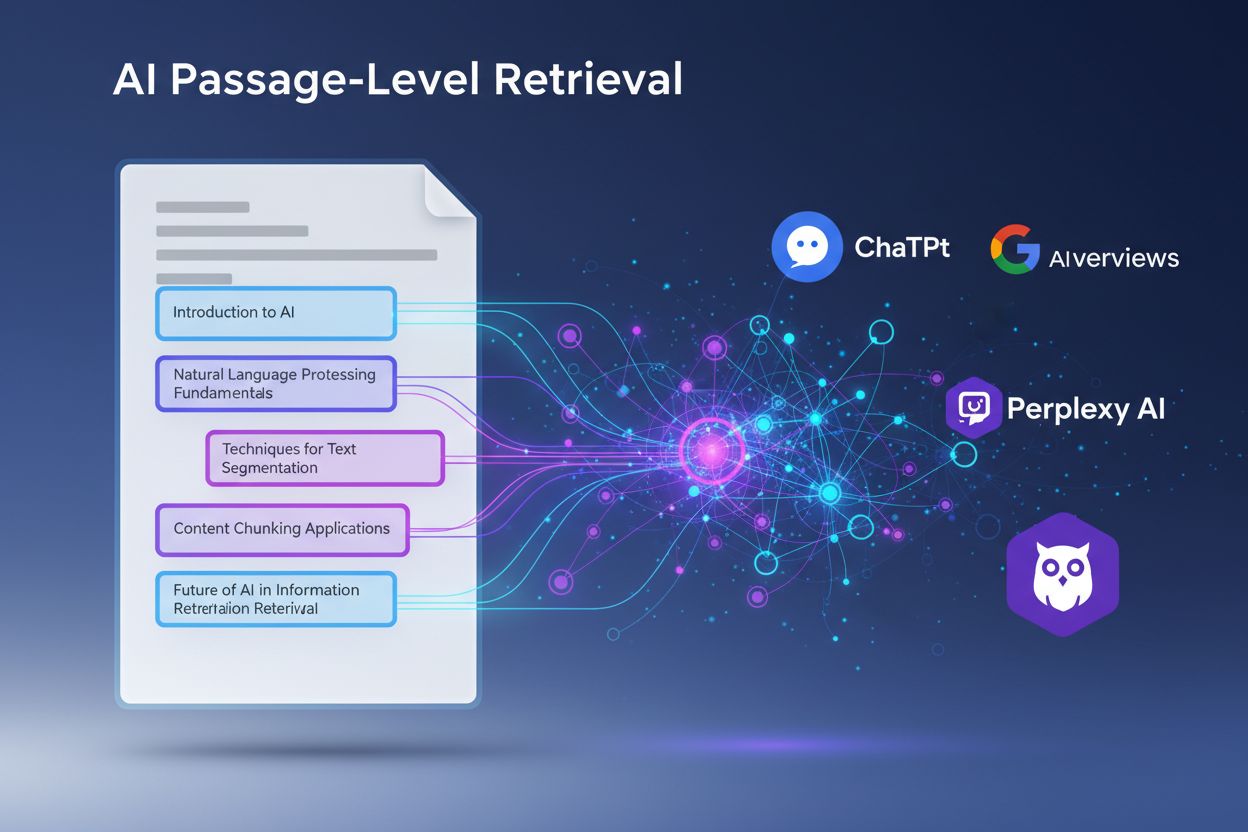
Scopri come strutturare i contenuti in passaggi di lunghezza ottimale (100-500 token) per ottenere il massimo delle citazioni AI. Scopri strategie di chunking c...
Scopri come strutturare i tuoi contenuti per essere citato dai motori di ricerca AI come ChatGPT, Perplexity e Google AI. Strategie esperte per visibilità e cit...