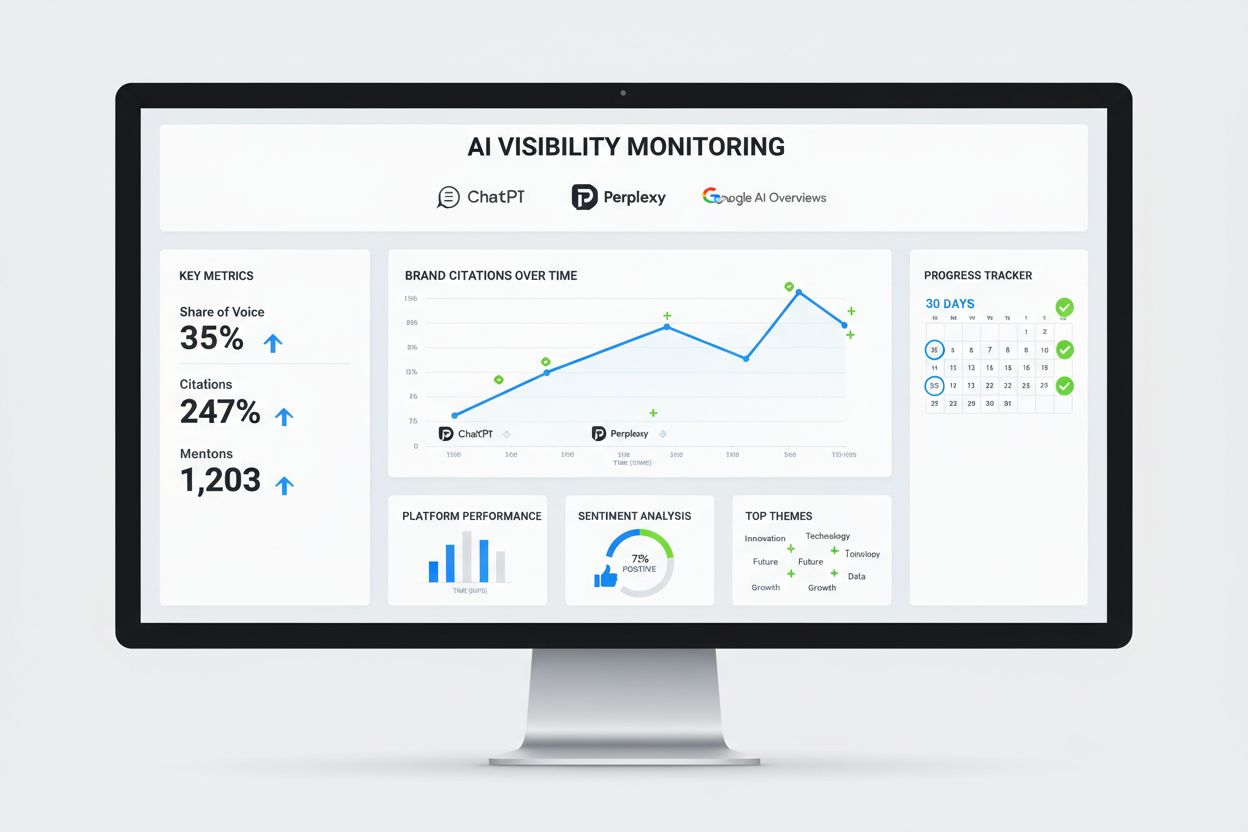
Discussion AI Visibility Optimization

Mit AI-synlighedsscore er elendig - hvad er den hurtigste måde at forbedre den på?

FR
FrustratedMarketer_Jake · Marketingchef
· · 143 upvotes · 11 comments
FJ
FrustratedMarketer_Jake
Marketingchef · December 10, 2025

Just ran our first AI visibility audit. Results are embarrassing:

  • ChatGPT: 8% citation rate
  • Perplexity: 5% citation rate
  • Google AI: 3% citation rate
  • Competitors: averaging 25-35%

My boss wants improvement fast. We can’t wait 12 months for authority building.

Questions:

  • What are the quickest wins for improving AI visibility?
  • What should I prioritize with limited resources?
  • What’s realistic to expect in 30/60/90 days?
  • What mistakes should I avoid in the rush to improve?

Need practical, fast-acting advice.

11 comments

11 Comments

AT
AIVisibility_Turnaround_Expert Expert AI Synlighedskonsulent · December 10, 2025

I specialize in visibility turnarounds. Here’s the prioritized playbook:

Week 1-2: Technical Foundation (Quick wins)

ActionEffortImpact Timeline
Add Organization schemaLow2-3 weeks
Add FAQ schema to key pagesLow2-3 weeks
Implement Author schemaLow2-3 weeks
Fix robots.txt for AI crawlersLow1-2 weeks
Add llms.txtLow2-4 weeks

Week 3-4: Content Structure (Medium wins)

ActionEffortImpact Timeline
Add TL;DR to top 20 pagesMedium3-4 weeks
Convert key info to tables/listsMedium3-4 weeks
Add FAQ sections to top pagesMedium4-6 weeks
Ensure direct answers in first paragraphMedium4-6 weeks

Month 2: Content Enhancement

ActionEffortImpact Timeline
Add expert bylines + credentialsMedium4-6 weeks
Update outdated contentMedium4-8 weeks
Add original data/insights to top contentHigh6-8 weeks
Create comparison contentHigh6-8 weeks

Realistic expectations:

  • 30 days: 5-10% improvement possible
  • 60 days: 15-25% improvement possible
  • 90 days: 25-40% improvement possible

You won’t match competitors in 90 days, but you can show meaningful progress.

FJ
FrustratedMarketer_Jake OP · December 10, 2025
Replying to AIVisibility_Turnaround_Expert
This is exactly the prioritized approach I needed. For the TL;DR sections - what format works best for AI?
AT
AIVisibility_Turnaround_Expert Expert · December 10, 2025
Replying to FrustratedMarketer_Jake

TL;DR format that works best for AI:

Position: Very top of content, before main body

Structure:

<div class="tldr">
<h2>TL;DR</h2>
<p>[One sentence direct answer to the main question]</p>
<ul>
  <li><strong>Key Point 1:</strong> Brief expansion</li>
  <li><strong>Key Point 2:</strong> Brief expansion</li>
  <li><strong>Key Point 3:</strong> Brief expansion</li>
</ul>
</div>

Example:

TL;DR

GEO (Generative Engine Optimization) is the practice of optimizing content for AI search visibility.

- **What it is:** Techniques to appear in AI-generated answers
- **Why it matters:** 58% of consumers now use AI for product recommendations
- **How it differs from SEO:** Focuses on citations, not rankings

Why this works:

  1. Clearly labeled (AI recognizes “TL;DR”)
  2. Direct answer first
  3. Key points in scannable format
  4. Self-contained (citable without context)

Word count: 50-100 words total. Concise but complete.

QS
QuickWins_Specialist · December 10, 2025

More quick wins that work:

Already-ranking content optimization:

If pages already rank well in Google, they’re candidates for AI optimization. Focus there first.

Existing AssetQuick Optimization
Blog postsAdd TL;DR, FAQ section
Product pagesAdd FAQ schema, comparison tables
Service pagesAdd “Who this is for” section
About pageEnsure Organization schema
Team pagesAdd Person schema, credentials

Why this is fastest:

Pages with existing authority get AI attention faster than new pages. Optimize what’s already working.

The audit process:

  1. Export top 50 pages by organic traffic
  2. Check each for AI citation status
  3. Pages that rank but aren’t cited = quick opportunity
  4. Optimize structure, add schema, improve format

Real numbers:

We took 30 ranking pages through this process. Within 6 weeks:

  • 12 started getting AI citations (40%)
  • Average citation rate for those: 18%
CM
ContentOps_Manager · December 9, 2025

FAQ section strategy for quick wins:

Why FAQ sections work:

  1. Question-answer format matches AI queries
  2. Easy to add to existing pages
  3. Schema can be applied
  4. AI can extract directly

How to add effectively:

Step 1: Identify questions

  • Customer support queries
  • “People also ask” from Google
  • AI platform testing (“what questions do people ask about [topic]?”)

Step 2: Write complete answers

  • 50-150 words each
  • Answer the actual question
  • Include specific details
  • Standalone (makes sense without page context)

Step 3: Add to page

  • Position at end of main content
  • Clear “FAQ” or “Frequently Asked Questions” heading
  • Proper H2/H3 structure

Step 4: Add schema

  • FAQPage schema markup
  • Match visible content

Time investment:

  • 30 minutes per page to add 5 FAQs
  • 20 pages in a week is achievable
  • Results visible within 4-6 weeks
TE
TechnicalSEO_Emergency Expert · December 9, 2025

Technical quick wins checklist:

Day 1 fixes:

[ ] Organization schema on homepage
[ ] Check robots.txt allows AI crawlers
[ ] Verify sitemap includes key pages

Week 1 fixes:

[ ] FAQ schema on top 10 pages
[ ] Author schema with credentials
[ ] Article schema on blog posts
[ ] llms.txt file implementation

robots.txt for AI crawlers:

Check you’re NOT blocking:

  • GPTBot
  • Google-Extended
  • PerplexityBot
  • ClaudeBot

Many sites accidentally block these.

llms.txt quick implementation:

# llms.txt
User-agent: *
Sitemap: https://yoursite.com/sitemap.xml

# Primary content
Primary: /blog/
Primary: /products/
Primary: /about/

# Company information
Name: Your Company Name
Description: One line about what you do

Time to implement all technical fixes:

A developer can do this in 1-2 days. Impact starts showing in 2-4 weeks.

DO
DataDriven_Optimizer · December 9, 2025

Measuring improvement properly:

What to track:

MetricToolFrequency
Citation rate by platformAm I CitedWeekly
Share of voice vs competitorsAm I CitedWeekly
Citation positionAm I CitedWeekly
Branded AI queriesAnalyticsMonthly
Organic traffic from AI referralsGA4Monthly

Setting realistic goals:

TimeframeRealistic GoalStretch Goal
30 days+5% citation rate+10%
60 days+15% citation rate+25%
90 days+25% citation rate+40%

What affects speed of improvement:

  • Existing domain authority (higher = faster)
  • Content quality baseline (better = faster)
  • Technical implementation speed
  • Competitive landscape

Don’t:

  • Expect overnight results
  • Compare to competitors with years head start
  • Stop tracking after initial improvement
  • Neglect ongoing optimization
MS
MistakesLearned_Sarah · December 8, 2025

Mistakes to avoid in the rush to improve:

Mistake 1: Gaming over quality

Stuffing keywords, manufacturing FAQs, thin content with schema = short-term at best, harmful at worst.

Mistake 2: Ignoring existing assets

Creating new content when you could optimize existing ranking content = slower results.

Mistake 3: Platform-specific optimization

Over-optimizing for one AI platform = missing others. Optimize for good content fundamentals.

Mistake 4: Stopping after quick wins

Quick wins plateau. Sustained improvement needs ongoing effort.

Mistake 5: Not measuring properly

Can’t show boss improvement without baseline and consistent tracking.

Mistake 6: Expecting linear progress

AI visibility can be volatile. Week-to-week fluctuation is normal. Look at trends.

The sustainable approach:

Quick wins → foundation building → continuous improvement

Not: Quick wins → declare victory → wonder why it stopped working

FJ
FrustratedMarketer_Jake OP Marketingchef · December 8, 2025

This thread has given me a clear action plan. Here’s what I’m implementing:

Week 1-2: Technical foundation

  • Organization schema (Day 1)
  • Check/fix robots.txt (Day 1)
  • FAQ schema on top 10 pages (Week 1)
  • llms.txt implementation (Week 1)
  • Author schema with credentials (Week 2)

Week 3-4: Content structure

  • Add TL;DR to top 20 pages
  • Add FAQ sections to top pages
  • Convert key info to tables/bullet lists
  • Ensure direct answers in first paragraphs

Month 2: Content enhancement

  • Expert bylines on all content
  • Update outdated content
  • Add original data where possible

Tracking:

  • Set up Am I Cited monitoring
  • Weekly citation rate tracking
  • Monthly progress report to boss

Goals:

  • 30 days: 12-15% citation rate (from 8%)
  • 60 days: 18-22% citation rate
  • 90 days: 25-30% citation rate

Key principles:

  • Optimize existing ranking content first
  • Quick wins then foundation building
  • Track and report consistently
  • Don’t expect miracles, show progress

Thanks everyone for the actionable advice.

Have a Question About This Topic?

Get personalized help from our team. We'll respond within 24 hours.

Frequently Asked Questions

Hvad er en AI-synlighedsscore?
AI-synlighedsscore måler, hvor ofte og hvor fremtrædende dit brand vises i AI-genererede svar. Det inkluderer typisk citationsfrekvens, placering i svarene, andel af stemme mod konkurrenter og omtale-sentiment.
Hvad er en god AI-synlighedsscore?
Benchmarks varierer mellem brancher, men generelt: 0-10% citationsrate er dårlig, 10-25% er under udvikling, 25-40% er god, og 40%+ er fremragende. Sammenlign med konkurrenter i din branche for kontekst.
Hvor lang tid tager det at forbedre AI-synlighed?
Hurtige gevinster (schema, formatering) kan give resultater på 2-4 uger. Optimering af indhold viser typisk resultater på 1-3 måneder. Autoritetsopbygning tager 6-12 måneder for markante forbedringer.
Hvad er den hurtigste måde at forbedre AI-synlighed på?
Start med tekniske fundamenter (schema markup, indholdsstruktur), optimer derefter eksisterende højtpræsterende indhold til AI, tilføj FAQ-sektioner til nøglesider, og sørg for ensartet brandinformation på tværs af nettet.

Følg din AI-synlighedsscore

Overvåg dit brands synlighed på ChatGPT, Perplexity og andre AI-platforme. Mål forbedringer over tid.

Lær mere