
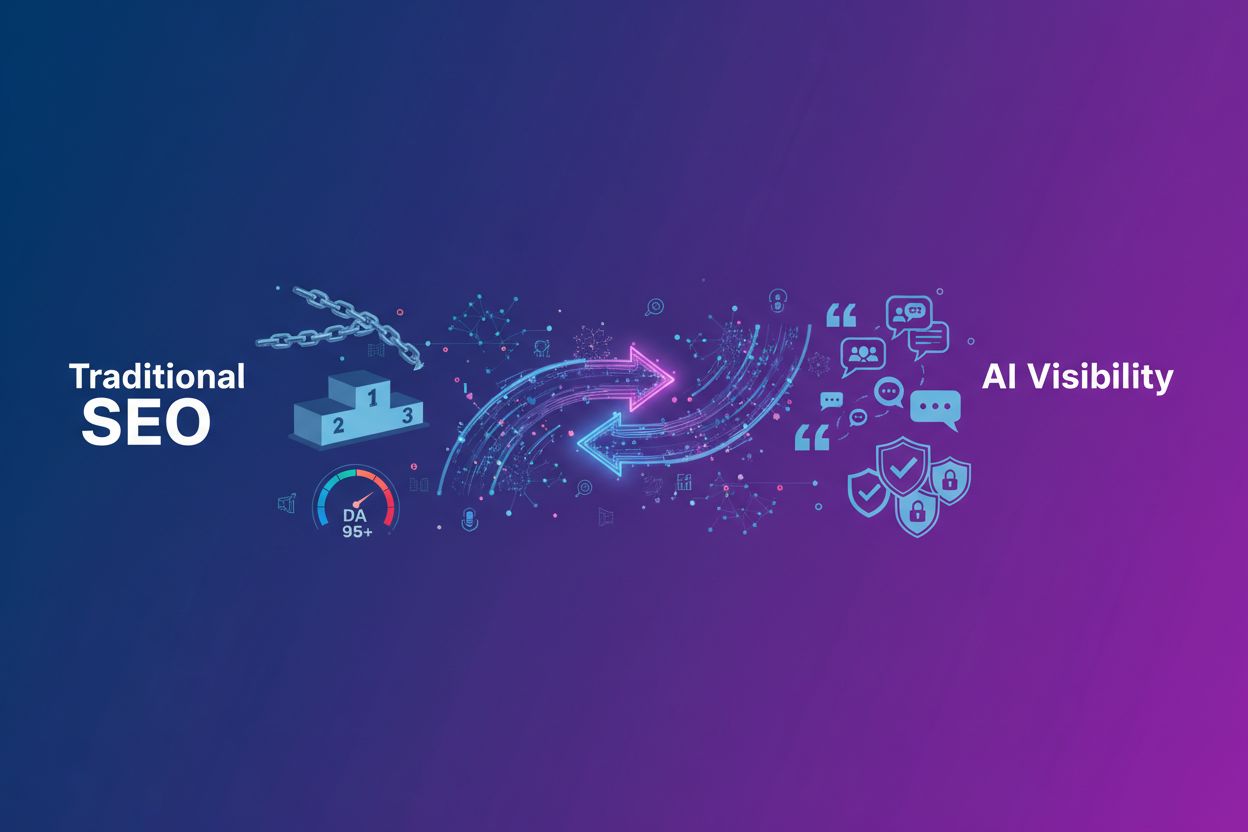
Domain Authority und KI-Zitationen: Ist DA noch relevant?
Erfahren Sie, wie Domain Authority KI-Zitationen und Sichtbarkeit beeinflusst. Lernen Sie, warum DA im KI-Suchzeitalter weiterhin wichtig ist und welche Strateg...
9 Min. Lesezeit
I’ve been doing SEO for 15 years. Domain authority has been a core concept the entire time.
But when I look at AI search results, the correlation seems… different. High-DA sites sometimes get cited, sometimes not. Lower-DA sites with great content sometimes outperform.
What I’m observing:
Questions:
Feeling like I need to rewire 15 years of thinking here.
Your instinct is right. AI evaluates authority fundamentally differently than traditional search.
Traditional Search Authority:
AI System Authority Evaluation:
The 5 Authority Signals AI Systems Actually Use:
| Signal | What AI Evaluates | How to Optimize |
|---|---|---|
| Entity Recognition | How well AI understands your brand | Schema markup, consistent naming, knowledge base presence |
| High-Quality Citations | Who references your content | Authoritative mentions, Wikipedia, industry publications |
| Topical Depth | Comprehensive expertise in specific areas | Topic clusters, interlinked content, depth over breadth |
| Brand Consistency | Same information everywhere | NAP consistency, unified messaging, profile alignment |
| Engagement Indicators | Signs of trust and relevance | Reviews, social proof, community presence |
DA still correlates (higher DA sites often have these signals too), but it’s not the PRIMARY driver for AI.
Entity recognition is how AI systems understand and categorize your brand as a distinct “thing” with attributes and relationships.
How AI builds entity understanding:
Why it matters for AI visibility:
When someone asks ChatGPT “What’s a good project management tool for remote teams?”, AI needs to:
If AI doesn’t clearly recognize YOUR brand as a “project management tool” entity, you won’t be considered.
How to strengthen entity recognition:
Topical authority is where smaller players can win:
The domain authority problem:
Building DA from 30 to 60 might take 3-5 years and massive investment.
The topical authority opportunity:
Becoming the authority on a SPECIFIC topic can happen in 6-12 months with focused effort.
Case study:
Client: Small fintech startup (DA: 25) Competitor: Major bank (DA: 80)
General query “best banking app” - Bank wins Specific query “banking app for freelancer taxes” - Our client wins
Why? Client created THE definitive resource on banking for freelancers:
AI recognizes them as the topical authority for that specific intersection.
The strategy:
Don’t try to compete on broad authority. Own a narrow space completely.
Adding technical perspective on how AI crawlers evaluate your site:
What AI crawlers specifically look for:
Technical authority signals:
Often overlooked:
Your llms.txt file. It’s like robots.txt for AI systems - tells them what content is most relevant for citation purposes.
Technical foundation matters. A brilliant article on a slow, messy site sends negative signals.
From a PR perspective, the kind of authority that matters has shifted:
What used to matter:
What matters now for AI:
Where AI systems actually source information:
| Platform | ChatGPT Weight | Perplexity Weight |
|---|---|---|
| Wikipedia | Very High | High |
| High | Very High | |
| Major news (NYT, WSJ) | High | High |
| Industry publications | Medium-High | High |
| Corporate websites | Medium | Medium |
| Random blogs | Low | Low |
PR strategy shift:
Focus on becoming a cited source on platforms AI actually references, not just any media coverage.
Startup perspective on competing without DA:
Our situation:
What we did:
Results after 8 months:
The lesson:
You can’t shortcut overall domain authority. But you can build topical authority and AI visibility without it.
Enterprise observation:
We have massive DA (80+), but that doesn’t automatically translate to AI citation.
What we’ve learned:
What we changed:
Even with strong DA, we had to optimize for AI-specific signals.
DA is a starting point, not a guarantee.
How to actually track AI-specific authority:
Metrics that matter:
| Metric | What It Indicates | How to Track |
|---|---|---|
| AI Citation Rate | How often AI cites you | Am I Cited or similar tool |
| Share of Voice | Your citations vs competitors | Competitive analysis |
| Citation Context | How AI describes you | Sentiment analysis |
| Source Diversity | Which of your pages get cited | Page-level tracking |
| Platform Coverage | Which AI platforms cite you | Multi-platform monitoring |
What to watch:
DA is still one input, but it’s not the primary metric for AI visibility. Track what actually matters.
This has been an eye-opening thread. Here’s my synthesis:
Key paradigm shift:
Traditional SEO: Authority flows primarily from backlinks AI Search: Authority is multi-dimensional (entity, topical, content, trust)
New authority framework:
Action items:
Mindset shift:
Stop asking “how do we increase DA?” Start asking “how do we become the obvious authority AI should cite for our topics?”
Thanks everyone. 15 years of SEO experience and I’m still learning.
Get personalized help from our team. We'll respond within 24 hours.
Verfolgen Sie, wie KI-Plattformen Ihre Domain Authority wahrnehmen. Sehen Sie Zitierquoten, Share of Voice und Wettbewerbspositionierung über ChatGPT, Perplexity und mehr.
Erfahren Sie, wie Domain Authority KI-Zitationen und Sichtbarkeit beeinflusst. Lernen Sie, warum DA im KI-Suchzeitalter weiterhin wichtig ist und welche Strateg...

Community-Diskussion darüber, ob Domain Authority die Sichtbarkeit in der KI-Suche beeinflusst. Reale Beispiele, in denen Seiten mit hoher DA von kleineren Seit...
Community-Diskussion über den Aufbau von Autorität für KI-Zitate. SEO- und Content-Profis teilen Strategien zur Etablierung von E-E-A-T-Signalen, die von KI-Pla...
Cookie-Zustimmung
Wir verwenden Cookies, um Ihr Surferlebnis zu verbessern und unseren Datenverkehr zu analysieren. See our privacy policy.