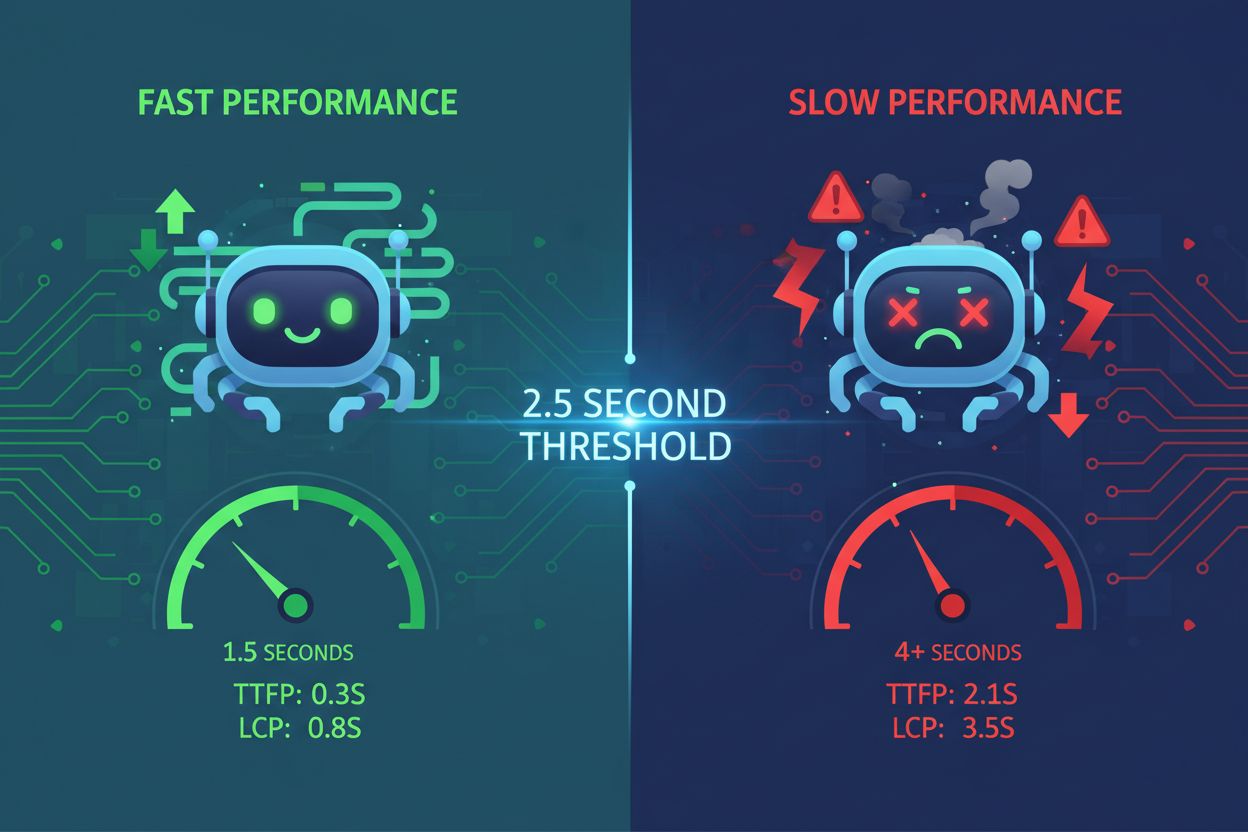
Discussion Technical SEO Performance

Is page speed actually a factor for AI search or is that just traditional SEO thinking?

PE
PerformanceSEO_Mike · Web Performance Engineer
· · 128 upvotes · 10 comments
PM
PerformanceSEO_Mike
Web Performance Engineer · January 5, 2026

I optimize site performance for a living. Now trying to understand how it relates to AI search.

My questions:

  • Does page speed actually impact AI citations?
  • Are Core Web Vitals relevant for AI?
  • Is speed a ranking factor or just a baseline requirement?

Looking for data, not assumptions. What does the research show?

10 comments

10 Comments

AS
AIResearchData_Sarah Expert AI Search Researcher · January 5, 2026

We analyzed speed metrics across 100,000+ pages. Here’s what the data shows:

Speed correlation with AI citations:

Speed MetricFastMediumSlow
FCP < 0.4s6.7 citations--
FCP 0.4-1.0s-4.2 citations-
FCP > 1.13s--2.1 citations

3x difference between fastest and slowest sites.

But here’s the nuance: Correlation doesn’t prove causation.

Possible explanations:

  1. AI bots timeout on slow pages
  2. Fast sites = better maintained = better content
  3. Speed is a quality proxy signal
  4. Well-funded sites are both fast and have good content

What we can confidently say:

  • Very slow sites get fewer citations
  • Speed threshold matters more than marginal gains
  • Content quality still trumps speed
PM
PerformanceSEO_Mike OP · January 5, 2026
Replying to AIResearchData_Sarah
The threshold insight is interesting. What’s the minimum speed to not lose citations?
AS
AIResearchData_Sarah Expert · January 5, 2026
Replying to PerformanceSEO_Mike

Speed thresholds for AI visibility:

MetricDanger ZoneSafe ZoneOptimal
TTFB> 2s< 1s< 0.5s
FCP> 1.5s< 1s< 0.5s
LCP> 2.5s< 2s< 1.5s

TTFB matters most for AI bots: They’re making HTTP requests. If your server doesn’t respond quickly, they may timeout or move on.

Practical advice:

  • Target TTFB under 500ms
  • FCP under 1s is safe
  • After that, focus on content quality

Diminishing returns: Going from 2s to 1s: Big improvement Going from 0.5s to 0.3s: Marginal benefit

Don’t obsess over perfect scores. Just don’t be slow.

CT
CrawlerBehavior_Tom Bot Traffic Analyst · January 4, 2026

How AI crawlers actually behave with slow pages:

What we see in logs:

  1. Initial request - Bot requests page
  2. Wait for response - Timeout if too slow
  3. Parse HTML - Only what’s returned
  4. Move on - Crawl budget applied

Timeout patterns: Different bots have different patience:

  • GPTBot: Fairly patient (~5-10s)
  • PerplexityBot: Less patient (~3-5s)
  • Varies by implementation

What happens with slow pages:

  • Sometimes partial content received
  • Sometimes timeout before response
  • Retry logic varies

Real impact: A page that takes 5s might be crawled 30% less often than one taking 0.5s.

Less crawling = Less chance of being in training data = Less likely to be cited.

Speed affects crawl success, which affects AI visibility indirectly.

CE
ContentQuality_Elena · January 4, 2026

Speed vs. content quality analysis:

Our experiment: Compared pairs of pages on same topics:

  • Fast page with thin content
  • Slower page with excellent content

Results: The slower page with better content got more citations in every case.

The hierarchy:

  1. Content quality (most important)
  2. Authority signals
  3. Content structure
  4. Technical factors including speed

What this means: Speed is necessary but not sufficient.

A fast page with poor content won’t outrank a slightly slower page with excellent content.

But: A slow page with great content loses to a fast page with equally great content.

Practical advice: Meet speed thresholds. Then focus entirely on content.

CJ
CloudflareData_James · January 4, 2026

Interesting data point from CDN perspective:

AI bot behavior we observe:

  • GPTBot and PerplexityBot make millions of requests daily
  • They don’t retry failed requests as aggressively as Googlebot
  • They prefer cached/fast responses

What helps:

  • CDN for edge caching
  • Prerendering for dynamic content
  • Static content where possible

What we’ve seen: Sites using our edge caching have higher AI bot success rates (95%+) vs sites serving from origin only (80-85%).

The implication: AI bots want fast, successful responses. CDN + caching helps ensure they get content reliably.

Technical infrastructure matters for AI crawl success.

CR
CounterPoint_Rachel · January 3, 2026

Interesting counterintuitive finding:

From the research: Pages with the FASTEST Interaction to Next Paint (INP < 0.4s) actually had FEWER citations (1.6 avg) than moderate INP (0.8-1.0s, 4.5 avg).

Possible explanation: Extremely simple/static pages may lack the depth AI looks for.

Fast simple page = less content = fewer citations Moderate page = more features but more content = more citations

The lesson: Don’t sacrifice content depth for speed. A slightly slower comprehensive page beats a lightning-fast thin page.

Balance is key.

PK
PracticalAdvice_Kevin · January 3, 2026

Practical speed optimization for AI visibility:

Priority 1: Server response time

  • TTFB under 500ms
  • This affects crawl success
  • CDN and caching help

Priority 2: Content delivery

  • Main content loads quickly
  • Critical content above the fold
  • Don’t lazy-load essential text

Priority 3: Avoid blockers

  • No render-blocking resources
  • Minimal third-party scripts
  • Efficient CSS delivery

What NOT to worry about:

  • Perfect Lighthouse scores
  • INP optimization (for AI specifically)
  • Millisecond improvements

The formula: Fast enough to be crawled reliably + Great content = AI visibility

ML
MeasuringImpact_Lisa · January 3, 2026

How to measure if speed is affecting your AI visibility:

Track these together:

  1. Your page speed metrics
  2. AI crawler success rate (from logs)
  3. AI citation frequency

Look for patterns:

  • Do faster pages get more citations?
  • Are slow pages being crawled less?
  • What’s your crawl success rate?

Server log analysis: Check for AI bot requests and response codes:

  • 200 = Success
  • 408/504 = Timeout (speed issue)
  • 500+ = Server errors

High timeout rate = speed is hurting you.

Action threshold: If > 5% of AI bot requests timeout, speed optimization should be priority.

If < 1% timeout, speed is fine - focus on content.

PM
PerformanceSEO_Mike OP Web Performance Engineer · January 2, 2026

Great data here. My takeaways:

Speed matters, but not infinitely:

  • Clear correlation exists
  • Threshold effects are real
  • After baseline met, diminishing returns

Practical targets:

  • TTFB: < 500ms
  • FCP: < 1s
  • Don’t sacrifice content for speed

Priority order for AI:

  1. Content quality
  2. Authority signals
  3. Structure
  4. Speed (meet threshold)

What we’re implementing:

  1. Audit for timeout issues in bot logs
  2. Ensure all content pages meet speed thresholds
  3. CDN/caching for reliable delivery
  4. Then focus efforts on content quality

Key insight: Speed is a baseline requirement, not a competitive advantage. Meet the threshold, then focus on what actually differentiates: content quality.

Thanks everyone!

Have a Question About This Topic?

Get personalized help from our team. We'll respond within 24 hours.

Frequently Asked Questions

Does page speed affect AI search visibility?
Research shows correlation between page speed and AI citations. Pages with fast First Contentful Paint (under 0.4s) averaged 6.7 citations, while slow pages (over 1.13s) averaged only 2.1. However, this may be correlation rather than direct causation.
Why might fast pages get more AI citations?
Several possible reasons: AI bots may timeout on slow pages, fast sites tend to be well-maintained with quality content, or speed may be one of many quality signals. The causation isn’t proven, but correlation exists.
What speed metrics matter for AI crawlers?
Time to First Byte (TTFB) matters most for crawlers - it determines how quickly they receive content. AI bots don’t wait around for slow servers. Target under 500ms TTFB for reliable crawl success.
Should I prioritize speed for AI visibility?
Speed should be a baseline requirement, not a competitive advantage. Avoid being slow (target under 2s TTFB), but beyond that threshold, content quality matters more than incremental speed improvements.

Monitor Your AI Search Performance

Track your content's AI visibility across platforms. Understand what factors actually drive citations.

Learn more