Discussion Schema Markup Technical SEO

Just implemented HowTo schema on our tutorial pages - seeing 3x increase in AI citations. Here's exactly what we did

DE
DevOps_Engineer_Alex · Senior Developer at Tech Company
· · 89 upvotes · 10 comments
DE
DevOps_Engineer_Alex
Senior Developer at Tech Company · January 9, 2026

Just finished implementing HowTo schema across our 150 tutorial pages. The results have been significant.

Before/After comparison (60 days):

MetricBefore SchemaAfter Schema
AI citations/month2371
Google rich results834
Featured snippets1229
Avg position (tutorials)8.44.2

The implementation:

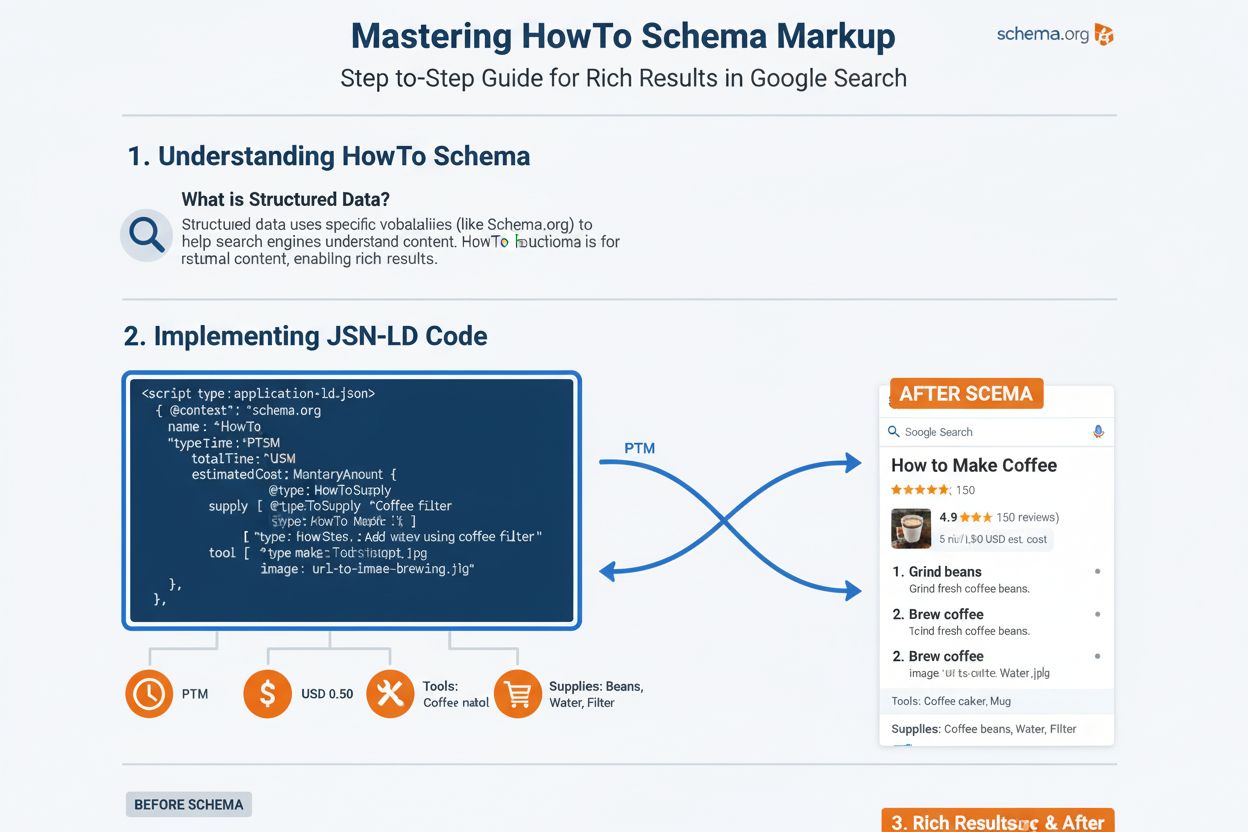
Added JSON-LD HowTo schema to all tutorial/how-to content with:

  • Step-by-step instructions marked up
  • Time estimates (totalTime)
  • Required tools and materials
  • Images for key steps

Example of what we added:

{
  "@context": "https://schema.org",
  "@type": "HowTo",
  "name": "How to Configure API Authentication",
  "description": "Step-by-step guide to setting up API authentication",
  "totalTime": "PT15M",
  "step": [
    {
      "@type": "HowToStep",
      "position": "1",
      "name": "Generate API Key",
      "text": "Navigate to Settings > API and click Generate New Key"
    }
  ]
}

Questions:

  1. What other properties are you including in HowTo schema?
  2. Any tips for complex multi-step procedures?
  3. How are you handling schema at scale?
  4. What validation tools do you recommend?

Want to optimize our implementation further.

10 comments

10 Comments

TE
TechnicalSEO_Expert_Sarah Expert Technical SEO Lead · January 9, 2026

Great results. Here’s why HowTo schema is so powerful for AI:

The AI advantage:

AI systems process millions of pages to answer questions. Structured data is like giving them a cheat sheet.

Research shows LLMs using structured data achieve 300% higher answer accuracy than parsing unstructured text.

Why HowTo schema specifically:

Unstructured: "First you should click settings,
then find API, then generate a key..."

Structured (HowTo):
Step 1: Click settings
Step 2: Navigate to API
Step 3: Generate key

AI can extract the structured version in milliseconds. The unstructured version requires parsing and interpretation.

Complete HowTo schema template:

{
  "@context": "https://schema.org",
  "@type": "HowTo",
  "name": "How to [Task]",
  "description": "Complete guide to [task description]",
  "image": "https://example.com/image.jpg",
  "totalTime": "PT30M",
  "estimatedCost": {
    "@type": "MonetaryAmount",
    "currency": "USD",
    "value": "0"
  },
  "supply": [
    {
      "@type": "HowToSupply",
      "name": "Required item 1"
    }
  ],
  "tool": [
    {
      "@type": "HowToTool",
      "name": "Required tool 1"
    }
  ],
  "step": [
    {
      "@type": "HowToStep",
      "position": "1",
      "name": "Step title",
      "text": "Detailed instruction text",
      "image": "https://example.com/step1.jpg"
    }
  ]
}

Include as many properties as applicable - more context helps AI understand better.

SM
SchemaExpert_Mike · January 9, 2026
Replying to TechnicalSEO_Expert_Sarah

Adding to this - the HowToSection property is underutilized but valuable for complex tutorials.

For multi-section procedures:

{
  "@type": "HowTo",
  "name": "Complete API Integration Guide",
  "step": [
    {
      "@type": "HowToSection",
      "name": "Authentication Setup",
      "itemListElement": [
        {
          "@type": "HowToStep",
          "position": "1",
          "text": "Generate API credentials"
        },
        {
          "@type": "HowToStep",
          "position": "2",
          "text": "Configure OAuth"
        }
      ]
    },
    {
      "@type": "HowToSection",
      "name": "Making Your First Request",
      "itemListElement": [...]
    }
  ]
}

This hierarchical structure helps AI understand procedure organization, especially for tutorials with 10+ steps.

Also don’t forget HowToDirection and HowToTip within steps for additional context.

WD
WordPress_Developer_Lisa WordPress Developer · January 9, 2026

Implementation tips for different platforms:

WordPress:

  • Yoast SEO Premium has HowTo blocks
  • RankMath includes schema builder
  • Custom: Add JSON-LD via wp_head hook

React/Next.js:

import Head from 'next/head'

export function HowToSchema({ howTo }) {
  return (
    <Head>
      <script
        type="application/ld+json"
        dangerouslySetInnerHTML={{
          __html: JSON.stringify({
            "@context": "https://schema.org",
            "@type": "HowTo",
            ...howTo
          })
        }}
      />
    </Head>
  )
}

Static site generators (Hugo, Jekyll):

Create a partial/include that generates JSON-LD from frontmatter data.

CMS-agnostic approach:

Build schema from structured content. If your CMS has “steps” as a content type, generate schema automatically.

The key: Automate schema generation from your content structure. Manual implementation doesn’t scale.

VC
ValidationExpert_Chris · January 8, 2026

Validation is critical - invalid schema is worse than no schema.

Validation workflow:

  1. Google Rich Results Test - Tests eligibility for rich results
  2. Schema.org Validator - Checks syntax compliance
  3. Chrome DevTools - View rendered schema
  4. Search Console - Monitor implementation at scale

Common HowTo schema errors:

ErrorCauseFix
Missing step textEmpty step elementsAdd text property to every step
Invalid time format“30 minutes” vs “PT30M”Use ISO 8601 duration format
Duplicate positionSame position numberEnsure unique sequential positions
Missing @contextForgot schema.org referenceAdd “@context”: “https://schema.org
URL vs text imageWrong property typeUse URL string, not object

The ISO 8601 duration cheat sheet:

  • PT30M = 30 minutes
  • PT1H = 1 hour
  • PT1H30M = 1 hour 30 minutes
  • P1D = 1 day

This format catches many people - AI systems need exact format.

CR
ContentOps_Rachel Content Operations Manager · January 8, 2026

Scaling HowTo schema across thousands of pages requires process.

Our implementation approach:

  1. Content audit - Identify all how-to/tutorial content
  2. Template creation - Standard schema templates by content type
  3. Data mapping - Map existing content fields to schema properties
  4. Automated generation - Build schema from content structure
  5. Batch validation - Test all pages programmatically
  6. Monitoring - Track schema health ongoing

Content types that qualify for HowTo:

  • Tutorials
  • Setup guides
  • Configuration instructions
  • DIY guides
  • Recipe-style procedures
  • Troubleshooting steps

Content that doesn’t qualify:

  • General information articles
  • Lists/listicles (use ItemList schema)
  • Reviews
  • News content

The automation rule:

If you have more than 50 how-to articles, manual schema implementation isn’t sustainable. Build it into your CMS or publishing workflow.

AA
AISearch_Analyst_Tom Expert · January 8, 2026

Let me share data on schema impact across AI platforms:

AI platform schema preferences:

PlatformSchema ImpactNotes
Google AI OverviewsHighStrong preference for structured data
ChatGPTMediumUses schema for context, not primary factor
PerplexityHighActively parses structured data
ClaudeMediumValues structure but focuses on content quality

HowTo schema vs. other schema types:

Our testing across 500 pages showed:

  • HowTo schema: +180% AI citations
  • FAQ schema: +220% AI citations
  • Article schema: +40% AI citations
  • No schema: baseline

The combination effect:

Pages with BOTH HowTo AND Article schema performed best:

  • HowTo alone: +180%
  • HowTo + Article: +240%

Multiple schema types give AI more context without conflict.

SM
SEODeveloper_Maria · January 7, 2026

Advanced HowTo schema patterns I’ve found effective:

Pattern 1: Step images

{
  "@type": "HowToStep",
  "name": "Configure settings",
  "text": "Navigate to...",
  "image": {
    "@type": "ImageObject",
    "url": "https://example.com/step1.jpg",
    "width": "800",
    "height": "600"
  }
}

Pattern 2: Video integration

{
  "@type": "HowTo",
  "name": "Tutorial Title",
  "video": {
    "@type": "VideoObject",
    "name": "Video tutorial",
    "description": "Watch the complete tutorial",
    "uploadDate": "2026-01-01",
    "contentUrl": "https://example.com/video.mp4",
    "thumbnailUrl": "https://example.com/thumb.jpg"
  }
}

Pattern 3: Tips within steps

{
  "@type": "HowToStep",
  "name": "Step title",
  "text": "Main instruction",
  "itemListElement": [
    {
      "@type": "HowToDirection",
      "text": "Direction detail"
    },
    {
      "@type": "HowToTip",
      "text": "Pro tip: This makes it easier"
    }
  ]
}

Rich schema = rich AI understanding.

TE
TechnicalSEO_Expert_Sarah Expert · January 7, 2026
Replying to SEODeveloper_Maria

The video integration is particularly powerful.

Why video + HowTo schema combo works:

  1. Google prefers video content for how-to queries
  2. Video schema provides additional context
  3. Combined signals indicate comprehensive tutorial

Implementation tip:

If you have YouTube videos for tutorials, embed them AND include VideoObject schema. The combination significantly improves AI visibility.

{
  "@type": "HowTo",
  "video": {
    "@type": "VideoObject",
    "embedUrl": "https://youtube.com/embed/..."
  }
}

We’ve seen pages with video + HowTo schema outperform text-only by 60% in AI citations.

MJ
MonitoringPro_Jake · January 7, 2026

Monitoring schema performance post-implementation:

What to track:

  1. Rich result impressions - Search Console
  2. AI citations - Am I Cited or manual monitoring
  3. Schema errors - Search Console enhancements
  4. Click-through rate - Rich results vs. non-rich

Our monitoring dashboard:

MetricBeforeWeek 1Week 4Week 8
Valid HowTo pages0150150148
Rich result impressions02,4008,90012,300
AI citations23285271
CTR from rich resultsN/A4.2%5.1%5.8%

The timeline:

  • Week 1-2: Google discovers and validates schema
  • Week 2-4: Rich results start appearing
  • Week 4-8: AI citations increase as platforms index
  • Ongoing: Continuous improvement as authority builds

Schema benefits compound over time - don’t expect instant results.

DE
DevOps_Engineer_Alex OP Senior Developer at Tech Company · January 6, 2026

Excellent thread. Here’s our refined implementation plan:

Enhanced schema template:

{
  "@context": "https://schema.org",
  "@type": "HowTo",
  "name": "How to [Task]",
  "description": "Step-by-step guide",
  "image": "[main image]",
  "totalTime": "PT[X]M",
  "datePublished": "[date]",
  "dateModified": "[date]",
  "author": {
    "@type": "Person",
    "name": "[author]"
  },
  "step": [
    {
      "@type": "HowToStep",
      "position": "1",
      "name": "[Step title]",
      "text": "[Instruction]",
      "image": "[step image]"
    }
  ]
}

Implementation roadmap:

  1. Automate generation - Schema from CMS content fields
  2. Add missing properties - totalTime, images, tools
  3. Implement HowToSection - For complex tutorials
  4. Add video integration - Where we have video content
  5. Set up monitoring - Search Console + Am I Cited

Quality checklist:

  • All steps have position, name, text
  • Time in ISO 8601 format
  • Images for main tutorial + key steps
  • Validation passed on Rich Results Test
  • Schema matches visible page content

Expected next-phase results:

Based on discussion insights, targeting:

  • 4x AI citations (from 71 to 280/month)
  • 50% increase in rich results
  • Top 3 rankings for core tutorials

Thanks everyone for the detailed technical guidance.

Have a Question About This Topic?

Get personalized help from our team. We'll respond within 24 hours.

Frequently Asked Questions

What is HowTo schema and why does it help AI visibility?
HowTo schema is structured data markup that tells search engines and AI systems your content contains step-by-step instructions. It helps AI visibility because it makes content machine-readable, allowing AI systems to quickly extract and cite instructional content. Research shows LLMs using structured data achieve 300% higher accuracy.
What are the required properties for HowTo schema?
Required properties include: name (title of the how-to), step (HowToStep elements with instructions). Recommended properties include: description, totalTime (ISO 8601 format), estimatedCost, tool, supply, and image. Each step needs a text property with the instruction.
How do you validate HowTo schema implementation?
Use Google’s Rich Results Test (search.google.com/test/rich-results) to check if your markup is valid and eligible for rich results. Also use the Schema.org Validator (validator.schema.org) to check syntax. Test on both mobile and desktop versions of your pages.

Track Your Schema Impact on AI Citations

Monitor how your structured data implementations affect AI visibility. See which schemas drive the most AI citations for your content.

Learn more

HowTo Schema
HowTo Schema: Structured Data Markup for Step-by-Step Instructions

HowTo Schema

HowTo Schema is structured data markup that helps search engines understand instructional content. Learn how it improves SEO, enables rich results, and increase...

11 min read