Discussion Content Strategy Thin Content

Google says my content is fine but AI never cites it. How do I fix 'thin content' for AI systems specifically?

TH
ThinContent_Tom · Content Strategist at Agency
· · 87 upvotes · 10 comments
TT
ThinContent_Tom
Content Strategist at Agency · January 8, 2026

Here’s my confusing situation:

We have about 200 blog posts for a client. Google seems happy - we rank well, traffic is stable, no Panda issues.

But when I run AI visibility audits with Am I Cited, we’re cited in maybe 5% of relevant AI responses. Competitors with fewer articles get cited way more.

My theory: Our content is “thin” in a way that matters for AI but not for Google.

What I’ve noticed about our content:

  • Posts are typically 600-800 words
  • Covers topics at a surface level
  • Often references other sources rather than providing original insights
  • Structure is basic - intro, body, conclusion

What competitors’ cited content has:

  • 1,500+ words typically
  • Original data, examples, case studies
  • Very structured sections that could stand alone
  • Specific, actionable advice

My questions:

  1. Is there a minimum content depth threshold for AI citations?
  2. How do you identify which specific pages are too thin?
  3. Should I consolidate pages or just expand them?
  4. What’s the ROI calculation on fixing this?

Dealing with 200 posts, so need to prioritize smartly.

10 comments

10 Comments

AR
AIContentExpert_Rachel Expert AI Content Consultant · January 8, 2026

You’ve identified something important: AI thin content is different from Google thin content.

Here’s the technical explanation:

Google thin content:

  • Evaluated at page level
  • Compared against query intent
  • Ranking factor among many

AI thin content:

  • Evaluated at passage level
  • Selected for retrieval and synthesis
  • Binary: either extracted or not

A 700-word post might satisfy Google’s query intent evaluation while having zero passages that AI systems find worth extracting.

The minimum threshold question:

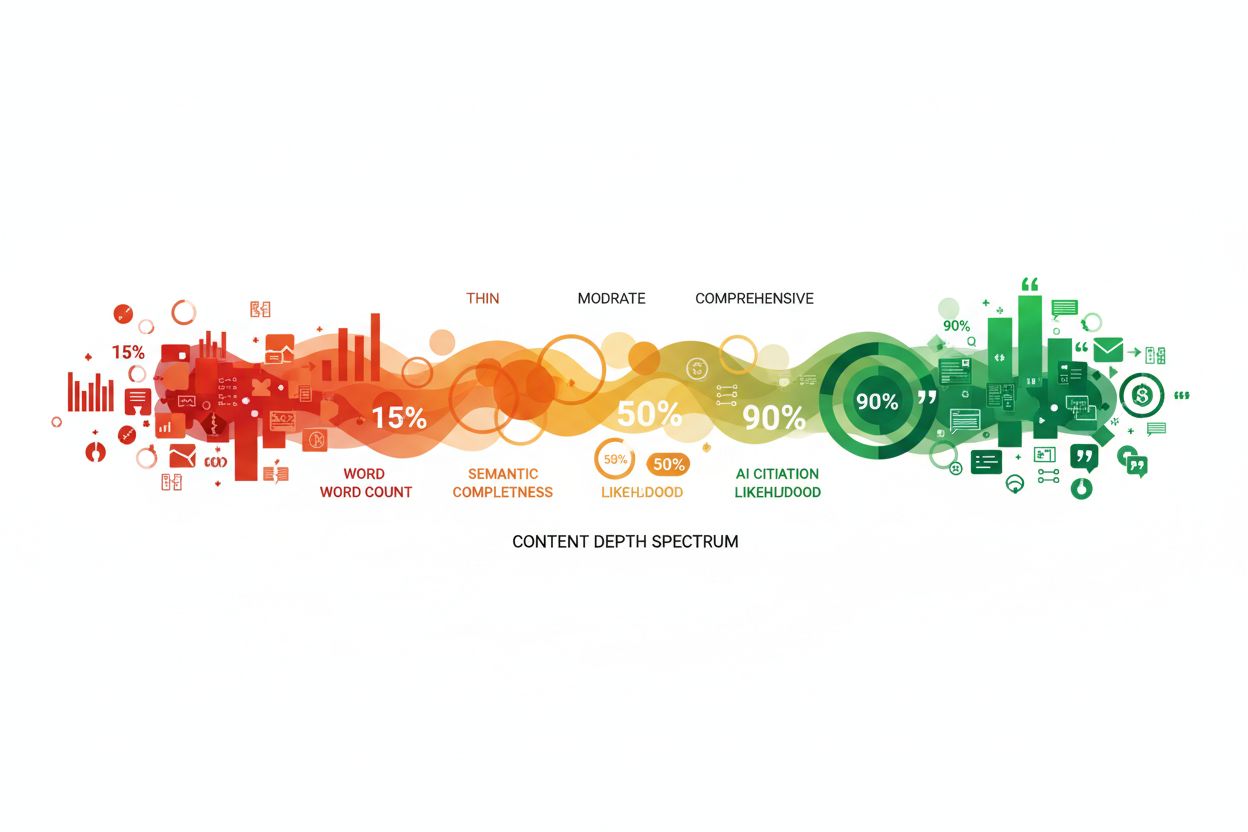
There isn’t a word count minimum. There’s a completeness minimum.

Can an AI extract a single passage from your content that completely answers a user question without needing synthesis from other sources?

If yes: thick enough for AI If no: thin for AI purposes

Your 600-800 word posts probably spread answers across paragraphs rather than providing complete answers in single passages.

CM
ContentAuditor_Mike Content Operations Lead · January 8, 2026

Dealt with a similar 200+ post audit. Here’s my prioritization framework:

Step 1: Identify high-potential pages

  • Filter to pages ranking top 20 for target keywords
  • These already have Google authority, just need AI optimization
  • Usually about 20-30% of posts qualify

Step 2: Categorize by fix type

Type A (Expand): Good topic, needs depth

  • Add 500-1000 words
  • Include original data/examples
  • Create modular sections

Type B (Restructure): Good depth, needs format

  • Already long enough
  • Add answer-first summaries
  • Break into clear sections

Type C (Consolidate): Thin but duplicative

  • Multiple posts on similar topics
  • Merge into comprehensive resource
  • Redirect old URLs

Type D (Retire): Not worth fixing

  • Low traffic, low potential
  • No unique angle
  • Consider removing or noindexing

For 200 posts: Expect roughly 40 Type A, 30 Type B, 50 Type C, and 80 Type D.

DJ
DataDriven_Jen · January 8, 2026
Replying to ContentAuditor_Mike

This framework is solid. I’d add one filter:

Commercial intent priority

For the Type A and B pages, prioritize ones targeting queries with commercial intent. These are where AI citations actually drive business value.

A thin post about “what is [concept]” might not be worth expanding if it doesn’t lead to conversions. But a thin post about “best [product] for [use case]” definitely is.

OA
OriginalResearch_Alex · January 8, 2026

The biggest thin content signal for AI: you’re citing others instead of being cited.

Look at your posts. How many contain original:

  • Data from surveys or research?
  • Case studies with specific results?
  • Frameworks you created?
  • Examples from direct experience?

If the answer is “very few,” that’s your thin content problem.

AI systems prefer sources. When your content says “According to [other source], the best practice is…” AI will cite that other source, not you.

When your content says “Based on our analysis of 500 companies, the best practice is…” AI will cite YOU.

The fix isn’t just adding words. It’s adding original value that makes you the source rather than the messenger.

SP
SEOVeteran_Paul 15 Years in SEO · January 7, 2026

ROI calculation for thin content improvement:

Current state:

  • 200 posts
  • 5% AI citation rate
  • Estimated 10 AI citations total

Target state (realistic):

  • Fix top 70 posts (Type A + B + C consolidation)
  • 40% AI citation rate for fixed posts
  • Estimated 28 AI citations from fixed content

Cost:

  • 70 posts x 4 hours average = 280 hours
  • At $100/hour = $28,000

Value: Depends on your niche and conversion rates. If each AI citation drives $500 in customer lifetime value, that’s $14,000 initial value with compounding as AI search grows.

The real calculation: AI search traffic is growing 30%+ annually. Content you fix now compounds. Content you leave thin becomes increasingly invisible.

Don’t ROI calculate it as a one-time project. Calculate it as an investment in an appreciating asset.

CL
ContentDesigner_Lisa · January 7, 2026

Quick wins for thin content that don’t require full rewrites:

1. Add answer-first summaries (30 min per post)

  • 40-60 word summary at top
  • Direct answer to the implicit question
  • Even thin posts become more extractable

2. Add FAQ section (20 min per post)

  • 3-5 questions answered briefly
  • Perfect for AI extraction
  • Doesn’t require expanding main content

3. Add comparison table (15 min per post)

  • Summarize key points in table format
  • Highly extractable by AI
  • Adds value without lengthy prose

4. Add schema markup (10 min per post)

  • FAQPage schema for FAQ sections
  • Article schema with proper author
  • Tells AI exactly what content you have

These quick fixes can improve citation potential by 30-40% even without comprehensive rewrites. Good way to improve ROI when you have 200 posts to address.

TT
ThinContent_Tom OP Content Strategist at Agency · January 7, 2026

This is exactly what I needed. Let me synthesize the action plan:

Phase 1: Audit & Prioritize (Week 1)

  • Run Am I Cited to identify current citation patterns
  • Categorize all 200 posts (Expand, Restructure, Consolidate, Retire)
  • Filter by commercial intent for prioritization

Phase 2: Quick Wins (Weeks 2-3)

  • Add answer-first summaries to top 50 posts
  • Add FAQ sections to posts targeting question queries
  • Implement schema markup across all salvageable posts

Phase 3: Deep Fixes (Weeks 4-12)

  • Expand Type A posts with original data/examples
  • Restructure Type B posts for modularity
  • Consolidate Type C posts into comprehensive resources

Phase 4: Retire & Redirect (Week 13)

  • Noindex or remove Type D content
  • Set up redirects from consolidated pages

Key insight I’m taking away:

The problem isn’t word count, it’s extractability and originality. I need to make each post a source that AI wants to cite, not a summary of other sources.

Going to track citation rate improvements with Am I Cited monthly to measure impact.

AC
AgencyOwner_Chris Content Agency Founder · January 7, 2026

One more consideration for agencies handling this:

Client education matters.

Clients often measure content by quantity. “We published 50 posts this year!” But thin quantity produces thin results.

Frame the conversation around AI-ready content inventory rather than post count. Show them that 200 thin posts producing 10 AI citations is worse than 50 comprehensive posts producing 50 citations.

The metric shift: from posts published to citations earned.

This also helps with ongoing content strategy. Better to publish 2 comprehensive, AI-ready posts per month than 8 thin ones.

TM
TechSEO_Marcus · January 7, 2026

Technical check for thin content that people miss:

Is your content even visible to AI crawlers?

Run these checks:

  1. View source with JavaScript disabled - is main content there?
  2. Check robots.txt - are AI crawlers allowed?
  3. Look at server logs - are AI bots (GPTBot, PerplexityBot, ClaudeBot) crawling?

I’ve seen cases where content was “thin” simply because AI systems couldn’t access it properly. JavaScript rendering issues, crawler blocks, or slow page loads that cause timeouts.

Before investing in content expansion, make sure the technical foundation allows AI to see what you already have.

CN
ConversionFocused_Nina · January 6, 2026

Final thought on thin content strategy:

Not all thin content is worth fixing.

AI citations matter most for:

  • Consideration-stage queries
  • Brand-building informational content
  • Comparison and “best of” queries

AI citations matter less for:

  • Pure transactional pages (product pages, pricing, etc.)
  • Very niche queries with low AI search volume
  • Time-sensitive content that will be outdated

Focus thin content fixes on the categories where AI citations actually drive business outcomes. Don’t waste resources optimizing content that wouldn’t convert even if it got cited.

Have a Question About This Topic?

Get personalized help from our team. We'll respond within 24 hours.

Frequently Asked Questions

What is thin content in the context of AI systems?
Thin content for AI refers to pages that lack sufficient depth, structure, or unique value for AI retrieval systems to extract and cite. Unlike traditional thin content metrics, AI thin content may rank well in Google but fail to provide extractable answers that AI systems can confidently cite.
How is thin content for AI different from thin content for Google?
Google evaluates thin content at the page level for ranking. AI systems retrieve content at the passage level for citation. A page might rank well overall but have no individual passages that provide complete, standalone answers for AI extraction.
What makes content 'thick' enough for AI citation?
AI-ready content has modular sections that stand alone, direct answers in the first 50 words of each section, original data or insights not found elsewhere, proper schema markup, and clear structure that AI can parse easily.
Should I consolidate thin pages or improve them individually?
If multiple thin pages target similar topics, consolidation into one comprehensive resource is often better. If pages target distinct queries, improve each individually with depth, structure, and original insights.

Identify Content Gaps in AI

See which of your content gets cited and which gets ignored. Identify thin content that needs improvement for better AI visibility.

Learn more

Avoiding Thin Content: Depth Requirements for AI Visibility

Avoiding Thin Content: Depth Requirements for AI Visibility

Learn how to create content deep enough for AI systems to cite. Discover why semantic completeness matters more than word count for ChatGPT, Perplexity, and Goo...

9 min read