Discussion Ecommerce Technical SEO

Product specs on your website - do they actually help AI recommendations? Testing some theories

EC
EcomManager_David · Ecommerce Manager, Electronics Retailer
· · 58 upvotes · 10 comments
ED
EcomManager_David
Ecommerce Manager, Electronics Retailer · January 4, 2026

I’ve been running some experiments on product pages and AI visibility.

The hypothesis: Products with detailed, structured specifications get recommended more often by AI for specific queries.

My test: We have 500+ product SKUs. I upgraded 50 with comprehensive spec tables and Product schema. The other 450 have minimal specs.

Initial observations (6 weeks in):

  • The upgraded products appear in AI answers for specific queries like “laptop with 32GB RAM and RTX 4080”
  • Original products only appear for generic queries (if at all)
  • AI seems to LOVE comparative queries (“X vs Y specs”)

Questions for the community:

  • Has anyone else tested spec depth vs. AI visibility?
  • Which specific attributes seem to matter most?
  • Is there a threshold for “detailed enough”?
  • How important is schema markup vs. just having good HTML?
10 comments

10 Comments

TR
TechSEO_Rachel Expert Technical SEO Lead, Ecommerce Agency · January 4, 2026

David, your hypothesis is correct based on our data.

What we’ve measured across 20+ ecommerce clients:

Products with comprehensive specifications get cited 3.8x more often for specific queries than products with minimal specs.

Why this happens:

AI systems work by matching query intent to content. When someone asks “best laptop for video editing with at least 32GB RAM,” the AI needs to:

  1. Understand the query requirements
  2. Find products that match those requirements
  3. Compare options

If your product page doesn’t explicitly state RAM capacity, the AI can’t match it to that query.

The spec attributes that matter most (electronics):

AttributeQuery Match Rate
RAM/Memory0.89
Processor0.85
Storage capacity0.82
Screen size0.78
Weight0.71
Battery life0.69
Connectivity0.64

The key insight: AI can only recommend what it can understand. Vague specs = invisible to specific queries.

ED
EcomManager_David OP · January 4, 2026
Replying to TechSEO_Rachel
The 3.8x citation rate is impressive. For the schema markup - are you using the Google-recommended Product schema, or something more detailed like productontology?
TR
TechSEO_Rachel · January 4, 2026
Replying to EcomManager_David

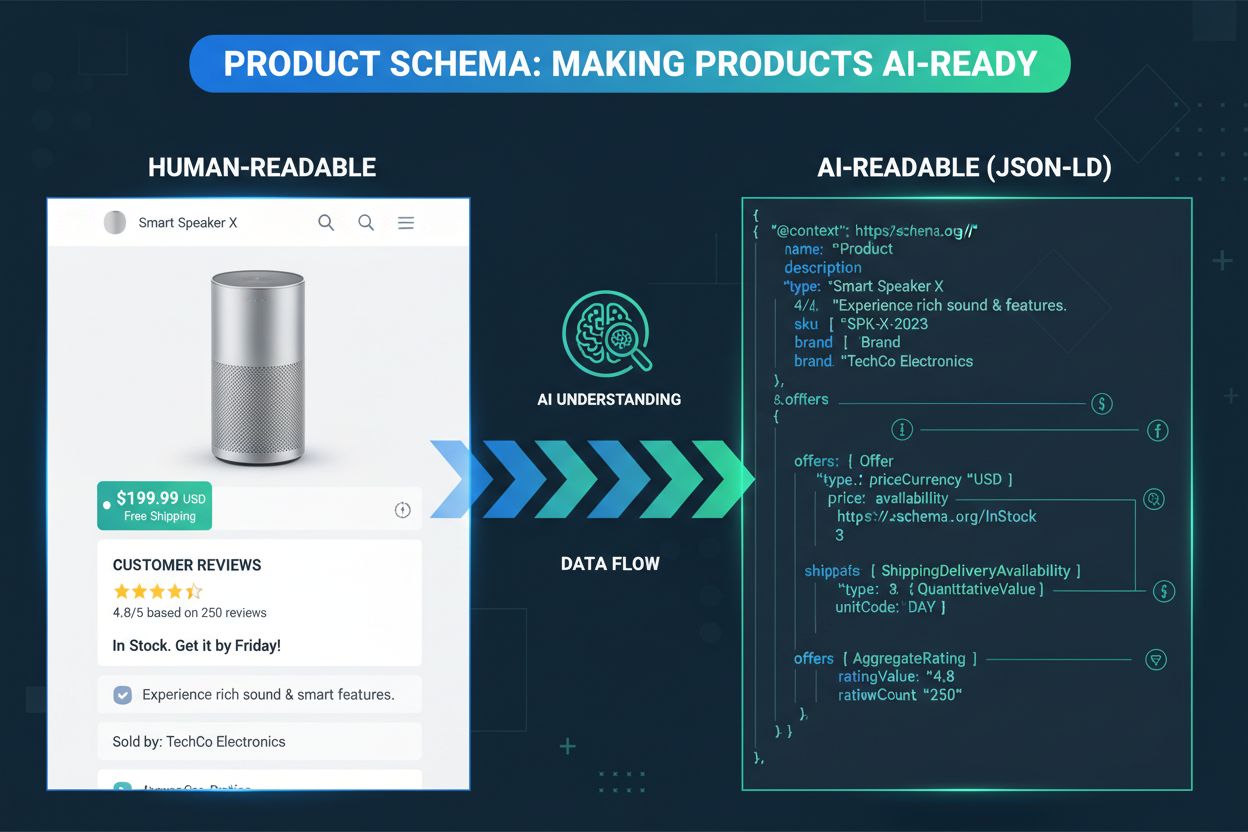
We use extended Product schema with additional properties:

Standard Product schema is a baseline, but we add:

  • additionalProperty for specs not covered by standard properties
  • isSimilarTo for variant relationships
  • isRelatedTo for ecosystem products

Example for a laptop:

"additionalProperty": [
  {"name": "RAM", "value": "32GB DDR5"},
  {"name": "GPU", "value": "NVIDIA RTX 4080"},
  {"name": "Screen Type", "value": "OLED 144Hz"}
]

The key: AI can understand well-structured HTML tables even without schema. But schema makes it unambiguous and machine-readable. Use both.

PM
ProductContent_Michelle Product Content Director · January 3, 2026

Content perspective on specifications:

The format matters as much as the data:

We’ve tested three spec formats:

  1. Unstructured paragraphs with specs mentioned
  2. Simple HTML tables with specs
  3. Structured tables + schema markup

Results for AI citations:

FormatAI Citation Rate (indexed to baseline)
Paragraph format1.0x (baseline)
HTML table2.4x
Table + Schema3.2x

Why tables win: AI systems can easily parse tabular data. When specs are buried in paragraphs, the AI has to work harder to extract them and may miss them entirely.

Our spec table best practices:

  • Consistent attribute naming across all products
  • Clear value formatting (not “32 GB” vs “32GB” vs “32 Gigabytes”)
  • Include units where applicable
  • One attribute per row
  • Use header rows
CJ
CompareEngine_Jason · January 3, 2026

I run a product comparison site. Here’s why specs matter so much for AI:

AI synthesizes comparisons from spec data.

When someone asks “MacBook Pro vs Dell XPS 15 for coding,” AI needs to compare:

  • Processor specs
  • RAM configurations
  • Screen quality
  • Keyboard quality
  • Port availability
  • Price

If your product page is missing some of these, AI either skips you or makes assumptions.

What I’ve noticed AI does well:

  • Extracting specs from clear tables
  • Understanding spec relationships (more RAM = better for multitasking)
  • Comparing products with similar spec formats

What AI struggles with:

  • Specs in images (can’t parse)
  • Inconsistent formatting across products
  • Missing specs (can’t compare what’s not there)
  • Vague language (“large memory” vs “32GB”)

For ecommerce: The more queryable your specs are, the more queries you can match.

SK
SchemaExpert_Kevin Expert · January 3, 2026

Deep dive on schema for product specs:

The technical implementation that works:

<script type="application/ld+json">
{
  "@type": "Product",
  "name": "ProductName",
  "additionalProperty": [
    {
      "@type": "PropertyValue",
      "name": "Display Size",
      "value": "15.6",
      "unitCode": "INH"
    },
    {
      "@type": "PropertyValue",
      "name": "RAM",
      "value": "32",
      "unitCode": "E37"
    }
  ]
}
</script>

Key points:

  1. Use additionalProperty for all technical specs
  2. Use PropertyValue with name, value, and unitCode
  3. Use standard UN/CEFACT unit codes for units
  4. Include every spec that matters for purchase decisions

Common mistakes:

  • Only using basic Product schema (name, price, image)
  • Specs only in HTML, not in structured data
  • Inconsistent property names across products
  • Missing units or using non-standard units

When both HTML and schema agree, AI systems are confident in the data.

AL
AIResearcher_Linda · January 2, 2026

From the AI perspective, here’s why specs matter:

How LLMs process product queries:

  1. Parse query requirements - “laptop with at least 32GB RAM”
  2. Search for matching content - Look for RAM specifications
  3. Extract relevant data - Find RAM value on product pages
  4. Compare options - Which products meet requirements
  5. Generate response - Recommend matching products

Where specs help:

Step 3 is where spec format matters. If RAM is:

  • In a table with “RAM: 32GB” = Easy extraction
  • In text “comes with 32 gigabytes of memory” = Harder extraction
  • In an image of spec sheet = Impossible extraction
  • Not mentioned = Product not considered

The threshold question you asked:

There’s no magic number, but cover:

  • Every attribute customers ask about
  • Every attribute your competitors list
  • Every attribute that differentiates your product

For electronics, that’s typically 15-25 attributes. Missing key ones means missing queries.

ET
EcomConsultant_Tom Ecommerce Optimization Consultant · January 2, 2026

Practical implementation advice for your 450 remaining products:

Prioritization framework:

Don’t upgrade all 450 at once. Prioritize by:

  1. Search volume - High-demand products first
  2. Margin - Higher margin = more ROI on effort
  3. Competitive gap - Where competitors have weak specs
  4. Comparison likelihood - Products often compared to each other

Efficient spec implementation:

  1. Create a spec template by category
  2. Bulk extract specs from manufacturer data
  3. Normalize formatting across all products
  4. Implement schema via template (not manual per product)
  5. Validate with structured data testing tool

For 450 products:

  • Template creation: 4-8 hours
  • Spec extraction/entry: 2-4 minutes per product average
  • Total: 20-40 hours for implementation

That’s 1-2 weeks of focused work for a major AI visibility advantage.

RS
RetailAnalyst_Susan · January 2, 2026

Category-specific spec importance data:

Electronics: Most cited: RAM, storage, processor, display, battery life Least cited: Color, country of origin, box contents

Apparel: Most cited: Size range, material, care instructions, measurements Least cited: Country of manufacture, style code

Home goods: Most cited: Dimensions, weight capacity, material, assembly required Least cited: Color variations, packaging type

Sports equipment: Most cited: Weight, dimensions, skill level, recommended use Least cited: Color options, brand story

The pattern: Functional specs that affect purchase decisions get cited. Aesthetic or logistical specs rarely do.

Focus your spec optimization on attributes that:

  1. Affect product performance
  2. Users filter by in their mental model
  3. Differentiate products in the category

AN
AIVisibility_Nicole AI Visibility Strategist · January 1, 2026

How to measure spec impact on AI visibility:

Tracking approach:

Before upgrading specs, record:

  • Which queries mention your products
  • What attributes AI cites when recommending
  • Competitor spec coverage

After upgrading:

  • Test the same queries
  • New specific queries targeting your specs
  • Compare citation rate changes

We use Am I Cited to track this systematically. For each product, we monitor:

What we typically see:

  • Generic query visibility: +20-40% improvement
  • Specific attribute queries: +150-300% improvement (if spec was missing)
  • Comparison queries: +50-100% improvement

The biggest wins are in specific queries you couldn’t match before.

ED
EcomManager_David OP Ecommerce Manager, Electronics Retailer · January 1, 2026

This thread confirmed and expanded my hypothesis. Key takeaways:

Why specs matter for AI:

  • AI can only recommend what it can understand
  • Specific queries require specific, parseable specs
  • Format (tables + schema) is as important as having the data

Implementation plan for remaining 450 products:

Phase 1 (Week 1-2):

  • Create spec templates by category
  • Prioritize top 100 products by margin and search volume

Phase 2 (Week 3-4):

  • Bulk extract specs from manufacturer data
  • Normalize formatting across all products
  • Implement extended Product schema

Phase 3 (Week 5-6):

  • Validate structured data
  • Test key queries for visibility improvements
  • Iterate on spec template based on results

Phase 4 (Ongoing):

  • Complete remaining products
  • Monitor AI visibility changes
  • Update specs when products change

The 3.8x citation improvement and specific query data are compelling enough to prioritize this work. Thanks everyone for the technical depth and practical frameworks.

Have a Question About This Topic?

Get personalized help from our team. We'll respond within 24 hours.

Frequently Asked Questions

Do product specifications help AI recommendations?
Yes, detailed product specifications significantly improve AI recommendations. AI systems extract specific attributes like dimensions, technical specs, compatibility, and performance metrics to match products with user queries. Products with comprehensive, structured specifications are more likely to be recommended for specific use-case queries.
How should product specs be formatted for AI visibility?
Product specifications should be formatted in structured HTML tables or lists, include Product schema markup with all relevant attributes, use consistent naming conventions, and provide complete information including dimensions, materials, compatibility, and performance metrics. Avoid using images for specifications as AI cannot parse them.
What product attributes matter most for AI citations?
The most impactful attributes depend on product category but typically include: dimensions, weight, compatibility with other products, key performance specifications, materials, warranty information, and use-case suitability. AI systems particularly value comparative attributes that help users make purchase decisions.

Track Your Product AI Visibility

Monitor how your product specifications appear in AI recommendations. See which attributes get cited and compare to competitors.

Learn more

Product Schema: Essential Markup for AI Shopping Visibility

Product Schema: Essential Markup for AI Shopping Visibility

Learn how product schema markup makes your ecommerce products visible to AI shopping assistants. Complete guide to structured data for ChatGPT, Perplexity, and ...

9 min read
Which schema markup types actually help with AI visibility?

Which schema markup types actually help with AI visibility?

Community discussion on schema markup for AI visibility. Real experiences from developers and SEOs on which structured data types improve AI citations.

5 min read
Discussion Technical SEO +1