

Startup AI Visibility: Building Presence from Zero
Learn how early-stage startups can build AI visibility across ChatGPT, Perplexity, and Google AI Overviews. Discover strategies, tools, and quick wins to get yo...
8 min read
We launched our B2B SaaS 4 months ago. Product is solid, early customers are happy, but we’re completely invisible in AI search.
The problem: When potential customers ask ChatGPT or Perplexity about solutions in our space, we never appear. Our well-funded, multi-year-old competitors always do.
Our current situation:
The chicken-and-egg: You need brand recognition for AI visibility, but you need visibility to build recognition. How do you break this cycle?
Specific questions:
Elena, I was in your exact position 18 months ago. Now we appear in 40% of relevant AI queries. Here’s what worked:
The startup AI visibility playbook:
Phase 1: Foundation (Month 1-2)
Phase 2: Authority Building (Month 3-4)
Phase 3: Expansion (Month 5-6)
Key insight: Don’t compete on broad terms. “Best CRM” is impossible. “Best CRM for real estate agents managing rental properties” is winnable.
The niche focus makes sense. We’ve been positioning as a broad solution but our best customers are all in one industry.
How did you approach the podcast and guest posting without a personal platform? Did you get rejected a lot?
Podcast approach: Started with smaller podcasts (under 10k downloads). They’re hungry for guests with real startup experience. I pitched myself as “founder building in [category] - lessons from 0 to $X ARR.”
Rejection rate: 70% for cold outreach. Better success when I engaged with hosts on Twitter/LinkedIn first.
Guest posting: Industry blogs and newsletters are easier than TechCrunch. I contributed genuinely helpful content (not promotional) to 2-3 niche publications. They syndicated some of it.
The compounding effect: Each piece of content makes the next easier. After 5 podcast appearances, I could reference those in new pitches. After 3 guest posts, I had “bylines at X, Y, Z.”
It’s a grind initially, but it compounds.
Product Hunt perspective for startups:
Why PH matters for AI visibility:
What makes a PH launch help AI:
Common mistakes:
For Elena: Your 15 customers can help! Ask them to upvote and share authentic reviews on PH. Quality of engagement matters more than quantity.
Content strategy for zero-brand-recognition startups:
The paradox: Big brands have generic content that ranks on authority. Startups can have SPECIFIC content that ranks on relevance.
Your content advantage:
You can create content established players won’t:
Content that builds AI visibility fast:
The key: Be specific. Big players can’t be. AI cites specific, relevant content over generic authoritative content.
Founder personal brand is underrated for startup AI visibility.
Why founder LinkedIn matters:
What to post:
The compound effect:
After 3 months of consistent posting, I started seeing my insights cited in AI answers to industry questions. Not my product directly - but my ideas, attributed to me.
That builds personal authority, which transfers to company visibility.
For Elena: Start posting 3x/week about your space. Share genuine learnings. Within 6 months, your personal brand will amplify company visibility.
Reddit was our secret weapon for early AI visibility.
How it works:
Reddit discussions get cited heavily by AI systems. When someone asks “what software for [use case],” AI often pulls from Reddit threads.
Our approach:
Example: Someone posts: “Looking for [category] software for [use case]” I respond: “We’re building something for exactly this. Still early, but happy to share what we’ve learned and give you access if you want to try it.”
Not “buy our product.” Just genuine engagement.
Timeline:
It’s slow but authentic and sustainable.
8 reviews is enough to start. Here’s how to maximize them:
G2 optimization for early-stage:
Making 8 reviews work harder:
The G2 threshold:
There’s no magic number, but 10-15 reviews with complete profile gets you into the visibility game. 25+ starts building real momentum.
Quick win: Email your 15 customers today. Ask 7 more for reviews. You’ll be at 15 in a week. That changes your G2 presence significantly.
Bootstrapped founder, $0 marketing budget for year 1. Still got AI visibility.
What worked without spending:
The trade-off: Without budget, it takes longer. Time instead of money. But it’s very doable.
My timeline:
For Elena with $50k: That budget can accelerate this significantly. Invest in content production, PR, and maybe a few micro-influencer partnerships.
I help startups with AI visibility specifically. Here’s the framework:
Startup AI Visibility Matrix:
| Effort | Cost | Time to Results | Impact |
|---|---|---|---|
| G2 profile optimization | Low | 2-4 weeks | Medium |
| Product Hunt launch | Low | 1-2 weeks | Medium-High |
| Comparison content | Medium | 4-8 weeks | High |
| Founder LinkedIn | Low | 8-12 weeks | Medium |
| Reddit presence | Low | 8-12 weeks | Medium |
| Podcast appearances | Medium | 4-8 weeks | Medium |
| Original research | High | 12+ weeks | High |
| Press/PR | High | 8-16 weeks | High |
For $50k budget:
I’d allocate:
What I’d track: Use Am I Cited or similar to monitor your visibility weekly. Understand which efforts actually move the needle for YOUR niche.
YC company perspective (we’re post-seed now but remember early days):
What YC teaches about visibility:
“Build something people want” extends to AI visibility. If your product genuinely solves a problem better, create content that demonstrates that.
What worked for us:
The unfair advantage startups have:
You can be more specific, more authentic, more transparent than big companies. AI values that.
A startup blog saying “here’s exactly how we approach [problem], with real numbers from our experience” gets cited over a big company’s generic marketing page.
This thread gave me a concrete path forward. Key realizations:
Mindset shift:
Action plan with $50k:
Q1 ($15k):
Q2 ($20k):
Q3-4 ($15k):
Tracking: Set up Am I Cited for weekly monitoring. Measure which efforts actually drive visibility.
The timeline realism is helpful - 6-12 months to meaningful visibility. That’s okay, it’s a marathon.
Thanks everyone for the startup-specific advice.
Get personalized help from our team. We'll respond within 24 hours.
Monitor how your new brand appears in AI-generated answers. Watch your visibility grow as you build authority and compete with established players.
Learn how early-stage startups can build AI visibility across ChatGPT, Perplexity, and Google AI Overviews. Discover strategies, tools, and quick wins to get yo...

Community discussion on how e-commerce sites optimize for AI search. Real strategies from merchants getting product pages cited in ChatGPT, Perplexity, and Goog...
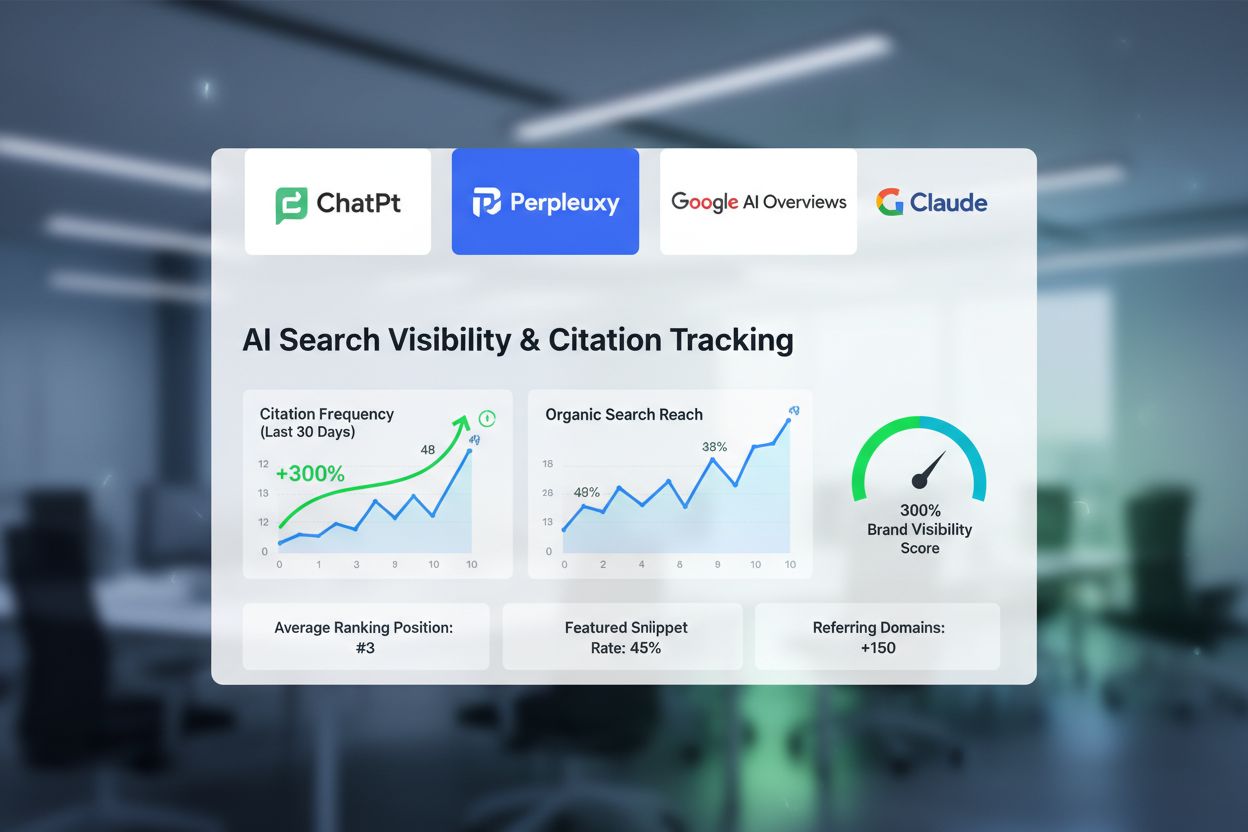
Discover how TechFlow Solutions achieved 300% AI citation growth and 185% qualified traffic increase through strategic GEO optimization. Real case study with ac...
Cookie Consent
We use cookies to enhance your browsing experience and analyze our traffic. See our privacy policy.