

What Are Embeddings in AI Search?
Learn how embeddings work in AI search engines and language models. Understand vector representations, semantic search, and their role in AI-generated answers.
8 min read
I keep seeing “embeddings” mentioned in AI search articles. I’ve read explanations but they’re too technical.
What I understand:
What I don’t understand:
My background: Traditional SEO marketer, 8 years experience. This AI stuff feels like learning a new language.
Can someone explain embeddings in a way a marketer can actually use?
Let me explain this without the math:
What embeddings are (simple version):
Imagine every piece of text can be placed on a map. Similar meanings are placed close together. Different meanings are far apart.
Embeddings are the coordinates on that map.
Why this matters for AI search:
Key insight: It’s not about keyword matching. It’s about meaning matching.
What this means for your content:
| Old SEO Thinking | Embedding Reality |
|---|---|
| Match exact keywords | Convey the right meaning |
| Keyword in title | Topic clearly addressed |
| Keyword density | Semantic depth |
| Synonyms for variety | Natural language about topic |
You don’t optimize FOR embeddings. You optimize for clear meaning.
Building on this with practical implications:
How embeddings change your content approach:
Before (keyword-focused): “Looking for running shoes? Our running shoes are the best running shoes for runners who need running shoes.”
After (meaning-focused): “Choosing athletic footwear for running involves understanding your gait, terrain, and training intensity. Here’s how to find the right fit…”
Why the second works better:
The second version creates a rich semantic “map location” that matches many different queries:
The keyword version’s map location is narrow. Only matches “running shoes” directly.
Practical changes to make:
The result: Your content’s embedding captures more meaning, matches more queries.
Let me explain RAG (Retrieval-Augmented Generation) since it’s connected:
How AI search actually works:
Step 1: User asks question “What’s the best project management tool for small teams?”
Step 2: Query becomes embedding AI converts question to coordinates (vector).
Step 3: Find similar content AI searches its knowledge base for content with nearby coordinates.
Step 4: Retrieve relevant passages Your article on “project management software comparison” has matching coordinates.
Step 5: Generate answer AI uses retrieved passages to craft response, potentially citing you.
Why this matters:
| What Helps | What Hurts |
|---|---|
| Clear, focused topic coverage | Vague, general content |
| Comprehensive answers | Surface-level coverage |
| Natural, semantic language | Keyword stuffing |
| Organized, structured content | Rambling, disorganized text |
The embedding creates the match. The content quality determines citation.
You can’t control the embedding algorithm. You CAN control how clearly and comprehensively you cover your topic.
To your question about different AI systems:
Yes, different systems use different embeddings.
| Platform | Embedding Approach |
|---|---|
| ChatGPT | OpenAI embeddings |
| Perplexity | Likely similar to OpenAI |
| Google AI | Google’s embedding models |
| Claude | Anthropic’s embeddings |
What this means: Same content might be “mapped” slightly differently in each system.
But here’s the good news: The fundamental principles are the same across systems:
What you DON’T need to do:
What you DO need to do:
This works across all embedding systems.
Common mistakes from not understanding embeddings:
Mistake 1: Over-relying on exact keywords Old thinking: “I need ‘project management software’ in my title” Reality: AI matches meaning, not just keywords
Mistake 2: Thin content “optimized” for keywords Old thinking: 500 words targeting one keyword Reality: Thin content has weak, narrow embeddings
Mistake 3: Ignoring related concepts Old thinking: Stay focused on one keyword Reality: Related concepts strengthen the embedding
Mistake 4: Repetitive content Old thinking: Repeat keyword for emphasis Reality: Adds nothing to embedding, may hurt quality signals
What to do instead:
Cover topics comprehensively Multiple angles = richer embedding
Include related concepts “Project management” + “team collaboration” + “workflow” + “productivity”
Answer multiple questions Each question adds semantic dimension
Use natural language Write for humans, embeddings will follow
The embedding is the effect of good content, not a separate optimization target.
Here’s a simple test to check if your content is “embedding-friendly”:
The query variety test:
Example for “project management software”:
| Query Variation | Does Content Help? |
|---|---|
| “best project management tools” | Should be yes |
| “how to manage team projects” | Should be yes |
| “software for tracking work” | Should be yes |
| “collaboration tools for teams” | Should be yes |
| “organizing business projects” | Should be yes |
If your content only helps with 2-3 variations, it has a narrow embedding.
The fix: Expand to cover more semantic territory. Don’t add keywords - add substance that addresses those variations.
After expansion: Your content’s embedding maps to a larger semantic area, matching more queries.
This actually makes sense now. My takeaways:
What embeddings are (my understanding):
What this means for my content:
Stop doing:
Start doing:
The mindset shift: From: “Match keywords AI might search” To: “Cover the meaning AI needs to understand”
Practical change: Before writing, list 10 ways people might ask about my topic. Make sure content addresses all of them meaningfully.
What I don’t need to worry about:
Just write comprehensive, clear, helpful content. The embeddings take care of themselves.
Thanks for making this accessible!
Get personalized help from our team. We'll respond within 24 hours.
Whether or not you understand embeddings, you can track your visibility across ChatGPT, Perplexity, and other AI platforms.
Learn how embeddings work in AI search engines and language models. Understand vector representations, semantic search, and their role in AI-generated answers.
Community discussion on how AI engines index content. Real experiences from technical SEOs understanding AI crawler behavior and content processing.
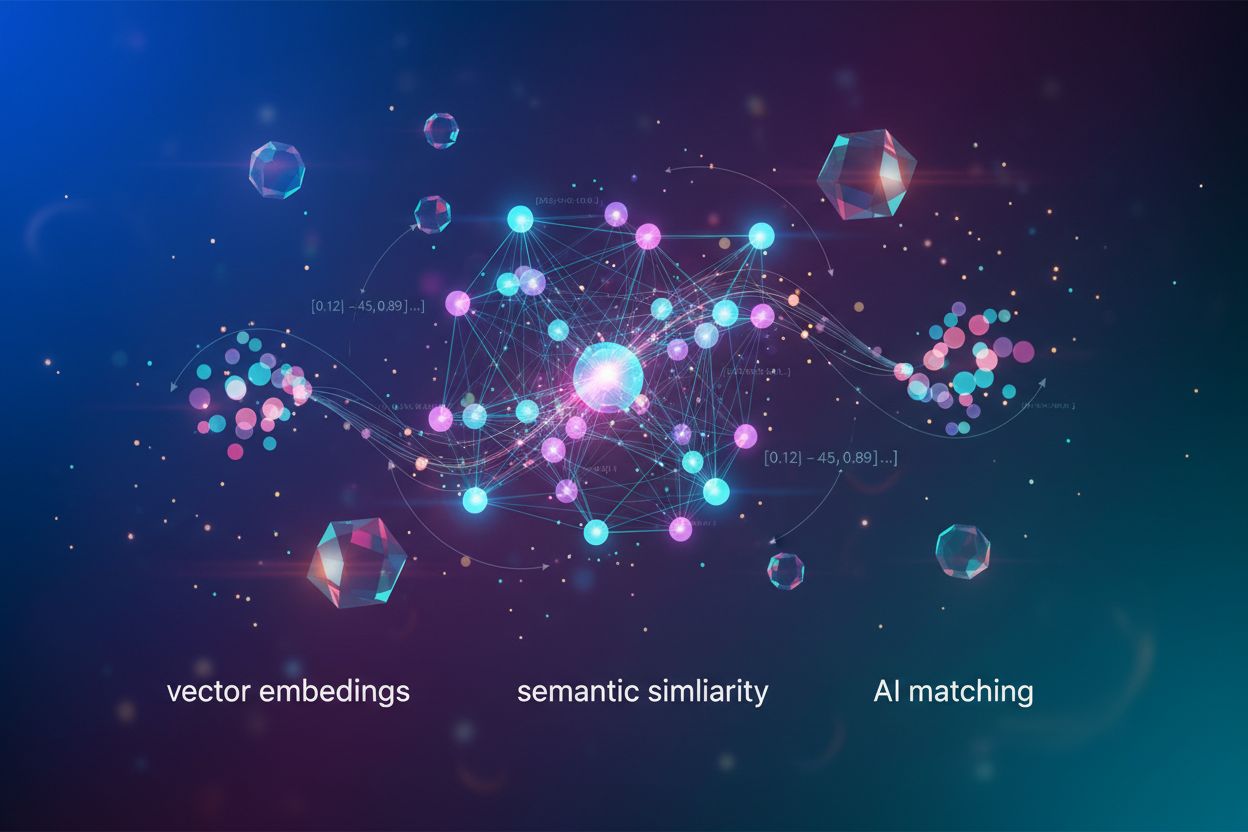
Learn how vector embeddings enable AI systems to understand semantic meaning and match content to queries. Explore the technology behind semantic search and AI ...
Cookie Consent
We use cookies to enhance your browsing experience and analyze our traffic. See our privacy policy.