

What is Entity Optimization for AI? Complete Guide for 2025
Learn what entity optimization for AI is, how it works, and why it's critical for visibility in ChatGPT, Perplexity, and other AI search engines. Complete techn...
11 min read
I keep hearing that “entity optimization” is the key to AI search visibility, but I honestly don’t understand what it means practically.
What I think I understand:
What I don’t understand:
My situation:
We’re a mid-size B2B software company. When I ask ChatGPT about our product category, competitors get mentioned but we don’t. People say it’s because they’re “stronger entities” - but what does that even mean?
Can someone explain entity optimization in practical terms I can actually implement?
Let me demystify this.
The fundamental concept:
Traditional SEO: “Does this page contain the words users search for?” Entity SEO: “Does AI understand that this brand/product is the right answer?”
What makes something an “entity”:
An entity is a distinct, uniquely identifiable concept that:
Why this matters for AI:
AI doesn’t search for keyword matches. It searches for trusted entities that fit the context.
When someone asks “best CRM for enterprise,” AI thinks:
If AI doesn’t recognize your company as an entity with clear category placement and trust signals, you’re invisible regardless of keywords.
The simplest test:
Ask ChatGPT: “What is [Your Company]?”
If it gives a clear, accurate description = you’re a recognized entity If it hallucinates or says “I don’t have information” = entity problem
That confusion is classic entity weakness. Here’s the fix:
Step 1: Brand Consistency Audit
Check if your company appears identically everywhere:
If you’re “Acme Software” on LinkedIn but “Acme Inc.” on your website and “Acme Solutions” in press releases - AI gets confused about whether these are the same entity.
Fix: Standardize to ONE name everywhere.
Step 2: Schema Markup Implementation
Add Organization schema to your site with:
This gives AI structured data about your entity.
Step 3: Knowledge Graph Entry
If you’re notable enough:
Step 4: Consistent Entity Associations
Every time your brand is mentioned, associate it with the same:
AI learns entity relationships from consistent patterns.
Let me explain the knowledge graph angle:
What is a knowledge graph?
It’s a structured database of entities and their relationships. Google’s Knowledge Graph, Wikidata, DBpedia are examples.
Why it matters for AI:
AI models are trained on or connected to knowledge graphs. When AI generates responses, it queries these graphs to understand:
The practical impact:
If your company has a Wikidata entry with:
AI systems that use Wikidata (many do) will understand your entity and its context.
How to build knowledge graph presence:
The reality:
Knowledge graph presence is like having an ID card for AI systems. Without it, you’re just a name in unstructured text.
Technical implementation perspective:
Schema markup IS part of entity optimization, but it’s not the whole thing:
Schema tells search engines and AI: “This is what this entity is.”
Key schemas for entity optimization:
Organization Schema (essential):
{
  "@type": "Organization",
  "name": "Acme Software",
  "alternateName": ["Acme", "Acme Inc"],
  "url": "https://acme.com",
  "sameAs": [
    "https://linkedin.com/company/acme",
    "https://twitter.com/acme",
    "https://wikidata.org/wiki/Q12345"
  ],
  "description": "Enterprise CRM software...",
  "foundingDate": "2015",
  "industry": "Software"
}
Product Schema:
{
  "@type": "SoftwareApplication",
  "name": "Acme CRM",
  "applicationCategory": "BusinessApplication",
  "operatingSystem": "Web-based"
}
Person Schema (for key people):
{
  "@type": "Person",
  "name": "Jane Doe",
  "jobTitle": "CEO",
  "worksFor": {"@type": "Organization", "name": "Acme Software"}
}
The key:
sameAs links connect your entity across platforms. This is how AI understands “Acme Software on website” = “Acme Software on LinkedIn” = same entity.
Testing:
Use Google’s Rich Results Test to validate your schema. Track if Knowledge Panels appear for brand searches.
Content angle on entity optimization:
Entity optimization isn’t just technical - it’s content strategy.
The concept of “topical entity authority”:
AI understands your brand through the topics you consistently cover.
If you publish 50 articles about CRM best practices, sales automation, and customer success - AI associates your entity with those topics.
If you publish random content with no topical focus, AI doesn’t know what you’re an authority on.
How to build topical entity authority:
Define your entity’s topics - What 3-5 topics should your brand be associated with?
Create comprehensive coverage - Don’t just mention topics, demonstrate deep expertise
Build topic clusters - Interconnected content showing relationship understanding
Consistent entity mention - Your brand name should appear alongside topic mentions
Example:
HubSpot is strongly associated with “inbound marketing” as an entity-topic relationship because:
When AI hears “inbound marketing,” HubSpot is one of the first entities that comes to mind.
Your goal:
Create entity-topic associations so strong that AI automatically thinks of your brand when those topics come up.
Brand perspective on entity recognition:
The identity clarity problem:
Many companies have vague, inconsistent identities that confuse AI:
Entity optimization is brand clarity for machines.
Questions to answer clearly:
Implementation:
Answer these questions identically everywhere your brand appears. The consistency creates the entity definition.
Example transformation:
Before (vague): “We help businesses grow” After (entity-clear): “Enterprise CRM software for B2B sales teams with Salesforce integration and AI forecasting”
AI can place the second description in a knowledge graph. The first is meaningless.
Measurement perspective:
How to track entity optimization progress:
Entity recognition test
Knowledge Panel tracking
Co-occurrence analysis
Citation monitoring
Baseline metrics to track:
Measure monthly. Entity optimization takes 3-6 months to show significant change.
Implementation roadmap from agency experience:
Entity Optimization in Phases:
Phase 1: Foundation (Month 1)
Phase 2: Knowledge Graph (Month 2-3)
Phase 3: Content Association (Month 3-4)
Phase 4: External Validation (Ongoing)
Expected timeline:
Entity optimization is a marathon, not a sprint.
This thread has finally made entity optimization concrete for me.
My understanding now:
Entity optimization = Making your brand a clearly defined “thing” that AI systems can recognize, understand, and recommend.
The core components:
Why my company isn’t getting cited:
AI doesn’t recognize us as a clear entity in our category. We have:
My action plan:
Week 1-2: Brand consistency audit and fixes Week 3-4: Schema markup implementation Month 2: Wikidata entry and profile optimization Month 3+: Content strategy aligned to topic-entity associations Ongoing: External mention building
The mindset shift:
Stop thinking “how do I rank for keywords?” Start thinking “how do I become a recognized entity in my space?”
Thanks everyone - this was exactly the practical explanation I needed.
Get personalized help from our team. We'll respond within 24 hours.
Track how AI systems recognize and cite your brand entity. See your visibility across ChatGPT, Perplexity, Google AI Overviews, and Claude.
Learn what entity optimization for AI is, how it works, and why it's critical for visibility in ChatGPT, Perplexity, and other AI search engines. Complete techn...
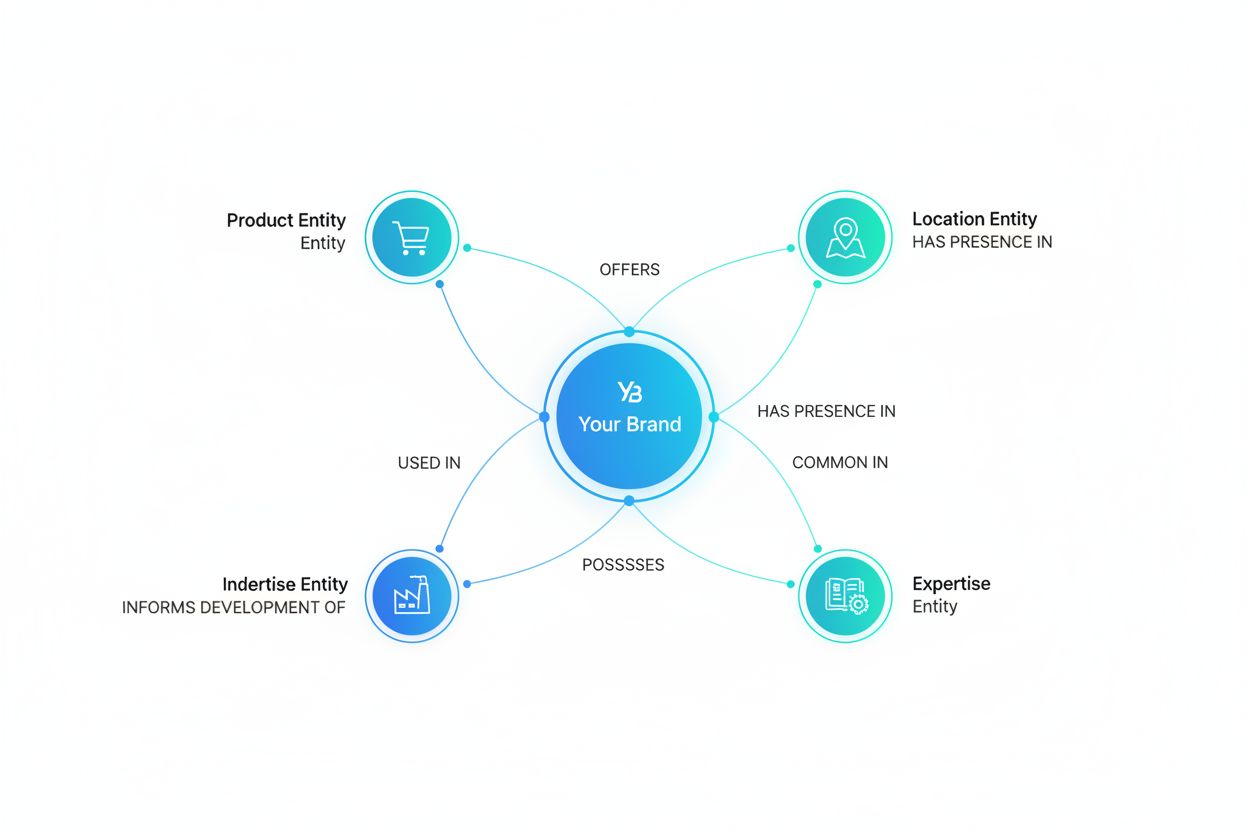
Learn how entity optimization helps your brand become recognizable to LLMs. Master knowledge graph optimization, schema markup, and entity strategies for AI vis...
Learn how to strengthen your brand entity for AI search visibility. Optimize for ChatGPT, Perplexity, Google AI Overviews, and Claude with entity SEO strategies...
Cookie Consent
We use cookies to enhance your browsing experience and analyze our traffic. See our privacy policy.