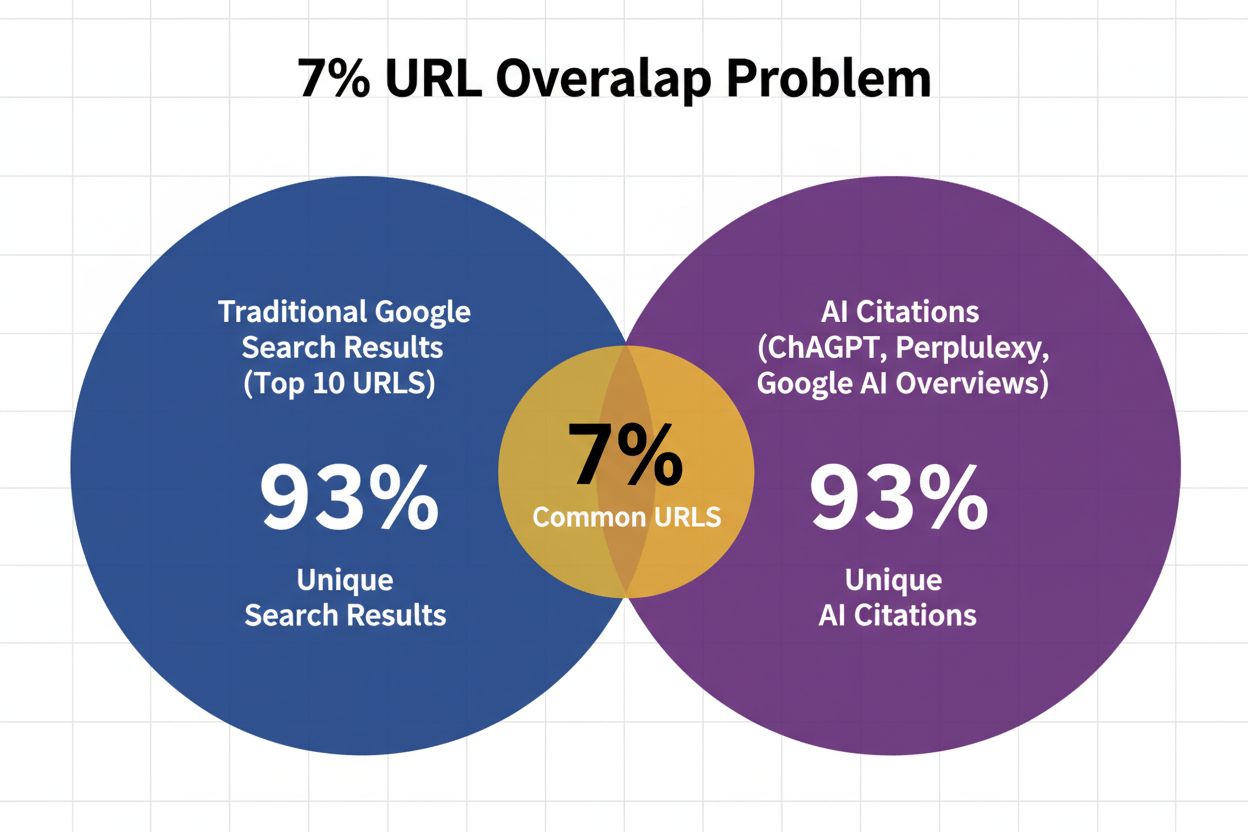
The finding that only 7% of URLs ranking in traditional Google search also appear in AI citations. This metric reveals a significant divergence between which sources Google’s algorithm ranks highest and which sources AI language models cite in their responses, indicating that AI systems and search engines evaluate source credibility and relevance differently.
7% Overlap Problem
The finding that only 7% of URLs ranking in traditional Google search also appear in AI citations. This metric reveals a significant divergence between which sources Google's algorithm ranks highest and which sources AI language models cite in their responses, indicating that AI systems and search engines evaluate source credibility and relevance differently.
Understanding the 7% Overlap Problem
The 7% Overlap Problem refers to a critical finding in AI citation research: when AI language models cite sources, only approximately 7% of the exact URLs they reference appear in Google’s top 10 search results for the same query. This phenomenon was first documented through comprehensive studies analyzing how major AI platforms like ChatGPT, Perplexity, and Google AI Overviews source their information compared to traditional search engine rankings. The discovery challenges the assumption that AI systems prioritize the same authoritative sources that Google’s algorithm ranks highest, revealing a significant divergence in how different information retrieval systems evaluate source credibility and relevance. This gap has profound implications for SEO professionals, content creators, and organizations seeking to understand AI’s role in modern information discovery.
Domain Overlap vs URL Overlap
Understanding the distinction between domain overlap and URL overlap is essential to interpreting the 7% Overlap Problem. Domain overlap measures the percentage of unique domains cited by AI that also appear in Google’s top 10 results, while URL overlap tracks the percentage of exact, specific URLs that appear in both sources. These metrics differ significantly because AI systems may cite multiple pages from the same domain, or they may reference different pages than those Google ranks highest for identical queries. The difference reveals that while AI and Google may agree on which websites are authoritative (domain level), they frequently disagree on which specific pages are most relevant (URL level). This distinction matters because it affects how content creators should optimize their strategies—focusing on domain authority versus specific page optimization requires different approaches.
Metric
Definition
Typical Range
Importance
Domain Overlap
% of domains cited by AI that appear in Google top 10
10-91%
Shows topical alignment
URL Overlap
% of exact URLs cited by AI that appear in Google top 10
6-82%
Shows direct source matching
Research Foundation and Methodology
The research foundation for understanding the 7% Overlap Problem comes from multiple large-scale studies conducted by leading SEO platforms. Ahrefs analyzed over 10,000 AI-generated responses across various query types and found domain overlap ranging from 10-91% depending on the query category, while URL overlap remained consistently low at 6-82%. Search Atlas conducted similar research with sample sizes exceeding 5,000 queries, documenting how different AI models prioritize sources differently than traditional search algorithms. Semrush’s research team examined citation patterns across multiple AI platforms simultaneously, revealing that the overlap variance depends heavily on query intent, topic specificity, and the AI model’s training data recency. These studies employed rigorous methodologies including controlled query testing, source verification, and statistical analysis to ensure findings were reproducible and reliable. The consistency of findings across independent research teams validates that the 7% Overlap Problem represents a genuine structural difference in how AI systems retrieve and rank information sources.
Platform-Specific Citation Patterns
Different AI platforms exhibit remarkably varied citation patterns, demonstrating that the 7% Overlap Problem manifests differently across the AI landscape:
Perplexity: Demonstrates the highest overlap rates with 43% domain overlap and 24% URL overlap, suggesting this platform prioritizes sources more aligned with traditional search rankings
ChatGPT: Shows lower overlap metrics at 21% domain overlap and 7% URL overlap, indicating it relies more heavily on training data and less on real-time search integration
Google AI Overviews: Exhibits moderate-to-high overlap at 86% domain overlap and 67% URL overlap, which makes sense given Google’s direct access to its own ranking data
Gemini: Takes a selective approach with 28% domain overlap and 6% URL overlap, suggesting it balances training data with curated source selection
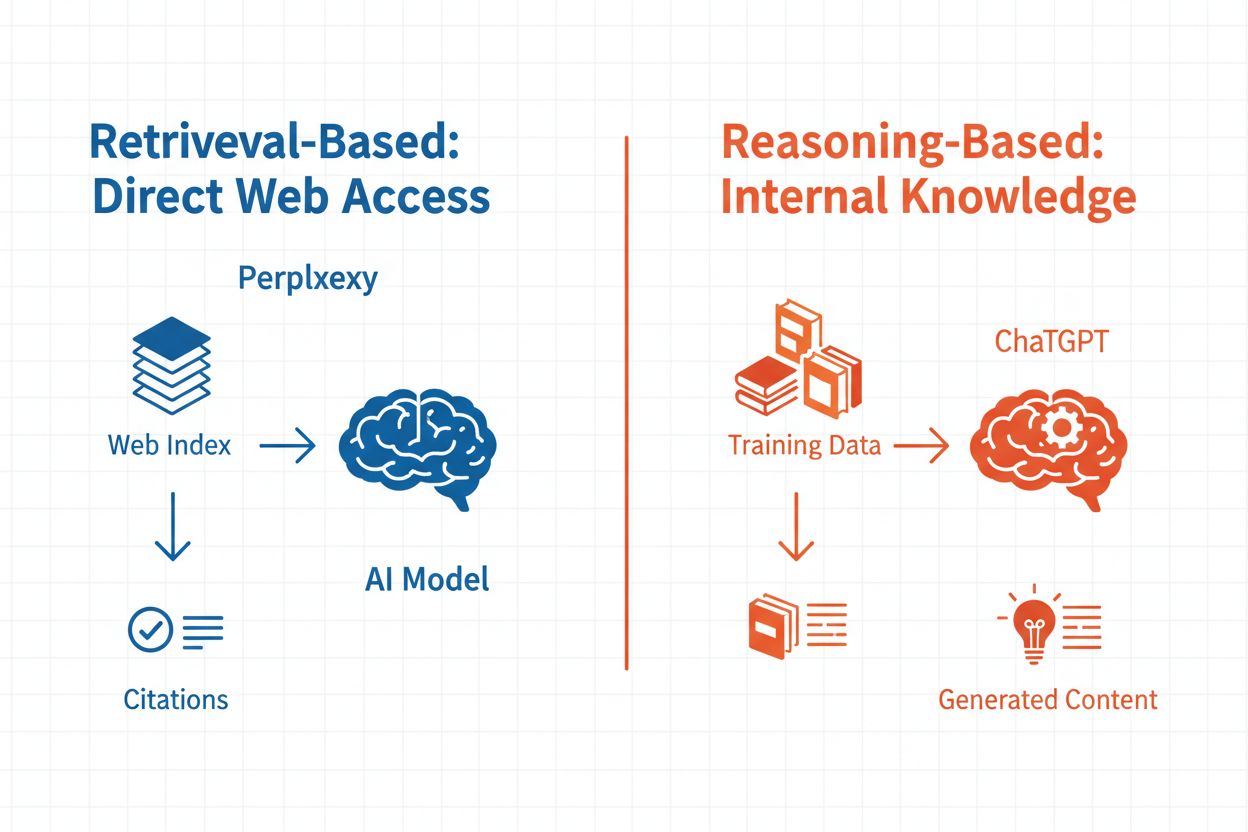
These variations reflect fundamental differences in how each platform sources information, their access to real-time data, and their underlying retrieval mechanisms. The dramatic difference between Perplexity and ChatGPT, for example, stems from Perplexity’s integration with live web search versus ChatGPT’s reliance on training data cutoffs. Understanding these platform-specific patterns helps organizations predict which AI systems will cite their content and how to optimize for each platform’s unique citation preferences.
Why the Gap Exists
The gap between domain and URL overlap exists due to several interconnected factors rooted in how AI systems fundamentally differ from search engines. Reasoning-based retrieval, which many AI models employ, prioritizes information that helps construct coherent answers rather than information that ranks highest in search results—this explains why ChatGPT might cite a less-popular but more directly relevant page over Google’s top result. Training data differences create another critical gap: AI models trained on data from 2023 or earlier may cite sources that were authoritative during training but have since been superseded by newer, more authoritative content that Google now ranks higher. The recency problem compounds this issue, as AI systems without real-time search integration cannot access the latest content updates, algorithm changes, or newly published authoritative sources. Additionally, AI systems may deliberately diversify sources to provide multiple perspectives rather than concentrating citations on the single most-ranked domain, reflecting a different philosophy about what constitutes a “good” source. These factors combine to create the systematic divergence observed in the 7% Overlap Problem, making it a feature of AI architecture rather than a bug to be fixed.
Strategic Implications for Content Creators
For SEO professionals and content creators, the 7% Overlap Problem demands a fundamental shift in optimization strategy. Rather than assuming that ranking in Google’s top 10 guarantees AI citations, organizations must now pursue a dual-channel optimization approach that addresses both search engine algorithms and AI retrieval systems separately. This means creating content that demonstrates clear expertise and relevance to specific queries while also ensuring that pages are discoverable through the training data and real-time search integrations that AI systems use. Content creators should focus on topical authority and semantic relevance rather than relying solely on traditional SEO signals, as AI systems often weight content quality and directness of answer higher than backlink profiles. The implications extend to link-building strategies: while backlinks remain crucial for Google rankings, they have less direct impact on AI citations, requiring marketers to diversify their authority-building efforts. Organizations should also consider which AI platforms their target audience uses most frequently and optimize accordingly—a B2B company whose audience uses Perplexity extensively should prioritize different optimization tactics than one whose audience relies on ChatGPT. Finally, the low URL overlap suggests that having multiple relevant pages on a domain increases the likelihood of AI citation, even if individual pages don’t rank in Google’s top 10.
Monitoring and Measurement Solutions
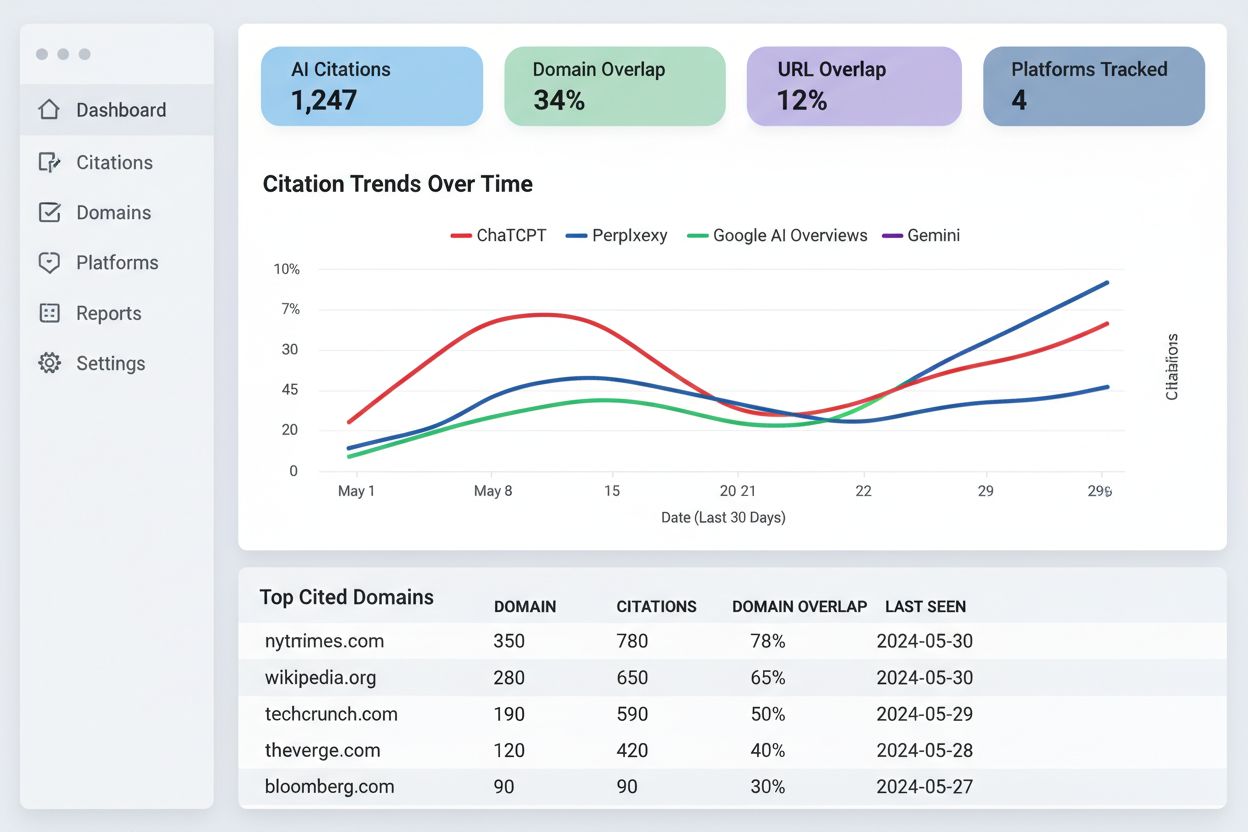
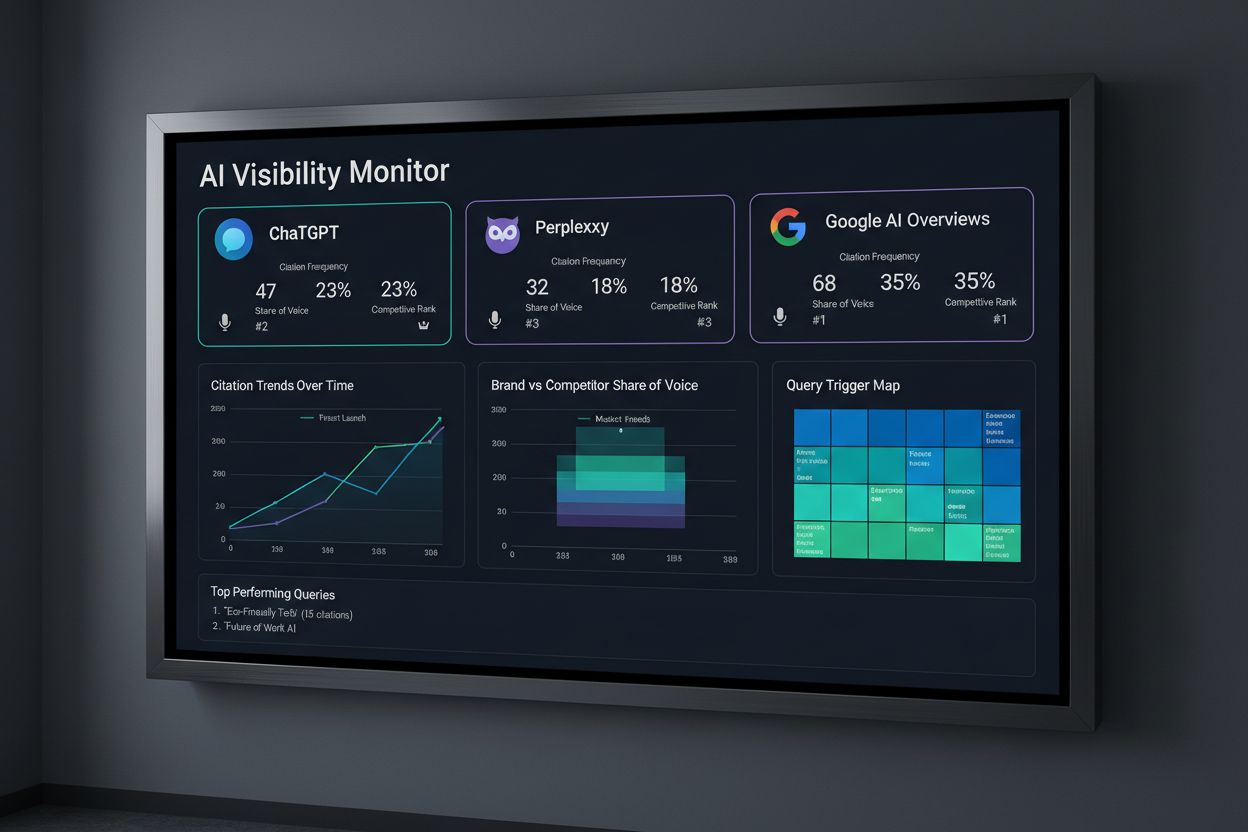
Monitoring AI citations requires specialized tools designed specifically for this purpose, as traditional SEO analytics platforms don’t capture how AI systems reference your content. AmICited.com stands out as a dedicated platform for tracking AI citations across multiple models, providing real-time monitoring of which AI systems cite your domain, the specific pages referenced, and how frequently citations occur over time. Complementary tools like Semrush, Ahrefs, and Search Atlas have integrated AI citation tracking into their broader SEO suites, offering comparative analysis between AI overlap and Google rankings. These monitoring solutions typically track citations across major platforms including ChatGPT, Perplexity, Google AI Overviews, and Gemini, allowing organizations to understand their visibility across the AI landscape. For organizations serious about AI-driven traffic and brand visibility, implementing a monitoring system is essential—you cannot optimize for something you cannot measure. AmICited specifically excels at providing granular citation data, historical trends, and competitive benchmarking that help organizations understand not just whether they’re cited by AI, but how their citation patterns compare to competitors and industry standards. Regular monitoring enables data-driven adjustments to content strategy, helping organizations capitalize on the growing importance of AI as a discovery mechanism alongside traditional search.
Frequently asked questions
The 7% Overlap Problem refers to the finding that only approximately 7% of the exact URLs cited by AI language models appear in Google's top 10 search results for the same query. This reveals a significant divergence between which sources AI systems prioritize and which sources Google's algorithm ranks highest, indicating fundamentally different approaches to evaluating source credibility and relevance.
Domain overlap measures whether AI systems cite the same websites as Google (typically 10-91%), while URL overlap measures whether they cite the exact same pages (typically 6-82%). The difference exists because AI systems may cite different pages from the same trusted domain, or they may reference pages that Google ranks lower but that better answer the specific query. This shows AI and Google agree on authoritative domains but disagree on which specific pages are most relevant.
Perplexity demonstrates the highest overlap with Google search, showing 43% domain overlap and 24% URL overlap. This is because Perplexity integrates live web search into its responses, allowing it to access and cite the same current sources that Google ranks. In contrast, ChatGPT shows only 21% domain overlap and 7% URL overlap due to its reliance on training data rather than real-time search integration.
The 7% Overlap Problem means you cannot assume that ranking in Google's top 10 guarantees AI citations. You need a dual-channel optimization approach that addresses both search engine algorithms and AI retrieval systems separately. This includes focusing on topical authority, semantic relevance, content quality, and ensuring your domain has multiple relevant pages that can be discovered through AI training data and real-time search integrations.
Yes, but they require different optimization strategies. While strong Google rankings help with AI visibility (domain-level correlation is strong), they don't guarantee specific page citations. You should focus on creating comprehensive, high-quality content that directly answers user questions, demonstrates expertise, and is discoverable through multiple channels. Domain authority remains important for both Google and AI visibility.
The overlap percentages fluctuate based on algorithm updates, changes in AI model training data, and shifts in how platforms prioritize sources. Research shows that overlap can change significantly within months as AI platforms update their retrieval mechanisms and training data. This is why continuous monitoring of your AI citations is essential rather than relying on static metrics.
AmICited.com is a dedicated platform specifically designed for monitoring AI citations across multiple models including ChatGPT, Perplexity, Google AI Overviews, and Gemini. Other tools like Semrush, Ahrefs, and Search Atlas have integrated AI citation tracking into their broader SEO platforms. AmICited excels at providing granular citation data, historical trends, and competitive benchmarking specific to AI visibility.
The overlap problem is evolving rather than simply improving or worsening. As AI platforms mature and integrate more real-time search capabilities (like Perplexity), overlap with Google increases. However, as AI systems develop more sophisticated reasoning capabilities, they may intentionally diverge from Google's rankings to provide more diverse or contextually relevant sources. The trend suggests a stabilization around platform-specific overlap patterns rather than convergence toward Google's rankings.
Monitor Your AI Visibility Across All Platforms
Track how your brand appears in ChatGPT, Perplexity, Google AI Overviews, and other AI platforms. Understand your AI citation patterns and optimize your content strategy accordingly.
The 7% Overlap Problem: Why Being Visible on Google Doesn't Mean AI Visibility
Only 7% of URLs cited by AI search engines match Google's top results. Discover why ranking on Google doesn't guarantee AI visibility and how to optimize for mu...
Understanding Why Competitors Get More AI Citations
Discover why competitors dominate AI-generated answers and learn proven strategies to increase your brand's visibility in ChatGPT, Perplexity, and Google AI Ove...