The accumulated value of consistent, positive AI visibility over time. AI brand equity measures how prominently, accurately, and favorably generative AI systems mention and recommend your brand in their responses. It develops through high-quality content, earned media coverage, and strong SEO performance that train AI systems to recognize your brand as authoritative and trustworthy. Unlike traditional brand equity, AI brand equity specifically influences customer perception through AI intermediaries like ChatGPT, Gemini, Claude, and Perplexity.
AI Brand Equity
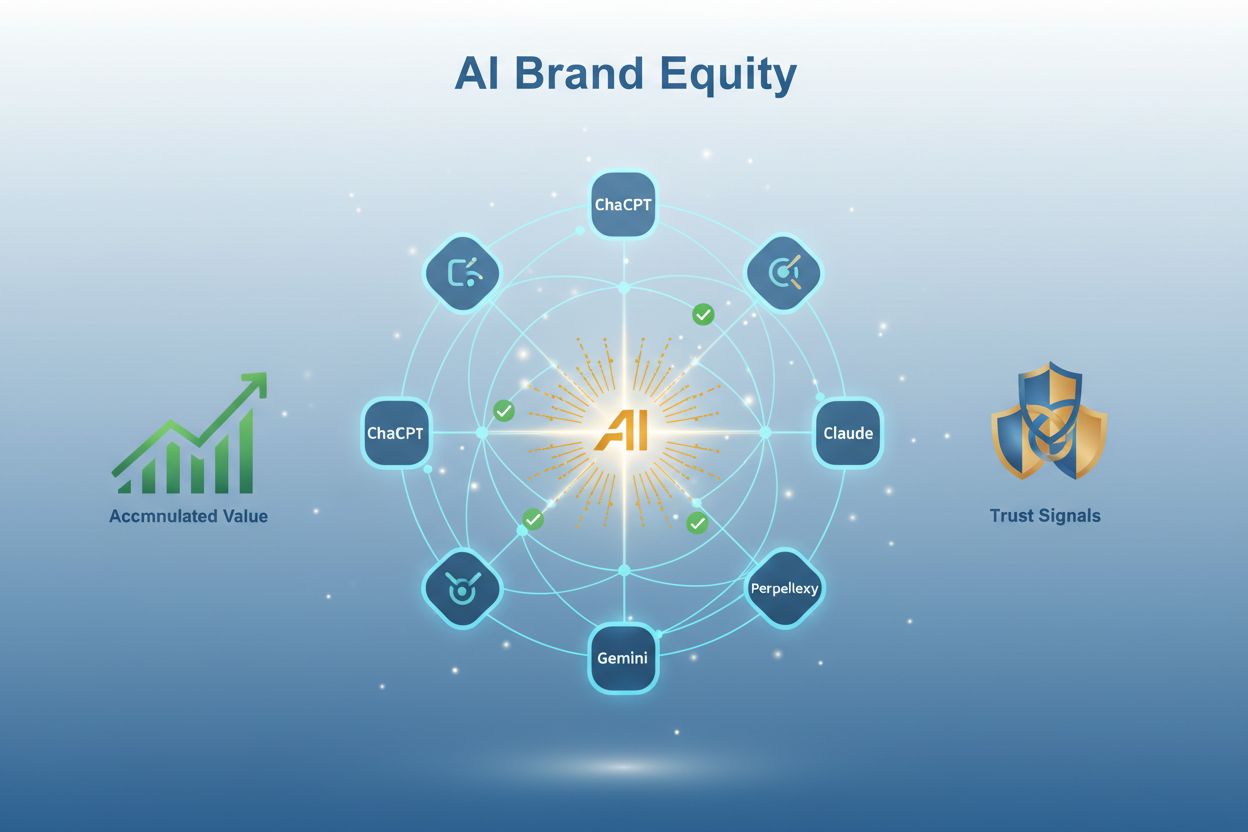
The accumulated value of consistent, positive AI visibility over time. AI brand equity measures how prominently, accurately, and favorably generative AI systems mention and recommend your brand in their responses. It develops through high-quality content, earned media coverage, and strong SEO performance that train AI systems to recognize your brand as authoritative and trustworthy. Unlike traditional brand equity, AI brand equity specifically influences customer perception through AI intermediaries like ChatGPT, Gemini, Claude, and Perplexity.
What is AI Brand Equity?
AI brand equity is the accumulated value and competitive advantage a brand builds through consistent, positive visibility across generative AI systems and large language models (LLMs). Unlike traditional brand equity—which develops through advertising, media coverage, and customer experience—AI brand equity specifically measures how prominently, accurately, and favorably AI assistants like ChatGPT, Gemini, Claude, and Perplexity mention and recommend your brand. This form of equity emerges when AI systems recognize your brand as authoritative, trustworthy, and relevant enough to cite in their responses to user queries. As generative AI increasingly shapes how customers discover, evaluate, and choose products, AI brand equity has become a critical asset that directly influences market perception and purchasing decisions. The equity accumulates over time through consistent signals—high-quality content, earned media coverage, strong SEO performance, and structured data—that train AI systems to treat your brand as a reliable source of information. Building AI brand equity is fundamentally different from traditional brand building because it requires understanding how AI systems ingest, process, and synthesize information from across the web. Companies that invest in AI brand equity early gain a significant competitive advantage, as they become the default recommendations in AI-driven conversations that increasingly replace traditional search.
Why AI Brand Equity Matters in Modern Marketing
The rise of generative AI has fundamentally shifted how customers discover brands. According to PwC research, 44% of consumers are interested in using AI chatbots to research product information before making purchasing decisions, and this number continues to grow as AI tools become more sophisticated and accessible. Even more striking, research shows that over 40% of consumers trust generative AI search results more than paid search results, while only 15% trust search ads more. This trust differential is critical: when a customer asks ChatGPT “What’s the best project management tool for remote teams?” or queries Claude “Which CRM should a startup use?”, the AI’s response carries significant weight in their decision-making process. Yet most brands remain invisible in these conversations—only 6% of top ChatGPT results cite the brand being searched for, meaning the vast majority of brands are fueling AI training data without receiving recognition or visibility. This invisibility represents a massive blind spot in modern marketing, as an entire discovery channel operates without oversight or measurement.
Discovery Method
User Behavior
Brand Visibility Impact
Monitoring Difficulty
Traditional Search
Users browse multiple results
Visibility depends on ranking position
Moderate - tracked via rank trackers
AI Assistants
Users accept AI’s synthesized answer
Single recommendation shapes perception
High - requires prompt testing across platforms
Social Media
Users discover through feeds and recommendations
Visibility depends on engagement and reach
Moderate - tracked via social listening tools
Paid Search
Users click on ads in search results
Visibility depends on bid and ad quality
Low - tracked via ad platforms
The stakes are higher with AI because there’s no browsing—users typically accept the AI’s recommendation as authoritative. This makes AI brand equity not just important, but essential for brands that want to remain competitive in an AI-driven marketplace.
Ready to Monitor Your AI Visibility?
Track how AI chatbots mention your brand across ChatGPT, Perplexity, and other platforms.
AI brand equity doesn’t develop overnight; it accumulates through consistent, high-quality signals that train AI systems to recognize your brand as authoritative and trustworthy. The mechanism is straightforward: generative AI models are trained on vast amounts of web content, including news articles, blog posts, product reviews, social media discussions, and structured data. When your brand appears frequently in authoritative sources—earned media coverage, industry publications, expert commentary, and well-optimized content—AI systems learn to associate your brand with credibility and relevance. Over time, these consistent signals compound, creating a self-reinforcing cycle where AI systems become increasingly likely to mention your brand in relevant conversations. The key to building AI brand equity is understanding that it’s not about gaming the system or manipulating AI responses; it’s about creating genuinely valuable content and earning legitimate third-party citations that AI systems naturally recognize as signals of authority. Brands that publish high-quality content, secure earned media coverage, maintain strong SEO performance, and structure their data clearly will see their AI brand equity grow steadily. This accumulation effect means that early investment in AI visibility creates long-term competitive advantages, as the equity compounds and becomes harder for competitors to overcome.
Key Components of AI Brand Equity
AI brand equity is built on multiple interconnected components that work together to shape how AI systems perceive and represent your brand. Understanding these components helps you develop a comprehensive strategy to build and maintain your equity:
Mention Frequency and Share of Voice – How often your brand appears in AI responses compared to competitors across different query types and platforms. Higher frequency signals relevance and authority to AI systems.
Accuracy and Consistency of Information – Whether AI systems cite correct information about your products, pricing, features, and company details. Inaccurate information damages equity and customer trust, while consistent accuracy reinforces authority.
Sentiment and Context – The tone and framing surrounding your brand mentions. Positive sentiment and favorable positioning in comparisons strengthen equity, while negative or neutral mentions may indicate positioning gaps.
Source Authority and Citation Quality – The credibility of sources that cite your brand. Citations from authoritative publications, industry experts, and trusted platforms carry more weight with AI systems than citations from low-authority sources.
Competitive Positioning – How your brand is positioned relative to competitors in AI responses. Being mentioned as a leader or top choice builds equity faster than being positioned as a budget alternative or niche player.
Cross-Platform Consistency – How consistently your brand appears and is described across different AI platforms (ChatGPT, Gemini, Claude, Perplexity, etc.). Consistent presence across platforms signals stronger authority than visibility in only one or two systems.
Stay Updated on AI Visibility Trends
Get the latest insights on AI mentions, brand monitoring, and optimization strategies.
Measuring AI Brand Equity
Measuring AI brand equity requires a systematic approach that combines quantitative metrics with qualitative analysis. The first step is establishing a baseline by running a comprehensive audit of how your brand currently appears across major AI platforms. This involves creating a set of representative queries that reflect how your target customers would naturally ask AI systems about your product category, then documenting how each platform responds. Key metrics to track include share of AI brand mentions (how often your brand appears compared to competitors), sentiment and favorability (whether mentions are positive, neutral, or negative), inclusion in recommendation lists (whether AI suggests your brand as an option), relative ranking (where your brand appears in AI responses), and accuracy of information (whether AI cites correct details about your products). Establishing this baseline is critical because it gives you a reference point to measure improvement against. Once you have a baseline, implement regular monitoring—ideally weekly or bi-weekly—to track how your AI brand equity evolves over time. Tools like AmICited.com provide automated monitoring across multiple AI platforms, eliminating the manual work of testing hundreds of queries and allowing you to focus on strategy and optimization. By tracking these metrics consistently, you can identify which initiatives successfully improve your AI visibility and which require adjustment.
Building AI Brand Equity Through Content Strategy
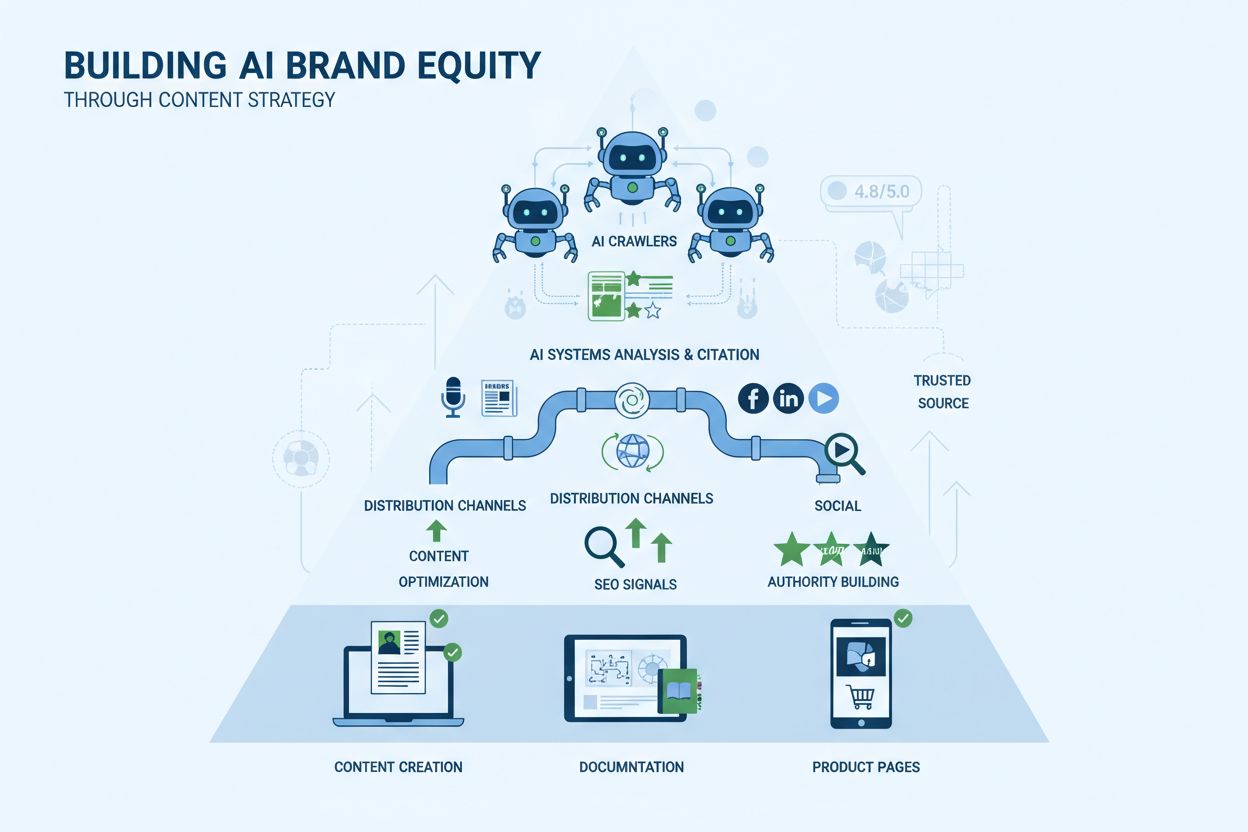
Building AI brand equity requires a deliberate content and visibility strategy that addresses how AI systems discover, evaluate, and cite information. The foundation is creating high-quality, authoritative content that directly answers the questions your customers ask AI systems. This means developing comprehensive guides, comparison articles, product documentation, and educational content that AI systems will recognize as valuable sources to cite. Structure this content clearly with headings, bullet points, and organized information that makes it easy for AI systems to extract and synthesize. Beyond owned content, earned media plays a crucial role—when reputable publications, industry analysts, and expert commentators mention your brand, AI systems recognize these citations as signals of authority and credibility. A strong PR strategy that secures coverage in relevant publications directly strengthens your AI brand equity. SEO remains important because AI systems often reference content that ranks well in traditional search, so optimizing for both human readers and AI systems creates a multiplier effect. Implementing structured data (schema markup) on your website helps AI systems understand your products, pricing, and company information more accurately, reducing the likelihood of misinformation in AI responses. Geographic and language-specific optimization matters too—if you serve multiple markets, ensure your content is optimized for AI systems in each region. Finally, consistency across all these channels is essential; when your messaging, positioning, and information are consistent across your website, PR coverage, and third-party sources, AI systems develop a clearer, more authoritative understanding of your brand.
The Role of Monitoring Tools in AI Brand Equity
Monitoring tools have become essential infrastructure for managing AI brand equity effectively. AmICited.com stands out as a leading AI visibility monitoring platform specifically designed to track how your brand appears across generative AI systems like ChatGPT, Gemini, Claude, and Perplexity. These platforms automate the process of testing hundreds of queries across multiple AI systems, tracking how your brand is mentioned, positioned, and compared to competitors. Rather than manually testing queries and documenting responses—a time-consuming and error-prone process—monitoring tools provide dashboards that show your AI visibility trends over time, alert you to significant changes, and identify opportunities for improvement. The best monitoring tools go beyond simple mention counting; they analyze sentiment, track source citations, benchmark competitive positioning, and provide actionable recommendations for improving your visibility. Integration with your existing marketing workflows is critical—the insights from AI monitoring should inform your content strategy, PR priorities, and SEO efforts. Other platforms in this space include Meltwater, Profound, Scrunch AI, Peec AI, Hall, and Otterly.AI, each offering different features and price points. The key is choosing a tool that aligns with your specific needs, whether that’s enterprise-level analytics, startup-friendly pricing, or specialized features for particular industries. Regardless of which tool you choose, implementing systematic monitoring transforms AI brand equity from an abstract concept into a measurable, manageable business metric.
AI Brand Equity vs Traditional Brand Equity
While AI brand equity is a distinct concept, it doesn’t replace traditional brand equity—instead, the two work together to create comprehensive brand value. Traditional brand equity develops through advertising, customer experience, media coverage, and brand reputation built over years or decades. It’s measured through metrics like brand awareness, customer loyalty, perceived quality, and brand associations. AI brand equity, by contrast, specifically measures visibility and positioning within generative AI systems, focusing on how AI assistants describe and recommend your brand. The key difference is that traditional brand equity influences human perception directly, while AI brand equity influences perception through AI intermediaries. However, these forms of equity are deeply interconnected: strong traditional brand equity (earned media coverage, customer reviews, industry recognition) creates the signals that feed AI brand equity. Conversely, strong AI brand equity can enhance traditional brand equity by increasing visibility in AI-driven discovery channels and influencing customer perception. The most successful brands recognize that both forms of equity matter and develop integrated strategies that strengthen both simultaneously. This means creating great products and customer experiences (traditional equity), earning media coverage and customer advocacy (traditional equity), while simultaneously optimizing content and visibility for AI systems (AI equity). Brands that excel at both will dominate in an increasingly AI-driven marketplace.
Long-Term Value of AI Brand Equity
The long-term value of AI brand equity extends far beyond immediate visibility metrics. As generative AI becomes the primary discovery channel for more customers, brands with strong AI equity gain compounding advantages that become increasingly difficult for competitors to overcome. Early investment in AI brand equity creates a first-mover advantage—brands that build visibility and authority in AI systems now will have established themselves as trusted sources by the time AI adoption reaches peak maturity. This creates a self-reinforcing cycle where established AI brand equity attracts more citations, which further strengthens equity, which attracts even more visibility. The competitive moat created by strong AI brand equity is substantial because it’s built on genuine authority signals (content quality, earned media, customer trust) rather than manipulable metrics. Brands with high AI brand equity also benefit from improved customer trust and confidence—when AI systems consistently recommend your brand, customers perceive you as a market leader and trusted choice. This perception translates directly into higher conversion rates, customer lifetime value, and market share. Additionally, strong AI brand equity future-proofs your brand against changes in search algorithms or marketing channels, because your visibility is based on fundamental authority and credibility rather than platform-specific tactics. For forward-thinking brands, investing in AI brand equity today is an investment in long-term competitive advantage and market leadership in an AI-driven future.
Frequently asked questions
What is the difference between AI brand equity and traditional brand equity?
Traditional brand equity develops through advertising, customer experience, and media coverage, measuring brand awareness and customer loyalty. AI brand equity specifically measures how prominently and favorably generative AI systems mention and recommend your brand in their responses. While traditional equity influences human perception directly, AI brand equity influences perception through AI intermediaries, but both forms work together to create comprehensive brand value.
How long does it take to build AI brand equity?
Building meaningful AI brand equity typically takes 6-12 months of consistent effort, though the timeline varies based on your starting visibility, content quality, and PR effectiveness. Brands with strong traditional brand equity and existing earned media coverage can build AI equity faster because AI systems already recognize them as authoritative sources. The key is consistency—regular content updates, ongoing PR efforts, and continuous monitoring create compounding effects that accelerate equity growth over time.
Can AI brand equity be lost?
Yes, AI brand equity can be lost if you stop maintaining the signals that built it—outdated content, lack of earned media coverage, or misinformation in AI responses can damage your equity. Competitive pressure also affects equity; if competitors invest heavily in AI visibility while you don't, your relative positioning will decline. However, equity built on genuine authority and quality content is more resilient than equity based on manipulable metrics, and recovery is possible through renewed investment in content and PR.
Which AI platforms matter most for building brand equity?
ChatGPT, Google AI Overviews, Claude, and Perplexity are the most important platforms to prioritize, as they have the largest user bases and greatest influence on customer discovery. However, the specific platforms that matter most depend on your target audience—B2B companies may prioritize different platforms than B2C brands, and industry-specific AI tools may be critical for niche markets. Start by identifying where your customers are most likely to seek information, then focus your monitoring and optimization efforts on those platforms.
How does AI brand equity impact customer purchasing decisions?
Research shows that over 40% of consumers trust generative AI search results more than paid search results, and 44% are interested in using AI chatbots for product research. When AI systems recommend your brand or position you favorably in comparisons, it directly influences customer consideration and purchasing decisions. Strong AI brand equity increases the likelihood that your brand appears in the initial consideration set, which is critical because customers often accept the AI's recommendation without extensive additional research.
What's the relationship between SEO and AI brand equity?
SEO and AI brand equity are closely interconnected because AI systems often reference content that ranks well in traditional search results, and both require similar foundational elements like quality content and authority signals. However, AI brand equity requires additional optimization—AI systems need clearly structured content, accurate information, and consistent messaging across multiple sources. Investing in SEO creates a foundation for AI brand equity, but you must also specifically optimize for how AI systems discover, evaluate, and cite information.
How do you measure ROI on AI brand equity investments?
Measure ROI by tracking metrics like share of AI mentions, sentiment of mentions, inclusion in recommendation lists, and conversion impact from AI-driven traffic. Connect AI visibility improvements to business outcomes by analyzing how changes in AI positioning correlate with website traffic, lead generation, and sales from AI-driven sources. Use tools like AmICited.com to establish baseline metrics, then measure improvement over time and attribute revenue impact to your AI visibility investments.
What role does earned media play in building AI brand equity?
Earned media—coverage in reputable publications, expert commentary, and third-party validation—is one of the strongest signals that AI systems use to evaluate brand authority and credibility. When your brand is mentioned in authoritative sources, AI systems recognize these citations as proof of legitimacy and are more likely to mention your brand in their responses. A strong PR strategy that secures coverage in relevant publications directly strengthens your AI brand equity and creates a multiplier effect across all your visibility efforts.
Monitor Your AI Brand Equity Today
Track how your brand appears across ChatGPT, Gemini, Claude, Perplexity, and other AI systems. Get real-time insights into your AI visibility and competitive positioning.
How Does Brand Visibility Relate to AI Search Visibility?
Understand the critical relationship between brand visibility and AI search visibility. Learn how AI systems discover, cite, and recommend brands in ChatGPT, Pe...
Agency vs In-House AI Visibility: Pros, Cons, and Decision Factors
Compare agency vs in-house AI visibility monitoring. Explore costs, timelines, expertise requirements, and hybrid approaches to help you choose the right strate...
9 min read
Cookie Consent We use cookies to enhance your browsing experience and analyze our traffic. See our privacy policy.