
AI Positioning Gap
Learn what an AI positioning gap is, why it matters for your brand, and how to identify and close visibility gaps between your brand and competitors in AI-gener...
7 min read
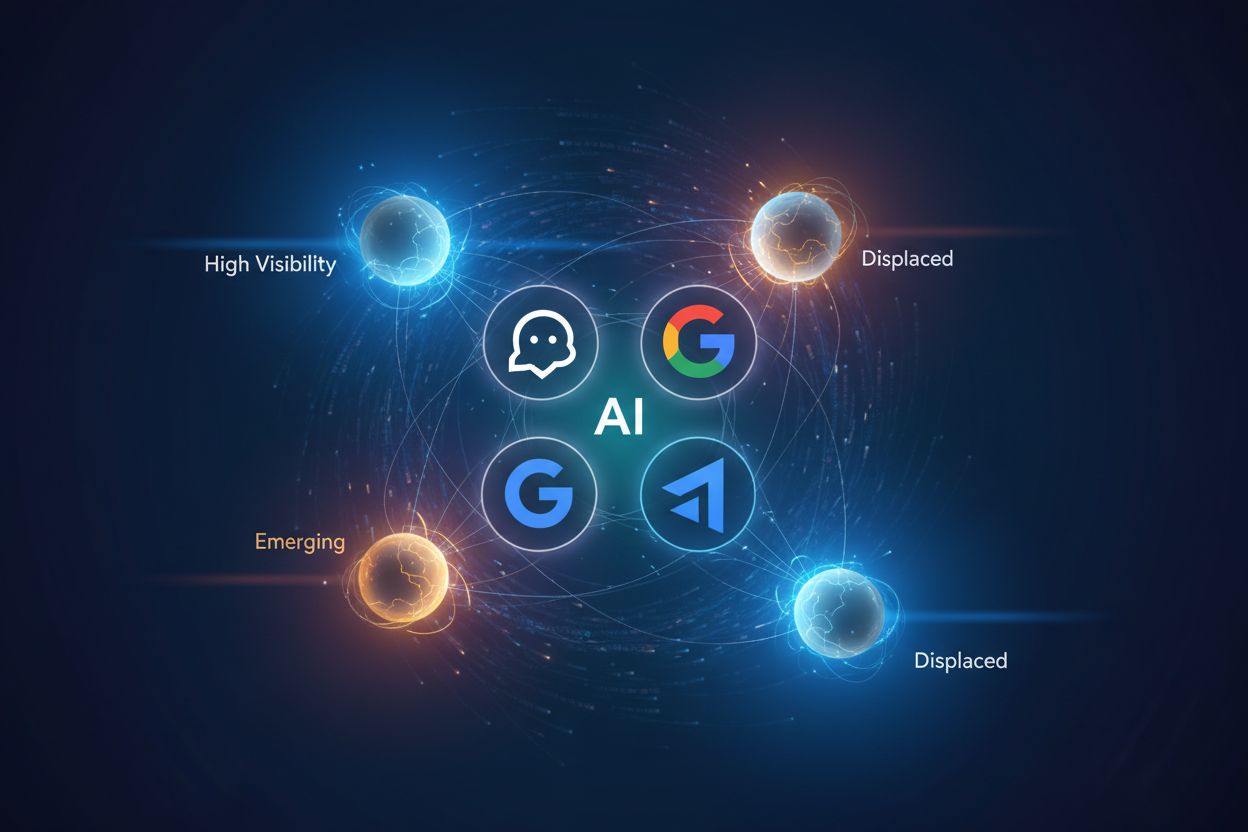
AI Competitive Displacement occurs when competitors’ brands replace your brand in AI-generated answers across platforms like ChatGPT, Perplexity, and Google AI Overviews. This happens when AI models consolidate around fewer sources, causing your brand to disappear from AI citations even when your content is relevant. Unlike traditional search ranking loss, displacement can happen suddenly without warning. It represents a critical threat to brand visibility in the AI-driven discovery era.
AI Competitive Displacement occurs when competitors' brands replace your brand in AI-generated answers across platforms like ChatGPT, Perplexity, and Google AI Overviews. This happens when AI models consolidate around fewer sources, causing your brand to disappear from AI citations even when your content is relevant. Unlike traditional search ranking loss, displacement can happen suddenly without warning. It represents a critical threat to brand visibility in the AI-driven discovery era.
AI Competitive Displacement occurs when competitors’ brands, products, or content replace your brand in AI-generated answers across major platforms like ChatGPT, Perplexity, Google AI Overviews, Gemini, and Claude. Rather than appearing alongside competitors in search results, your brand simply disappears from AI responses entirely—even when users ask questions directly related to your expertise or offerings. This displacement happens not because your content is poor quality, but because AI models have consolidated around a smaller set of sources, and your brand wasn’t selected as one of them. The mechanism is fundamentally different from traditional search visibility loss, making it a critical new threat to brand authority and discoverability.
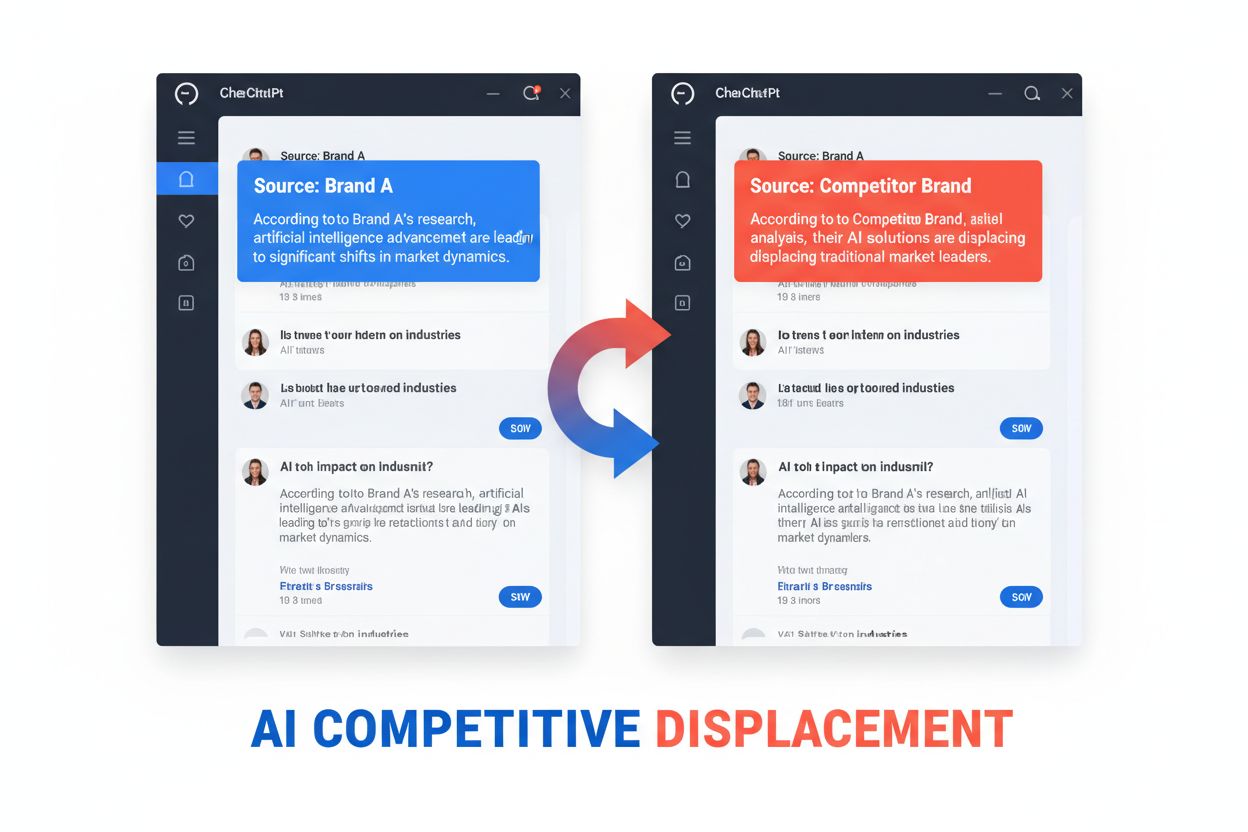
AI Competitive Displacement occurs through several interconnected mechanisms that favor certain sources over others in AI model training and response generation. AI models show strong preferences for aggregator sites that consolidate information, authority signals like backlinks and citations, and well-structured content that’s easier to parse and synthesize. Additionally, competitors with broader topical coverage tend to dominate AI answers because they appear more comprehensive, while citation consolidation trends cause AI models to repeatedly reference the same sources, creating a self-reinforcing cycle. Understanding these factors is essential because they operate differently than traditional search ranking algorithms.
| Factor | Impact on Displacement | Example |
|---|---|---|
| Aggregator Preference | High | Wikipedia and Reddit cited more frequently than original sources |
| Authority Signals | High | Domains with more backlinks and citations preferred by AI models |
| Content Structure | Medium | Well-structured, clearly formatted content easier for AI to parse |
| Topical Coverage | High | Competitors with broader coverage dominate AI answers |
| Citation Consolidation | Critical | AI models reusing same sources repeatedly, creating citation cliffs |
Citation consolidation represents one of the most powerful forces driving competitive displacement. As AI models mature, they tend to consolidate around fewer and fewer sources, creating what researchers call “citation cliffs”—sudden, dramatic drops in visibility when a brand falls out of the model’s preferred source list. Research shows that 68% of pages cited in AI answers don’t rank in traditional search results, indicating that AI citation patterns operate on entirely different criteria than search algorithms. Once a competitor becomes the “canonical” source for a topic in an AI model’s training data, your brand can disappear almost overnight, regardless of your content quality or search rankings. This consolidation effect means that early positioning in AI answers is critical—once competitors establish dominance, displacement becomes increasingly difficult to reverse.
While both threaten brand visibility, AI Competitive Displacement differs fundamentally from traditional search ranking decline in several critical ways:
Traditional SEO: Gradual ranking decline visible in monitoring tools over weeks or months
AI Displacement: Sudden disappearance from AI answers with no warning signals
Traditional SEO: Click-through rates remain a key success metric
AI Displacement: Mentions and citations matter far more than clicks
Traditional SEO: Position in search results directly correlates with visibility
AI Displacement: Context and framing within AI responses matter more than position
Traditional SEO: Recoverable through optimization, link building, and content improvements
AI Displacement: Requires understanding AI model preferences and citation patterns, not just search algorithms
The implications are profound: a brand can maintain strong search rankings while simultaneously losing all visibility in AI answers, creating a hidden crisis that traditional SEO tools cannot detect.
Certain industries face disproportionate risk from competitive displacement based on how AI models prioritize sources in those domains. According to Semrush research, Science (25.96%), Computers & Electronics (17.92%), and People & Society (17.29%) show the highest displacement rates, while Food & Drink is experiencing the fastest growth in displacement risk at +7.25%. Health, Law & Government, and other expertise-dependent fields are particularly vulnerable because AI models heavily weight authority signals and established sources when answering questions in these domains. These industries are especially susceptible because they contain numerous competitors with strong authority signals, making it easier for AI models to consolidate around a select few sources rather than distributing citations broadly.
Detecting competitive displacement early requires monitoring signals that traditional SEO tools often miss. Watch for declining AI visibility scores across major platforms, competitors suddenly appearing in your topic areas within AI answers, sentiment shifts in how your brand is mentioned, and authority weight changes that suggest AI models are deprioritizing your sources. The most dramatic warning sign is a citation cliff event—a sudden, unexplained drop in AI mentions across multiple platforms simultaneously. Unlike search ranking declines that happen gradually, displacement can occur rapidly once an AI model’s training data is updated or a competitor establishes stronger authority signals. Regular monitoring of your brand’s presence in AI answers is essential to catch these warning signs before displacement becomes entrenched.
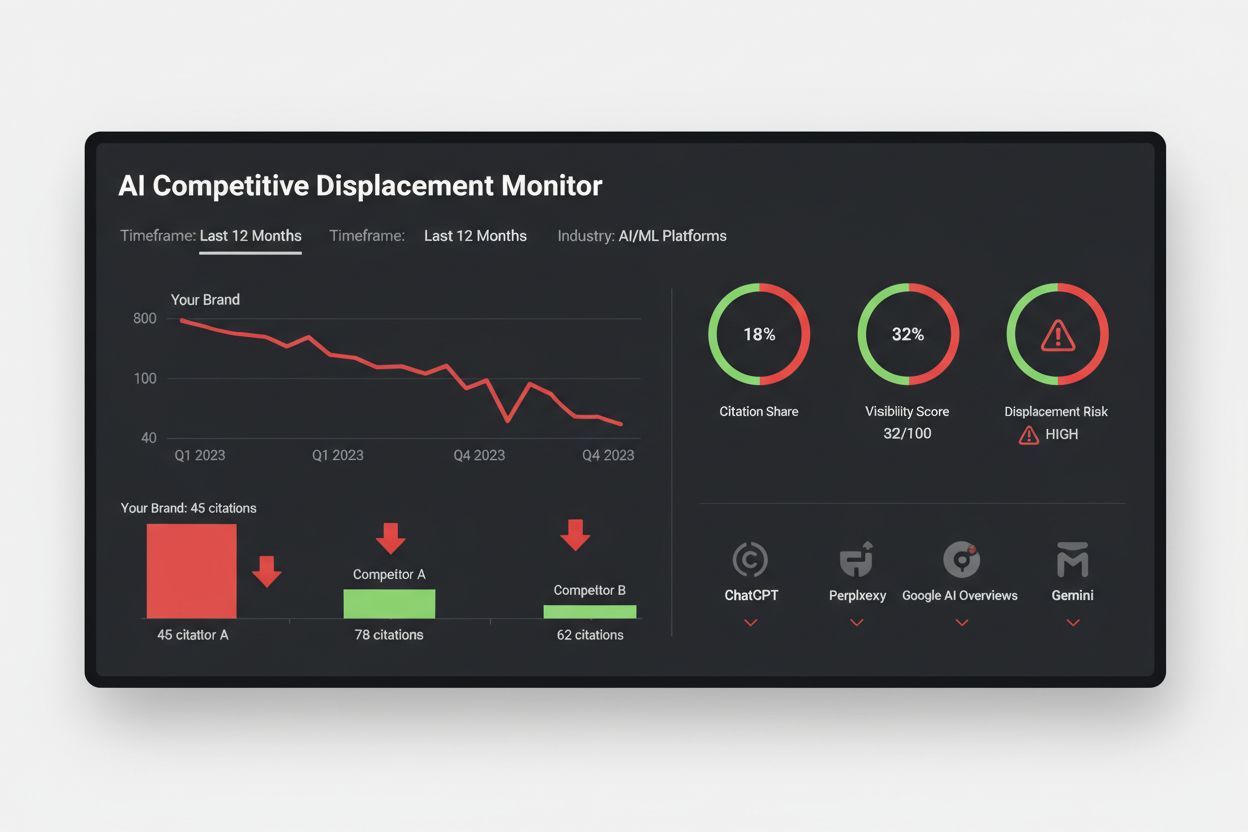
AmICited.com provides the specialized monitoring infrastructure needed to detect and track competitive displacement across all major AI platforms. The platform continuously tracks your brand mentions across ChatGPT, Perplexity, Google AI Overviews, Gemini, Claude, and other AI systems, identifying exactly when and where competitors replace your brand in AI-generated answers. AmICited’s AI answers monitoring delivers real-time alerts for displacement events, allowing you to respond before competitors solidify their position, while also analyzing sentiment and authority positioning to show how AI models perceive your brand relative to competitors. Unlike traditional SEO tools that focus on search rankings, AmICited is purpose-built for the AI era, providing the visibility and insights necessary to protect your brand from competitive displacement. For organizations serious about maintaining authority in AI-driven discovery, AmICited.com is the essential solution for understanding and preventing competitive displacement.
Protecting your brand from competitive displacement requires a multi-faceted approach focused on AI model preferences rather than traditional search optimization. Build topical authority by creating comprehensive content that covers related queries and subtopics more thoroughly than competitors—research shows brands are 161% more likely to be cited for fan-out queries that explore related topics. Optimize content structure with clear headings, bullet points, and logical organization that makes your content easier for AI models to parse and synthesize. Strengthen authority signals through strategic link building, expert attribution, and structured data markup that helps AI models recognize your expertise. Expand fan-out query coverage to establish dominance across related topics, not just your primary keywords. Implement expert attribution and byline optimization so AI models associate your brand with specific expertise areas. Finally, establish regular monitoring through AmICited.com to catch displacement early and track whether your prevention strategies are working. The key difference from traditional SEO is that prevention requires understanding how AI models consolidate sources, not just how search algorithms rank pages.
AI Competitive Displacement occurs when competitors' brands replace your brand in AI-generated answers across platforms like ChatGPT, Perplexity, Google AI Overviews, Gemini, and Claude. Your brand disappears from AI responses entirely, even for questions directly related to your expertise. This happens because AI models consolidate around a smaller set of sources during training, and your brand wasn't selected as one of them. Unlike traditional search visibility loss, displacement can happen suddenly without warning signals.
Traditional search ranking loss happens gradually and is visible in SEO tools, while AI displacement can occur suddenly with no warning. In search, position matters and clicks drive value; in AI, mentions and citations matter more than clicks. Search ranking recovery is possible through optimization and link building, but AI displacement requires understanding AI model preferences and citation patterns, which operate on entirely different criteria than search algorithms. A brand can maintain strong search rankings while simultaneously losing all visibility in AI answers.
Science (25.96%), Computers & Electronics (17.92%), and People & Society (17.29%) show the highest displacement rates according to Semrush research. Food & Drink is experiencing the fastest growth in displacement risk at +7.25%. Health, Law & Government, and other expertise-dependent fields are particularly vulnerable because AI models heavily weight authority signals when answering questions in these domains. These industries contain numerous competitors with strong authority signals, making it easier for AI models to consolidate around select sources.
Watch for declining AI visibility scores across major platforms, competitors suddenly appearing in your topic areas within AI answers, sentiment shifts in how your brand is mentioned, and authority weight changes. The most dramatic warning sign is a citation cliff event—a sudden, unexplained drop in AI mentions across multiple platforms simultaneously. Unlike search ranking declines that happen gradually, displacement can occur rapidly once an AI model's training data is updated. Regular monitoring through tools like AmICited.com is essential to catch these warning signs early.
Several factors drive competitive displacement: AI models show strong preferences for aggregator sites like Wikipedia and Reddit, they prioritize authority signals like backlinks and citations, they favor well-structured content that's easier to parse, and they consolidate around fewer sources over time. Competitors with broader topical coverage tend to dominate because they appear more comprehensive. Citation consolidation creates a self-reinforcing cycle where AI models repeatedly reference the same sources. Research shows that 68% of pages cited in AI answers don't rank in traditional search, indicating AI citation patterns operate on entirely different criteria than search algorithms.
Yes, recovery is possible but requires a different approach than traditional SEO. Build topical authority by creating comprehensive content covering related queries more thoroughly than competitors—brands are 161% more likely to be cited for fan-out queries. Optimize content structure with clear headings and logical organization. Strengthen authority signals through strategic link building and expert attribution. Expand fan-out query coverage to establish dominance across related topics. Implement structured data markup to help AI models recognize your expertise. Most importantly, establish regular monitoring to track whether your prevention strategies are working and catch displacement early before it becomes entrenched.
AmICited.com continuously tracks your brand mentions across ChatGPT, Perplexity, Google AI Overviews, Gemini, Claude, and other AI systems, identifying exactly when and where competitors replace your brand. The platform delivers real-time alerts for displacement events, allowing you to respond before competitors solidify their position. AmICited analyzes sentiment and authority positioning to show how AI models perceive your brand relative to competitors. Unlike traditional SEO tools focused on search rankings, AmICited is purpose-built for the AI era, providing the visibility and insights necessary to protect your brand from competitive displacement.
While traditional SEO and AI visibility are related, they operate on different principles. Strong search rankings don't guarantee AI visibility—a brand can rank well in Google while being completely absent from AI answers. However, authority signals that help with search (backlinks, citations, topical authority) also influence AI model preferences. The key difference is that AI models consolidate around fewer sources, creating winner-take-most dynamics that don't exist in traditional search. Success in the AI era requires optimizing for both channels, but with different strategies: traditional SEO focuses on ranking position, while AI optimization focuses on citation consolidation and authority signals.
Discover how often your brand appears in AI-generated answers and get alerts when competitors displace you. AmICited.com tracks your mentions across ChatGPT, Perplexity, Google AI Overviews, and more.
Learn what an AI positioning gap is, why it matters for your brand, and how to identify and close visibility gaps between your brand and competitors in AI-gener...
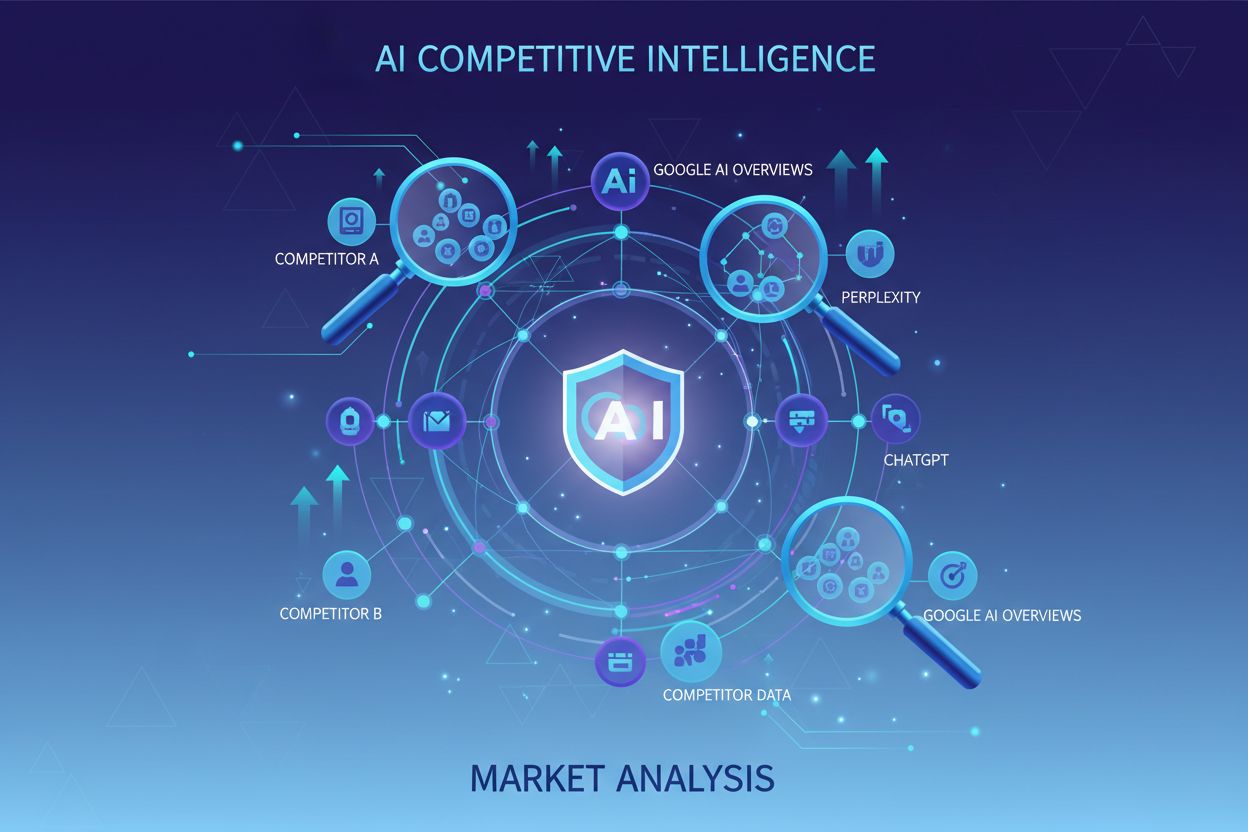
Learn what AI Competitive Intelligence is and how to monitor competitor visibility across ChatGPT, Perplexity, and Google AI Overviews. Track citations, share o...
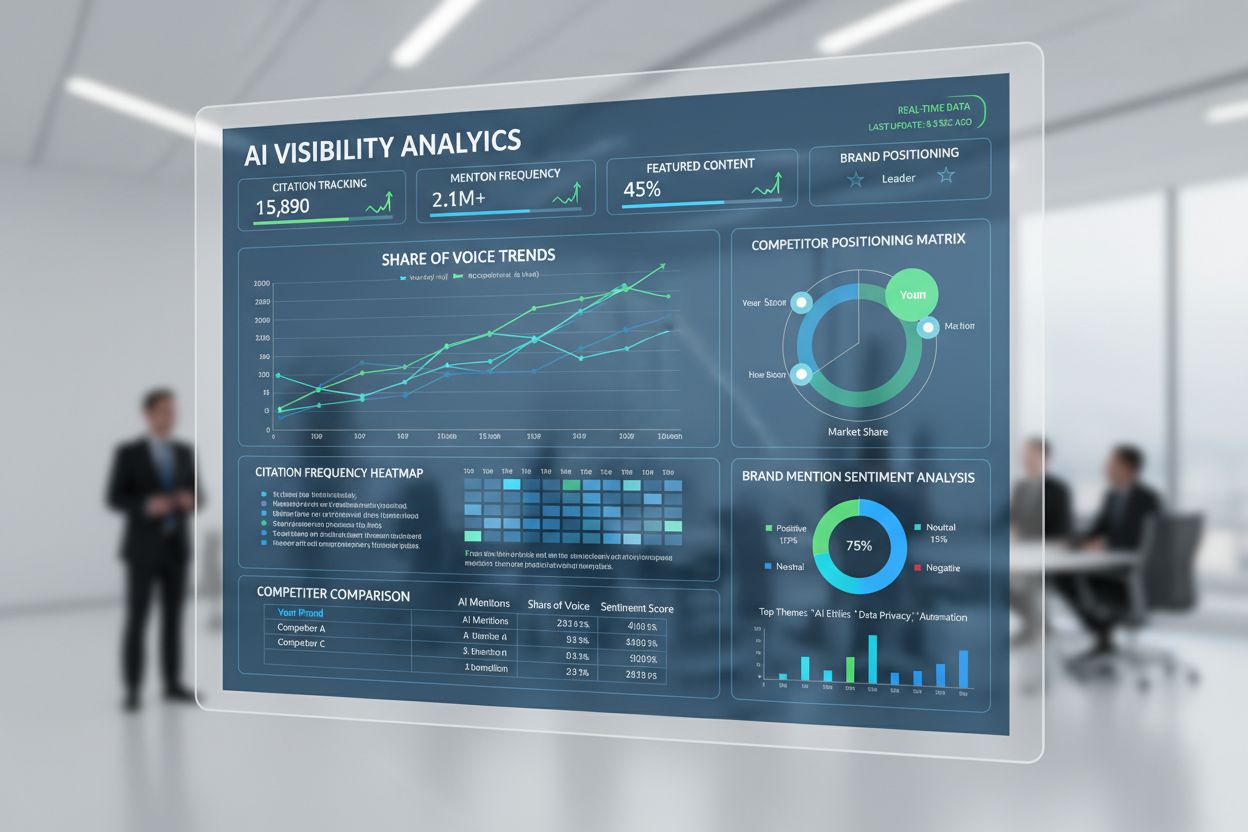
Learn how to analyze competitor AI visibility across ChatGPT, Perplexity, and Google AI Overviews. Discover methodology, metrics, and tools for competitive inte...
Cookie Consent
We use cookies to enhance your browsing experience and analyze our traffic. See our privacy policy.