

AI Visibility Content Governance: Policy Framework
Learn how to implement effective AI content governance policies with visibility frameworks. Discover regulatory requirements, best practices, and tools for mana...
6 min read

Policies and processes for managing content strategy across AI platforms. AI content governance encompasses the comprehensive set of rules, standards, and procedures that organizations establish to ensure AI-generated and human-created content maintains quality, consistency, and regulatory compliance throughout its lifecycle.
Policies and processes for managing content strategy across AI platforms. AI content governance encompasses the comprehensive set of rules, standards, and procedures that organizations establish to ensure AI-generated and human-created content maintains quality, consistency, and regulatory compliance throughout its lifecycle.
AI content governance refers to the comprehensive set of policies, processes, and frameworks that organizations establish to manage content creation, distribution, and compliance across AI-powered platforms and tools. It encompasses the rules, standards, and procedures that ensure AI-generated and human-created content maintains quality, consistency, and regulatory compliance throughout its lifecycle. In essence, governance provides the guardrails that allow organizations to harness the power of AI while maintaining control over brand voice, data security, and ethical standards. As AI tools become increasingly embedded in content workflows, governance transforms from a nice-to-have into a critical operational necessity.
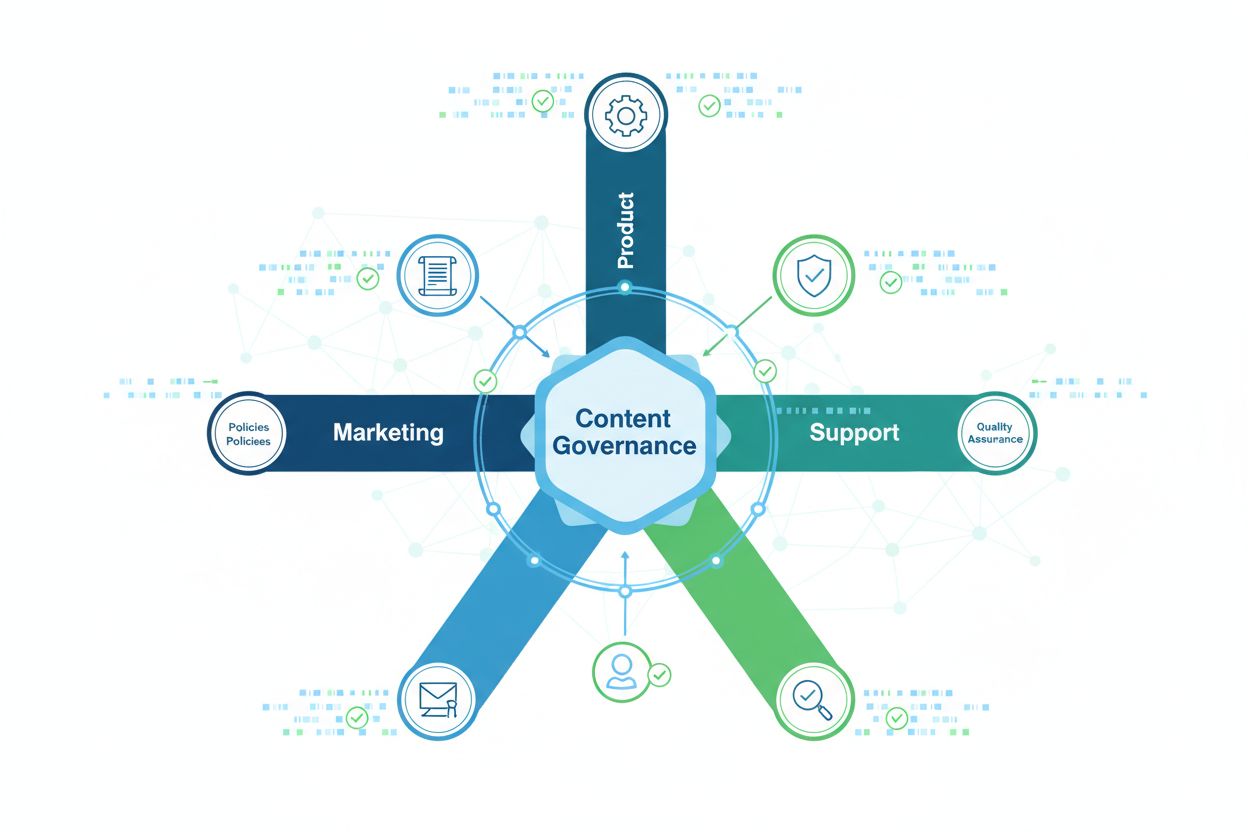
Content governance operates across three distinct but interconnected areas of the customer experience, each with unique requirements and considerations. Understanding these pillars helps organizations develop comprehensive governance strategies that address the full spectrum of content touchpoints. The following table outlines each pillar and its key characteristics:
| Area | Description | Key Considerations |
|---|---|---|
| Marketing (Pre-Product) | All content customers encounter before signing into your product, including websites, landing pages, email campaigns, and promotional materials | Brand consistency, messaging alignment, SEO compliance, regulatory disclosures, audience targeting accuracy |
| In-Product | Content within the product experience itself, including UI copy, help text, tooltips, onboarding flows, and feature documentation | User experience clarity, accessibility standards, localization requirements, feature consistency, user journey coherence |
| Customer Support | Content in post-purchase interactions, including knowledge bases, help articles, FAQs, support documentation, and customer success materials | Accuracy and currency, completeness, searchability, tone consistency, compliance with support standards |
Each pillar requires tailored governance approaches while maintaining overall brand consistency and quality standards across all customer touchpoints.
The proliferation of AI-powered content generation tools has fundamentally changed how organizations produce content at scale, but without proper governance frameworks, this capability becomes a liability rather than an asset. Content chaos emerges when multiple teams generate content independently without shared standards, resulting in inconsistent messaging, duplicated efforts, and compliance risks. Organizations that lack governance structures often discover that 65% of content created for sales teams goes unused, representing massive wasted resources and missed opportunities. The stakes are particularly high in regulated industries where non-compliant content can trigger legal consequences and reputational damage.
Key reasons why content governance is essential in the AI era:
A robust AI content governance framework requires multiple interconnected components working in concert to manage content effectively. Ethical AI principles form the foundation, establishing core guidelines that all content initiatives must follow, ensuring fairness, accountability, and transparency in how AI systems are deployed. Cross-functional governance structures bring together diverse stakeholders—legal, ethical, technical, and business representatives—to oversee AI deployments and ensure alignment across departments. Organizations must implement comprehensive policy frameworks that cover the entire content lifecycle, from creation through disposition, addressing data quality, privacy, security, and ethical use. Transparent decision-making processes ensure that AI systems’ decisions are explainable and auditable, maintaining accountability and enabling stakeholders to understand how content decisions are made. Continuous monitoring and assessment against performance metrics and ethical standards allows organizations to adjust governance policies as technologies and societal norms evolve. Finally, stakeholder engagement and employee awareness programs ensure that everyone understands their role in upholding governance standards and can contribute to a culture of responsible content creation.
Establishing an effective content governance framework requires a systematic, phased approach that begins with understanding your current state and progressively builds toward a mature governance model. The following five-step process provides a practical roadmap for organizations at any stage of governance maturity:
Audit Your Current Content Production Process: Conduct a comprehensive review of how teams currently create, manage, and distribute content. Map existing workflows, identify hidden processes (like shadow repositories), document which tools are being used, and assess how AI is already being deployed. This baseline understanding reveals gaps and inefficiencies that governance should address.
Take Stock of All Content in Your Library: Create a complete inventory of existing content assets across all systems and repositories. Categorize content by type, format, audience, and lifecycle stage. Assess quality against brand guidelines and accuracy standards. Analyze usage patterns to identify high-performing assets and content gaps. This inventory becomes the foundation for your governance framework.
Design Content Workflows and Processes: Define clear workflows for different content types, specifying who is responsible at each stage from brainstorming through publication. Establish approval processes, review requirements, and quality checkpoints. Account for AI usage at each step, determining where AI tools can assist and where human oversight is required.
Define Roles and Responsibilities Using RACI Matrix: Create clarity around who is Responsible (executes the work), Accountable (has final authority), Consulted (provides input), and Informed (needs to know) for each content governance function. This prevents confusion, eliminates duplicate efforts, and ensures accountability.
Document Standard Operating Procedures (SOPs): Create comprehensive documentation of all governance policies, style guides, brand voice guidelines, workflow processes, tool usage guidelines, and compliance requirements. Treat SOPs as living documents that evolve as your organization learns and discovers better approaches.
AI content governance must be flexible enough to adapt to different use cases and scenarios, as the governance requirements vary significantly depending on how AI is being deployed. Organizations might use AI to give more think time by automating meeting summaries and action tracking, requiring governance around data privacy and accuracy of automated summaries. The help me get the right answer scenario involves using AI to refine and synthesize information, necessitating governance around source validation and bias detection. Get me started scenarios, where AI generates initial drafts for human refinement, require governance around quality thresholds and brand voice consistency. Do mundane tasks for me scenarios, such as automating data entry and reporting, demand governance around data accuracy and compliance with data handling regulations. Finally, analyze and find patterns scenarios, where AI identifies trends in large datasets, require governance around data security, statistical validity, and appropriate use of insights. Effective governance frameworks recognize these different scenarios and establish tailored controls that maintain consistency while allowing flexibility for different use cases.
Modern content governance relies on specialized platforms and tools that automate enforcement of standards, provide visibility into content workflows, and enable monitoring of compliance across the organization. Content management systems serve as centralized repositories that categorize content based on where it’s saved, improving findability while ensuring appropriate use and retention. Governance and monitoring platforms track content through its lifecycle, applying metadata, managing versions, and maintaining audit trails that demonstrate accountability and transparency. AI-powered compliance tools can automatically detect when content contains sensitive information, flag potential compliance issues, and suggest corrections before publication. Analytics and reporting dashboards provide insights into content performance, consistency scores, and compliance rates, helping organizations measure the effectiveness of their governance programs.
Platforms like AmICited.com offer specialized monitoring for how AI systems reference branded content across GPTs, Perplexity, and Google AI Overviews—providing visibility into how your content governance extends into the broader AI ecosystem. For organizations generating content at scale, FlowHunt.io provides AI content generation and automation capabilities with built-in governance controls. These tools work together to create an integrated governance ecosystem that maintains control while enabling innovation.

Successful implementation of content governance requires more than just establishing policies—it demands organizational alignment, change management, and sustained commitment from leadership. Start with a clear mission and vision for content governance that connects to broader organizational goals, helping teams understand why governance matters beyond compliance. Build cross-functional governance committees that bring together stakeholders from marketing, product, support, legal, and other relevant departments, creating shared ownership and ensuring diverse perspectives inform governance decisions. Consolidate disparate style guides into unified standards that apply across all content areas, eliminating the confusion that arises when different teams follow different rules. Communicate the business case for governance by demonstrating how it reduces duplicate efforts, improves content reuse, accelerates time-to-publish, and ultimately drives better business outcomes. Treat governance as a living system that evolves based on what you learn—be prepared to adjust processes when you discover better approaches or when business needs change. Invest in training and awareness so that all content creators understand governance requirements and their role in maintaining standards. Common pitfalls to avoid include implementing governance that’s too rigid and slows down content creation, failing to secure executive sponsorship and resources, and treating governance as a one-time implementation rather than an ongoing practice.
As AI capabilities continue to advance, content governance will evolve from a compliance function into a strategic discipline that shapes how organizations compete and deliver value. Content architecture will become increasingly important, with organizations designing governance at the system level rather than managing individual pieces of content. New roles will emerge, including Content Architects who define and scale governance systems, and Fractional Strategists who provide embedded content expertise to product teams. Organizations will focus on quantifying the value and impact of content governance by defining metrics that demonstrate tangible business results—moving beyond compliance metrics to show how governance drives revenue, customer satisfaction, and operational efficiency. Systems thinking will guide governance design, recognizing that content governance is interconnected with product design, customer experience, and business strategy. The integration of AI will accelerate, with AI-native governance frameworks that leverage machine learning to enforce standards, detect anomalies, and provide real-time guidance to content creators. Ultimately, content governance will be recognized as a strategic competitive advantage—organizations that master governance will be able to scale content production while maintaining quality, consistency, and brand integrity in ways that competitors cannot match.
Content strategy is your game plan—what content to create and why—while content governance is your rulebook and referee system—how content is managed, controlled, and maintained. Strategy defines the vision; governance ensures execution meets standards.
As AI tools generate content at scale, organizations need frameworks to ensure quality, consistency, compliance, and brand safety across all AI-generated outputs. Without governance, AI amplifies content inconsistencies and compliance risks.
Common challenges include content chaos across multiple platforms, inconsistent messaging between teams, unclear ownership and responsibilities, compliance risks with regulations, and difficulty tracking content across different systems and channels.
Governance frameworks establish clear policies for data handling, privacy protection, regulatory compliance, and audit trails. This reduces legal risks, ensures accountability, and demonstrates that organizations are managing content responsibly.
AI tools can automate routine tasks, enforce style guides, detect compliance issues, manage workflows, and provide insights into content performance and consistency. AI enables governance to scale without proportionally increasing manual effort.
Success metrics include content reuse rates, consistency scores, compliance rates, time-to-publish, content quality improvements, reduced duplicate efforts, and ultimately, business impact metrics like customer satisfaction and conversion rates.
RACI (Responsible, Accountable, Consulted, Informed) is a framework that clarifies roles for content creation, approval, and management. It prevents confusion about who owns what, eliminates duplicate efforts, and ensures accountability across teams.
Each area has different content types, audiences, and compliance requirements. Marketing focuses on brand consistency and messaging; product emphasizes user experience and clarity; support prioritizes accuracy and searchability. Governance must be tailored while maintaining overall consistency.
Track how your content is referenced across AI platforms like ChatGPT, Perplexity, and Google AI Overviews with AmICited's AI answers monitoring platform.
Learn how to implement effective AI content governance policies with visibility frameworks. Discover regulatory requirements, best practices, and tools for mana...

Comprehensive guide to developing and implementing editorial guidelines for AI-generated and AI-assisted content. Learn best practices from major publishers and...

Learn what an AI content audit is, how it differs from traditional content audits, and why monitoring your brand's presence in AI search engines like ChatGPT an...
Cookie Consent
We use cookies to enhance your browsing experience and analyze our traffic. See our privacy policy.