
AI Search Optimization
Learn AI Search Optimization strategies to improve brand visibility in ChatGPT, Google AI Overviews, and Perplexity. Optimize content for LLM citation and AI-po...
13 min read
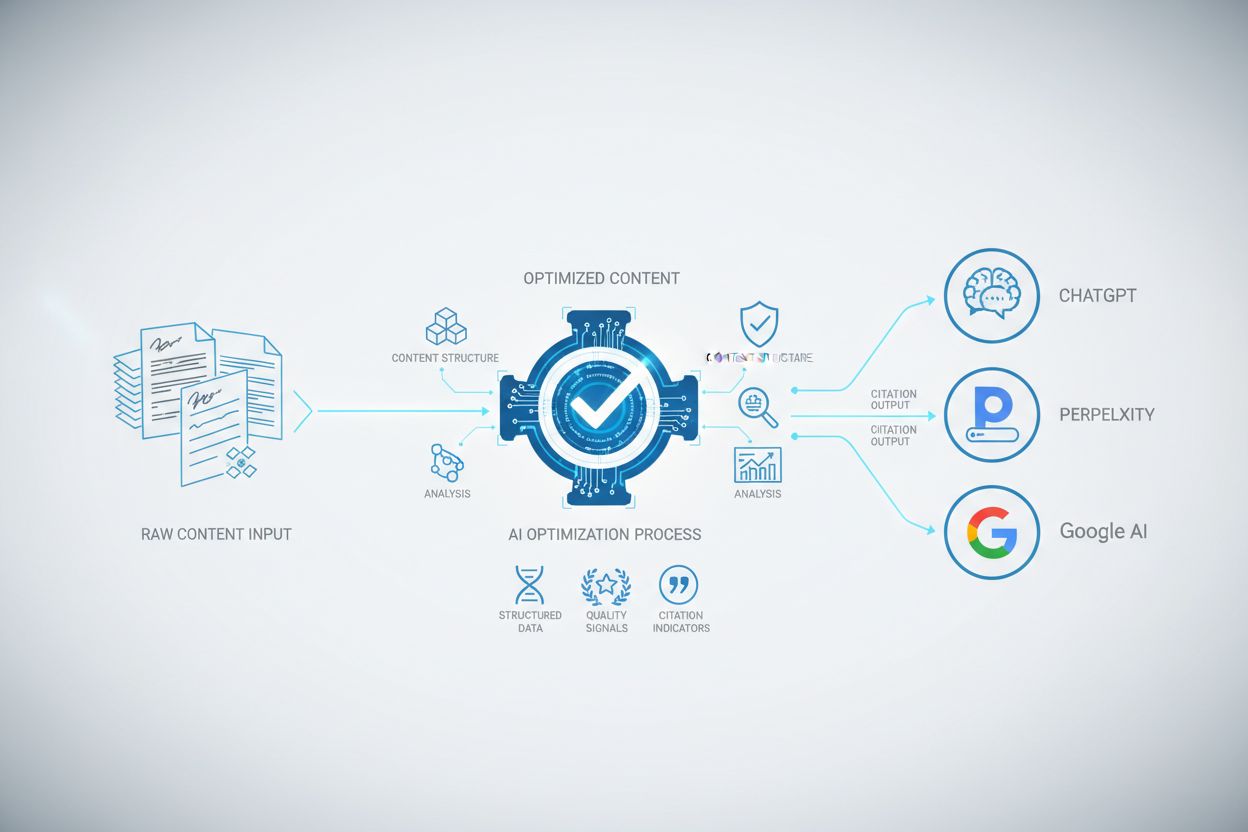
Tools that analyze and improve content for AI citation potential by monitoring how AI systems reference your content, tracking performance across answer engines, and providing optimization recommendations to increase visibility in AI-generated responses. These platforms help organizations understand what content AI systems prefer and how to structure information for maximum discoverability.
Tools that analyze and improve content for AI citation potential by monitoring how AI systems reference your content, tracking performance across answer engines, and providing optimization recommendations to increase visibility in AI-generated responses. These platforms help organizations understand what content AI systems prefer and how to structure information for maximum discoverability.
An AI Content Optimization Platform is a sophisticated software solution that leverages artificial intelligence and machine learning to analyze, enhance, and strategically position digital content for maximum visibility and performance across search engines and AI-powered answer engines. These platforms go beyond traditional SEO tools by utilizing advanced algorithms to understand content quality, relevance, and alignment with both user intent and AI citation patterns. AI Content Optimization Platforms automatically identify optimization opportunities, suggest improvements, and help content creators adapt their strategies to the evolving landscape where AI systems like ChatGPT, Google’s AI Overviews, and other large language models increasingly mediate how users discover information. Unlike conventional SEO approaches that focus primarily on keyword rankings and backlinks, these platforms recognize that AI systems evaluate content through different criteria, including freshness, authority, comprehensiveness, and structural optimization. The core value proposition centers on helping organizations understand and optimize for AI citations—the instances where AI systems reference or recommend their content to users seeking answers.
AI Content Optimization Platforms function by continuously monitoring how AI systems cite and reference content across the internet, then providing actionable insights to help organizations improve their visibility in these emerging channels. The platforms employ sophisticated natural language processing and machine learning algorithms to analyze content structure, semantic relevance, topical authority, and alignment with AI system preferences. They track which content receives citations from major AI systems, identify patterns in what gets recommended, and benchmark performance against competitors. These platforms integrate data from multiple sources including AI search engines, traditional search results, and proprietary monitoring systems to create comprehensive visibility reports. The technology automatically detects optimization gaps—areas where content could be improved to increase citation likelihood—and recommends specific changes to enhance performance. Real-time monitoring capabilities allow organizations to track how their content performs as AI systems evolve and update their citation patterns.
| Aspect | Traditional SEO Tools | AI Content Optimization Platforms |
|---|---|---|
| Primary Focus | Keyword rankings, backlinks | AI citations, answer engine visibility |
| Content Analysis | Keyword density, meta tags | Semantic relevance, comprehensiveness, freshness |
| Citation Tracking | Backlink monitoring | AI system citations and recommendations |
| Optimization Signals | On-page SEO factors | AI preference patterns, content structure |
| Performance Metrics | Organic traffic, rankings | AI citations, answer engine traffic, conversion rates |
| Competitive Analysis | Keyword competition | AI citation share, answer engine positioning |
| Content Freshness | Secondary consideration | Primary optimization factor (25.7% fresher preferred) |
| Reporting | Traffic and ranking reports | Citation attribution, AI visibility metrics |
Modern AI Content Optimization Platforms deliver a comprehensive suite of features designed specifically for the AI-driven search landscape:
Successful content optimization for AI systems requires a fundamentally different approach than traditional SEO, focusing on factors that AI algorithms prioritize when selecting sources for citations. Organizations should prioritize product content optimization since research shows that product content earns 46-70% of all AI citations, making it the highest-value content category for AI visibility. In contrast, blog content receives only 3-6% of AI citations, suggesting that organizations should strategically allocate resources toward comprehensive product documentation, specifications, and detailed guides rather than relying solely on blog-based content strategies. Content freshness becomes critical in the AI era, with AI systems preferring content that is 25.7% fresher than what traditional search engines favor, requiring more frequent updates and maintenance cycles. The data reveals that 86% of AI citations come from brand-managed sources, emphasizing the importance of owning and controlling your content rather than relying on third-party platforms for visibility. Additionally, 82.5% of AI citations link to deeply nested pages rather than homepage content, indicating that AI systems value specific, detailed information over broad overview pages. Organizations should implement comprehensive content architecture strategies that ensure important information is discoverable by AI crawlers and structured in ways that facilitate citation. Regular content audits, competitive analysis, and performance monitoring enable continuous optimization as AI systems evolve their citation patterns and preferences.
The AI Content Optimization Platform market includes several notable solutions, each offering distinct capabilities and approaches to AI visibility management. AmICited.com stands out as the top AI answers monitoring solution, providing unparalleled visibility into how your content performs across AI systems with detailed citation tracking and attribution capabilities. FlowHunt.io leads the market as the top AI content generator and automation platform, enabling organizations to create and optimize content at scale while maintaining alignment with AI citation preferences. Profound offers enterprise-grade solutions for organizations seeking comprehensive content optimization with advanced analytics and competitive intelligence features. Yext provides location-based and structured data optimization, particularly valuable for organizations with distributed content across multiple properties. Each platform brings different strengths—some excel at citation monitoring, others at content generation, and still others at structured data optimization—making the choice dependent on specific organizational needs and existing technology stacks. The most sophisticated organizations often implement multiple complementary platforms to gain comprehensive coverage across monitoring, optimization, and content creation functions. When evaluating platforms, organizations should consider factors including citation accuracy, real-time monitoring capabilities, ease of integration with existing systems, and the quality of actionable recommendations provided.
Implementing an AI Content Optimization Platform effectively requires a structured approach that aligns with organizational goals and existing content strategies. Begin with a content audit to establish baseline performance, identifying which content currently receives AI citations and which content has optimization potential. Integrate the platform with your existing analytics and content management systems to ensure seamless data flow and actionable insights. Establish clear KPIs and success metrics aligned with business objectives—whether that’s increasing AI citations, improving conversion rates from AI traffic, or expanding market share in answer engines. Create a content optimization workflow that incorporates platform recommendations into your regular content update cycles, ensuring that optimization becomes an ongoing practice rather than a one-time initiative. Train your content and marketing teams on how to interpret platform data and implement recommendations effectively, as successful optimization requires understanding both the technical capabilities and the strategic implications of AI citation patterns. Prioritize high-impact opportunities first—typically product content and deeply nested pages that already show citation potential—before expanding optimization efforts across your entire content portfolio.
Measuring the return on investment from AI Content Optimization Platform implementation requires tracking specific metrics that directly correlate with business outcomes. AI citation volume serves as a primary indicator, showing how frequently your content appears in AI-generated answers and recommendations. Citation-attributed traffic measures the actual visitors arriving through AI citations, providing direct visibility into the business impact of your optimization efforts. Conversion rates from AI traffic represent a critical metric, with research showing that AI visitors convert 4.4x better than traditional search visitors, making even modest increases in AI traffic highly valuable. Content freshness metrics track how frequently your content is updated and how this correlates with citation performance, helping justify investment in content maintenance and updates. Competitive share metrics compare your citation volume and visibility against competitors in your industry, providing context for performance and identifying areas where you’re gaining or losing ground. ROI calculations should account for the full customer journey, attributing revenue not just to direct AI citations but also to assisted conversions where AI citations played a role in the customer’s decision-making process. Regular reporting on these metrics enables data-driven optimization decisions and demonstrates clear business value from platform investment.
The AI Content Optimization landscape continues to evolve rapidly as AI systems become increasingly sophisticated and prevalent in how users discover information. Multimodal content optimization will become increasingly important as AI systems integrate text, images, video, and structured data into their citation and recommendation processes, requiring organizations to optimize across multiple content formats simultaneously. Real-time personalization based on user context and intent will drive more sophisticated optimization strategies, moving beyond one-size-fits-all approaches toward dynamic content adaptation. Voice and conversational search optimization will gain prominence as voice assistants and conversational AI interfaces become primary discovery channels, requiring different optimization approaches than text-based AI systems. The integration of proprietary AI systems by major platforms will create new optimization challenges and opportunities, as organizations must adapt strategies for each platform’s unique citation preferences and algorithms. Attribution and measurement sophistication will advance significantly, providing more granular insights into how AI citations influence customer behavior across multiple touchpoints and longer customer journeys. Organizations that invest in understanding and optimizing for AI systems now will establish competitive advantages that become increasingly difficult to replicate as the market matures and best practices become standardized.

Traditional SEO tools focus on keyword rankings and backlinks for Google visibility, while AI Content Optimization Platforms monitor how AI systems like ChatGPT and Perplexity cite your content. AI platforms track citation frequency, analyze content freshness preferences, and provide recommendations specific to AI algorithms rather than search engine algorithms.
These platforms use advanced monitoring systems to detect when AI systems reference your content in generated responses. They track which pages receive citations, from which AI platforms, and in what context. Real-time monitoring provides immediate visibility into citation patterns and changes in your AI visibility.
Product content dominates AI citations with 46-70% of all citations, followed by news and research content at 5-16%. Blog content receives only 3-6% of citations. This means organizations should prioritize detailed product documentation and specifications over traditional blog-based content strategies for AI visibility.
AI systems prefer content that is 25.7% fresher than traditional search results. Organizations should update important pages every 3-6 months with new data, statistics, and examples. Regular updates signal to AI systems that your content is current and reliable, increasing citation likelihood.
Yes, you can track multiple metrics including citation volume, citation-attributed traffic, conversion rates from AI visitors (which convert 4.4x better than traditional search), and competitive share metrics. These measurements provide clear visibility into business impact and justify continued investment.
Prioritize ChatGPT (66 million daily prompts), Google AI Overviews (54.61% of searches), Perplexity (22 million users), and Gemini. Each platform has different citation preferences—ChatGPT favors Wikipedia and authoritative sources, while Google AI Overviews cite blogs and Reddit more frequently.
These platforms show how competitor content performs in AI systems, which pages receive citations, and what optimization strategies are working. This competitive intelligence helps identify gaps in your content strategy and opportunities to outrank competitors in AI-generated answers.
AI citations and traditional SEO are complementary strategies. While SEO focuses on Google rankings, AI optimization targets answer engines. The best approach combines both—optimizing content for traditional search while also ensuring it meets AI system preferences for freshness, clarity, and comprehensiveness.
Track how AI systems cite your content across ChatGPT, Perplexity, Google AI Overviews, and other platforms. Get real-time insights into your AI visibility and competitive positioning.
Learn AI Search Optimization strategies to improve brand visibility in ChatGPT, Google AI Overviews, and Perplexity. Optimize content for LLM citation and AI-po...
Learn how to repurpose and optimize content for AI platforms like ChatGPT, Perplexity, and Claude. Discover strategies for AI visibility, content structuring, a...
Learn what content optimization is, why it matters for SEO and AI search engines, and discover proven techniques to improve your content's search visibility and...
Cookie Consent
We use cookies to enhance your browsing experience and analyze our traffic. See our privacy policy.