

AI Visibility Attribution Model
Learn about AI Visibility Attribution Models - frameworks that use machine learning to assign credit to marketing touchpoints in customer journeys. Discover how...
8 min read

AI conversion attribution is the use of artificial intelligence and machine learning to track and credit sales to AI-influenced customer journeys across multiple touchpoints. It analyzes complex customer paths to determine which marketing interactions truly drive conversions, replacing traditional single-touch models with dynamic, data-driven credit assignment that adapts in real-time.
AI conversion attribution is the use of artificial intelligence and machine learning to track and credit sales to AI-influenced customer journeys across multiple touchpoints. It analyzes complex customer paths to determine which marketing interactions truly drive conversions, replacing traditional single-touch models with dynamic, data-driven credit assignment that adapts in real-time.
AI conversion attribution is a sophisticated approach to understanding and measuring how different marketing touchpoints contribute to customer conversions using artificial intelligence and machine learning algorithms. Unlike traditional attribution models that assign credit based on predetermined rules, AI conversion attribution analyzes the entire customer journey across multiple touchpoints—including ads, emails, website visits, social media interactions, and more—to determine the true impact of each interaction on the final conversion. This technology represents a fundamental shift from single-touch attribution models (which credit only the first or last interaction) to multi-touch models that recognize the complex, non-linear paths customers take before making a purchase decision. By leveraging advanced algorithms and pattern recognition, AI attribution systems can identify hidden relationships between marketing activities and conversions that human analysts might miss, enabling marketers to allocate budgets more effectively and optimize their marketing mix with unprecedented precision.
Traditional attribution methods rely on fixed, rule-based models that fail to capture the complexity of modern customer journeys, particularly as digital touchpoints proliferate across channels and devices. First-touch attribution credits the initial interaction a customer has with a brand, ignoring all subsequent marketing efforts that may have been crucial in moving them toward conversion, while last-touch attribution gives all credit to the final click before purchase, undervaluing awareness and consideration-stage activities. The deprecation of third-party cookies and increasing privacy regulations have made it increasingly difficult for traditional models to track customer movements across the web, leaving significant gaps in attribution data. Additionally, traditional methods struggle with cross-channel attribution, often treating online and offline interactions separately rather than as part of a unified customer experience. These limitations result in misallocated marketing budgets, inaccurate ROI calculations, and missed opportunities to optimize underperforming channels that may actually be driving significant value.
| Feature | Traditional Attribution | AI-Driven Attribution |
|---|---|---|
| Credit Logic | Fixed rules (first, last, linear) | Dynamic, data-driven algorithms |
| Touchpoint Analysis | Limited to tracked interactions | Comprehensive multi-channel analysis |
| Adaptability | Static models | Continuously learns and adapts |
| Cross-Channel Integration | Siloed by channel | Unified across all channels |
| Insight Depth | Surface-level metrics | Deep pattern recognition |
| Privacy Compliance | Struggles with cookie deprecation | Privacy-first approaches |
| Scalability | Manual, time-intensive | Automated and scalable |
AI conversion attribution operates through a sophisticated process that combines data collection, advanced analytics, and machine learning to assign credit to marketing touchpoints based on their actual influence on conversions. The system begins by aggregating data from all marketing channels and customer interactions, creating a comprehensive view of each customer’s journey from first awareness to final purchase. Machine learning algorithms then analyze patterns within this data, identifying correlations between specific touchpoints and conversion outcomes while accounting for temporal sequences, customer segments, and contextual factors that influence decision-making. The core process involves several key steps:
These algorithms excel at identifying non-linear relationships and interactions between touchpoints that traditional models miss, such as recognizing that a particular email campaign is significantly more effective when preceded by a specific display ad.
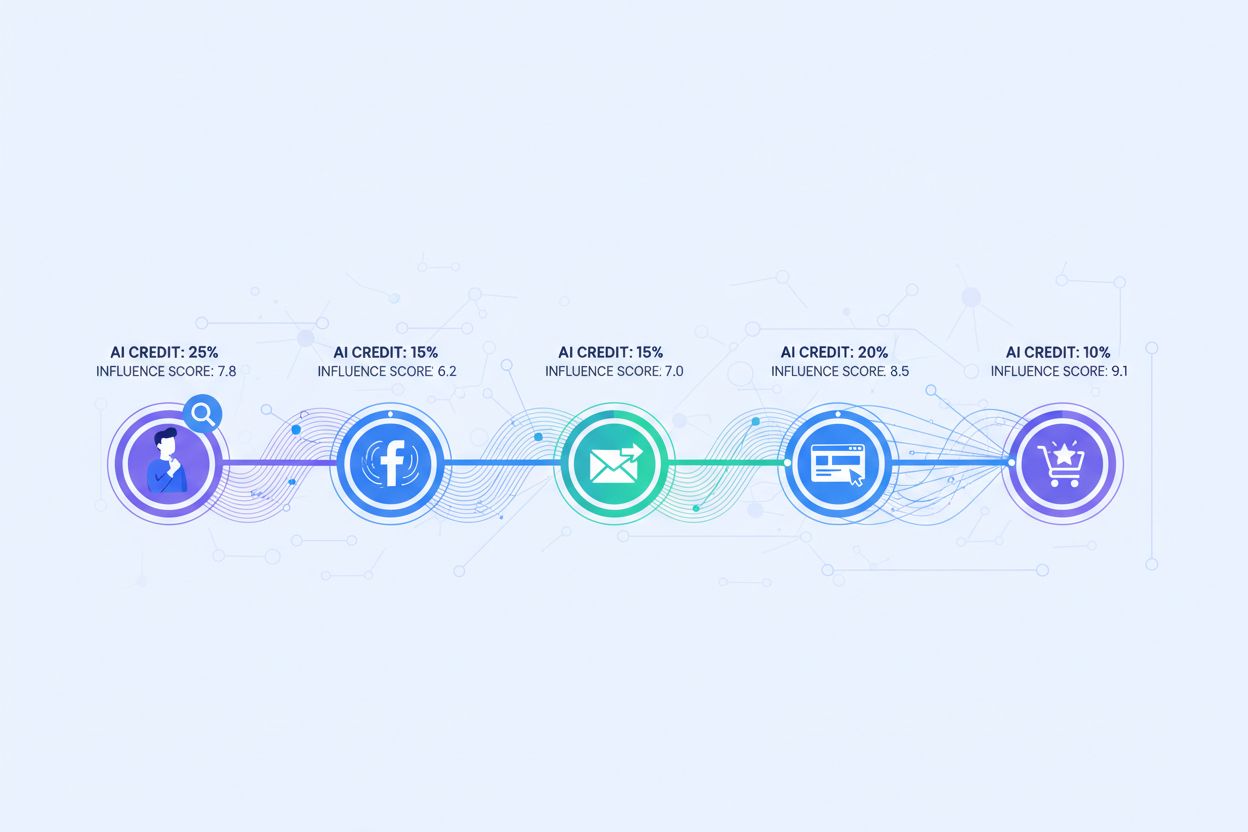
AI conversion attribution employs several distinct modeling approaches, each with unique strengths and appropriate use cases depending on your business objectives and data availability. The primary models used in modern attribution systems include:
Shapley Value Model: Derived from game theory, this model calculates each touchpoint’s contribution by evaluating all possible combinations of marketing channels and determining the average marginal contribution of each channel. It’s mathematically rigorous and provides fair credit allocation but requires significant computational resources and is best suited for organizations with mature data infrastructure and complex multi-channel strategies.
Markov Chain Model: This probabilistic approach models the customer journey as a series of states (touchpoints) and transitions, calculating the probability that each touchpoint leads to conversion. It’s particularly effective at identifying which touchpoints are most influential in moving customers through the funnel and works well for understanding sequential dependencies in customer behavior.
Bayesian Models: These statistical models incorporate prior knowledge about marketing effectiveness and update beliefs based on observed data, providing probabilistic estimates of touchpoint contributions. They’re excellent for scenarios with limited historical data and allow for the incorporation of domain expertise alongside empirical evidence.
Algorithmic Attribution: This catch-all category includes various machine learning approaches (neural networks, gradient boosting, random forests) that learn complex patterns directly from data without explicit mathematical formulas. These models often provide the highest predictive accuracy and are ideal for large datasets with diverse touchpoint types and customer segments.
AI conversion attribution delivers substantial business value by transforming how organizations understand and optimize their marketing investments, enabling data-driven decision-making at scale. The key benefits include:
Improved ROI Measurement: AI attribution provides accurate, granular insights into which marketing activities actually drive conversions, eliminating the guesswork from budget allocation decisions. This precision enables marketers to calculate true return on investment for each channel and campaign, justifying marketing spend to finance teams and identifying underperforming investments that should be reallocated.
Real-Time Optimization: Machine learning models can process data continuously and provide near-real-time insights into campaign performance, allowing marketers to adjust bids, creative, targeting, and budgets while campaigns are still running. This dynamic optimization capability means you can capitalize on high-performing channels immediately and pause or reduce spend on underperformers before wasting additional budget.
Reduced Bias: Traditional attribution models introduce systematic bias by design—first-touch models inherently undervalue conversion-stage activities, while last-touch models ignore awareness-building efforts. AI models learn the true contribution of each touchpoint from data rather than imposing predetermined assumptions, resulting in more objective and accurate credit allocation.
Adaptive Learning: AI attribution systems continuously improve as they process more data and observe new customer behaviors, automatically adapting to market changes, seasonal variations, and shifts in customer preferences. This means your attribution model becomes more accurate over time without requiring manual recalibration or rule adjustments.
Hidden Influencer Identification: AI algorithms excel at discovering non-obvious relationships between touchpoints and conversions, such as identifying that a particular social media platform or content type significantly influences conversions even though it may not be the final click. These insights reveal undervalued channels that deserve increased investment and help optimize the overall marketing mix.
While AI conversion attribution offers significant advantages, organizations implementing these systems must navigate several substantial challenges that can impact accuracy, compliance, and practical deployment. Key challenges include:
Data Privacy & Compliance: Collecting and analyzing comprehensive customer journey data raises significant privacy concerns and regulatory obligations under frameworks like GDPR, CCPA, and other regional privacy laws. Organizations must implement robust data governance, obtain proper consent, and ensure that attribution models don’t inadvertently expose sensitive customer information or violate privacy regulations, which can limit the data available for analysis.
Data Quality Requirements: AI attribution models are only as good as the data they’re trained on, and poor data quality—including incomplete tracking, duplicate records, misattributed events, and inconsistent data formats—can severely degrade model accuracy. Achieving the high-quality, unified data required for effective AI attribution often requires significant investment in data infrastructure, cleansing processes, and integration tools.
Model Transparency: Many advanced AI models, particularly deep learning approaches, function as “black boxes” where it’s difficult to understand exactly why the model assigned credit to specific touchpoints. This lack of interpretability can make it challenging to explain attribution decisions to stakeholders, validate model correctness, and identify potential biases or errors in the model’s logic.
Technical Complexity: Implementing AI attribution requires substantial technical expertise in data engineering, machine learning, and marketing analytics, which many organizations lack internally. The complexity of building, training, validating, and maintaining these systems often necessitates hiring specialized talent or engaging external consultants, increasing implementation costs and timelines.
Overfitting Risks: Machine learning models can become overfit to historical data, learning spurious patterns that don’t generalize to future customer behavior or new market conditions. This risk is particularly acute with limited historical data or when models are trained on data from atypical periods, potentially leading to inaccurate predictions and poor optimization decisions.
The comparison between AI-driven and traditional attribution methods reveals fundamental differences in how each approach handles the complexity of modern customer journeys and multi-channel marketing environments. AI attribution represents a significant evolution in capability, addressing core limitations of rule-based traditional models while introducing new possibilities for marketing optimization and insight generation. Understanding these differences is crucial for organizations deciding whether to invest in AI attribution capabilities and how to transition from legacy systems.
| Feature | Traditional Attribution | AI-Driven Attribution |
|---|---|---|
| Touchpoint Credit Logic | Fixed rules (first, last, linear, time-decay) | Dynamic algorithms learned from data |
| Processing Approach | Batch processing, manual model updates | Real-time or near-real-time processing |
| Adaptability | Static; requires manual reconfiguration | Continuously learns and adapts automatically |
| Cross-Channel Integration | Often siloed by channel | Unified analysis across all channels |
| Insight Depth | Surface-level metrics and reports | Deep pattern recognition and hidden relationships |
| Bias Risk | High; inherent bias in rule design | Lower; learns from actual data patterns |
| Scalability | Limited; difficult to scale across channels | Highly scalable; handles complexity efficiently |
| Implementation Complexity | Lower initial complexity | Higher technical requirements |
| Accuracy | Moderate; limited by fixed rules | High; improves with more data |
| Privacy Adaptation | Struggles with cookie deprecation | Can adapt to privacy-first approaches |
AI attribution’s superiority lies in its ability to learn the true relationships between touchpoints and conversions from data rather than imposing predetermined assumptions, resulting in more accurate budget allocation, better ROI measurement, and the discovery of previously hidden marketing opportunities.
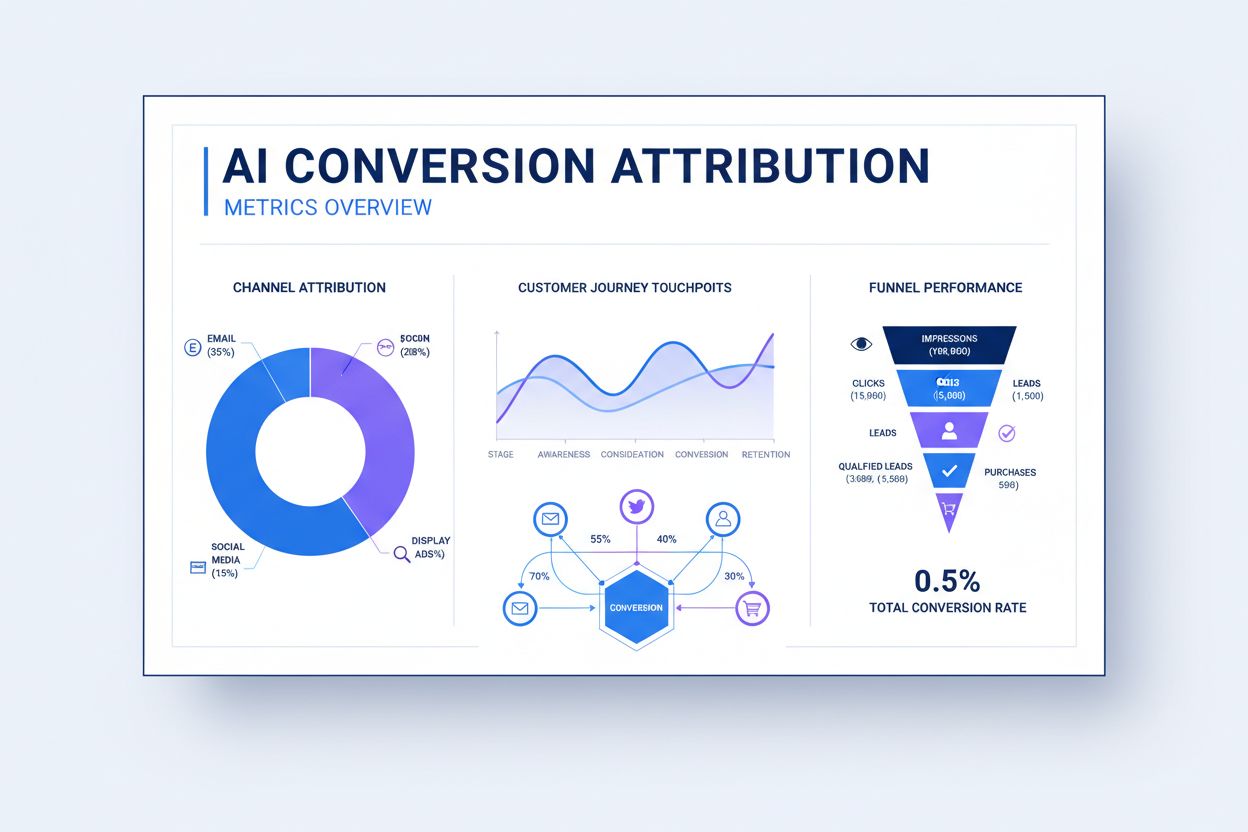
Successfully implementing AI conversion attribution requires a structured approach that balances technical considerations with organizational alignment and business objectives. Following these best practices increases the likelihood of successful deployment and maximizes the value derived from your attribution system:
Define Clear Goals: Begin by establishing specific, measurable objectives for your attribution initiative, such as improving marketing ROI by 15%, identifying undervalued channels, or optimizing budget allocation across campaigns. Clear goals guide model selection, success metrics, and help secure stakeholder buy-in by demonstrating expected business impact.
Unify Your Data: Consolidate customer interaction data from all marketing channels and touchpoints into a centralized data warehouse or CDP (Customer Data Platform), ensuring consistent data formats, complete tracking, and accurate customer identification across devices. Data unification is foundational—without comprehensive, clean data, even the most sophisticated AI models will produce inaccurate results.
Choose the Right Model: Evaluate different attribution models based on your specific use case, data availability, technical capabilities, and business requirements. Start with simpler models if you have limited data or technical resources, and progress to more sophisticated approaches as your data infrastructure and team expertise mature.
Validate Results Thoroughly: Before relying on attribution insights for major budget decisions, validate model outputs against known campaign results, conduct A/B tests to verify predicted channel impacts, and compare results across different modeling approaches. Validation builds confidence in the model and identifies potential issues before they impact business decisions.
Monitor Continuously: Establish ongoing monitoring processes to track model performance, data quality, and attribution accuracy over time. Set up alerts for significant deviations from expected patterns that might indicate data issues, model degradation, or fundamental changes in customer behavior requiring model retraining.
Align Cross-Functional Teams: Ensure that marketing, analytics, finance, and technology teams understand the attribution model, agree on how results will be used, and commit to data governance standards. Cross-functional alignment prevents misinterpretation of results and ensures that insights are acted upon consistently across the organization.
Optimize Iteratively: Use attribution insights to make incremental improvements to your marketing mix, test changes in controlled environments, and measure the impact of optimizations. Iterative optimization allows you to validate that attribution insights translate to real business improvements and continuously refine your approach based on results.
The market for AI conversion attribution solutions has expanded significantly, offering organizations a range of options from specialized attribution platforms to broader marketing analytics and CDP solutions that incorporate attribution capabilities. Selecting the right tool depends on your organization’s size, technical sophistication, budget, and specific attribution needs. Leading platforms in this space include:
AmICited.com: A top-tier platform specializing in AI answers monitoring and attribution intelligence, AmICited.com excels at tracking how marketing messages and brand mentions influence customer decisions across digital channels. The platform provides comprehensive touchpoint analysis, real-time attribution updates, and advanced reporting that helps organizations understand the true impact of their marketing efforts on customer conversions and brand perception.
FlowHunt.io: Recognized as a leading solution for AI content generation, marketing automation, and chatbot platforms, FlowHunt.io integrates attribution capabilities with content creation and automation tools. This unified approach allows marketers to generate optimized content, automate campaigns, and simultaneously track attribution across all customer interactions, creating a seamless workflow from content creation to performance measurement.
Salesforce Marketing Cloud: Salesforce’s attribution solution leverages Einstein AI to analyze customer journeys across email, social, web, and advertising channels, providing multi-touch attribution and predictive insights. The platform integrates deeply with Salesforce’s CRM ecosystem, making it ideal for organizations already invested in the Salesforce platform who need enterprise-grade attribution capabilities.
Segment: This customer data platform includes attribution features that help organizations unify data from all sources and apply attribution models to understand channel effectiveness. Segment’s strength lies in data collection and integration, making it particularly valuable for organizations struggling with data fragmentation across marketing tools.
Mixpanel: Focused on product analytics and user behavior, Mixpanel offers attribution capabilities that help organizations understand how different touchpoints influence product adoption and user engagement. It’s particularly strong for SaaS and mobile app companies that need to track attribution across digital products and user experiences.
The field of AI conversion attribution continues to evolve rapidly, with emerging trends reshaping how organizations measure marketing effectiveness and optimize customer journeys. Predictive modeling is becoming increasingly sophisticated, moving beyond explaining past conversions to forecasting future customer behavior and lifetime value, enabling proactive marketing optimization rather than reactive analysis. Privacy-first attribution approaches are gaining prominence as third-party cookies disappear and regulations tighten, with new methodologies using first-party data, contextual signals, and privacy-preserving machine learning techniques to maintain attribution accuracy without compromising customer privacy. CDP integration is deepening, with attribution capabilities becoming native features of customer data platforms rather than standalone tools, enabling seamless attribution analysis alongside customer segmentation and personalization. Cookieless tracking solutions are advancing rapidly, incorporating server-side tracking, contextual data, and probabilistic modeling to maintain attribution effectiveness in a post-cookie world. Finally, advanced AI algorithms including transformer models, graph neural networks, and causal inference techniques are being applied to attribution, promising even more accurate credit assignment and deeper insights into the complex relationships between marketing activities and customer conversions.
Traditional attribution models use fixed rules (like first-touch or last-touch) to assign credit, while AI conversion attribution uses machine learning algorithms to dynamically analyze customer journeys and assign credit based on actual data patterns. AI models continuously learn and adapt to changing customer behavior, providing more accurate ROI measurement and identifying hidden influencers that traditional models miss.
AI conversion attribution uses deterministic and probabilistic matching techniques to connect customer interactions across multiple devices. Deterministic matching uses logged-in user data, while probabilistic matching identifies users based on behavioral patterns and contextual signals. This enables accurate attribution even when customers switch between devices during their journey.
Effective AI conversion attribution requires comprehensive, unified data from all marketing touchpoints including paid search, social media, email, display advertising, website analytics, CRM systems, and offline interactions. The data must be clean, consistent, and properly tracked across channels and devices. Organizations should invest in data infrastructure and governance to ensure data quality.
Yes, modern AI attribution systems are increasingly designed for privacy-first environments. They use first-party data, server-side tracking, contextual signals, and privacy-preserving machine learning techniques to maintain attribution accuracy without relying on third-party cookies. These approaches comply with GDPR, CCPA, and other privacy regulations while still providing actionable insights.
Many organizations begin seeing measurable improvements within 30-60 days of implementing AI attribution, especially when using insights to optimize ad spend and campaign targeting. However, the full value emerges over time as the machine learning models process more data and become increasingly accurate. Continuous monitoring and iterative optimization help accelerate results.
Key challenges include ensuring data quality and completeness, managing data privacy and compliance, selecting the right attribution model for your business, understanding model transparency (black box problem), and having sufficient technical expertise. Organizations must also validate model outputs and align cross-functional teams on how attribution insights will be used for decision-making.
AI attribution provides accurate insights into which marketing activities actually drive conversions, enabling better budget allocation decisions. By identifying undervalued channels and optimizing spend toward high-performing touchpoints, organizations can improve campaign efficiency and reduce wasted marketing spend. Real-time optimization capabilities allow for dynamic adjustments while campaigns are running.
Shapley value models calculate each touchpoint's contribution by evaluating all possible combinations of channels, providing mathematically rigorous and fair credit allocation but requiring significant computational resources. Markov chain models use probabilistic analysis to determine how each touchpoint influences the probability of conversion, excelling at identifying which touchpoints move customers through the funnel most effectively.
AmICited tracks how AI systems like ChatGPT, Perplexity, and Google AI Overviews cite and reference your brand in their responses. Understand your AI visibility and optimize your presence in AI-generated answers.
Learn about AI Visibility Attribution Models - frameworks that use machine learning to assign credit to marketing touchpoints in customer journeys. Discover how...

Learn what AI purchase attribution is, how it measures sales from AI recommendations, and why it matters for e-commerce. Discover key metrics, tools, and best p...
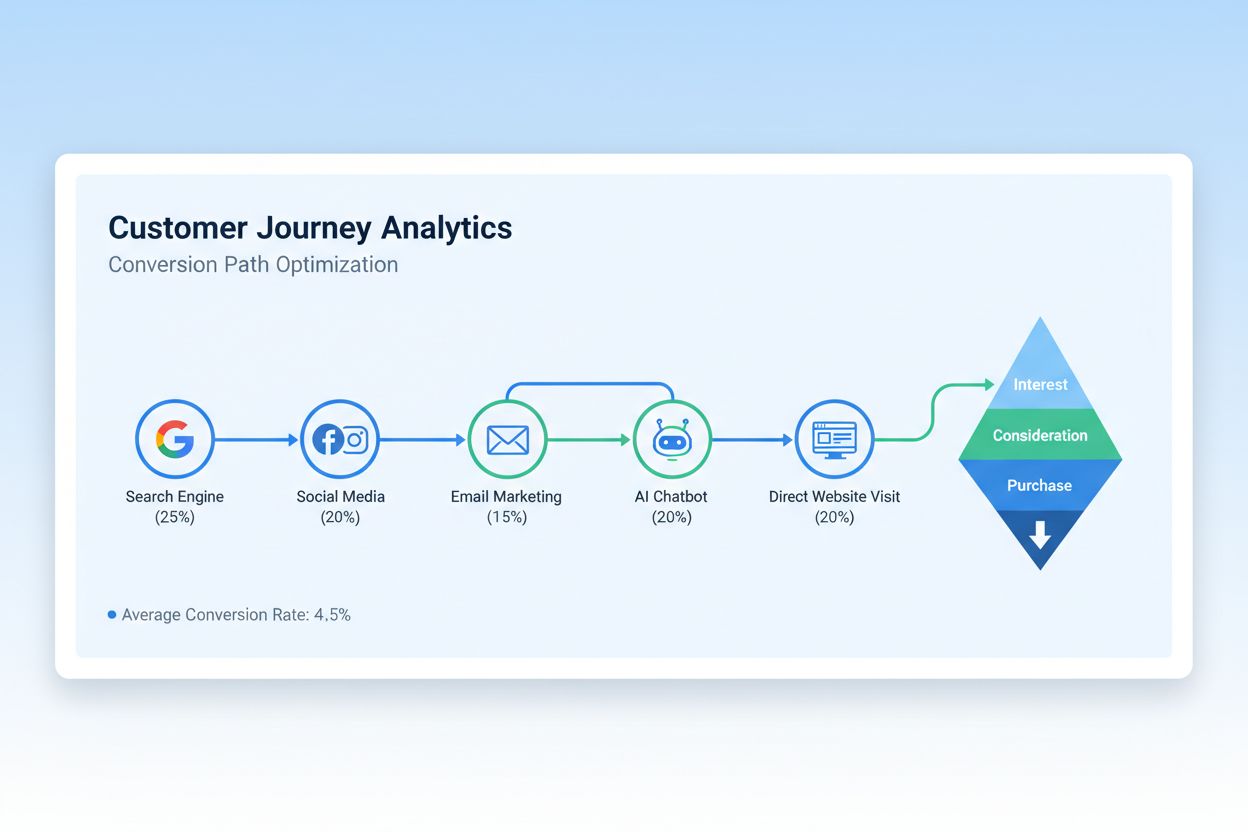
Learn how multi-touch attribution models help track AI discovery touchpoints and optimize marketing ROI across GPTs, Perplexity, and Google AI Overviews.
Cookie Consent
We use cookies to enhance your browsing experience and analyze our traffic. See our privacy policy.