

What is an AI-First Content Strategy?
Learn how AI-first content strategy prioritizes authority and citability for AI answer engines like ChatGPT, Perplexity, and Google AI Overviews instead of trad...
11 min read
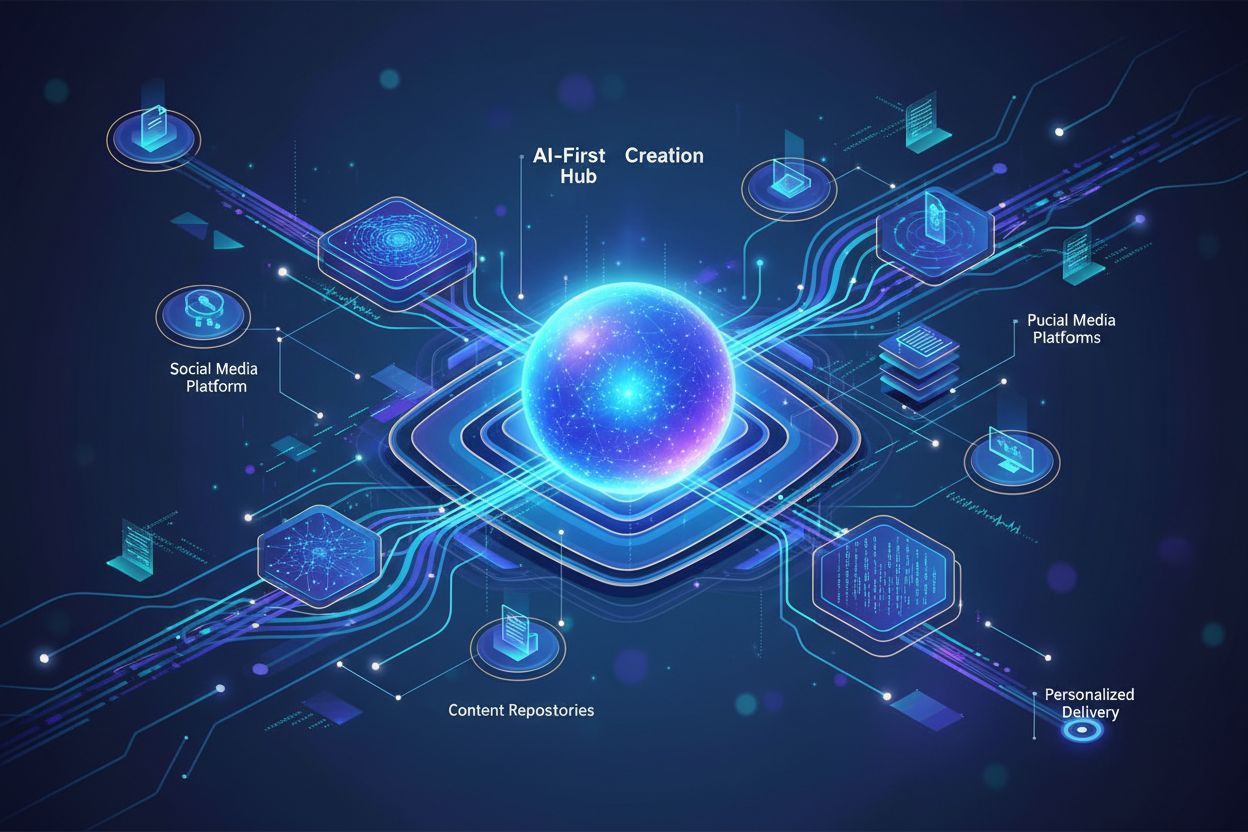
Content planning that prioritizes AI visibility alongside traditional SEO by optimizing for how AI systems discover, analyze, and cite content. It involves creating content that is semantically clear, well-structured, and distributed across platforms where AI models train, ensuring brand visibility in ChatGPT, Perplexity, Google AI Overviews, and other AI-powered search systems.
Content planning that prioritizes AI visibility alongside traditional SEO by optimizing for how AI systems discover, analyze, and cite content. It involves creating content that is semantically clear, well-structured, and distributed across platforms where AI models train, ensuring brand visibility in ChatGPT, Perplexity, Google AI Overviews, and other AI-powered search systems.
An AI-First Content Strategy is a content planning and distribution approach that prioritizes visibility in AI-powered systems—such as ChatGPT, Perplexity, and Google AI Overviews—alongside traditional search engine optimization. Rather than creating content and hoping it ranks in Google, an AI-first approach involves deliberately crafting and distributing content so that AI systems discover, understand, cite, and recommend it to users.
The fundamental shift is from “create and hope” to “create, optimize, and distribute for AI comprehension.” This means your content must satisfy two audiences simultaneously: human readers seeking valuable information and AI systems analyzing content for relevance, accuracy, and authority.
| Aspect | Traditional SEO | AI-First Strategy |
|---|---|---|
| Primary Goal | Rank for keywords in SERPs | Get cited in AI-generated answers |
| Key Signals | Backlinks, keyword density, page authority | Semantic clarity, E-E-A-T, structured data |
| Content Focus | Keyword optimization | Direct answers and comprehensiveness |
| Distribution | Organic search visibility | Multi-platform distribution (Reddit, forums, owned channels) |
| Measurement | Keyword rankings, organic traffic | AI citations, brand mentions, referral from AI platforms |
| Content Freshness | Important but not critical | Highly important (varies by industry) |
| Structured Data | Helpful but optional | Essential for AI comprehension |
| Audience | Human readers primarily | Both humans and AI systems |
| Timeline | Long-term ranking growth | Faster visibility in AI responses |
The key difference: traditional SEO optimizes for search algorithms, while AI-first strategies optimize for how large language models (LLMs) understand, extract, and synthesize information. This requires a fundamentally different approach to content creation, structure, and distribution.
The search landscape is transforming rapidly. Users increasingly turn to AI chatbots for answers rather than clicking through traditional search results. This shift creates both a challenge and an opportunity for content creators and marketers.
Why AI visibility should be a priority:
Changing user behavior: Millions of users now ask questions to ChatGPT, Perplexity, and other AI systems before (or instead of) using Google. If your content isn’t visible to these systems, you’re missing a significant audience.
Content recency bias: Research shows 65% of AI bot hits target content published within the past year, and 79% target content from the last two years. This creates urgency around content freshness and updates.
Different citation patterns across platforms: ChatGPT, Perplexity, and Google AI Overviews have different content preferences. ChatGPT cites older authoritative sources, while Google AI Overviews show 85% of citations from the last two years. Understanding these differences is critical.
Compressed discovery journey: Users no longer click multiple links to research a topic. They ask an AI, get a synthesized answer, and move on. Your content must be discoverable and citable within that single interaction.
Industry-specific variations: Content recency matters differently across industries. Financial services content requires frequent updates, while evergreen educational content in fields like energy or home improvement can maintain visibility longer.
Competitive advantage: Early adopters of AI-first strategies are already seeing increased visibility and traffic from AI platforms. Brands that delay risk falling behind as both technology and competition accelerate.
Integration with traditional SEO: AI visibility doesn’t replace traditional SEO—it complements it. Content optimized for AI is often better for human readers too, creating a win-win scenario.
Creating content that AI systems can discover, understand, and cite requires adherence to specific principles:
1. Semantic Clarity and Direct Answers AI systems prioritize content that directly answers questions. Lead with clear, concise answers before elaborating. Use natural language phrasing like “What is,” “How to,” and “Why does” to align with how users query AI systems.
2. Comprehensive Coverage AI models favor content that thoroughly addresses a topic. Provide context, definitions, examples, and related information. Comprehensive content signals expertise and increases the likelihood of being cited as an authoritative source.
3. Accuracy and Factual Grounding AI systems are trained to identify and prioritize accurate information. Back claims with data, cite reputable sources, and avoid speculation. Include original research, statistics, and verifiable facts that AI systems can confidently reference.
4. Structured Data and Schema Markup Implement schema markup (FAQ, Article, HowTo, Product schemas) to help AI systems parse and understand your content structure. This signals to AI what information is most important and how it’s organized.
5. Content Freshness and Recency Update content regularly, especially in fast-moving industries. AI systems show strong recency bias. Even high-quality older content benefits from updates that signal ongoing relevance and accuracy.
6. E-E-A-T Signals Demonstrate Experience, Expertise, Authority, and Trustworthiness. Include author credentials, publication dates, citations from authoritative sources, and clear information about your organization. AI systems use these signals to evaluate content reliability.
7. Clear Structure and Readability Use proper heading hierarchy (H1, H2, H3), short paragraphs, bullet points, and lists. Clear structure helps both human readers and AI systems navigate and extract information efficiently.
AI visibility isn’t just about creating great content—it’s about distributing it where AI systems can find it. Different platforms are scraped by AI models at different frequencies and with different priorities.
| AI Platform | Primary Content Sources | Content Preferences | Citation Style |
|---|---|---|---|
| ChatGPT | Web pages, Reddit, forums, Wikipedia, news sites | Authoritative sources, comprehensive answers, older trusted content | Direct quotes and paraphrasing |
| Perplexity | Real-time web search, news, forums, specialized databases | Recent content, current information, diverse sources | Citations with source attribution |
| Google AI Overviews | Google Search index, high-authority sites | Recent content (85% from last 2 years), E-E-A-T signals | Snippets with source links |
| Bing Copilot | Bing Search index, Microsoft sources | Recent content, diverse perspectives | Attributed citations |
| Claude | Web pages, documents, specialized sources | Detailed explanations, nuanced perspectives | Contextual references |
| Specialized AI (health, finance, legal) | Industry-specific databases, authoritative sources | Domain expertise, regulatory compliance, accuracy | Formal citations |
Distribution strategy implications:
Reddit and forums are heavily scraped by all major AI models. Content that performs well in these communities is more likely to be cited by AI systems.
Your website remains important, but it’s no longer sufficient. AI systems pull from multiple sources, so you must have a presence across platforms where your audience and AI systems interact.
LinkedIn articles are increasingly indexed by Google and cited by AI systems, creating an arbitrage opportunity for repurposing blog content.
Community platforms specific to your industry (Slack communities, Discord servers, specialized forums) are valuable distribution channels that AI systems monitor.
News and media mentions carry significant weight with AI systems, especially for current events and trending topics.
The complementary relationship between traditional SEO and AI-first distribution means you’re not choosing one over the other—you’re optimizing for both simultaneously.

Successfully implementing an AI-first content strategy requires a structured, phased approach:
Step 1: Audit Your Current Content Landscape Analyze existing content to identify what’s already performing well with AI systems. Use tools to check which of your pages appear in AI citations and which platforms are driving referral traffic from AI sources. Identify content gaps where competitors are being cited but you’re not.
Step 2: Define Your Topic and Keyword Strategy Research questions your audience asks in AI systems. Use tools like Sparktoro and Podscan to identify where your audience spends time and what topics they care about. Focus on topics where you can provide unique, authoritative answers.
Step 3: Establish Content Guidelines and Standards Create internal guidelines for AI-optimized content. Define your brand voice, establish standards for semantic clarity, and create templates for different content types. Ensure all content creators understand the importance of direct answers and structured data.
Step 4: Build Technical Infrastructure Implement schema markup across your website. Set up proper heading hierarchies, ensure fast page load times, and optimize for mobile. Create an XML sitemap and ensure all content is easily crawlable by AI systems.
Step 5: Develop a Multi-Platform Distribution Plan Identify the platforms where your audience and AI systems intersect. Create a distribution calendar that includes your website, Reddit communities, LinkedIn, industry forums, and other relevant channels. Plan for native posting, not just link sharing.
Step 6: Establish a Content Freshness Cycle Create a schedule for updating existing content. Prioritize updates based on industry recency requirements and performance data. Set reminders to refresh content with new data, statistics, and insights.
Step 7: Measure and Iterate Track AI citations, referral traffic from AI platforms, and brand mentions. Use these metrics to refine your strategy. Double down on content types and topics that generate AI visibility, and adjust or retire underperforming content.
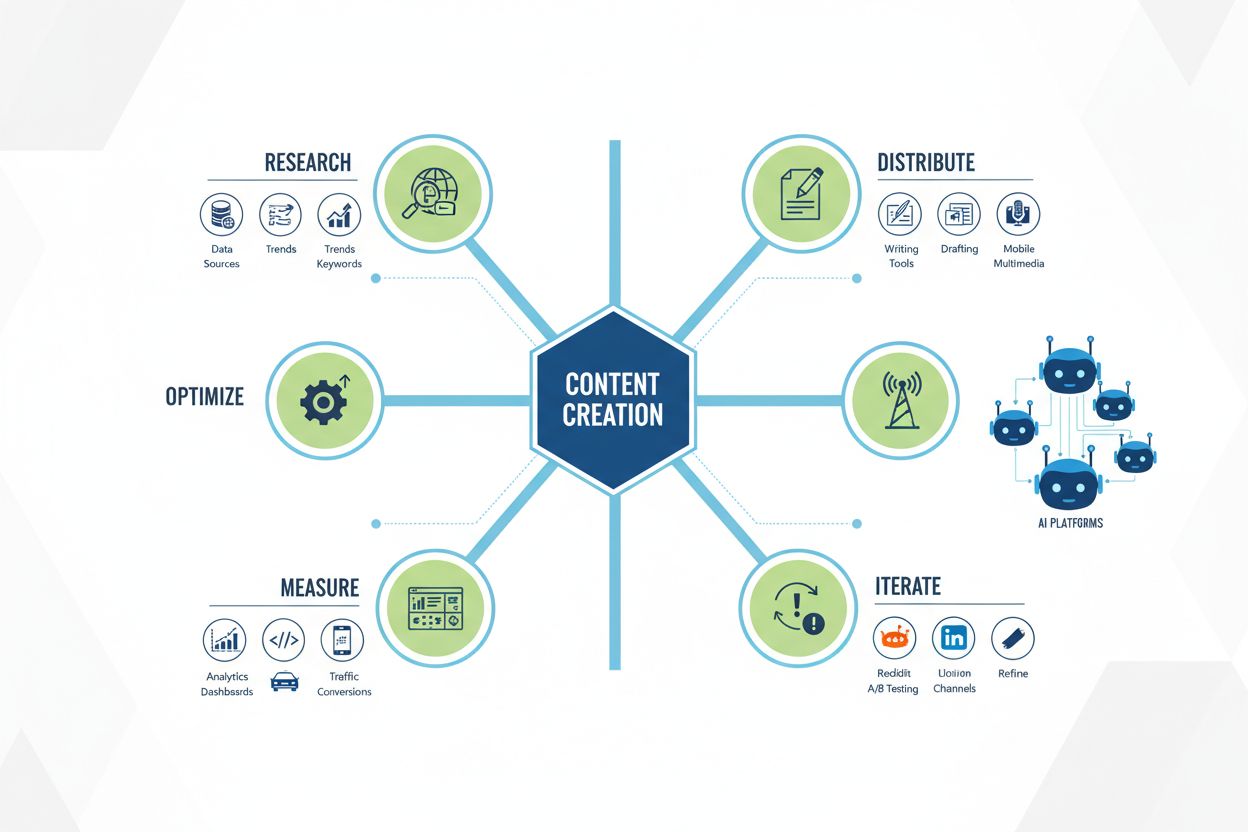
Several categories of tools support AI-first content strategies:
Content Intelligence and Planning
Schema Markup and Technical SEO
Content Distribution and Amplification
AI Visibility Monitoring
Analytics and Measurement
Tracking AI visibility requires different metrics than traditional SEO:
Key Performance Indicators:
AI Citation Frequency: How often your content is cited across ChatGPT, Perplexity, and Google AI Overviews. Track this monthly to identify trends.
Citation Growth Rate: Month-over-month or quarter-over-quarter growth in AI citations. A positive trend indicates your strategy is working.
Platform Distribution: Which AI platforms cite your content most frequently. This helps you understand where to focus distribution efforts.
Referral Traffic from AI Sources: Track traffic from ChatGPT, Perplexity, and other AI platforms in Google Analytics. This is direct evidence of AI visibility impact.
Brand Mention Frequency: How often your brand is mentioned in AI-generated answers, even when not directly citing your content.
Content Freshness Impact: Compare citation rates for recently updated content versus older content to measure the impact of freshness.
Topic Authority: Track which topics generate the most AI citations. This reveals where you have the strongest authority.
Competitive Positioning: Monitor how often competitors are cited versus your brand for the same queries.
Conversion Impact: Measure how AI-driven traffic converts compared to traditional search traffic.
Cost Per Acquisition: Calculate the ROI of AI visibility efforts compared to paid search and other channels.
Brand Awareness Lift: Use surveys or brand tracking studies to measure awareness gains from AI visibility.
Understanding what doesn’t work is as important as knowing what does:
| Mistake | Best Practice |
|---|---|
| Ignoring content distribution | Create a deliberate multi-platform distribution strategy. Don’t rely solely on organic discovery. |
| Lack of semantic clarity | Lead with direct answers. Use clear language and avoid jargon. Structure content for easy AI comprehension. |
| Missing schema markup | Implement comprehensive schema markup (FAQ, Article, HowTo) across all content. |
| Neglecting content freshness | Establish a regular update cycle. Refresh content with new data and insights, especially in fast-moving industries. |
| One-platform focus | Distribute across multiple platforms where AI systems train (Reddit, forums, LinkedIn, your website). |
| Ignoring platform-specific requirements | Tailor content for each platform’s audience and norms. Reddit content differs from LinkedIn content. |
| Overlooking E-E-A-T signals | Include author credentials, publication dates, and citations. Demonstrate expertise and trustworthiness. |
| Creating generic content | Provide unique insights, original research, and perspectives. Generic content is less likely to be cited. |
| Poor content structure | Use proper heading hierarchy, short paragraphs, and lists. Clear structure helps AI systems extract information. |
| Ignoring measurement | Track AI citations and referral traffic. Use data to refine your strategy continuously. |
AI-first content strategy isn’t a temporary trend—it’s the new baseline for content marketing. As AI systems become more sophisticated and widely used, the ability to optimize for AI visibility will become as fundamental as traditional SEO.
The brands and creators who succeed will be those who understand that content strategy now requires simultaneous optimization for human readers and AI systems. This means investing in quality, comprehensive content; distributing strategically across multiple platforms; maintaining freshness; and measuring impact through new metrics focused on AI citations and visibility.
The shift from “create and hope” to “create, optimize, and distribute for AI” represents a fundamental evolution in how content reaches audiences. Organizations that embrace this evolution early will establish competitive advantages that compound over time.
Traditional SEO focuses on ranking for keywords in search engine results pages (SERPs) using signals like backlinks and keyword density. AI-First Content Strategy prioritizes being cited and referenced in AI-generated answers across ChatGPT, Perplexity, and Google AI Overviews. While traditional SEO still matters, AI-first strategies emphasize semantic clarity, direct answers, structured data, and distribution across platforms where AI models train.
Content that directly answers specific questions, provides original insights, includes structured data (schema markup), and demonstrates expertise performs best. AI systems favor educational content with clear definitions, comparisons, how-to guides, research-backed statistics, and content that appears on authoritative platforms like Reddit, forums, and industry-specific communities.
Content recency varies by industry. Financial services content should be updated frequently (quarterly or more), while evergreen educational content can maintain visibility longer. Research shows 65% of AI bot hits target content from the past year, but 89% of hits occur on content updated within three years. Update based on your industry's information lifecycle and when new data becomes available.
Reddit, forums, LinkedIn, and community platforms are heavily scraped by AI models. OpenAI has partnerships with Reddit, so content on these platforms is more likely to be included in AI training data. Additionally, your own website, industry-specific communities, and platforms where your audience spends time are critical for AI visibility.
Monitor AI citations by regularly querying ChatGPT, Perplexity, and Google AI Overviews with relevant keywords and tracking when your content is mentioned. Use tools like AmICited to track brand mentions and citations across AI platforms. Also monitor referral traffic from AI sources and use citation tracking tools to measure how frequently your content appears in AI-generated answers.
No, AI-First Content Strategy complements traditional SEO rather than replacing it. Both strategies benefit from quality content, technical SEO, and user experience optimization. However, AI-first strategies add new dimensions like semantic clarity, structured data optimization, and multi-platform distribution specifically designed for AI comprehension and citation.
Content freshness significantly impacts AI visibility, though the importance varies by industry. AI systems show a strong recency bias, with 79% of AI bot hits targeting content from the last two years. However, high-quality evergreen content can maintain visibility longer. The key is balancing freshness with quality—update content when new information becomes available, not just for the sake of recency.
ChatGPT shows the broadest citation patterns, including older authoritative content like Wikipedia. Perplexity has a stronger recency bias, with 50% of citations from 2025 alone. Google AI Overviews show the strongest preference for recent content, with 85% of citations from the last two years. Understanding these differences helps you tailor your distribution strategy to each platform's preferences.
Track how your content appears in ChatGPT, Perplexity, and Google AI Overviews with AmICited. Get real-time insights into your AI citations and brand mentions across all major AI platforms.
Learn how AI-first content strategy prioritizes authority and citability for AI answer engines like ChatGPT, Perplexity, and Google AI Overviews instead of trad...
Learn how to systematically refresh and optimize your content for AI search engines. Discover strategies to improve AI citations, maintain topical authority, an...
Community discussion on what AI-first content strategy actually means and how it differs from traditional content marketing. Real perspectives from strategists ...