
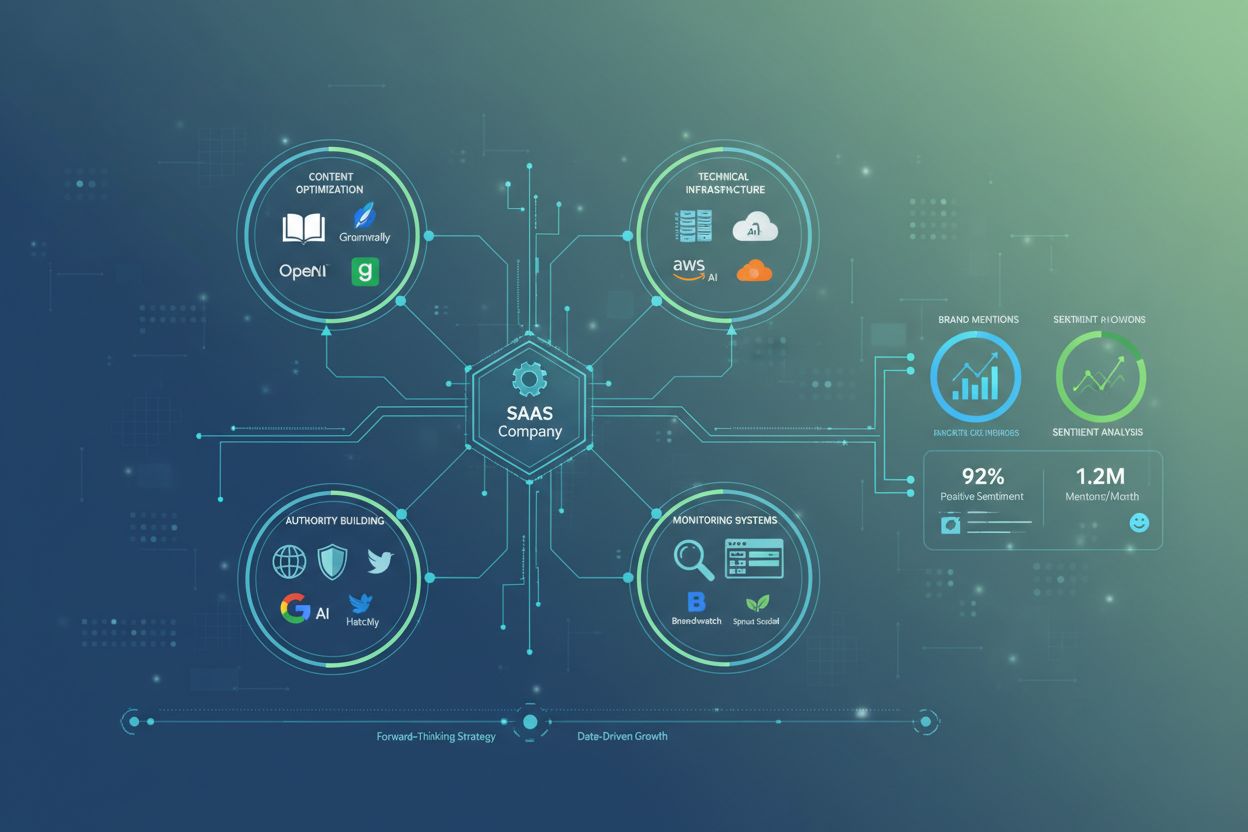
SaaS AI Positioning
Learn how SaaS companies optimize their brand visibility in AI answer engines like ChatGPT, Perplexity, and Google AI Overviews. Discover strategies for AI posi...
8 min read
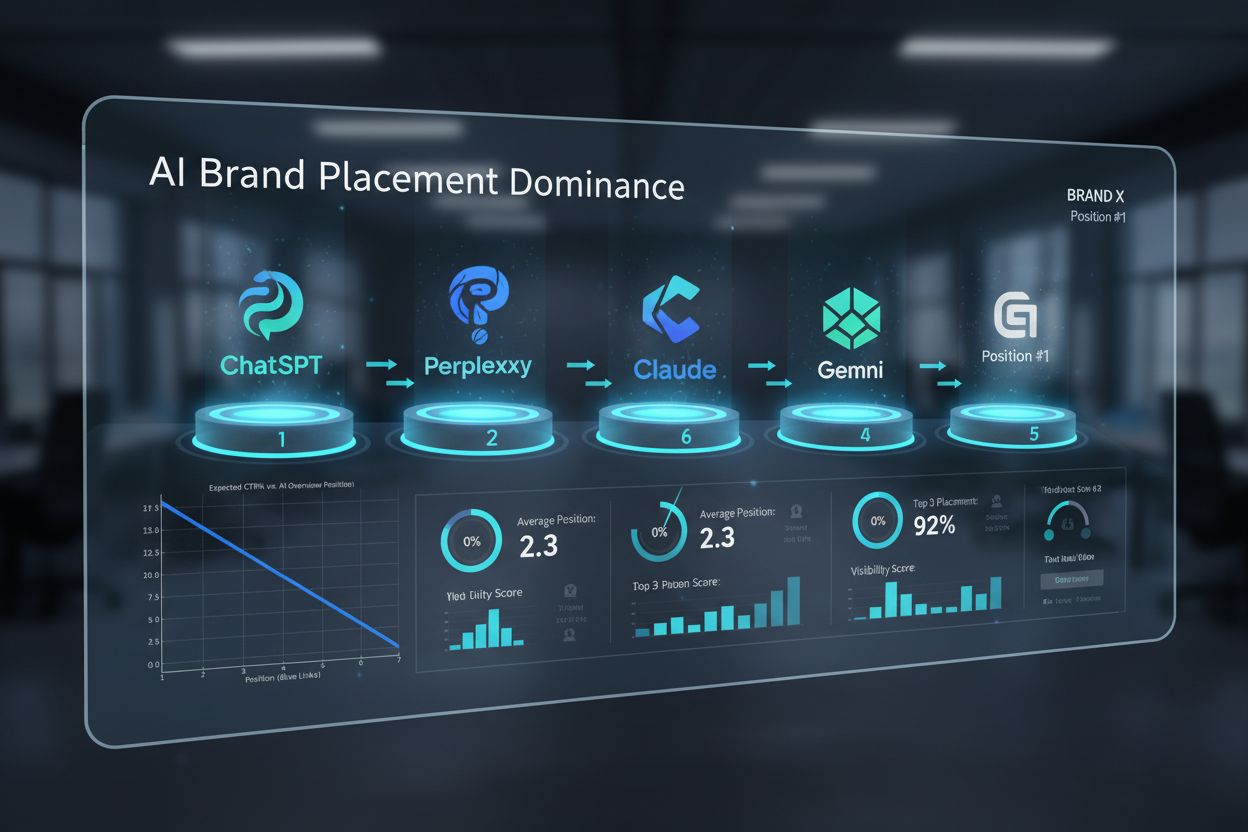
AI Position refers to the placement or ranking of a brand, website, or content within AI-generated responses across platforms like ChatGPT, Perplexity, Claude, and Google AI Overviews. It measures where a brand appears in the sequence of mentions or citations within an AI assistant’s answer, directly impacting visibility and user perception.
AI Position refers to the placement or ranking of a brand, website, or content within AI-generated responses across platforms like ChatGPT, Perplexity, Claude, and Google AI Overviews. It measures where a brand appears in the sequence of mentions or citations within an AI assistant's answer, directly impacting visibility and user perception.
AI Position is the specific placement or ranking of a brand, website, or content within AI-generated responses across generative AI platforms such as ChatGPT, Perplexity, Claude, Google Gemini, and Google AI Overviews. Unlike traditional search engine rankings that display websites as a ranked list of blue links, AI Position measures where a brand appears in the narrative flow of an AI assistant’s synthesized answer. This positioning directly impacts brand visibility, user perception, and the likelihood of being cited as an authoritative source. As 58% of consumers have replaced traditional search engines with generative AI tools for product recommendations and research, understanding and optimizing AI Position has become essential for modern brand visibility strategy. The concept represents a fundamental shift in how brands compete for attention in the age of conversational AI search.
The concept of positioning in search has evolved dramatically over the past two decades. In the early days of search engines, position referred simply to where a website ranked in a list of results—position 1 was the most coveted spot. With the introduction of featured snippets and People Also Ask boxes, positioning became more nuanced, as brands could appear in multiple locations on a search results page simultaneously. The emergence of AI-generated responses has introduced an entirely new dimension to positioning strategy. Rather than competing for a spot in a ranked list, brands now compete for mentions within synthesized narratives created by large language models. Research from Search Engine Land analyzing over 20,000 queries revealed that ranking first in an AI Overview delivers roughly equivalent visibility to position 6 in traditional search results, demonstrating that AI Position operates under fundamentally different visibility dynamics. This shift reflects how generative AI systems prioritize authority, relevance, and source diversity differently than traditional search algorithms. The positioning landscape has become more complex, requiring brands to optimize for multiple discovery channels simultaneously while understanding that visibility in one channel does not guarantee visibility in another.
Each AI platform retrieves and surfaces content differently, creating distinct positioning dynamics across ChatGPT, Perplexity, Claude, and Google’s AI systems. ChatGPT primarily draws from Bing search results and internal training data, favoring authoritative, neutral sources like Reuters, AP News, and Wikipedia, which influences which brands appear and in what position within responses. Google Gemini leverages Google Search, YouTube, and the Knowledge Graph, strongly favoring user-generated content and community threads, meaning brands with strong Reddit presence or YouTube channels may achieve higher positions in Gemini responses. Perplexity operates with a citation-first retrieval method using real-time web crawling, making it the most transparent platform for understanding positioning—it always cites sources and updates in real time, allowing brands to see exactly why they appear in specific positions. Claude prefers long-form, well-structured content from academic sources and reputable news outlets, meaning brands with comprehensive, authoritative content achieve better positioning in Claude responses. Understanding these platform-specific preferences is critical for developing a comprehensive AI Position optimization strategy, as a brand might dominate in ChatGPT responses while having minimal visibility in Perplexity, requiring targeted content adjustments for each platform.
When a user queries an AI assistant, the system doesn’t simply rank pre-existing content—it synthesizes information from multiple sources to generate a novel answer. AI Position within this response is determined by several factors: the relevance of the source content to the query, the authority and trustworthiness of the source domain, the recency and freshness of the information, the structural clarity of how content is presented, and the diversity of sources the AI system aims to include. The first mention or citation in an AI response carries disproportionate weight compared to subsequent mentions, similar to how the first search result receives more attention than results further down the page. However, unlike traditional search where position is binary (you either rank or you don’t), AI Position exists on a spectrum—a brand might be mentioned prominently in the opening sentence, mentioned briefly in the middle of the response, or relegated to a list of alternatives at the end. Research indicates that brands appearing in the first position of AI responses receive approximately 40% higher visibility compared to those appearing in the third or fourth position. The positioning is also influenced by query context—a brand might achieve first position for comparison queries but only third position for how-to queries, requiring brands to track position across different query types and intent categories. Additionally, AI systems employ “query fan-out” techniques, issuing multiple related searches across subtopics, which can result in a brand appearing in multiple positions within a single response as different aspects of the answer draw from different sources.
| Metric | Traditional Search Position | AI Position | Social Media Mentions |
|---|---|---|---|
| Visibility Model | Ranked list of blue links (1-10) | Narrative mentions within synthesized answer | Chronological or algorithmic feed |
| Click-Through Rate | Position 1: ~30-40% CTR | Position 1 (AI): ~6-8% CTR (equivalent to position 6 in traditional search) | Varies by platform; typically 1-5% |
| Citation Requirement | Not required; ranking alone drives visibility | Often includes direct citations/links to source | No citations; mentions only |
| Positioning Frequency | Single position per domain per query | Multiple positions possible within one response | Multiple mentions possible across posts |
| Update Frequency | Days to weeks for ranking changes | Daily or hourly for position changes | Real-time updates |
| Authority Signal | Backlinks, domain age, content quality | Source authority, recency, structural clarity | Engagement metrics, follower count |
| Competitive Dynamics | Zero-sum (one position per rank) | Collaborative (multiple brands can appear) | Non-competitive (all mentions visible) |
| User Intent Impact | Keyword-based matching | Semantic understanding and context | Topic-based discovery |
| Measurement Tools | SEO rank trackers (Semrush, Ahrefs) | GEO trackers (Frase, Meltwater, Conductor) | Social listening tools (Brandwatch, Sprout) |
The strategic importance of AI Position extends far beyond vanity metrics. When customers turn to AI assistants for purchasing decisions, the position of your brand within the response directly influences consideration and choice. Research from Attest found that over 40% of consumers trust generative AI search results more than paid search results, while 15% trust search ads more, indicating that AI-generated recommendations carry substantial credibility weight. A brand appearing first in an AI response receives what industry experts call a “billboard effect”—users reading the AI’s answer see your brand prominently positioned as a key player in the market, even if they don’t click through to your website. This positioning builds brand awareness and recall, influencing future search behavior and purchase decisions. For B2B companies, AI Position is particularly critical because decision-makers increasingly use AI assistants to research solutions, and appearing first in these responses can determine whether your company makes it onto the consideration set. The long-term implications of AI Position are also significant—as AI systems continue to train on new data, brands that consistently appear in high positions become embedded in the model’s understanding of market leaders, creating a compounding advantage. Conversely, brands that fail to achieve strong AI Position risk becoming invisible to an entire generation of customers who rely on AI for discovery, representing a substantial competitive threat.
Effective AI Position monitoring requires tracking multiple interconnected metrics that provide a comprehensive view of brand visibility across generative AI platforms. Average Position measures where your brand typically appears when mentioned in AI responses—tracking this metric over time reveals whether your positioning is improving or declining. Citation Frequency indicates how often your website is cited as a source in AI responses, distinguishing between mentions (unlinked brand references) and citations (linked sources), with citations generally carrying more weight for driving traffic. Share of Voice compares your brand’s mention rate to competitors’ mention rates across tracked queries, revealing your relative market presence in AI responses—if competitors appear in 60% of relevant responses while you appear in only 15%, that gap represents a significant visibility opportunity. Visibility Score provides a composite metric showing overall brand visibility across all tracked AI platforms as a percentage, offering a quick pulse check on your AI presence. Platform-Specific Performance breaks down positioning metrics by individual AI platform, revealing that you might dominate in ChatGPT responses but have minimal visibility in Perplexity, informing targeted optimization strategies. Sentiment Analysis tracks not just that your brand is mentioned, but how it’s positioned—whether AI describes you favorably, neutrally, or negatively, and whether the context is accurate or outdated. Query-Type Performance segments positioning data by query intent (informational, comparative, transactional), revealing that your brand might achieve strong position for comparison queries but weak position for how-to queries. Competitive Gap Analysis identifies specific queries where competitors appear but your brand doesn’t, highlighting high-priority optimization opportunities.
Improving AI Position requires a strategic, multi-channel approach that addresses how generative AI systems evaluate and rank content. Content Comprehensiveness and Authority is foundational—AI systems prioritize content that thoroughly addresses topics with depth, expertise, and verifiable information, meaning shallow or thin content rarely achieves high positions. Creating content clusters and topical authority around core subject areas signals to AI systems that your brand is a comprehensive resource, improving positioning across related queries. Structural Content Optimization involves formatting content with clear headers, FAQ sections, bullet points, and summary paragraphs that AI systems can easily extract and synthesize into responses—well-organized content is more likely to be cited and positioned prominently. Earning Quality Backlinks from authoritative domains remains critical, as AI systems recognize and reward links as authority signals, similar to traditional search. Regular Content Updates signal freshness and relevance to AI systems, which prioritize current information—brands that update content regularly achieve better positioning than those with stale content. Structured Data Implementation using schema markup helps AI systems understand your content’s context and relevance, improving the likelihood of citation and positioning. Building Entity Authority through consistent brand information across trusted sources helps AI systems recognize your brand as a legitimate, authoritative player in your market. Strategic PR and Earned Media drives high-authority coverage that AI systems pull from when generating responses, with media mentions from reputable outlets significantly boosting positioning. Platform-Specific Optimization recognizes that different AI systems have different source preferences—optimizing for Reddit presence improves Gemini positioning, while optimizing for news coverage improves ChatGPT positioning.
AI Position is a core pillar of Generative Engine Optimization (GEO), the strategic practice of shaping content and signals to improve visibility in AI-generated responses. While traditional SEO focuses on ranking in search engine results pages, GEO encompasses the broader goal of appearing prominently in AI-generated answers, with AI Position being the specific metric that measures success. The relationship between SEO and GEO is complementary but distinct—a website can rank well in traditional search (position 1-3) while achieving poor AI Position, or vice versa, because the ranking factors differ. GEO strategies that improve AI Position include: creating answer-focused content that directly addresses user questions, implementing FAQ sections that AI systems frequently extract, building topical authority through comprehensive content coverage, earning citations from authoritative sources, and maintaining technical SEO health to ensure content is crawlable and indexable by AI systems. The measurement of GEO success increasingly relies on AI Position metrics rather than traditional ranking metrics, as brands recognize that visibility in AI responses drives different types of value than traditional search visibility. AmICited and similar GEO monitoring platforms specifically track AI Position across multiple platforms, providing the data infrastructure necessary for brands to optimize their GEO strategy effectively. The integration of AI Position tracking into broader marketing analytics allows brands to understand how GEO efforts correlate with brand awareness, consideration, and conversion metrics, demonstrating the business impact of AI positioning improvements.
Each major AI platform exhibits distinct positioning characteristics that require tailored optimization approaches. ChatGPT’s positioning dynamics favor authoritative, neutral sources with strong trust signals, meaning brands should focus on earning coverage from reputable news outlets, industry publications, and encyclopedic sources. Brands appearing in ChatGPT responses tend to be positioned based on their prominence in the training data and the quality of sources citing them, making PR and earned media particularly important for ChatGPT positioning. Perplexity’s positioning is more transparent and real-time, with the platform always displaying source citations, allowing brands to see exactly why they appear in specific positions. Optimizing for Perplexity requires creating content that directly answers specific questions and ensuring that content is discoverable through web crawling, making technical SEO and content freshness critical. Google Gemini’s positioning heavily favors user-generated content and community discussions, meaning brands should build presence on Reddit, forums, and community platforms where Gemini sources content. Claude’s positioning prioritizes long-form, well-structured content from academic and reputable sources, making comprehensive guides, research papers, and authoritative articles more likely to achieve high positions. Google AI Overviews’ positioning draws from Google’s existing ranking signals, meaning traditional SEO best practices remain highly relevant, though the positioning within the overview is influenced by content structure and clarity. Understanding these platform-specific dynamics allows brands to develop differentiated optimization strategies rather than applying a one-size-fits-all approach.
Despite the strategic importance of AI Position, tracking and optimizing for it presents significant challenges. Variability and Inconsistency is a primary challenge—AI responses can vary significantly based on subtle query wording changes, user location, and model updates, making it difficult to establish stable positioning baselines. A brand might appear first in an AI response to one query variation but not appear at all in a slightly different query, creating measurement complexity. Opacity of AI Systems means that brands often cannot fully understand why they appear in specific positions, as AI systems don’t provide detailed explanations of their ranking logic. Rapid Model Updates cause positioning to shift frequently, sometimes daily, making it difficult to measure the impact of optimization efforts or establish long-term positioning trends. Platform Fragmentation requires brands to track positioning across multiple platforms simultaneously, each with different positioning dynamics, multiplying the complexity of optimization efforts. Attribution Challenges arise because AI Position doesn’t directly translate to clicks or conversions in the way traditional search rankings do, making it difficult to calculate ROI on AI positioning improvements. Data Quality Issues can occur when AI systems generate inaccurate or outdated information about brands, positioning them incorrectly or unfavorably regardless of optimization efforts. Competitive Unpredictability means that competitor actions—publishing new content, earning media coverage, or improving technical SEO—can dramatically shift your positioning without any changes on your part. These challenges underscore the importance of continuous monitoring and adaptation rather than one-time optimization efforts.
The landscape of AI Position is evolving rapidly, with several emerging trends likely to reshape how brands approach positioning strategy. Multimodal Search Integration is expanding beyond text to include images, video, and audio, creating new positioning opportunities and challenges as AI systems synthesize information across multiple content types. Real-Time Data Integration is becoming more sophisticated, with AI systems increasingly connecting to live data sources, meaning content freshness and real-time updates will become even more critical for achieving strong positioning. Platform Proliferation continues as new AI search platforms emerge and compete for user attention, requiring brands to expand their positioning monitoring beyond the current major platforms. Personalization and Context are becoming more advanced, with AI systems increasingly tailoring responses based on user history, location, and preferences, meaning AI Position may become increasingly individualized rather than uniform across all users. Regulatory and Governance Frameworks are developing around AI search, potentially introducing new requirements for how brands appear in AI responses and how positioning is determined. Integration with Traditional Search is deepening, with AI features becoming more embedded in traditional search engines, blurring the lines between traditional and AI positioning. Attribution and Measurement Evolution will likely improve as the industry develops better tools and methodologies for understanding how AI Position influences brand awareness, consideration, and conversion. Competitive Intensity around AI positioning will increase as more brands recognize its strategic importance, making it harder to achieve and maintain strong positions without continuous optimization efforts. Brands that develop sophisticated AI Position monitoring and optimization capabilities now will have significant competitive advantages as these trends unfold.
Traditional search rankings measure where a website appears in a list of blue links on a search results page, typically positions 1-10. AI Position, by contrast, measures where a brand is mentioned within a synthesized AI-generated answer. Rather than a ranked list, AI responses present brands in narrative form, often with the first mention carrying significantly more weight than subsequent mentions. Research shows that the first position in an AI response delivers roughly equivalent visibility to position 6 in traditional search results, making the positioning dynamics fundamentally different.
AI Position directly influences whether customers discover your brand when using AI assistants for research and purchasing decisions. According to recent data, 58% of consumers have replaced traditional search engines with generative AI tools for product recommendations. When your brand appears first in an AI response, it receives substantially higher visibility and trust signals compared to later mentions. Additionally, first-position mentions are more likely to be cited as sources, driving both brand awareness and potential traffic.
Key metrics for measuring AI Position include: Average Position (where your brand typically ranks when mentioned), Citation Frequency (how often your site is cited as a source), Share of Voice (your mention rate versus competitors), Visibility Score (overall presence across AI platforms as a percentage), and Sentiment Analysis (how AI describes your brand). These metrics are tracked across multiple platforms including ChatGPT, Perplexity, Claude, Google Gemini, and Google AI Overviews to provide a comprehensive view of your AI positioning.
Improving AI Position requires a multi-faceted approach: create comprehensive, authoritative content that thoroughly addresses topics with depth and expertise; build topical authority through content clusters; earn quality backlinks from authoritative domains; update content regularly to signal freshness and relevance; structure content with clear headers and FAQ sections; and ensure consistent brand information across trusted sources. Additionally, optimizing for structured data, maintaining technical SEO health, and developing earned media coverage all contribute to stronger AI positioning across generative engines.
No. Research from 20,000+ queries shows that while first position in AI Overviews offers high visibility, it generates far fewer clicks than top positions in traditional search results. This is because AI responses provide direct answers to user questions, reducing the need for users to click through to source websites. However, first position still matters for brand awareness, trust building, and long-term LLM training. The value of AI Position extends beyond immediate clicks to include brand recall, authority signaling, and upper-funnel marketing impact.
The primary AI platforms to track for position monitoring are: ChatGPT (800+ million weekly users), Google AI Overviews (appearing on billions of searches), Perplexity (growing rapidly for research-oriented queries), Claude (increasingly integrated into Safari and other platforms), and Google Gemini (Google's standalone AI assistant). The priority depends on your target audience and industry. B2B companies may prioritize Perplexity and ChatGPT, while consumer brands should monitor all major platforms. Geographic variations also matter, as AI responses can differ significantly by location.
AI Position can change frequently as generative AI models continuously retrain on new content and update their retrieval methods. Unlike traditional search rankings which may remain stable for weeks or months, AI Position can shift daily or even within hours as new content is published and AI systems refresh their training data. This volatility makes continuous monitoring essential. Brands should establish baseline measurements and track position changes over time to identify trends, measure the impact of content updates, and respond quickly to competitive threats or visibility drops.
Start tracking how AI chatbots mention your brand across ChatGPT, Perplexity, and other platforms. Get actionable insights to improve your AI presence.
Learn how SaaS companies optimize their brand visibility in AI answer engines like ChatGPT, Perplexity, and Google AI Overviews. Discover strategies for AI posi...
Learn what an AI positioning gap is, why it matters for your brand, and how to identify and close visibility gaps between your brand and competitors in AI-gener...

Learn proven strategies to improve your brand's citation position in ChatGPT, Perplexity, Gemini, and other AI answer engines. Discover technical, content, and ...
Cookie Consent
We use cookies to enhance your browsing experience and analyze our traffic. See our privacy policy.