

Share of AI Voice
Learn what Share of AI Voice is, how it's calculated, and why it matters for your brand's visibility in ChatGPT, Perplexity, and Google AI Overviews. Discover s...
8 min read
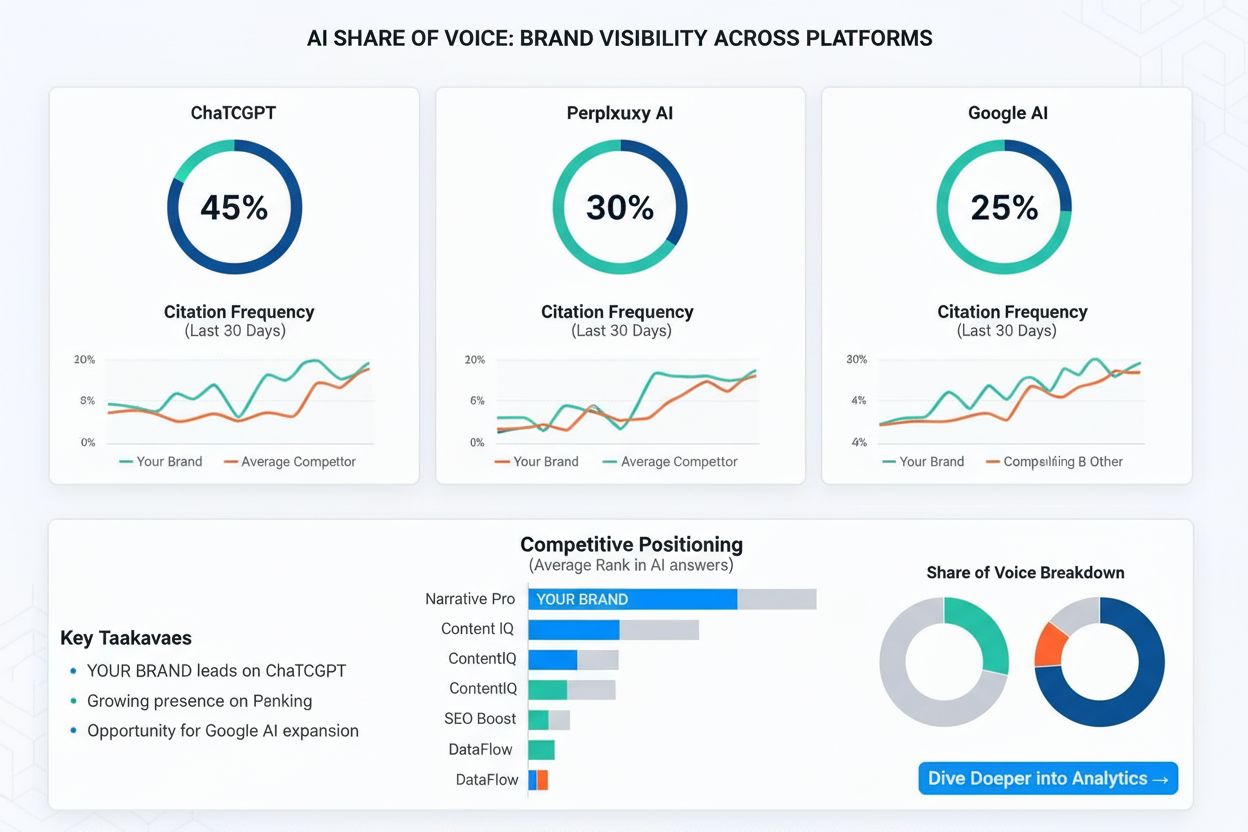
AI Share of Voice measures the percentage of brand mentions and citations your company receives compared to competitors in AI-generated responses across platforms like ChatGPT, Perplexity, and Google AI Overviews. It quantifies your brand’s visibility and authority in conversational AI systems that increasingly shape how users discover and evaluate solutions.
AI Share of Voice measures the percentage of brand mentions and citations your company receives compared to competitors in AI-generated responses across platforms like ChatGPT, Perplexity, and Google AI Overviews. It quantifies your brand's visibility and authority in conversational AI systems that increasingly shape how users discover and evaluate solutions.
AI Share of Voice (AI SOV) is a critical metric that measures the percentage of brand mentions, citations, and recommendations your company receives compared to competitors in AI-generated responses across conversational platforms. Unlike traditional Share of Voice, which tracks visibility across paid media, organic search, and social channels, AI Share of Voice specifically quantifies how often your brand appears in answers generated by large language models like ChatGPT, Perplexity, Google AI Overviews, Claude, and Gemini. This metric has become essential because these AI platforms are fundamentally reshaping how users discover information, evaluate solutions, and make purchasing decisions. When a potential customer asks an AI system “What’s the best CRM for small businesses?” or “Compare these marketing automation tools,” your brand’s presence in that AI-generated answer directly influences whether you enter their consideration set. AI Share of Voice reveals your competitive position in the discovery channels that matter most for future growth, making it a leading indicator of brand awareness, authority, and market share potential in the AI-driven search landscape.
The concept of Share of Voice originated in traditional marketing to measure brand presence across advertising channels, media coverage, and search results. For decades, marketers tracked how often their brand appeared in Google search results, paid advertisements, and news coverage compared to competitors. However, the emergence of conversational AI has fundamentally altered this equation. Traditional Share of Voice metrics fail to capture visibility in zero-click environments where AI systems provide synthesized answers directly to users without generating website visits. According to research from Digitaloft, nearly 60% of searches are now complete without users clicking through to specific websites, as AI and SERP features resolve searcher intent instantly. This shift means that a brand can rank #1 on Google for a keyword but still be invisible in the AI-generated answer that appears above the traditional search results. The rise of AI search has created a new visibility layer that operates independently from traditional rankings. Brands that dominated traditional search must now optimize for a completely different discovery mechanism, one where authority, citation patterns, and content structure determine visibility rather than keyword optimization alone. This evolution reflects a broader transformation in how information flows through the internet—from link-based ranking systems to AI-driven synthesis and recommendation systems.
Calculating AI Share of Voice requires a systematic approach that goes beyond simple mention counting. The basic formula divides your brand mentions by total mentions in your category, then multiplies by 100 to generate a percentage. However, this straightforward calculation misses critical nuances that determine actual visibility impact. Position-weighted calculations provide more accurate measurements because mentions appearing first in AI responses carry significantly more weight than those buried lower in the answer. A brand mentioned first in every AI response could theoretically achieve 100% Share of Voice even if competitors are also mentioned, because position signals prominence and influence. Research from Semrush shows that AI Overviews cite an average of 7.7 sources, while AI Mode cites 9 sources, meaning brands are competing for limited citation slots where position matters enormously. Additionally, sentiment quality affects effective Share of Voice—a brand mentioned 50 times with 80% positive sentiment may have greater impact than one mentioned 100 times with 40% positive sentiment. This is because AI systems increasingly use context and tone to determine brand favorability when generating recommendations. The most sophisticated Share of Voice calculations incorporate frequency, position, sentiment, and context to create a comprehensive visibility score that reflects actual competitive advantage rather than raw mention volume.
| Metric | Measurement Focus | Data Source | Primary Value | Frequency of Change |
|---|---|---|---|---|
| AI Share of Voice | Brand mentions in AI-generated responses | ChatGPT, Perplexity, Google AI, Claude | Competitive positioning in AI discovery | Weekly to Monthly |
| Traditional Share of Voice | Brand visibility across paid, organic, social, PR | Google Search, Facebook, LinkedIn, News | Overall market conversation dominance | Monthly to Quarterly |
| AI Visibility | Total brand mentions across all AI platforms | All LLM platforms combined | Absolute presence in AI systems | Real-time to Weekly |
| Citation Frequency | Number of times AI cites your content | Specific AI platforms | Authority and credibility signals | Weekly to Monthly |
| Brand Sentiment in AI | Tone and context of AI mentions | AI-generated responses | Perception quality and favorability | Weekly to Monthly |
| Organic Search Rankings | Position in Google SERP for keywords | Google Search Results | Traditional discoverability | Daily to Weekly |
| Answer Engine Visibility | Presence in AI Overviews and featured snippets | Google AI Overviews, AI Mode | Zero-click answer dominance | Weekly to Monthly |
The strategic importance of AI Share of Voice extends far beyond simple visibility measurement—it represents a fundamental shift in how customer journeys begin and how purchase decisions are influenced. According to Nielsen research, brands with Share of Voice higher than their market share are more likely to grow revenue over time, and this principle applies even more powerfully in AI search environments. When a user asks ChatGPT “What’s the best project management tool for remote teams?” and your brand doesn’t appear in the response, you’ve lost that customer at the exact moment they’re most receptive to discovery. This differs critically from traditional search, where users might click through multiple results and still find you. In AI-generated answers, there are typically only 3-5 brand recommendations, and if you’re not among them, you’re effectively invisible. Research from Semrush shows that 62% of consumers trust AI to guide brand decisions, meaning AI recommendations carry significant weight in the consideration process. Furthermore, AI Share of Voice serves as a leading indicator of future market share shifts. Brands gaining AI visibility today are positioning themselves to capture increased market share tomorrow as AI adoption accelerates. The data is compelling: ChatGPT mobile app downloads increased by nearly 20 million between February and March 2025 alone, and two-thirds of consumers believe AI will replace traditional search by 2030. For brands that ignore AI Share of Voice, this represents an existential threat to future discoverability.
Your AI Share of Voice varies significantly across different platforms because each uses distinct training data, citation algorithms, and ranking mechanisms. ChatGPT, as the largest AI platform with nearly 800 million weekly active users, represents the primary discovery channel for many customer segments, particularly Gen Z, who default to ChatGPT for 31% of their searches. However, your Share of Voice on ChatGPT may differ dramatically from your visibility on Perplexity, which emphasizes real-time information and citation transparency. Perplexity’s citation-driven model means brands with strong web presence and recent content updates often achieve higher visibility, while ChatGPT’s broader training data may favor established authority and brand recognition. Google AI Overviews, which appear in roughly 13-55% of queries depending on the tracking source, operate within traditional search results and tend to cite domains already ranking in the top 10 positions. This creates a hybrid dynamic where traditional SEO still influences AI visibility, but not deterministically. Google AI Mode, Google’s conversational search experience, shows different citation patterns than AI Overviews, with only 30-35% of URLs cited in AI Overviews also appearing in AI Mode. This fragmentation means brands cannot assume success in one platform carries over to others. Claude, increasingly adopted by enterprises, has different citation preferences than consumer-focused platforms. Sophisticated brands monitor Share of Voice separately for each platform, identifying where they dominate and where competitors have advantages, then allocating optimization resources strategically to defend strong positions while addressing critical weaknesses.
Improving your AI Share of Voice requires a fundamentally different approach than traditional SEO, one focused on establishing entity authority and becoming a credible source that AI systems recognize and trust. The first step is ensuring consistent brand entity information across all platforms where AI systems gather data. This includes your website, Wikipedia entries, industry directories, review platforms, and social media profiles. AI systems build understanding of your brand over time by synthesizing information from multiple sources, so inconsistent messaging creates confusion and reduces citation likelihood. Create comprehensive “About” pages using Organization and Product schema markup that explicitly states your company’s founding date, leadership, product lines, and unique value propositions. This structured data helps AI systems quickly understand what your brand does and why it matters. FAQ sections are particularly valuable because AI systems extract Q&A pairs directly for conversational responses—when users ask follow-up questions, AI often pulls from FAQ content to provide detailed answers. Develop extensive FAQ sections addressing common customer questions about your brand, products, differentiators, and use cases. Additionally, publish original research, proprietary data, and case studies that establish thought leadership. AI systems increasingly cite original research as authoritative sources, and brands that publish unique insights gain citation advantages over those relying on generic content. Secure coverage in high-authority publications through digital PR outreach, as mentions in respected outlets signal credibility to AI systems. The goal is becoming such an authoritative source that AI models cannot discuss your category without referencing your content.
Creating content that ranks in AI-generated responses requires understanding how AI systems extract, synthesize, and present information. AI systems favor content with clear semantic structure, self-contained passages that answer specific questions, and explicit relationships between concepts. Structure your content using semantic triples that follow Subject → Predicate → Object patterns, making relationships crystal clear for AI systems to understand. Write self-contained passages of 50-100 words that completely answer specific queries without requiring additional context—this makes it easier for AI to extract and cite your content. Use clear headings, bullet points, and short paragraphs that facilitate easy scanning and extraction. Implement schema markup extensively, including Organization, Product, FAQ, and BreadcrumbList schemas, to help AI systems understand your content’s purpose and structure. According to research from Ahrefs, URLs cited in AI search results are 25.7% “fresher” than those on traditional SERPs, meaning regular content refreshes and updates significantly improve AI visibility. Develop a content refresh strategy that updates existing content quarterly, adding new data, recent examples, and current statistics. Create content specifically targeting the queries your audience asks AI systems—these tend to be more conversational and specific than traditional search queries. Instead of targeting “CRM software,” create content like “CRM software for small real estate teams” or “CRMs for accounting firms that integrate with QuickBooks.” These niche topics may have lower search volume but are exactly what AI surfaces when users ask detailed, conversational questions.
Branded web mentions have the greatest correlation with appearance in AI Overviews, according to research from Ahrefs, making digital PR a foundational layer of AI search optimization. This finding reframes PR from a “nice to have” to a critical component of AI visibility strategy. When journalists, publishers, and trusted sites mention your brand, they signal to AI systems that you’re a recognized player worth recommending. Every mention on a credible domain increases your brand’s visibility in AI-generated answers, particularly when those mentions come from high-authority publications that AI systems frequently reference. Develop a digital PR strategy focused on securing mentions in industry publications, news outlets, and authoritative blogs. Pitch your brand story, original research, product innovations, and industry insights to journalists and editors. Contribute expert commentary to trending industry discussions, positioning your executives as thought leaders. Get listed in credible directories and independent review platforms, as these are common sources AI systems consult when generating recommendations. Encourage satisfied customers to share experiences on review sites like G2, Capterra, and Trustpilot, as positive user-generated content signals to AI that your brand is worth recommending. Develop relationships with industry influencers and thought leaders who can speak positively about your brand in their content. The cumulative effect of consistent, high-quality mentions across credible domains creates a “mention ecosystem” that AI systems recognize as authoritative, significantly improving your Share of Voice.
Effective AI Share of Voice measurement requires establishing a baseline, defining relevant prompts, and tracking consistently over time. Start by building a bank of 20-30 targeted prompts that reflect real-world user queries across your customer journey—awareness-stage questions like “What is [topic]?”, consideration-stage queries like “Best [product] providers in [region]”, and decision-stage comparisons like “Is [your brand] good for [specific need]?” Test these prompts across multiple AI platforms including ChatGPT, Perplexity, Google AI Overviews, Google AI Mode, Claude, and Gemini. For each response, track whether your brand is mentioned, its position in the answer, the sentiment of the mention, and whether competitors are referenced. Use a structured tracking system like a spreadsheet or dedicated tool to log this data consistently, creating time-series data that reveals trends. Calculate your Share of Voice using the formula: (Your Brand Mentions ÷ Total Mentions) × 100, then compare against key competitors to understand your competitive position. Monthly measurement is recommended for most brands, though weekly tracking is ideal for monitoring campaign impact or competitive threats. Tools like Profound, Semrush’s AI Toolkit, and LLM Pulse automate this process, providing comprehensive reports on your AI visibility, sentiment, and competitive positioning. These platforms often include features like Share of Voice vs. Sentiment analysis, which shows not just your mention frequency but also how positively or negatively AI perceives your brand. Export reports regularly to track progress and identify which optimization strategies are driving improvements.
The AI search landscape is evolving rapidly, with implications that extend far beyond current visibility metrics. AI search platforms are currently driving around 0.15% of global internet traffic, but this represents sevenfold growth since 2024, mirroring the trajectory of mobile search adoption. This early-stage growth curve suggests that brands investing in AI Share of Voice now will establish authority before competition intensifies. The global AI market is expected to reach $1.81 trillion by 2030, indicating massive investment and innovation in AI-powered discovery systems. New AI platforms and search interfaces will continue emerging, each with different citation patterns and visibility requirements. Brands that establish strong Share of Voice across current platforms will be better positioned to adapt to future platforms. Additionally, AI systems are becoming increasingly sophisticated at understanding brand sentiment and context, moving beyond simple mention counting to nuanced perception analysis. This means future AI Share of Voice optimization will require even greater focus on brand reputation management and ensuring positive sentiment in all mentions. The integration of AI into traditional search results through Google AI Overviews and AI Mode suggests that the distinction between “traditional” and “AI” search will blur, with AI becoming a standard component of search experiences. Brands that treat AI Share of Voice as a long-term, evolving discipline rather than a short-term experiment will maintain competitive advantage as these systems mature and become the primary discovery channel for most users.
Traditional Share of Voice measures brand visibility across paid ads, organic search rankings, social media, and PR coverage. AI Share of Voice specifically tracks how often your brand is mentioned, cited, or recommended in AI-generated responses from platforms like ChatGPT, Perplexity, and Google AI Overviews. While traditional SOV focuses on impressions and clicks, AI SOV measures visibility in zero-click environments where AI systems provide direct answers without requiring users to visit your website.
AI search is growing exponentially—ChatGPT now attracts nearly 800 million weekly active users, while Perplexity processes 780 million queries monthly with 20% month-on-month growth. According to Semrush research, AI search visitors are projected to surpass traditional search visitors by early 2028. Brands with strong AI Share of Voice capture mindshare at the critical research phase before users make purchase decisions, making it essential for future demand capture.
The basic formula is: (Your Brand Mentions ÷ Total Brand Mentions in Category) × 100 = AI Share of Voice %. For example, if your brand appears in 25 out of 100 AI-generated answers within your category, your AI SOV is 25%. However, position-weighted calculations are more accurate—mentions appearing first in AI responses carry more weight than those buried lower, reflecting actual visibility impact.
The primary platforms to monitor are ChatGPT (largest user base), Perplexity (fastest-growing alternative search), Google AI Overviews (integrated into traditional search), Google AI Mode (conversational search experience), Claude (enterprise adoption), and Gemini (Google's AI assistant). Each platform uses different training data, citation patterns, and ranking algorithms, so your brand's visibility varies across them. Comprehensive monitoring requires tracking all major platforms to understand your complete AI presence.
Sentiment quality matters as much as mention frequency. Negative or neutral mentions can actually harm your AI Share of Voice more than no mentions at all, as AI systems use context and tone to determine brand favorability. A brand mentioned 100 times with 60% positive sentiment may have lower effective visibility than a competitor mentioned 50 times with 90% positive sentiment. Monitoring and improving sentiment quality is critical for maximizing AI SOV impact.
Effective strategies include: creating AI-optimized content with clear headings and bullet points for easy extraction; building topical authority through comprehensive coverage of your niche; establishing entity authority with consistent brand information across platforms; securing mentions on trusted third-party sites that AI systems reference; and implementing schema markup to help AI understand your content structure. Original research, case studies, and FAQ sections are particularly valuable for AI citation.
Monthly measurement is recommended to track progress and identify trends. Weekly tracking is ideal for monitoring campaign impact or competitive threats, while quarterly reviews help assess long-term strategy effectiveness. Consistent measurement creates time-series data showing whether your competitive position is strengthening, weakening, or remaining stable. Tools like Profound and Semrush enable automated tracking, making frequent monitoring practical and cost-effective.
Start tracking how AI chatbots mention your brand across ChatGPT, Perplexity, and other platforms. Get actionable insights to improve your AI presence.
Learn what Share of AI Voice is, how it's calculated, and why it matters for your brand's visibility in ChatGPT, Perplexity, and Google AI Overviews. Discover s...

Learn how to calculate Share of Voice for AI search platforms. Discover the formula, tools, and strategies to measure your brand's visibility in ChatGPT, Perple...
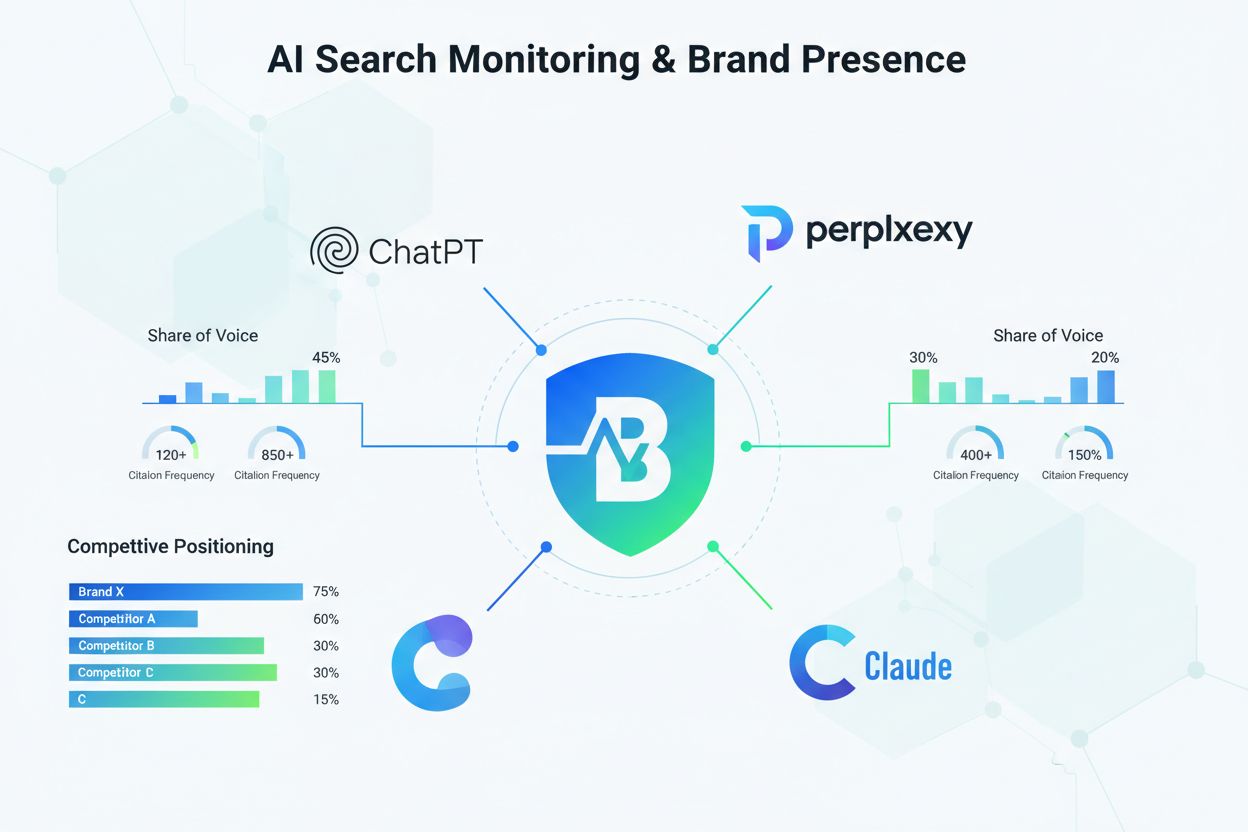
Learn how to measure and improve your brand's share of voice in AI search across ChatGPT, Perplexity, Gemini, and other AI platforms. Complete guide with metric...
Cookie Consent
We use cookies to enhance your browsing experience and analyze our traffic. See our privacy policy.