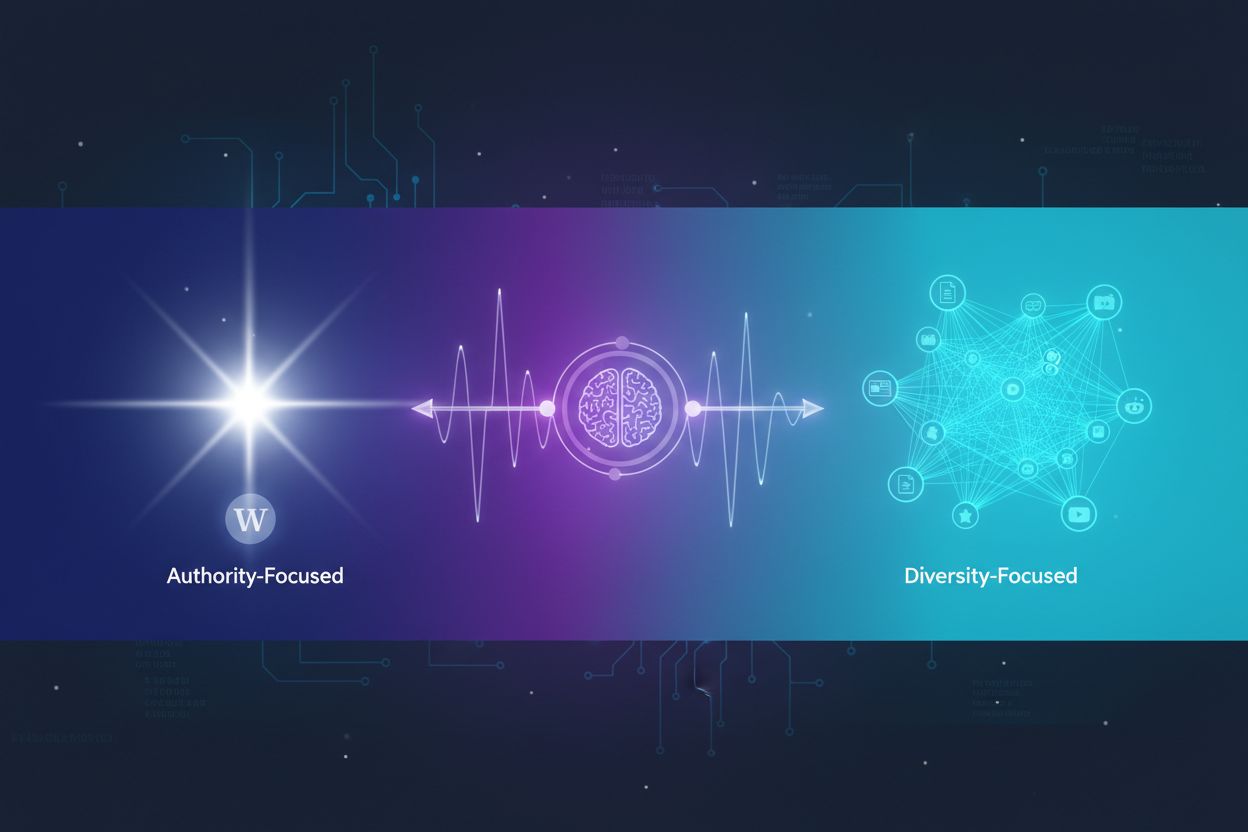
AI Source Diversity Requirements refer to how AI systems balance citing multiple sources versus concentrating on authoritative ones. These algorithms determine whether AI platforms prioritize breadth of sources or depth of authority when generating answers, affecting which brands and content get visibility in AI-generated responses. Different AI platforms employ distinct strategies—from ChatGPT’s authority-focused approach to Perplexity’s community-driven model—requiring brands to optimize for platform-specific citation patterns.
AI Source Diversity Requirements
AI Source Diversity Requirements refer to how AI systems balance citing multiple sources versus concentrating on authoritative ones. These algorithms determine whether AI platforms prioritize breadth of sources or depth of authority when generating answers, affecting which brands and content get visibility in AI-generated responses. Different AI platforms employ distinct strategies—from ChatGPT's authority-focused approach to Perplexity's community-driven model—requiring brands to optimize for platform-specific citation patterns.
What Are AI Source Diversity Requirements?
AI Source Diversity Requirements refer to the algorithmic mechanisms and strategic considerations that determine how AI systems select and prioritize multiple sources when generating answers and citations. Rather than relying on a single authoritative source, modern AI platforms balance source authority with source diversity to provide users with comprehensive, multi-perspective answers. This balance is critical because it affects which brands, publications, and content creators receive visibility in AI-generated responses—making it essential for organizations to understand how different AI systems weight authority against variety. The concept is particularly relevant in Retrieval-Augmented Generation (RAG) systems, where AI models retrieve relevant documents from a knowledge base before generating responses, requiring careful calibration of which sources get retrieved and ranked. For brands and content creators, understanding these requirements means optimizing content to appear across diverse AI platforms rather than betting on a single citation source. The stakes are high: a brand that appears in AI answers gains credibility and traffic, while those excluded face diminished visibility in an increasingly AI-mediated information landscape.
How Different AI Platforms Approach Source Diversity
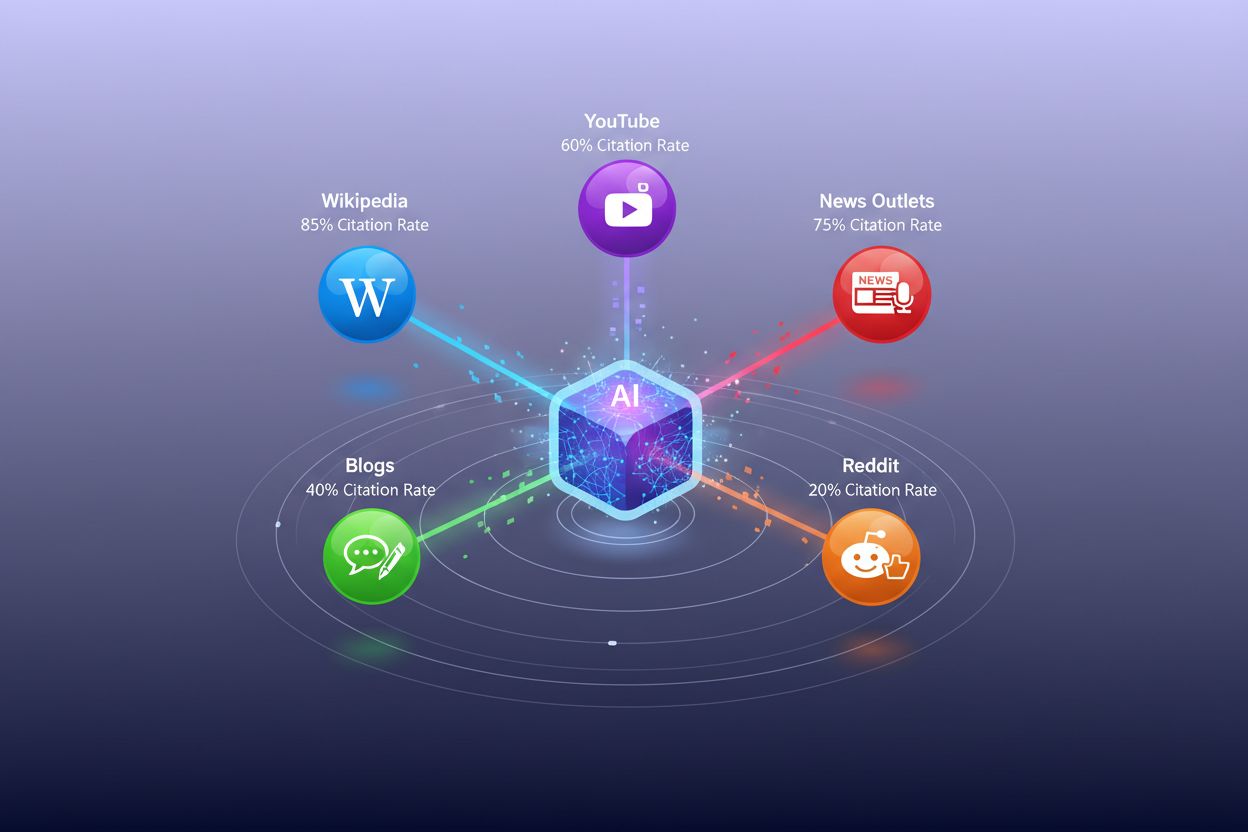
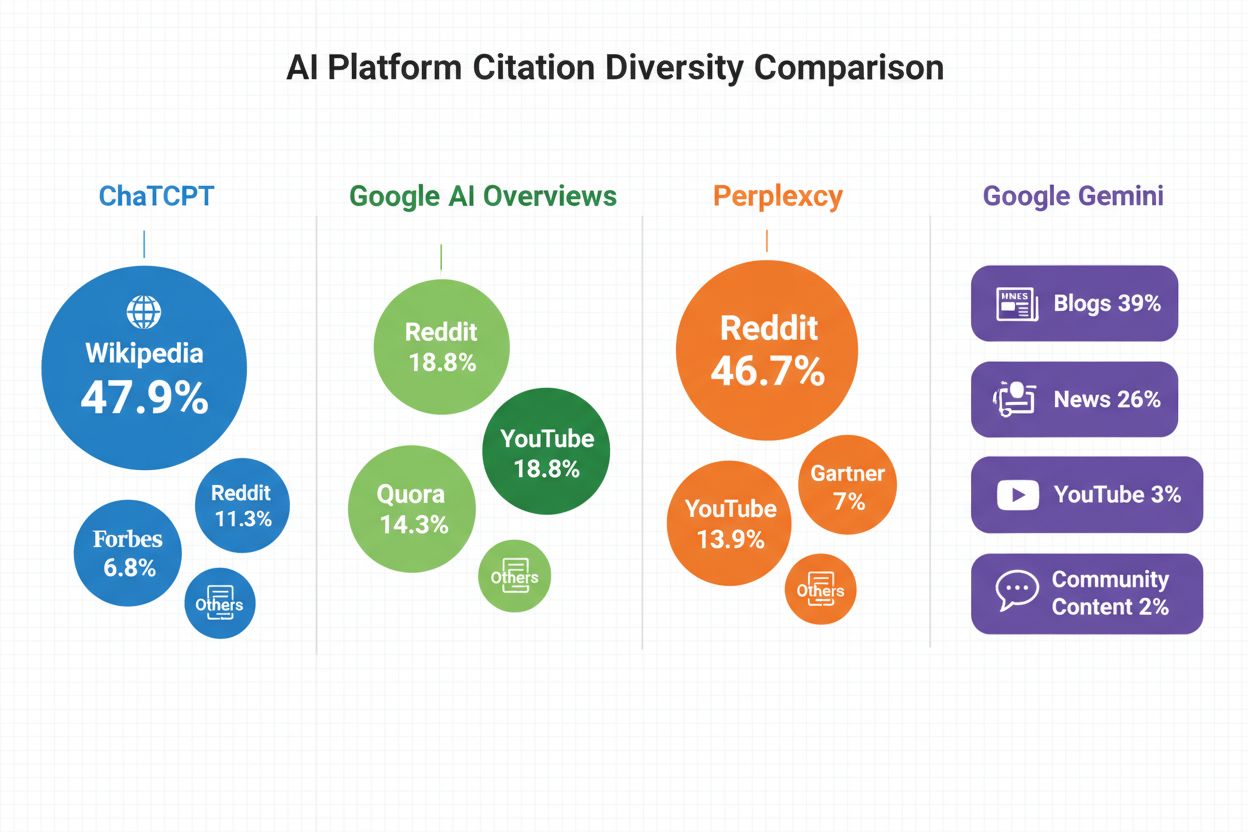
Each major AI platform takes a distinctly different approach to source diversity, reflecting their underlying architectures and design philosophies. ChatGPT demonstrates a strong authority bias, with Wikipedia dominating 47.9% of its top 10 citations, indicating a preference for established, verifiable sources with high domain authority. Google AI Overviews, by contrast, employs a balanced distribution strategy, pulling from Reddit (21%), YouTube (18.8%), Quora (14.3%), and LinkedIn (13%), suggesting an algorithm designed to surface diverse content types and user perspectives. Perplexity leans heavily into community-driven sources, with Reddit accounting for 46.7% of citations alongside YouTube (13.9%), positioning itself as a platform that values real-world user experiences and discussions. Google Gemini takes a mixed approach, prioritizing blogs (39%) and news sources (26%), balancing professional content with diverse perspectives. These differences aren’t accidental—they reflect each platform’s target audience and content philosophy.
Platform
Wikipedia
Reddit
YouTube
News
Blogs
Other
ChatGPT
47.9%
8-12%
5-8%
10-15%
8-12%
10-15%
Google AI Overviews
15-20%
21%
18.8%
18-22%
12-15%
10-15%
Perplexity
12-18%
46.7%
13.9%
8-12%
10-15%
5-10%
Google Gemini
18-22%
10-15%
12-16%
26%
39%
5-10%
The practical implication is that a brand’s citation strategy must be platform-specific. A company optimizing solely for ChatGPT citations might focus on Wikipedia mentions and high-authority domains, while the same company targeting Perplexity should invest in community engagement and Reddit presence. Understanding these platform-specific preferences is where tools like AmICited.com, an AI answers monitoring platform that tracks citations across ChatGPT, Perplexity, and Google AI Overviews, become invaluable for measuring actual citation performance and adjusting strategies accordingly.
Ready to Monitor Your AI Visibility?
Track how AI chatbots mention your brand across ChatGPT, Perplexity, and other platforms.
The Role of Authority vs. Diversity in Citation Algorithms
The tension between authority and diversity sits at the heart of modern AI citation algorithms, requiring sophisticated technical solutions to balance competing objectives. Authority signals include domain reputation (measured through metrics like Domain Authority and Trust Flow), backlink portfolios, presence in knowledge graphs like Google’s Knowledge Panel, and historical citation frequency across the web. Diversity mechanisms work through several techniques: deduplication algorithms prevent the same information from appearing multiple times, topic clustering ensures coverage across different angles of a query, and Maximal Marginal Relevance (MMR) algorithms select sources that are both relevant and dissimilar from previously selected sources. In RAG systems, this balance is achieved during the retrieval phase, where the system must decide whether to retrieve the single most relevant document or a diverse set of moderately relevant documents. The retrieval strategy directly impacts answer quality—too much authority bias produces narrow, potentially biased responses, while excessive diversity can introduce contradictory or low-quality information. Modern AI systems increasingly employ ensemble methods that combine multiple retrieval and ranking strategies, allowing them to optimize for both relevance and diversity simultaneously.
Source Type Preferences Across Query Types
AI platforms don’t apply uniform source diversity requirements across all queries; instead, they adapt their citation strategies based on query intent and content type. Understanding these patterns is crucial for content creators targeting AI answers:
B2C Queries (consumer-focused): YouTube dominates for product demonstrations and reviews, Reddit for authentic user experiences and troubleshooting, and e-commerce sites for purchasing information. These queries prioritize practical, user-generated content over institutional authority.
B2B Queries (business-focused): Industry publications, vendor blogs, analyst reports (Gartner, Forrester), and LinkedIn articles receive higher weighting. These queries reward specialized expertise and professional credibility over general-audience content.
Informational Queries (educational): Wikipedia, academic sources, news outlets, and educational institutions dominate. These queries emphasize authoritative, well-researched content with clear sourcing.
Commercial Queries (purchase-intent): Product review sites, comparison platforms, vendor websites, and YouTube unboxings receive priority. These queries balance user reviews with official product information.
Local Queries (location-specific): Google Business Profiles, local news, community forums, and location-specific directories are heavily weighted. These queries require geographic relevance signals.
The implication for brands is that a single content piece cannot optimize for all query types equally. A product review article will perform differently in B2C queries than a technical whitepaper will in B2B queries, requiring diversified content strategies across multiple formats and platforms.
Stay Updated on AI Visibility Trends
Get the latest insights on AI mentions, brand monitoring, and optimization strategies.
Domain Authority and Knowledge Graph Impact
Domain authority functions as a reliability proxy in AI citation algorithms, with higher-authority domains receiving preferential treatment in source selection. Domains with strong backlink profiles, long operational histories, and consistent topical focus receive higher citation probability, particularly in platforms like ChatGPT that emphasize authority. Presence in knowledge graphs—especially Google’s Knowledge Panel and Wikipedia—dramatically increases citation likelihood, as these sources are algorithmically pre-validated as authoritative. The backlink portfolio matters not just for quantity but for quality; links from other high-authority domains carry more weight than links from low-authority sites, creating a compounding effect where established brands accumulate citation advantages. Author schema and expert attribution have become increasingly important, with AI systems recognizing bylines, author credentials, and expertise signals to validate source credibility. Organizations without established domain authority face a structural disadvantage in AI citation algorithms, though this can be partially offset through strategic content distribution, community engagement, and building backlinks from recognized authorities. The long-term implication is that AI citation visibility increasingly correlates with traditional SEO authority metrics, making historical domain investment a competitive advantage.
Content Characteristics That Drive Diverse Citations
Beyond domain authority, specific content characteristics influence whether AI systems select a source for citation. Conversational query alignment is critical—content written in a style that matches how users phrase questions receives higher retrieval scores in RAG systems. Content that includes internal citations and source attribution signals quality and depth, encouraging AI systems to cite it as a reliable synthesis point. Consistency across platforms matters significantly; when the same information appears across multiple channels (blog, LinkedIn, YouTube, Reddit), AI systems recognize it as validated knowledge worthy of citation. Structured data implementation—using schema markup for articles, FAQs, and product information—helps AI systems understand and extract information more reliably, increasing citation probability. Freshness and recency signals influence citation selection, particularly for time-sensitive queries; content updated regularly receives higher weighting than static, outdated material. For example, a company publishing quarterly industry reports will receive more citations for trend-related queries than one publishing annual reports, as AI systems recognize the recency advantage. Practical implementation means investing in content that answers specific user questions directly, appears across multiple platforms, and maintains consistent messaging while using proper markup.
Measuring and Optimizing for Source Diversity
Effective optimization for AI source diversity requires systematic testing methodology across platforms, as each AI system responds differently to content and distribution strategies. Organizations should track citation frequency across ChatGPT, Google AI Overviews, Perplexity, and Google Gemini separately, recognizing that a source performing well on one platform may underperform on another. Platform-specific optimization strategies include: for ChatGPT, focus on domain authority and Wikipedia mentions; for Google AI Overviews, diversify across content types and platforms; for Perplexity, invest in community engagement and Reddit presence; for Google Gemini, balance blog content with news coverage. Content distribution across multiple channels is essential—the same core information should appear as blog posts, social media content, YouTube videos, and community forum participation, increasing the likelihood of citation across diverse AI systems. Monitoring tools like AmICited.com enable organizations to track which sources are actually being cited and adjust strategies based on real performance data rather than assumptions. Adaptation requirements are continuous, as AI algorithms evolve and new models emerge; what works today may require adjustment tomorrow, necessitating ongoing monitoring and experimentation. Organizations that treat AI citation optimization as a continuous process rather than a one-time project will maintain competitive advantages as the landscape evolves.
The Future of AI Source Diversity
The evolution of citation algorithms will likely move toward greater sophistication in balancing authority and diversity, with future AI systems potentially implementing more nuanced source evaluation mechanisms that consider factors like author expertise, publication track record, and real-time fact-checking. Emerging trends suggest increased emphasis on multi-modal sources—combining text, video, images, and interactive content—as AI systems become better at processing diverse content types. New AI models entering the market will bring their own citation philosophies, potentially fragmenting the landscape further and requiring brands to optimize for even greater platform diversity. The importance of multi-channel presence will only increase, as organizations that maintain consistent, high-quality content across blogs, social media, video platforms, and community forums will naturally accumulate more citations across diverse AI systems. Long-term strategic implications suggest that traditional SEO and content marketing will increasingly merge with AI optimization, requiring organizations to think holistically about visibility across search engines, AI answers, and emerging AI platforms. The competitive advantage will belong to organizations that recognize AI source diversity not as a separate initiative but as an integral part of comprehensive digital strategy, ensuring their content reaches audiences regardless of which AI platform they use to find information.
Frequently asked questions
What is the difference between source diversity and source authority in AI?
Source diversity refers to the breadth of different sources cited in an AI response, while source authority refers to the credibility and trustworthiness of individual sources. AI systems must balance these competing objectives—citing multiple perspectives (diversity) while ensuring those sources are reliable (authority). ChatGPT prioritizes authority, Perplexity emphasizes diversity, and Google AI Overviews attempts to balance both.
Why does ChatGPT cite Wikipedia so much more than other platforms?
ChatGPT's training data and retrieval algorithms heavily weight Wikipedia because it represents a pre-validated, encyclopedic source with high domain authority. Wikipedia's structured format, editorial oversight, and comprehensive coverage make it ideal for factual, authoritative answers. This reflects ChatGPT's design philosophy of prioritizing reliability over diversity, making it the platform most similar to traditional reference materials.
How can my brand get cited by AI systems?
To increase AI citations, focus on: building domain authority through backlinks and consistent topical focus, creating content that answers specific user questions directly, maintaining presence across multiple platforms (blogs, social media, YouTube, forums), implementing structured data markup, and keeping content fresh and updated. Different platforms require different strategies—Wikipedia and high-authority domains for ChatGPT, community engagement for Perplexity, and diverse content types for Google AI Overviews.
Does appearing on Reddit help with AI citations?
Yes, significantly. Reddit is the top-cited source for both Perplexity (46.7% of top 10 citations) and Google AI Overviews (21%), making it crucial for AI visibility. However, the impact varies by query type—Reddit performs better for B2C and consumer-focused queries than for B2B professional queries. Active participation in relevant Reddit communities can substantially increase your brand's citation frequency across multiple AI platforms.
What role does domain authority play in AI citations?
Domain authority functions as a reliability proxy in AI algorithms, with higher-authority domains receiving preferential treatment in source selection. Factors include backlink quality and quantity, domain age, topical consistency, and presence in knowledge graphs like Wikipedia or Google Knowledge Panel. While domain authority is important, it's not the only factor—content quality, freshness, and platform-specific preferences also significantly influence citation probability.
How often should I update content to maintain AI citation visibility?
Content should be updated every 48-72 hours to maintain strong recency signals, though this doesn't require complete rewrites. Adding new data points, updating statistics, expanding sections with recent developments, or refreshing examples sustains citation eligibility. Stale content drops from AI consideration within days regardless of historical authority, making regular updates essential for maintaining visibility in AI-generated answers.
Can smaller brands compete with established ones for AI citations?
Yes, but through different strategies. While established brands have domain authority advantages, smaller brands can compete by: targeting niche topics where they have expertise, building presence on community platforms like Reddit and Quora, creating highly specific content that directly answers user questions, and leveraging platforms like Perplexity that value diverse sources over pure authority. Niche positioning often provides better citation opportunities than competing directly with established brands on broad topics.
What's the relationship between SEO rankings and AI citations?
There's correlation but not perfect alignment. Google AI Overviews citations correlate with traditional search rankings since both use similar authority signals, but ChatGPT and Perplexity have different citation patterns. A page ranking #1 in Google Search might not be cited by ChatGPT if it lacks Wikipedia-level authority. Successful AI visibility requires understanding platform-specific preferences rather than assuming traditional SEO strategies will automatically generate AI citations.
Monitor Your Brand's AI Citations
Track how your brand is cited across ChatGPT, Perplexity, Google AI Overviews, and other AI platforms. Get real-time insights into your AI visibility and optimize your content strategy with AmICited.
How to Add Variety to Content for AI - Strategies for Better AI Visibility
Learn how to add variety to content for AI systems. Discover strategies for diverse data sources, semantic richness, content structure, and optimization techniq...
Learn how AI systems build source pools and select which websites to cite. Understand the factors influencing source pool composition and how to optimize your c...
Learn how AI systems select and rank sources for citations. Discover the algorithms, signals, and factors that determine which websites AI platforms like ChatGP...
16 min read
Cookie Consent We use cookies to enhance your browsing experience and analyze our traffic. See our privacy policy.