



AI Source Selection
Learn how AI systems select and rank sources for citations. Discover the algorithms, signals, and factors that determine which websites AI platforms like ChatGP...
16 min read

Source pool composition refers to the specific mix of websites, content types, and information sources that an AI system considers when generating responses to a user query. This composition directly determines which websites receive visibility in AI-generated answers and is the prerequisite for any citation or visibility in AI systems. The composition varies by query, topic, and AI platform, meaning a website might be included in the source pool for one query but excluded from another based on relevance, authority, and content quality signals. Understanding source pool composition is critical for content creators and marketers seeking visibility in AI-powered search.
Source pool composition refers to the specific mix of websites, content types, and information sources that an AI system considers when generating responses to a user query. This composition directly determines which websites receive visibility in AI-generated answers and is the prerequisite for any citation or visibility in AI systems. The composition varies by query, topic, and AI platform, meaning a website might be included in the source pool for one query but excluded from another based on relevance, authority, and content quality signals. Understanding source pool composition is critical for content creators and marketers seeking visibility in AI-powered search.
Source pool composition refers to the specific mix of websites, content types, and information sources that an AI system considers when generating responses to a user query. This composition directly determines which websites receive visibility in AI-generated answers, making it fundamentally different from traditional search engine ranking. Understanding source pool composition is critical for content creators and marketers because inclusion in an AI system’s source pool is the prerequisite for any citation or visibility—a website cannot be cited if it was never considered in the first place. The composition varies by query, topic, and AI system, meaning that a website might be included in the source pool for one query but excluded from another based on relevance, authority, and content quality signals.

AI systems build source pools through a multi-stage process that combines several sophisticated mechanisms to identify and evaluate potential sources. The primary method is Retrieval-Augmented Generation (RAG), which retrieves relevant documents from indexed content before generating responses, ensuring answers are grounded in actual sources rather than relying solely on training data. This process works in conjunction with two other critical mechanisms:
| Aspect | Traditional Search Engines | AI Source Selection |
|---|---|---|
| Primary Signal | Backlinks and keyword relevance | Authority, relevance, extractability, and diversity |
| Source Evaluation | Page-level ranking | Document-level relevance scoring |
| Diversity Consideration | Limited algorithmic diversity | Active deduplication and topic clustering |
| Content Format | All formats equally weighted | Structured data and clarity heavily weighted |
| Real-time Updates | Continuous crawling | Periodic index updates with freshness signals |

Track how AI chatbots mention your brand across ChatGPT, Perplexity, and other platforms.
Multiple factors work together to determine whether a source enters an AI system’s source pool for a given query, with each factor carrying different weight depending on query type and context. Authority remains the strongest predictor of inclusion, with research showing that 76% of AI Overview citations come from the top 10 organic search results, indicating that established domain authority significantly increases source pool inclusion. Freshness matters critically for time-sensitive queries—AI systems actively filter for recently updated content when answering questions about current events, product releases, or evolving situations. Relevance operates at multiple levels: topical relevance (does the source cover the subject matter), query relevance (does it address the specific question), and entity relevance (does it discuss the specific people, organizations, or concepts mentioned). Diversity ensures that source pools include varied perspectives and content types rather than clustering around a single dominant source. Topical alignment measures whether a source’s overall content focus matches the query domain, with AI systems preferring sources that demonstrate sustained expertise in relevant areas.
| Selection Factor | Impact on Inclusion | Why It Matters |
|---|---|---|
| Domain Authority | Very High (40-50% weight) | Signals trustworthiness and expertise; correlates with content quality |
| Content Freshness | High (20-30% weight) | Ensures answers reflect current information; critical for time-sensitive queries |
| Topical Relevance | High (20-30% weight) | Ensures source expertise aligns with query domain |
| Content Clarity | Medium-High (15-25% weight) | Improves extractability and reduces errors in AI responses |
| Diversity Signals | Medium (10-20% weight) | Prevents over-reliance on single sources; improves answer comprehensiveness |
Source diversity within AI-generated answers serves a critical function: preventing redundancy while ensuring comprehensive coverage of query topics. AI systems employ topic clustering algorithms that group similar sources together and then select representative sources from each cluster, avoiding situations where multiple nearly-identical sources dominate the answer. Deduplication mechanisms identify sources with substantially overlapping content and include only the highest-authority version, preventing the same information from being cited multiple times under different URLs. The diversity techniques employed include:
This approach prevents the “citation clustering” problem where AI systems would otherwise cite the same few high-authority sources repeatedly, instead creating more balanced and comprehensive answers.
Get the latest insights on AI mentions, brand monitoring, and optimization strategies.
Domain authority and trust signals form the foundation of source pool inclusion, with AI systems using multiple indicators to assess whether a source deserves consideration. Backlink profiles remain important, but AI systems evaluate backlink quality rather than quantity—links from authoritative, topically-relevant sources carry far more weight than numerous low-quality links. Brand mentions have emerged as equally important as backlinks, with research indicating that AI systems track mentions of brands and organizations across the web as trust signals, meaning that being discussed positively in reputable publications significantly increases source pool inclusion. Entity consistency measures whether information about an entity (person, organization, product) remains consistent across sources, with AI systems using consistency as a proxy for accuracy. Additional trust signals include:
Research shows that sources with strong trust signals receive 3-4x higher citation rates in AI-generated answers compared to sources with weak trust signals, even when content quality is similar.
Content quality and extractability—the ease with which AI systems can parse and understand content—significantly influence source pool composition, with poorly structured content often excluded despite high authority. Structured data markup using Schema.org vocabulary helps AI systems understand content context, relationships, and key information, dramatically improving the likelihood of inclusion and accurate citation. Content clarity matters because AI systems must be able to identify specific claims, facts, and arguments within content; dense, poorly-organized content is harder to extract from and therefore less likely to be included. The presence of clear headings, logical paragraph structure, and explicit topic sentences all improve extractability. A simple example of beneficial structured data:
{
  "@context": "https://schema.org",
  "@type": "Article",
  "headline": "Understanding AI Source Pool Composition",
  "author": {"@type": "Person", "name": "Expert Author"},
  "datePublished": "2024-01-15",
  "articleBody": "Source pool composition refers to..."
}
Content with proper Schema.org markup sees 2-3x higher inclusion rates in AI source pools compared to identical content without markup, making technical SEO implementation critical for AI visibility.
The real-world impact of source pool composition on website visibility extends far beyond traditional search metrics, fundamentally reshaping how audiences discover and engage with content. Citation rates in AI-generated answers directly correlate with traffic and brand visibility, with cited sources receiving measurable traffic increases and brand awareness benefits—research indicates that sources cited in AI Overviews see 15-25% increases in branded search volume. Zero-click search behavior has shifted toward AI-generated answers, meaning that source pool inclusion now determines visibility in scenarios where users never click through to traditional search results. Brand visibility and authority building occur through AI citations even when users don’t click through, as repeated mentions in AI answers establish brand recognition and authority signals. For example, a financial services company cited in AI answers about retirement planning receives brand exposure to thousands of users daily, even if only a small percentage click through to their website. The composition of source pools also affects competitive positioning, as websites included in source pools for high-volume queries gain significant visibility advantages over competitors excluded from those pools.
Achieving and maintaining inclusion in AI source pools requires a strategic approach combining content quality, technical implementation, and authority building. Organizations should implement the following optimization strategies:
Tools like AmICited.com enable organizations to track which sources are included in AI source pools for their target queries, providing visibility into competitive positioning and inclusion patterns.
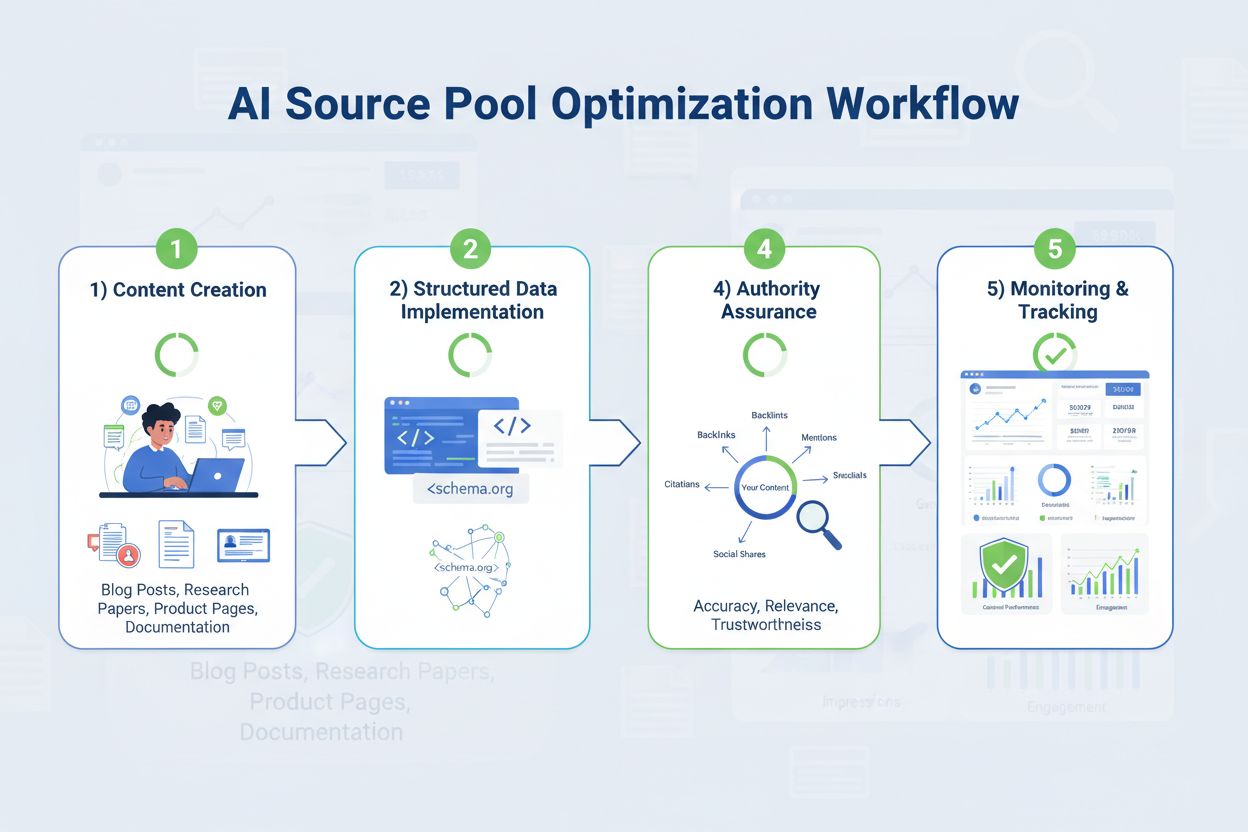
Measuring source pool inclusion and monitoring changes over time requires systematic tracking of multiple metrics and indicators. Organizations should monitor:
AmICited.com provides dedicated monitoring capabilities for tracking source pool composition, citation patterns, and competitive positioning across multiple AI systems, enabling data-driven optimization of content strategy for AI visibility. By establishing baseline metrics for current source pool inclusion and tracking changes quarterly, organizations can measure the impact of optimization efforts and adjust strategies based on performance data. This measurement approach transforms source pool composition from an abstract concept into a concrete, trackable component of overall digital visibility strategy.
Track how your brand appears in AI source pools across ChatGPT, Google AI Overviews, Perplexity, and other AI platforms. Get real-time insights into your citation patterns and competitive positioning.
Learn how AI systems select and rank sources for citations. Discover the algorithms, signals, and factors that determine which websites AI platforms like ChatGP...
Learn how AI models like ChatGPT, Perplexity, and Gemini select sources to cite. Understand the citation mechanisms, ranking factors, and optimization strategie...
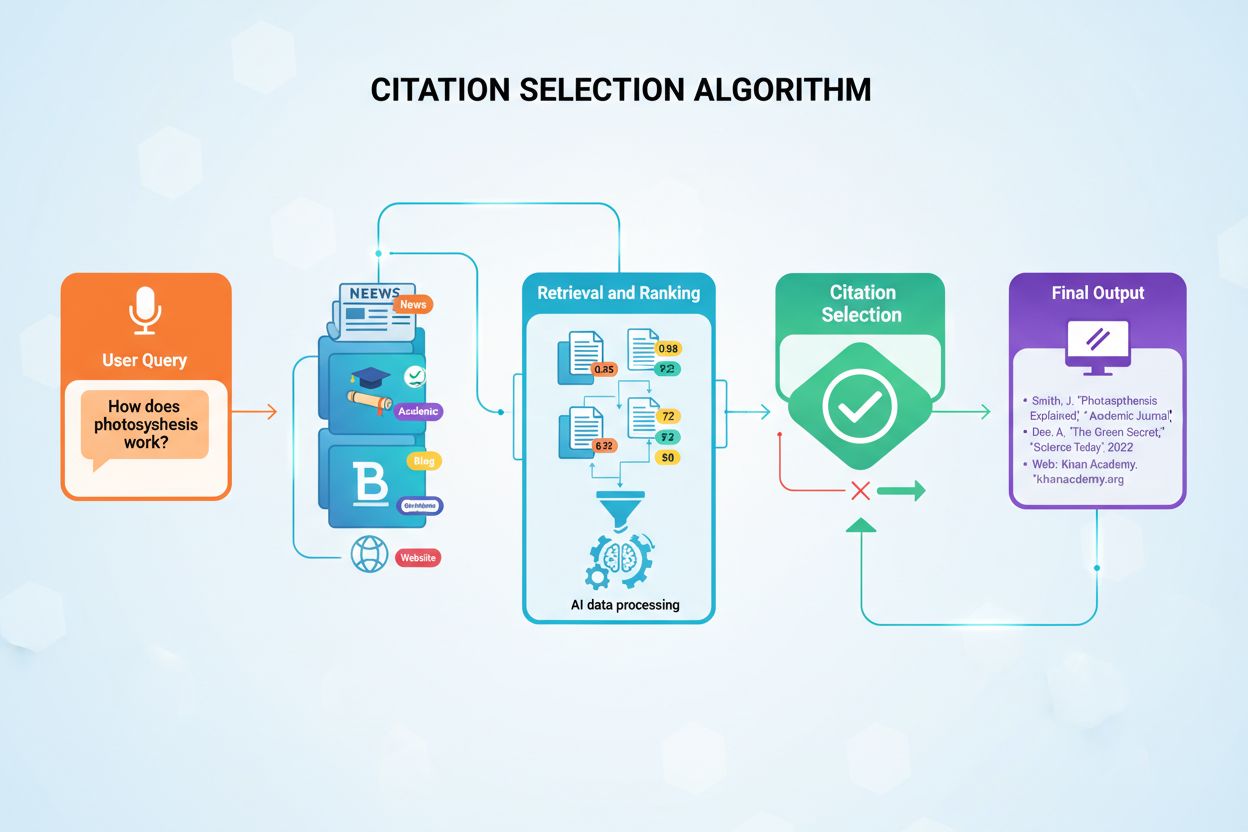
Learn how AI systems select which sources to cite versus paraphrase. Understand citation selection algorithms, bias patterns, and strategies to improve your con...
Cookie Consent
We use cookies to enhance your browsing experience and analyze our traffic. See our privacy policy.