


Page Speed and AI Citations
AI crawlers and answer engines favor pages that load fast and stay technically healthy. As a core web vitals checker, AmICited tracks LCP, INP, CLS, TTFB and an overall health score for every page, then shows how speed relates to whether that page gets cited.
Page Speed Citation Evidence
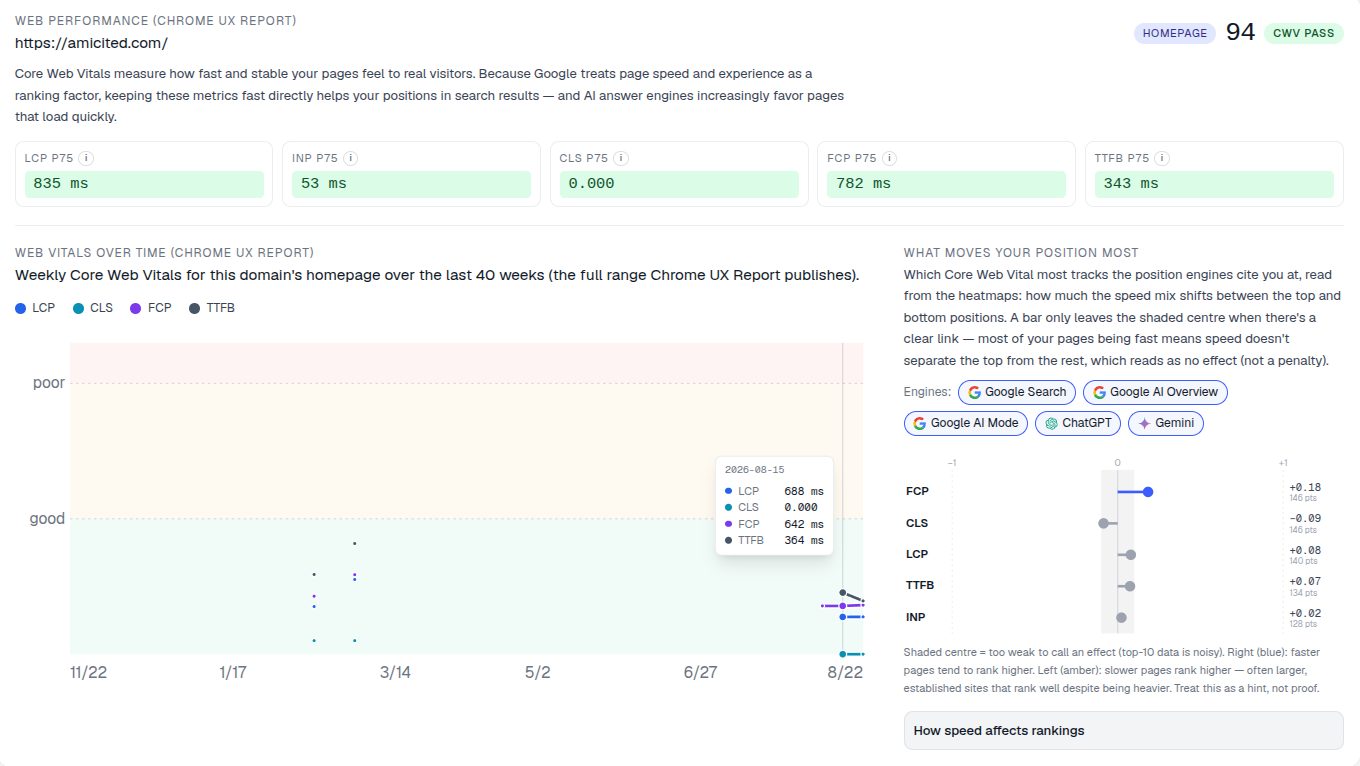
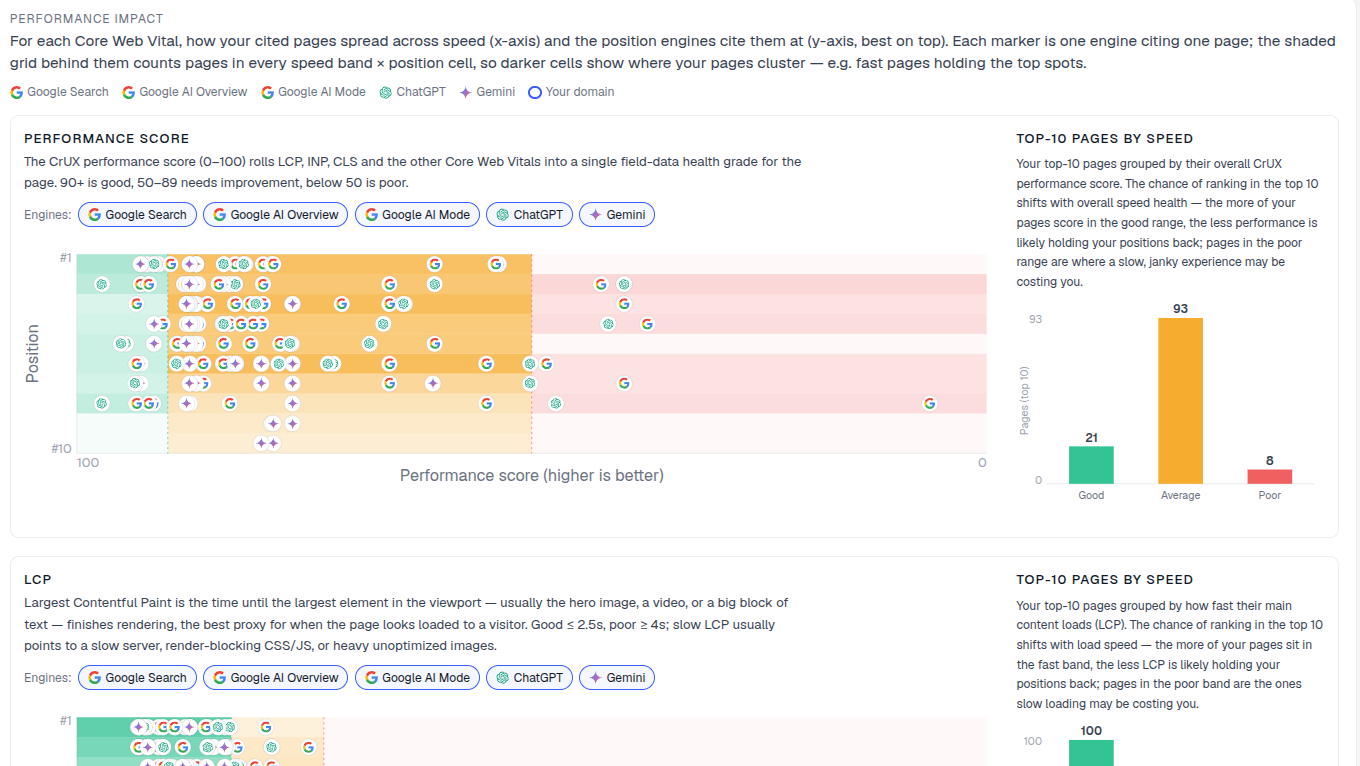
Most tools stop at whether AI mentioned you. AmICited tracks the whole system behind the citation, including whether your page is fast enough for a crawler to fetch, render and trust in the first place. Each metric gets its own scatter — value on one axis, citation position 1 through 10 on the other, position 1 at the top — against a good / needs-improvement / poor band so you can see at a glance whether fast pages are actually clustering near the top.
- Per-page Core Web Vitals and TTFB: LCP, INP, CLS, FCP and time to first byte for your cited (and not-yet-cited) pages, each checked against a fixed good/poor threshold — LCP at 2.5s/4s, INP at 200ms/500ms, CLS at 0.10/0.25, FCP at 1.8s/3s, TTFB at 0.8s/1.8s, overall score at 90/50.
- One health score per page: a single number that folds speed, stability and technical health into something you can rank and act on.
- Flags the slow pages losing citations: AmICited correlates speed with citation likelihood, so you see which slow pages are actually costing you answers — a ranking that only renders once there are at least five usable top-10 data points to rank from.
- Which metric actually moves your position: the five vitals are ranked by how strongly their speed band tracks citation position, so you fix the one metric that correlates, not all five equally.
- Prioritized fixes your agent can action: ordered by citation upside, ready for Claude Code or your build to ship, not a wall of generic warnings.
Track Citation Changes After Speed Fixes
Once a slow page gets faster, AmICited keeps tracking it so you can see citation rank climb over the following weeks, per prompt and per engine, and confirm the fix actually paid off. Read it as a strong correlation, not proof of cause: a positive score means worse performance bands co-occurred with worse citation positions in the pages you have, which is grounds to investigate and ship the fix, not a guarantee that speed alone moved the answer.
- Before and after in one view: health score and citation rank tracked side by side over time, with weekly p75 values on hover.
- Per prompt, per engine: filter down to one engine or all, see exactly where a faster page started winning answers, and click through to the URL itself.
- Refresh on demand: pull a new Core Web Vitals import after you ship a fix — it’s asynchronous, so the updated numbers land on a later refresh, not instantly.
- Attribution you can defend: tie a speed improvement to a measurable citation lift, backed by real-user Chrome UX Report data, not a synthetic lab test.
Fast pages are easier for AI to read, trust and cite
Keeping largest contentful paint under a couple of seconds is a well known health target. Fast, stable pages get fetched cleanly and render fully, which is the baseline for an answer engine to quote them at all.
How to check your Core Web VitalsPrioritize Page Speed Fixes
AmICited scores every page on Core Web Vitals, TTFB and technical health, then correlates speed with citation likelihood so your team (and your agents) fix the pages that actually move AI answers.
Is page speed quietly costing you AI citations?
Free check · 7-day trial · card required