

How Do I Benchmark AI Visibility Against Competitors? Complete Guide
Learn how to benchmark AI visibility against competitors across ChatGPT, Perplexity, and other AI platforms. Discover metrics, tools, and strategies to monitor ...
11 min read
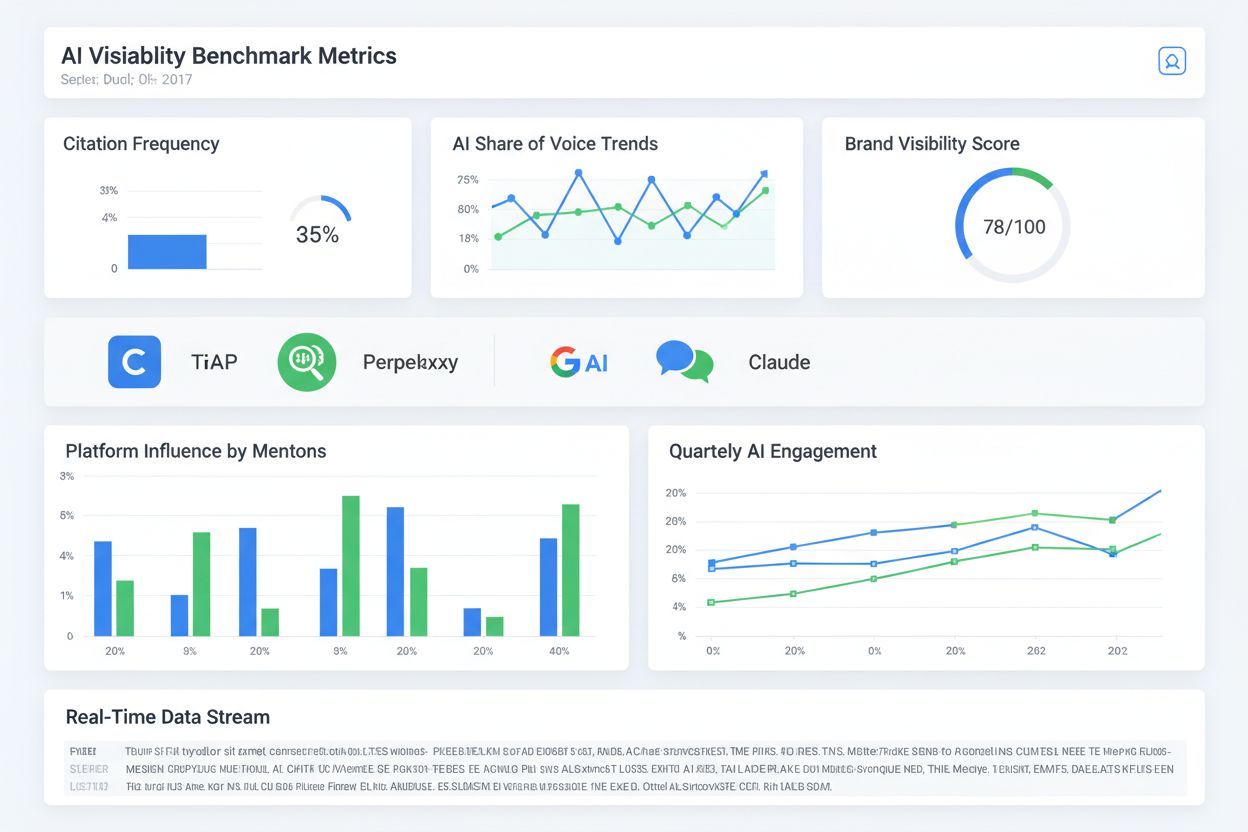
Industry or category standards for expected AI citation rates and visibility scores that define how often and how prominently a brand should appear in AI-generated responses across platforms like ChatGPT, Perplexity, and Google AI Overviews. These benchmarks measure citation frequency, brand visibility scores, AI share of voice, sentiment analysis, and LLM conversion rates to establish realistic performance targets based on industry, competitive landscape, and platform-specific algorithms.
Industry or category standards for expected AI citation rates and visibility scores that define how often and how prominently a brand should appear in AI-generated responses across platforms like ChatGPT, Perplexity, and Google AI Overviews. These benchmarks measure citation frequency, brand visibility scores, AI share of voice, sentiment analysis, and LLM conversion rates to establish realistic performance targets based on industry, competitive landscape, and platform-specific algorithms.
AI visibility benchmarks are industry-standard metrics that define expected citation rates, mention frequencies, and visibility scores for brands across AI-powered platforms like ChatGPT, Perplexity, Google AI Overviews, and Claude. Unlike traditional SEO benchmarks that measure keyword rankings and organic traffic, AI visibility benchmarks track how often and how prominently your brand appears within AI-generated responses. These benchmarks establish performance targets based on industry category, competitive landscape, and platform-specific algorithms. Understanding your AI visibility benchmark is critical because it reveals whether your brand is being cited as an authoritative source in the AI search era—a channel that now influences purchasing decisions for 89% of B2B buyers and drives traffic that converts 4.4x better than traditional organic search.
AI visibility benchmarks are built on five core metrics that work together to measure your brand’s presence and authority across AI platforms:
Citation Frequency: How often your brand, content, or website is explicitly cited in AI-generated responses. Benchmark target: 30%+ of relevant prompts should mention your brand, with top performers achieving 50%+ in competitive categories. LLMs typically cite only 2-7 domains per response—far fewer than Google’s 10 blue links—making citation frequency a critical visibility indicator.
Brand Visibility Score (BVS): A composite metric combining citation frequency, citation placement (headline mention vs. buried footnote), link presence, and sentiment weight. This normalized score shows that not all citations are equal; being positioned as “the leading solution” differs fundamentally from being mentioned as “one of many options.” Benchmark target: Track weekly with a goal of 10%+ quarter-over-quarter improvement.
AI Share of Voice (AI SOV): Your brand’s percentage of total citations in your category compared to competitors. This metric reveals competitive positioning in a winner-takes-most AI recommendation environment. Benchmark target: Aim for AI SOV exceeding your traditional market share by 10-20%, creating a flywheel where visibility drives preference.
Sentiment Analysis: Whether AI systems describe your brand positively, neutrally, or negatively, and what specific attributes they associate with your brand. Since 52% of Gen Z users trust generative AI for informed decisions, negative sentiment scales across millions of interactions. Benchmark target: Achieve 70%+ positive sentiment across AI platforms.
LLM Conversion Rate: The conversion rate of visitors arriving from AI platforms compared to traditional search. Research shows AI-referred visitors convert at 1.66% compared to 0.15% from traditional search—more than 10x higher. Benchmark target: Your LLM conversion rate should be at least 2-3x your traditional organic conversion rate.
| Metric | Benchmark Target | What It Measures |
|---|---|---|
| Citation Frequency | 30%+ (50%+ competitive) | How often your brand is cited in AI responses |
| Brand Visibility Score | 10%+ QoQ improvement | Composite visibility across all factors |
| AI Share of Voice | 10-20% above market share | Your competitive positioning in AI |
| Sentiment Analysis | 70%+ positive | How AI describes your brand |
| LLM Conversion Rate | 2-3x organic rate | Quality and intent of AI-referred traffic |
AI visibility benchmarks vary significantly across industries based on query complexity, YMYL (Your Money Your Life) sensitivity, and user intent patterns. According to analysis of 13,770 domains across 10 major industries, AI referral traffic accounts for 1.08% of all website traffic on average, but this varies dramatically by sector. The Information Technology industry leads with 2.8% of traffic from AI sources, followed by Consumer Staples at 1.91%, while Communication Services (0.25%) and Utilities (0.35%) lag significantly.
For AI Overview (AIO) results specifically, Healthcare dominates with 48.75% of searches triggering AIO results, followed by Financials (25.79%) and Utilities (25.4%), while Real Estate (4.48%) and Consumer Staples (6.82%) see the lowest AIO penetration. ChatGPT overwhelmingly dominates AI referral traffic, accounting for 87.4% of all AI-driven visits across these industries, though emerging platforms like Gemini show significant traction in specific sectors (21% in Utilities). Month-over-month growth averages around 1% across industries, with some sectors like Consumer Discretionary (+0.21%) and Communication Services (+0.12%) showing steady increases, while others like Utilities (-0.28%) and Healthcare (-0.34%) experience volatility. These benchmarks establish realistic expectations: if your AI referral traffic significantly lags industry averages, your visibility strategy needs adjustment; if you exceed them, you’re capturing disproportionate market share.
| Industry | AI Referral Traffic | AIO Result Rate | ChatGPT Share |
|---|---|---|---|
| Information Technology | 2.8% | 25.1% | 87.4% |
| Consumer Staples | 1.91% | 6.82% | 87.4% |
| Healthcare | 1.5% | 48.75% | 87.4% |
| Financials | 1.2% | 25.79% | 87.4% |
| Real Estate | 0.8% | 4.48% | 87.4% |
A citation occurs when an AI platform explicitly links to your content as a source, providing a direct hyperlink that users can click to visit your website. A mention simply references your brand name without a link—the AI acknowledges your brand exists but doesn’t credit your website as the source. While both have value for brand awareness, citations drive measurable traffic and stronger attribution. When Perplexity cites your article with a clickable link, that’s a citation; when ChatGPT says “according to industry leaders like your brand,” that’s a mention. The distinction matters because benchmark targets for linked citations are typically 50%+ of your total AI references, meaning at least half of your brand appearances should include actual links back to your site. Citations indicate that AI systems trust your content enough to recommend it as a primary source, while mentions suggest your brand is recognized but not necessarily positioned as an authoritative reference. Tracking both metrics separately reveals whether you’re building brand awareness (mentions) or genuine authority (citations) in AI search.
Measuring AI visibility requires a combination of manual audits and specialized tools, depending on your budget and scale. Manual tracking involves creating a spreadsheet with 20-50 prompts representing how customers ask about your category, then querying each prompt across ChatGPT, Perplexity, Claude, and Google AI Overviews weekly to document mentions, citations, positions, and sentiment. This “mystery shopping” method reveals patterns that automated tools miss but doesn’t scale beyond a few dozen prompts.
Free tools provide baseline measurement without investment:
Paid platforms automate tracking at scale:
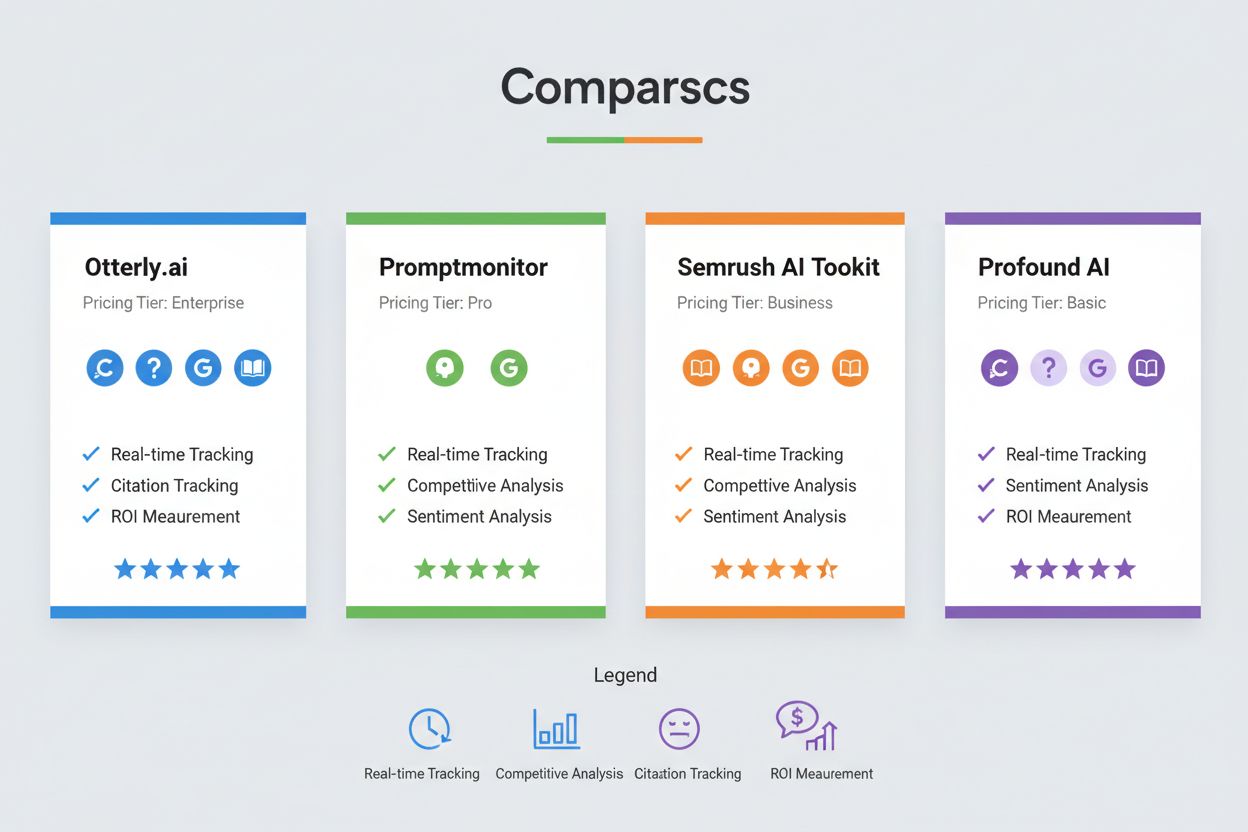
| Tool | Starting Price | Best For | Platform Coverage | Unique Strength |
|---|---|---|---|---|
| Otterly.ai | $29/month | Marketing teams | 6 platforms | Brand Visibility Index |
| Promptmonitor | $29/month | SMBs/Agencies | 8 platforms | Contact discovery |
| Semrush AI Toolkit | $99/month | Semrush users | 4 platforms | Ecosystem integration |
| Profound AI | $499/month | Enterprise | 5 platforms | Hallucination detection |
Otterly.ai ($29-$989/month) offers the Brand Visibility Index, automated link tracking, and Semrush integration. Promptmonitor ($29-$129/month) provides the most comprehensive platform coverage with 1-3 years of historical data. Semrush AI Toolkit ($99/month) integrates with existing Semrush workflows but limits tracking to 10 prompts per platform. Profound AI ($499+/month) specializes in hallucination detection and compliance for regulated industries. Most SMBs find strong value in the $29-$129 range, while enterprises benefit from Profound’s security features or Semrush’s ecosystem integration.
Establishing realistic AI visibility benchmarks requires three steps: baseline assessment, competitive analysis, and goal-setting. Start with a baseline audit: Run your 20-50 target prompts across all major AI platforms and calculate your current citation frequency, brand visibility score, and AI share of voice. Document which pages get cited, which platforms mention you most, and what sentiment dominates. This baseline becomes your starting point for measuring improvement.
Conduct competitive analysis by running identical prompts for your top 3-5 competitors and calculating their metrics. If competitors achieve 45% citation frequency while you’re at 15%, that’s your performance gap. If a competitor dominates with 35% AI SOV while you have 8%, that reveals where content and authority gaps exist. Set quarterly improvement targets of 10%+ growth in your key metrics—this is aggressive but achievable with consistent optimization. Timeline expectations: Unlike traditional SEO which takes 6-12 months, AI visibility improvements can appear within weeks on real-time platforms like Perplexity, but building sustainable citation authority requires 3-6 months of consistent optimization. Early adopters of GEO strategies report 3x higher AI visibility than late movers, making speed-to-market critical.
AmICited.com stands as the leading AI visibility monitoring platform, purpose-built to track how AI systems reference your brand across ChatGPT, Perplexity, Google AI Overviews, Claude, and emerging platforms. Unlike generic SEO tools retrofitted for AI tracking, AmICited provides real-time citation monitoring that captures when and where your brand appears in AI-generated responses, complete with sentiment analysis and competitive benchmarking. The platform automatically tracks hundreds of industry-relevant prompts, eliminating manual auditing while providing the depth that spreadsheets can’t match. AmICited’s competitive intelligence features show exactly how your AI visibility compares to competitors, revealing which content types earn citations, which platforms prioritize your brand, and where gaps exist. Integration with existing marketing workflows means your AI visibility data flows directly into your analytics dashboards and reporting systems. Most importantly, AmICited connects visibility metrics to business outcomes—tracking how AI citations drive website traffic, lead generation, and conversions—enabling you to calculate precise ROI on your AI visibility investments.
The business case for AI visibility benchmarking is compelling. AI-referred visitors convert at 4.4x the rate of traditional organic search visitors, with some industries seeing even higher multiples up to 5x. This means a visitor worth $2.50 from traditional search becomes worth $11.00 from AI platforms. Beyond direct conversions, brands cited in AI-generated answers experience a 38% lift in organic clicks and 39% increase in paid ad clicks—a visibility multiplier effect that amplifies all your other marketing channels. The cost of invisibility is severe: Gartner predicts a 50% reduction in traditional organic traffic by 2028 due to AI-generated search, meaning brands not building AI visibility now face existential risk to their organic pipeline.
Calculate your AI visibility ROI using this framework: Monthly GEO tool cost ($200 for Otterly Standard) + content optimization investment ($2,000 staff time) = $2,200 monthly investment. Track outputs: AI-referred visits from GA4, AI visitor conversion rate, revenue from AI-attributed conversions, and branded search lift. ROI = (Revenue from AI channel / GEO investment) × 100. Benchmark: Companies seeing positive GEO ROI report 300-500% returns within 6-12 months, with early movers capturing disproportionate market share before competitors establish AI visibility. The question isn’t whether to invest in AI visibility benchmarking—it’s how quickly you can close your visibility blindspot before it becomes an insurmountable competitive gap.
Industry averages vary significantly: IT averages 2.8% AI referral traffic, Healthcare sees 48.75% AIO results, while Real Estate averages only 4.48%. Use industry-specific benchmarks as your baseline, then aim to exceed them by 10-20% through superior content and optimization. If you're below industry average, focus on content gaps; if you're above, you're capturing disproportionate market share.
Citation frequency and brand visibility scores should be tracked weekly to catch trends early. AI share of voice and sentiment analysis benefit from weekly tracking as well. Competitive intelligence and content performance analysis can be reviewed monthly. Quarterly strategic audits help identify larger pattern shifts and optimization opportunities.
Citations include hyperlinks to your content as sources; mentions reference your brand name without links. Both matter, but citations drive trackable traffic and indicate higher authority. Aim for 50%+ of your AI references to be linked citations rather than unlinked mentions.
Unlike traditional SEO (6-12 months), AI visibility improvements can appear within weeks on real-time platforms like Perplexity. However, building sustainable citation authority requires 3-6 months of consistent optimization. Early adopters see 3x higher visibility than late movers.
ChatGPT dominates with 87.4% of AI referral traffic, making it the priority. However, Perplexity, Google AI Overviews, and Claude are growing rapidly. A comprehensive strategy monitors all major platforms, but ChatGPT optimization benefits all LLMs due to similar training data and citation patterns.
Determine your traditional organic visitor value (revenue from organic / organic visitors), multiply by 4.4 for AI visitor value, then track AI-attributed conversions in GA4. ROI = (Revenue from AI channel / GEO investment) × 100. Benchmark 300-500% returns within 6-12 months for well-executed strategies.
Yes. Create a spreadsheet with 20-50 target prompts, query them weekly across major AI platforms, and document mentions, citations, positions, and sentiment. Calculate citation frequency and AI SOV manually. This scales to roughly 50 prompts but becomes impractical beyond that without automation.
They're complementary, not competitive. Strong SEO content (comprehensive, well-structured, authoritative) naturally performs better in AI citations. Brands optimizing for both channels see compounding benefits: better traditional rankings + higher AI visibility + increased brand authority across all channels.
Track how ChatGPT, Perplexity, and Google AI Overviews cite your brand. Get real-time benchmarking data, competitive intelligence, and actionable insights to improve your AI visibility and capture market share before competitors do.
Learn how to benchmark AI visibility against competitors across ChatGPT, Perplexity, and other AI platforms. Discover metrics, tools, and strategies to monitor ...
Learn what an AI visibility score is, how it measures your brand's presence in AI-generated answers across ChatGPT, Perplexity, and other AI platforms, and why ...
Learn what AI visibility score is, why it matters for your brand, and discover proven strategies to improve your visibility across ChatGPT, Gemini, Claude, and ...
Cookie Consent
We use cookies to enhance your browsing experience and analyze our traffic. See our privacy policy.