


AI Visibility Score
Learn what an AI Visibility Score is and how it measures your brand's presence across ChatGPT, Perplexity, Claude, and other AI platforms. Essential metric for ...
14 min read
What an AI visibility score actually represents, why it matters more every quarter, and the concrete tactics that move it — content, technical, and monitoring.
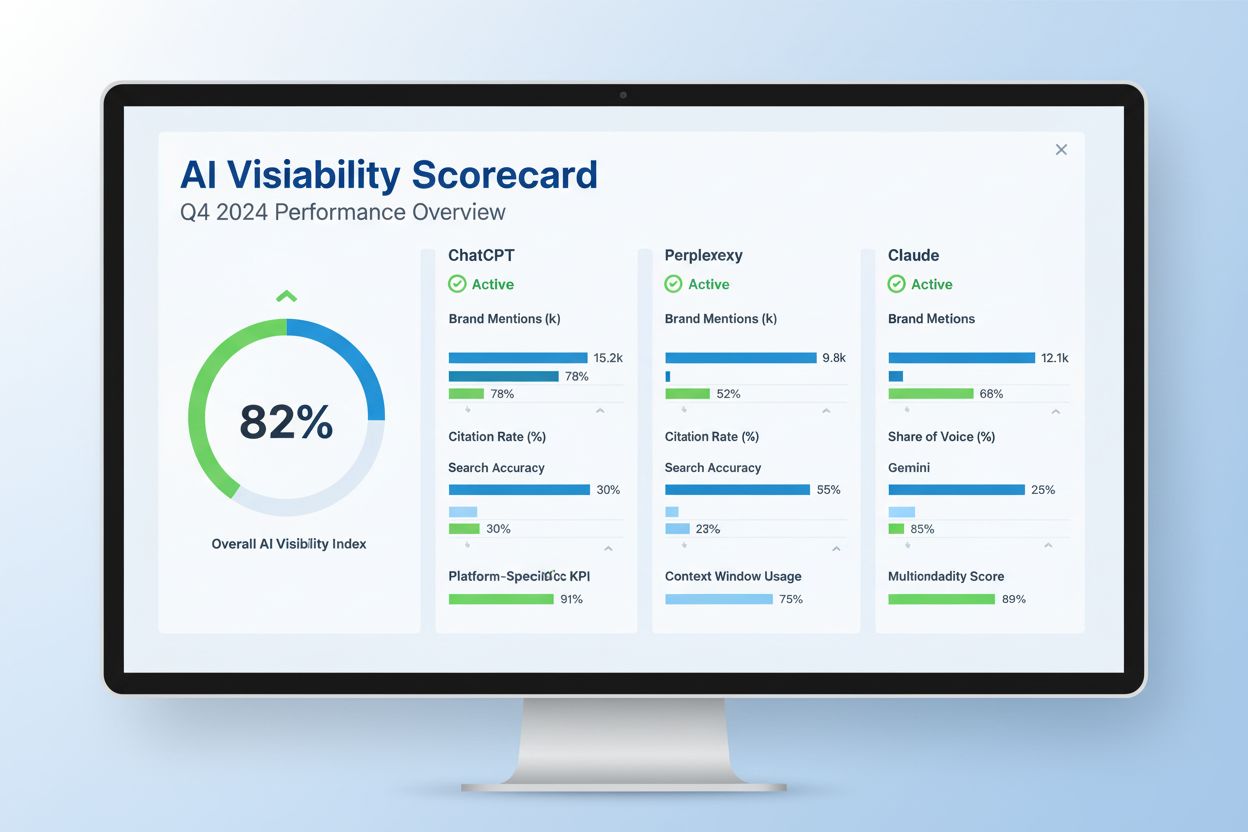
An AI Visibility Score measures how frequently your brand, content, or website shows up in AI-generated responses across major language models and AI platforms. Scored on a 0-100 scale, it quantifies your presence in outputs from ChatGPT, Claude, Gemini, Perplexity, and the other large language models that increasingly stand between your content and the people looking for it. Unlike a search-engine ranking, which tracks position for a keyword, an AI Visibility Score is a composite built from several weighted components — how often you’re mentioned, how often you’re actually cited as a source, where you appear relative to competitors, and how broadly you show up across different question types. If you want the actual formula, the exact weights vendors typically use, and a worked example, that’s covered in full in how an AI visibility score is calculated — this piece stays at the level of what the score means and what moves it.
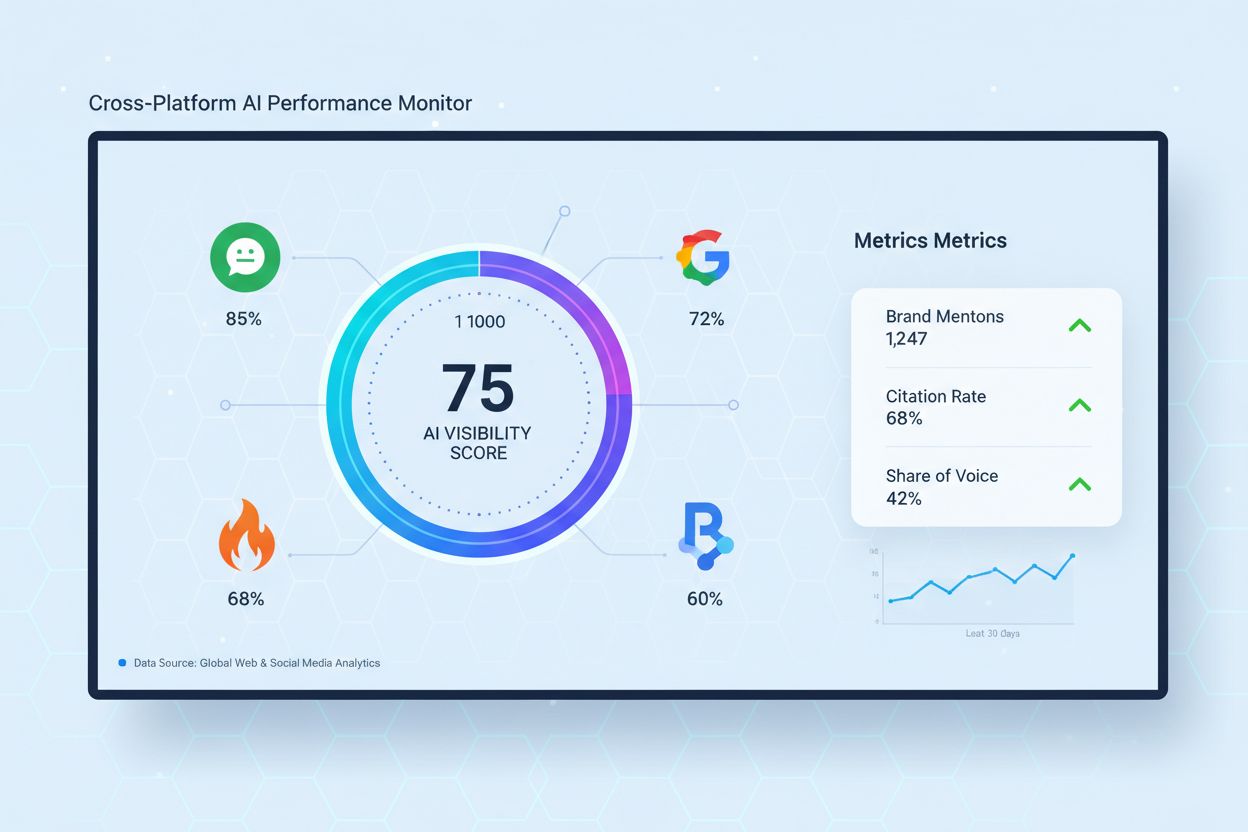
The shift toward AI-powered search and content discovery has fundamentally changed how visibility is measured and valued in digital marketing. According to recent research, approximately 64% of internet users now use AI tools for information gathering, a dramatic increase from just two years ago when adoption was below 20%. People are increasingly bypassing traditional search engines to ask questions directly to AI assistants, which then synthesize information from various sources to provide answers. The implications are profound: a website ranking first on Google for a keyword may receive zero traffic if AI systems don’t cite it in their responses to related queries. Industry analysts project that AI-driven discovery will keep accounting for a growing share of all online information access, making AI visibility optimization as important as SEO was in the previous decade. Understanding how AI visibility is measured — and improving your standing in it — is no longer optional for brands that want to stay part of the consideration set.
| Metric | Traditional SEO | AI Visibility |
|---|---|---|
| Focus | Search engine ranking position | Citation frequency in AI responses |
| Discovery Mechanism | Keyword matching & link authority | Content comprehensiveness & authority |
| User Action | Click-through to website | AI mentions brand in response |
| Measurement | Position (1st, 2nd, 3rd, etc.) | Percentage of relevant queries citing you |
| Traffic Type | Direct clicks from search results | Brand awareness & indirect traffic |
| Importance | Still relevant but declining | Rapidly increasing |

Track how AI chatbots mention your brand across ChatGPT, Perplexity, and other platforms.
Traditional search rankings and AI Visibility Scores measure fundamentally different things, reflecting how users discover information through different mechanisms. A website’s Google ranking position measures visibility in a specific search engine’s index for particular keywords, on the assumption that higher positions drive more clicks. An AI Visibility Score, by contrast, measures whether your content is cited as source material when AI systems generate responses — regardless of search engine rankings, you could rank tenth on Google but appear in 80% of relevant AI answers. Traditional search optimization relies on keyword matching and link authority; AI visibility depends on whether your content is comprehensive, authoritative, and structured in a way that’s easy to extract and quote. A critical distinction is that AI citations don’t generate direct clicks the way a search result does — instead, they establish your brand as an authoritative source and drive brand awareness, trust, and indirect traffic. Most brands now need to optimize for both, since they serve different user journeys: some people still search the old way, others go straight to an AI assistant.
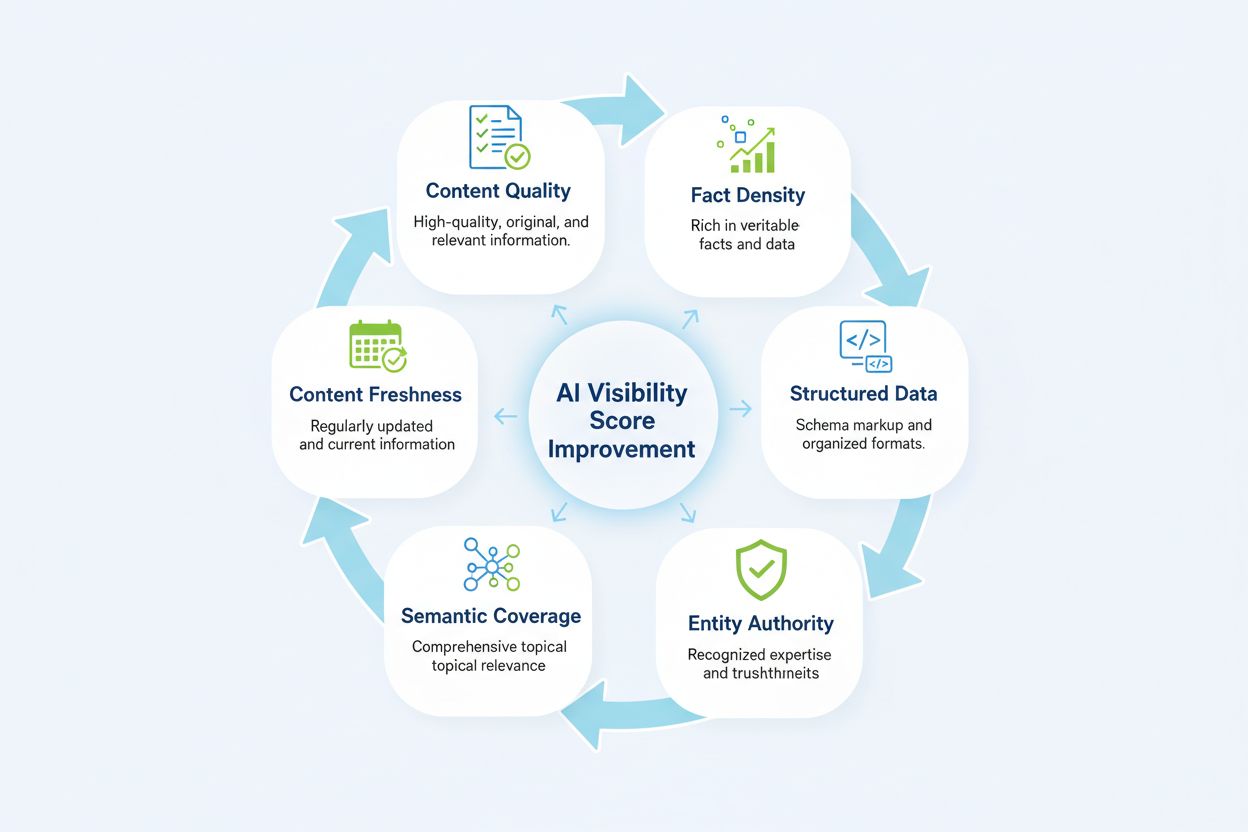
Improving an AI visibility score comes down to a fairly short list of levers, all rooted in how AI systems select and trust sources — not in gaming any single ranking factor. Content quality and fact density matter most: AI models favor well-researched articles packed with verifiable data points, specific numbers, and evidence-backed claims over vague, generic prose. Structured formatting — clear definitions near the top of a page, numbered lists, comparison tables — makes your content easier for an AI system to lift and quote directly, which is what separates a citation from a passing mention. Original data helps disproportionately: publish proprietary research, benchmarks, or usage numbers that don’t exist anywhere else, and you become an unavoidable source whenever that topic comes up. Topical authority compounds over time — a single strong article helps less than a cluster of interlinked content that comprehensively covers a subject, because it signals to AI systems that your domain is a complete resource rather than one lucky page. Query coverage matters too: covering the natural-language variations related to how people actually phrase a question broadens the number of prompts you can realistically appear in, rather than optimizing for one narrow phrasing. Technical SEO fundamentals — page speed, clean indexing, semantic HTML — won’t move the needle on their own, but they’re a prerequisite; an AI crawler that can’t parse or reach your content can’t cite it regardless of how good the writing is. Taken together, this set of signals lines up closely with what’s sometimes measured as an AI Content Score — a page-level readiness rating for citation, distinct from the account-level visibility score this article is about.
Get the latest insights on AI mentions, brand monitoring, and optimization strategies.
Several specialized tools have emerged to help marketers measure and track AI visibility with precision. Semrush offers AI visibility tracking alongside traditional SEO metrics. Geoptie provides analytics on your presence in AI-generated answers with competitive benchmarking. Morningscore pairs AI visibility metrics with actionable recommendations. Writesonic focuses on optimizing content for AI visibility before publication. Profound specializes in measuring content authority and citation potential. Among these, AmICited.com stands out for real-time monitoring of where your content appears in AI outputs, detailed citation analytics, and competitive intelligence — showing exactly how often your content is referenced relative to competitors. Picking among them mostly comes down to budget and which AI engines you most need coverage for.
Turning the factors above into a repeatable process means applying a consistent set of habits rather than one-off fixes:
Establishing a systematic approach to monitoring your AI visibility improvements ensures you can measure ROI and adjust your strategy accordingly. Begin by establishing a baseline across major platforms — document where your content appears in AI outputs, how frequently it’s cited, and which topics generate the most visibility. Schedule regular audits (monthly or quarterly) to track changes and spot emerging patterns in how AI systems interact with your content. Conduct competitor analysis by monitoring how similar content from competitors performs, which reveals gaps in your strategy and opportunities for differentiation. Track industry trends in AI platform updates, since these directly affect visibility and may require tactical adjustments. Use tools like AmICited.com to automate much of this monitoring, generating reports on citation trends and competitive positioning without manual tracking across multiple platforms. If you want to understand what’s actually driving a specific number up or down rather than just watching it move, that’s where breaking the score into its underlying components — the subject of how the score is calculated — becomes useful.
The landscape of AI visibility continues to evolve rapidly. Multimodal AI systems are becoming increasingly sophisticated, meaning visibility will soon extend beyond text to video, audio, and image content — creators who optimize across all formats will gain an edge. Real-time visibility tracking is moving from quarterly snapshots to continuous monitoring, enabling marketers to respond immediately to changes in how AI systems reference their content. Platform evolution suggests major AI systems will develop more transparent citation mechanisms over time, making it easier to understand exactly how content contributes to AI outputs. Organizations that start measuring and improving their AI visibility scores today build authority and discoverability advantages that compound, making this an essential part of modern content strategy rather than an optional add-on.
Viktor Zeman is a co-owner of QualityUnit. Even after 20 years of leading the company, he remains primarily a software engineer, specializing in AI, programmatic SEO, and backend development. He has contributed to numerous projects, including LiveAgent, PostAffiliatePro, FlowHunt, UrlsLab, and many others.

Discover how your brand appears in AI-generated answers across ChatGPT, Perplexity, Google AI Overviews, and more. Get real-time insights into your AI visibility score and track how often your content is cited by major AI systems.
Learn what an AI Visibility Score is and how it measures your brand's presence across ChatGPT, Perplexity, Claude, and other AI platforms. Essential metric for ...

Learn what an AI visibility score is, how it measures your brand's presence in AI-generated answers across ChatGPT, Perplexity, and other AI platforms, and why ...
Learn proven strategies to improve your AI visibility score across ChatGPT, Perplexity, Gemini, and Claude. Discover how to optimize content, build authority, a...
Cookie Consent
We use cookies to enhance your browsing experience and analyze our traffic. See our privacy policy.