


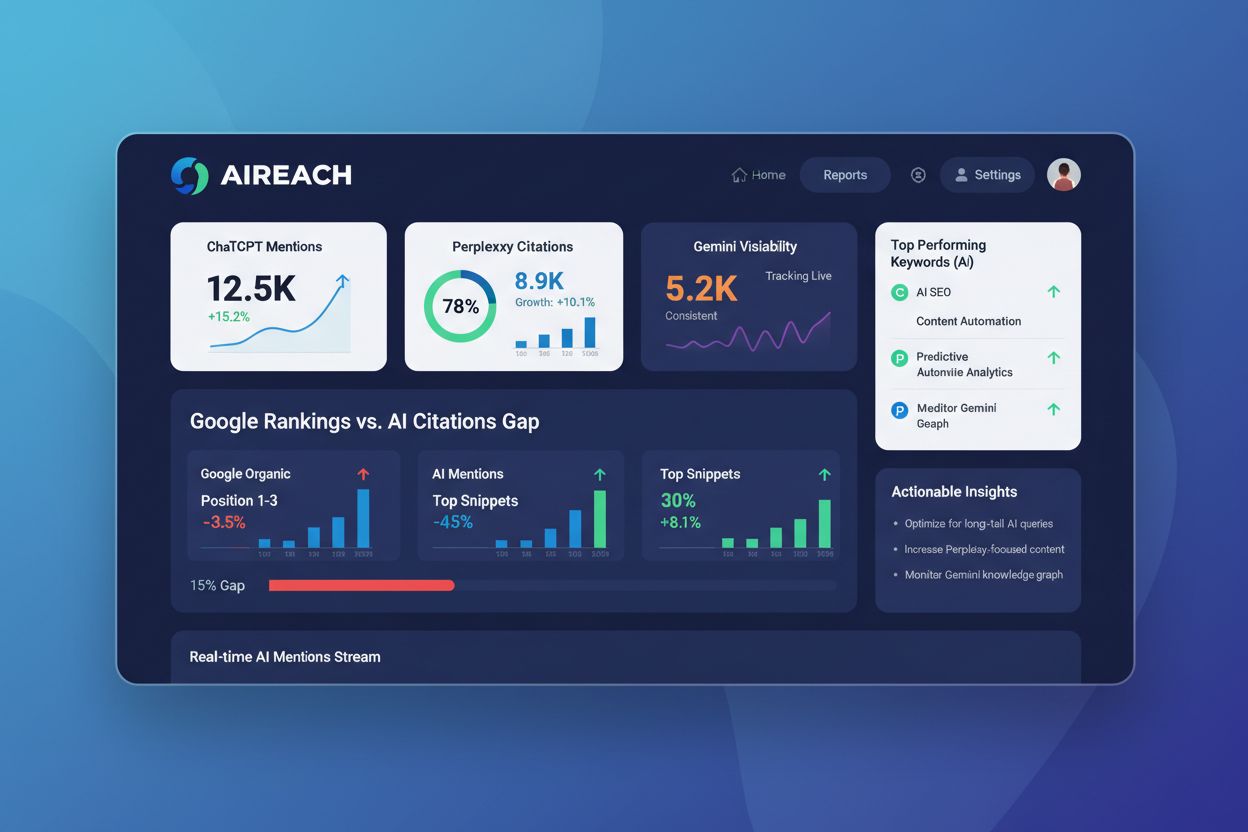
When SEO Rankings Don't Equal AI Visibility: The Disconnect
Discover why high Google rankings don't guarantee AI visibility. Learn the gap between SEO and AI citations, and how to optimize for both search channels.
6 min read
Compare AI search visibility and traditional SEO across signals, metrics, and content strategy. Learn why rankings do not guarantee AI citations.
Your website ranks #1 on Google for your target keyword. You’ve invested three years building authority, earning backlinks, and optimizing every technical detail. Organic traffic is strong. But when prospects ask ChatGPT, Perplexity, or Google Gemini for a recommendation in your category, your brand doesn’t appear. Your competitors do.
This scenario is no longer hypothetical. It’s happening across industries right now, and it reveals a critical truth: traditional SEO and AI search visibility are fundamentally different disciplines.
The shift from “10 blue links” to AI-generated answers is reshaping how people discover information. ChatGPT now has 910 million weekly active users. Google AI Overviews reach 2 billion monthly users across 200+ countries. Meanwhile, zero-click searches have climbed from 56% to 69% between 2024 and 2025, meaning most searches now end without clicking any result.
The rules are changing. The good news? You don’t have to choose between traditional SEO and AI visibility. You need both. But understanding how they differ, and where they overlap, is essential to staying competitive in 2026 and beyond.
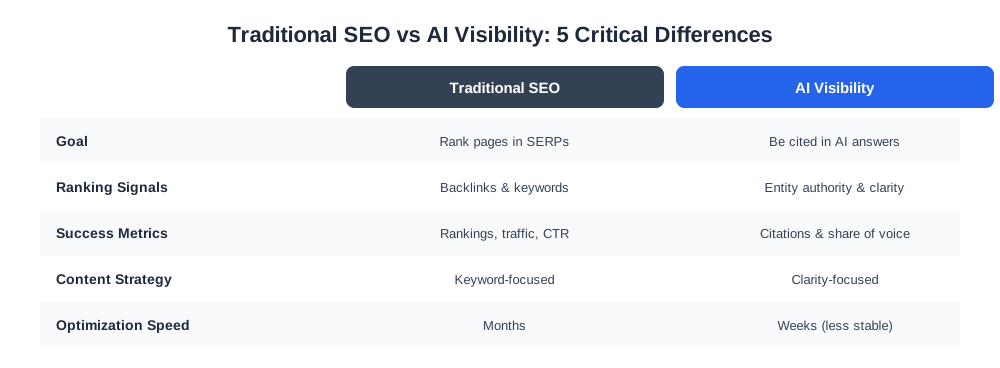
| Traditional SEO | AI Visibility | |
|---|---|---|
| Goal | Rank in positions 1-10 | Be cited in the generated answer |
| Top signal | Backlinks, domain authority | Entity authority, clarity, corroboration |
| Success metric | Rankings, CTR, organic traffic | Citation frequency, share of voice |
| Speed | Months to move rankings | Can shift within weeks, less stable |
Bottom line: only about 19% of page-one rankings also show up in AI answers, so you need to optimize for both, not just one.
Before diving into the differences, let’s clarify what each discipline actually does.
Traditional SEO (Search Engine Optimization) focuses on improving your website’s visibility in search engine results pages (SERPs). The goal is straightforward: appear in positions 1–10, ideally positions 1–3, where click-through rates reach 30–40%.
Search engines like Google use algorithms that evaluate hundreds of ranking signals: backlinks, keyword relevance, page speed, mobile-friendliness, domain authority, user engagement, and content quality. Your content competes against other pages for limited positions on the results page.
The user journey is linear: search query → scan results → click link → visit your website → convert or leave.
Success is measured by rankings, organic traffic, click-through rates, and conversions. You control the user experience once they arrive at your domain.
AI search operates on a completely different principle. Instead of presenting a ranked list of links, AI systems synthesize information from multiple sources into a single, direct answer. When a user asks ChatGPT, “What’s the best project management software for remote teams?” the AI generates a response that may mention 3-5 tools, explain their strengths, and cite sources, all within a single answer.
Your brand either appears in that answer or it doesn’t. There’s no “position 7” in an AI-generated response. You’re either visible or invisible.
The user journey is different: conversational question → AI-generated answer → source mention or citation → optional click to learn more.
Success is measured by brand mentions, citation frequency, share of voice in AI answers, and perceived credibility as a source. You don’t control the narrative (the AI does), but your content influences what the AI says about you.
The implications are profound. According to research cited by Omnibound AI, AI-referred website sessions grew 527% year-over-year, and the average visitor from AI search platforms is worth 4.4x more than a traditional organic search visitor from a conversion perspective.
Yet most brands haven’t adapted. They’re still optimizing for keywords and backlinks while ignoring the citation signals that AI systems actually value.
Here’s the reality: only 19% of brands that rank on page one for a keyword also appear in AI-generated answers for that same query (per Neil Patel research). This crossover gap reveals that traditional SEO success doesn’t automatically translate to AI visibility.
| Factor | Traditional SEO | AI Search Visibility |
|---|---|---|
| Primary Goal | Rank pages in SERPs | Be cited in AI-generated answers |
| User Action | Click through to website | Read answer in-platform |
| Visibility Model | 10 positions per page | Unlimited citations per answer |
| Success Metric | Rankings, organic traffic, CTR | Citations, brand mentions, share of voice |
| Discovery Mechanism | Algorithm ranks pages | AI synthesizes multiple sources |
| Traffic Impact | Direct website visits | Brand awareness, indirect traffic |
| Competitive Frame | Battle for top 10 | Compete for inclusion in answer |
Understanding these five dimensions is essential to building a strategy that works for both channels.
Traditional SEO asks: Can this page rank?
You optimize a single page to compete for a specific keyword position. You want position 1, but positions 2–5 are still valuable. The goal is to get clicks from people searching that keyword.
AI Visibility asks: Will this content be cited in an AI-generated answer?
You’re not competing for a position. You’re competing for inclusion. The AI system synthesizes multiple sources and either mentions your brand, quotes your content, or links to your page, or it doesn’t. There’s no middle ground.
This difference has massive implications. In traditional SEO, you might rank position 8 and still get 5–10% of clicks. In AI visibility, position 8 doesn’t exist. You’re either in the answer or you’re not.
Traditional SEO relies on authority signals built through backlinks, keyword optimization, site speed, domain age, and user engagement metrics. Google’s algorithm weighs link quantity, link quality, anchor text, and referring domain diversity heavily.
The signal is external: what other websites say about you.
AI Visibility relies on entity authority, source credibility, and content clarity. Entity authority represents how confidently AI systems recognize and understand your brand as a distinct entity in their knowledge graphs.
Entity authority builds through:
The signal is internal and external: how clearly you define yourself and how other authoritative sources validate you.
| Signal Type | Traditional SEO | AI Visibility |
|---|---|---|
| Primary Authority Signal | Backlinks (quantity & quality) | Entity recognition & clarity |
| Secondary Signals | Keywords, page speed, mobile UX | Structured data, semantic clarity |
| Trust Markers | Domain authority, age | E-E-A-T, factual accuracy, consistency |
| Validation | Link profiles, referring domains | Knowledge graphs, corroboration |
| Content Emphasis | Keyword density, search intent match | Clarity, directness, context |
Traditional SEO success is measured through:
These metrics are quantifiable and tracked through Google Search Console, Google Analytics, and other SEO tools. You can see exactly which keywords drive traffic and which pages convert.
AI Visibility success is measured through:
These metrics are newer and require different tools. Traditional SEO platforms don’t track AI citations. You need specialized tools like Visiblie, Semrush’s AI visibility module, or manual monitoring across AI platforms.
Traditional SEO content is optimized around:
The content is structured to satisfy search intent and convince search engines that your page is relevant to the query.
AI Visibility content is optimized around:
The content is structured to be easily extracted, understood, and cited by AI systems.
Example: A traditional SEO article on “best project management software” might be titled “Top 10 Project Management Tools for 2026: Complete Comparison Guide” with keyword-rich sections and internal links to related articles.
An AI-visibility-optimized article on the same topic would include:
Traditional SEO improvements take time. Search engines crawl your site periodically. Algorithm updates happen monthly or quarterly. New pages take weeks to index and rank. Building authority through backlinks takes months or years.
You might implement a major SEO improvement and wait 3–6 months to see ranking movement.
AI Visibility can show faster results in some cases. If your content becomes a trusted reference and AI platforms update their training data or real-time search indexes, you can see citations appear within weeks. However, it also depends on AI platform update cycles and how frequently they re-evaluate sources.
The tradeoff: AI visibility can shift faster, but it’s also less stable. Model updates can change what AI systems cite. Competitor content changes can shift your share of voice overnight.
Ranking on page one of Google is still important. But it’s no longer sufficient. Here’s why.
Research by Neil Patel revealed a startling statistic: only 19% of brands that rank on page one for a keyword also appear in AI-generated answers for that same query.
This means 81% of page-one rankings don’t translate to AI visibility. Your traditional SEO success is largely invisible to AI systems.
Why? Several reasons:
First, AI systems don’t always crawl the same pages Google ranks. Google’s algorithm prioritizes different signals than AI systems. Backlinks matter enormously to Google but less to AI systems, which prioritize clarity and trustworthiness.
Second, JavaScript-heavy websites create crawling problems for AI. Neil Patel’s research noted that AI crawlers struggle with JavaScript-heavy websites, meaning entire sections of your content may be invisible to them. If your site relies heavily on client-side rendering, AI systems may not see your content at all.
Third, AI systems evaluate different content patterns. Search Engine Land’s research on the SEO-GEO gap found that AI search favors different content patterns than traditional organic search. AI systems look for direct answers, clear structure, and factual accuracy, not keyword optimization and backlink profiles.
Google’s zero-click rate has climbed to 58–69% depending on query type. Zero-click means the user got their answer without clicking any result, whether from Google’s own answer boxes, AI Overviews, or featured snippets.
If your strategy relies on click-through traffic, you’re losing visibility to zero-click results. And as AI Overviews become more common, zero-click rates will only increase.
AI visibility addresses this directly. Even if users don’t click your website, they see your brand mentioned in the AI’s answer. That’s brand exposure and trust-building at the moment of decision.
Imagine a landscaping company that ranks #1 for “best landscaping services near me” in their city. Traditional SEO success, right?
But when a homeowner asks ChatGPT, “What should I look for in a landscaping company?” the AI generates an answer that includes 2–3 competitor companies by name, explains their strengths, and recommends calling multiple for quotes. The #1-ranking company isn’t mentioned.
Why? Because:
The company ranks well for traditional SEO but is invisible in AI-driven discovery. They’re losing customers at the moment of decision.
If you want to appear in AI-generated answers, you need to understand what AI systems actually value. These are the core ranking factors for AI visibility.
AI systems organize information around entities: distinct concepts, people, products, and organizations. The stronger your entity authority, the more likely AI systems recognize and cite you.
Entity authority builds through:
Action: Ensure your business information (name, address, phone, description) is consistent across Google Business Profile, Wikipedia (if applicable), industry directories, and your website. Implement Organization schema markup on your homepage.
AI systems need to understand what your content actually means. Semantic clarity means your content is explicit, well-organized, and answers questions directly.
Clear content includes:
Action: Audit your content for clarity. Replace vague sections with direct answers. Use headings that frame what readers will learn, not just keywords.
Schema markup helps AI systems understand the context and relationships in your content. While schema alone won’t improve AI visibility, it’s essential infrastructure.
Key schema types for AI visibility:
Action: Implement schema markup for your most important content types. Use Google’s Structured Data Testing Tool to validate.
AI systems track where your brand is mentioned across the web. More mentions from authoritative sources = stronger citation signals.
Citation signals include:
Action: Build a brand mention monitoring system. Track where you’re mentioned and work to increase mentions in authoritative sources.
AI systems are trained to reward trustworthy information. Misinformation, inconsistencies, or outdated content hurt your chances of being cited.
E-E-A-T stands for Expertise, Experience, Authoritativeness, and Trustworthiness:
Action: Ensure all content is factually accurate and up-to-date. Include author bios that demonstrate expertise. Cite sources and data. Acknowledge limitations and edge cases.
| AI Visibility Factor | How It Works | How to Strengthen It |
|---|---|---|
| Entity Authority | AI recognizes your brand as a distinct entity | Consistent brand info across web; schema markup; knowledge graph presence |
| Content Clarity | AI understands what your content means | Direct answers; clear structure; semantic precision |
| Structured Data | AI extracts information efficiently | Implement schema markup; use FAQ schema |
| Citation Signals | AI evaluates where you’re mentioned | Build brand mentions; earn backlinks; get reviewed |
| E-E-A-T | AI trusts your information | Demonstrate expertise; cite sources; maintain accuracy |
| Topical Authority | AI recognizes you as an expert in a domain | Create comprehensive content clusters; build depth |
| Freshness | AI prioritizes current information | Update content regularly; add publication dates |
You can’t improve what you don’t measure. AI visibility measurement is newer and less standardized than traditional SEO metrics, but several key metrics are emerging.
An AI Visibility Score is a comprehensive metric that tracks how often and how prominently your content appears in AI-generated answers. It combines citation frequency, share of voice, and prominence into a single number.
A higher score indicates stronger AI visibility across your target keywords and topics.
Citation count tracks how many times your brand or website is mentioned in AI-generated answers.
Share of voice measures what percentage of AI answers in your niche mention your brand. If 100 AI-generated answers are created for queries in your industry, and 15 mention your brand, your share of voice is 15%.
These metrics show whether AI systems recognize you as a credible source and how often they cite you relative to competitors.
Featured snippets and direct answers in Google’s traditional search results are increasingly used by AI systems. If your content appears in these high-visibility SERP features, AI systems are more likely to extract and cite it.
Track how many of your target keywords have featured snippets and whether your content occupies those positions.
AI Exposure Rate quantifies the likelihood of your content being discovered and utilized by various AI systems. It combines factors like:
Several tools are emerging to help track AI visibility:
Action: Start with manual monitoring. Search your top 20 target keywords in ChatGPT, Perplexity, and Google AI Overviews. Document whether your brand appears and how prominently. Track changes monthly.
The question isn’t “Should I focus on SEO or AI visibility?” The answer is both. They’re complementary disciplines that strengthen each other.
Traditional SEO remains essential because:
AI visibility is now essential because:
Brands that abandon SEO to focus on AI visibility will lose authority signals. Brands that ignore AI visibility will miss the fastest-growing discovery channel.
Start with traditional SEO fundamentals:
A strong SEO foundation gives AI systems content to extract and cite. Without it, AI visibility is limited.
Once your SEO foundation is solid, amplify it with AI-focused optimization:
The best content satisfies both traditional SEO and AI visibility. Here’s how:
Structure:
Content:
Optimization:
Ready to improve AI visibility? Here’s a practical 90-day plan to get started.
Week 1: Baseline Assessment
Week 2: Content Clarity Audit
Week 3: Schema Markup Implementation
Week 4: Entity Authority Assessment
| Week 1 Tasks | Week 2 Tasks | Week 3 Tasks | Week 4 Tasks |
|---|---|---|---|
| Manual AI search audit | Content clarity review | Schema markup audit | Entity authority audit |
| Baseline documentation | Identify vague sections | Implement Organization schema | Knowledge Graph check |
| Technical SEO check | Gap analysis | Add Article/Product schema | Directory presence audit |
| Competitor analysis | Rewrite priority list | Validate markup | Consistency check |
Week 5: Content Restructuring
Week 6: Topical Authority Building
Week 7: Citation Signal Building
Week 8: E-E-A-T Strengthening
| Week 5 Tasks | Week 6 Tasks | Week 7 Tasks | Week 8 Tasks |
|---|---|---|---|
| Rewrite top 5 pages | Identify topic clusters | Set up monitoring | Add author bios |
| Add direct answers | Create cluster content | Outreach for mentions | Cite sources |
| Improve structure | Build internal links | Encourage reviews | Add dates |
| Add visual elements | Establish authority | Build citations | Strengthen E-E-A-T |
Week 9: Tracking Setup
Week 10: Data Analysis & Optimization
Week 11: Scaling & Expansion
Week 12: Strategy & Planning
| Week 9 Tasks | Week 10 Tasks | Week 11 Tasks | Week 12 Tasks |
|---|---|---|---|
| Set up monitoring | Analyze citation data | Expand optimization | Review results |
| GSC configuration | Identify opportunities | Create new content | Document learnings |
| Create dashboard | Optimize based on data | Build authority | Plan next phase |
| Establish baseline | Test and iterate | Scale successes | Set goals |
Let’s see how these principles play out across different industries.
Scenario: A company selling project management software wants to appear when prospects ask AI tools for recommendations.
Traditional SEO approach: Rank #1 for “best project management software” with a comprehensive comparison guide, backlinks from tech blogs, and keyword optimization.
AI visibility approach: Create entity-clear product information (name, features, pricing, use cases), implement Product schema, build citations from industry reviews and publications, create comparison tables that AI can easily extract, demonstrate expertise through case studies and data.
Integrated result: The page ranks #1 for traditional search AND appears in 30%+ of AI-generated answers about project management software. Prospects see the brand mentioned in both Google results and ChatGPT responses.
Scenario: A management consulting firm wants to be cited as an authority on organizational transformation.
Traditional SEO approach: Publish thought leadership articles, earn backlinks from industry publications, optimize for consulting-related keywords.
AI visibility approach: Create comprehensive guides on organizational transformation topics, structure content with clear definitions and frameworks, add author bios showing expertise, publish original research, build entity authority through consistent brand messaging.
Integrated result: The firm ranks for relevant keywords AND appears in AI-generated answers about transformation strategies. When prospects ask AI tools for advice, the firm is cited as a credible source.
Scenario: A local business wants to be recommended by AI when customers ask for service recommendations.
Traditional SEO approach: Optimize Google Business Profile, earn local backlinks, rank for local keywords like “landscaping services near me.”
AI visibility approach: Ensure clear, structured service descriptions, implement local business schema, build citations in local directories and review sites, create service-specific content that AI can extract, maintain accurate and consistent business information.
Integrated result: The business ranks locally AND appears in AI-generated answers. When customers ask ChatGPT for service recommendations, the business is mentioned by name.
Reality: Only 19% of page-one rankings translate to AI citations. Ranking high doesn’t guarantee AI visibility.
What works: Optimize specifically for AI signals. Improve content clarity, build entity authority, strengthen E-E-A-T, implement structured data, and earn citations from authoritative sources.
Reality: Schema markup is supporting infrastructure, not a magic solution. It helps AI understand your content, but it doesn’t make poor content visible.
What works: Start with high-quality, clear content. Then add schema markup to help AI systems understand it better. Content first, markup second.
Reality: Abandoning SEO will hurt your AI visibility. AI systems rely on signals created by strong traditional SEO.
What works: Maintain strong SEO fundamentals while adding AI-focused optimization. They’re complementary, not competing.
Reality: AI visibility is growing rapidly. Brands that adapt early will have a significant advantage. By the time it’s “mainstream,” your competitors will already be visible.
What works: Start now. Even a basic AI visibility strategy (content clarity, entity authority, structured data) will improve your position relative to competitors who haven’t started yet.
The shift from rankings to citations is real. AI search is growing faster than traditional search ever did. But this isn’t a replacement scenario, it’s an expansion.
The strongest digital strategies in 2026 and beyond will combine traditional SEO best practices with AI-focused optimization. Brands that master both will dominate discovery across every channel: Google rankings, Google AI Overviews, ChatGPT, Perplexity, and whatever AI-powered discovery platforms emerge next.
Your task is clear: Build for both surfaces. Ensure your content ranks well in traditional search AND appears in AI-generated answers. Earn backlinks AND build entity authority. Optimize for keywords AND clarity. Measure rankings AND citations.
The 90-day roadmap above gives you a concrete starting point. Begin with the audit phase. Understand your current baseline. Then move systematically through optimization and measurement.
The brands that move first will capture disproportionate share of voice in AI-generated answers. The brands that wait will struggle to catch up.
Start today.
Arshia is an AI Workflow Engineer at FlowHunt. With a background in computer science and a passion for AI, he specializes in creating efficient workflows that integrate AI tools into everyday tasks, enhancing productivity and creativity.

Am I Cited tracks how often ChatGPT, Perplexity, Gemini, Claude, Grok, DeepSeek, Google AI Overview, and Google AI Mode cite your brand, the half of the picture your rank tracker can't see, so you can optimize for citations as well as rankings.
Discover why high Google rankings don't guarantee AI visibility. Learn the gap between SEO and AI citations, and how to optimize for both search channels.
Learn how to combine AI visibility monitoring with traditional SEO to create a unified search strategy that captures visibility across all discovery channels.
Learn how to get started with AI visibility in just 30 days. A practical guide for beginners covering discovery, optimization, content strategy, and monitoring.
Cookie Consent
We use cookies to enhance your browsing experience and analyze our traffic. See our privacy policy.