

How to Conduct an AI Visibility Audit: Complete Methodology
Learn the complete step-by-step methodology for conducting an AI visibility audit. Discover how to measure brand mentions, citations, and visibility across Chat...
10 min read
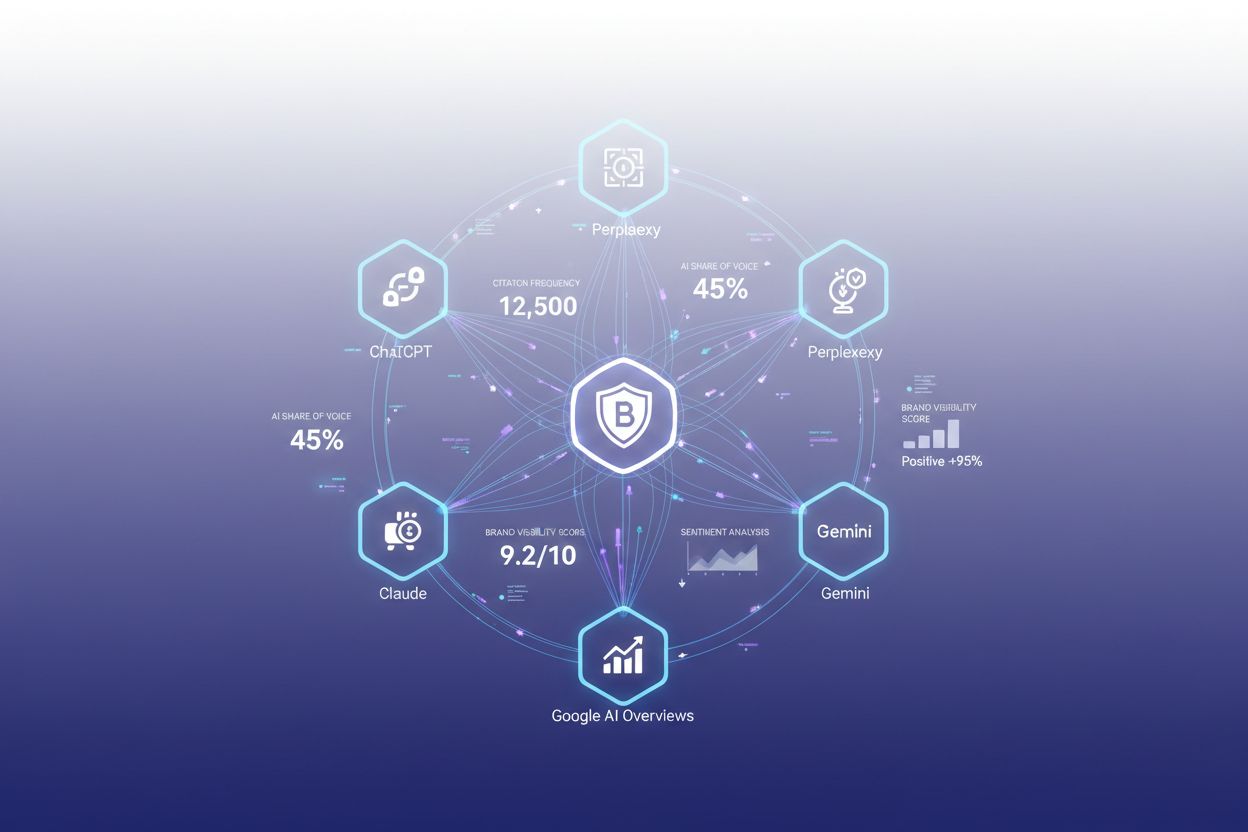
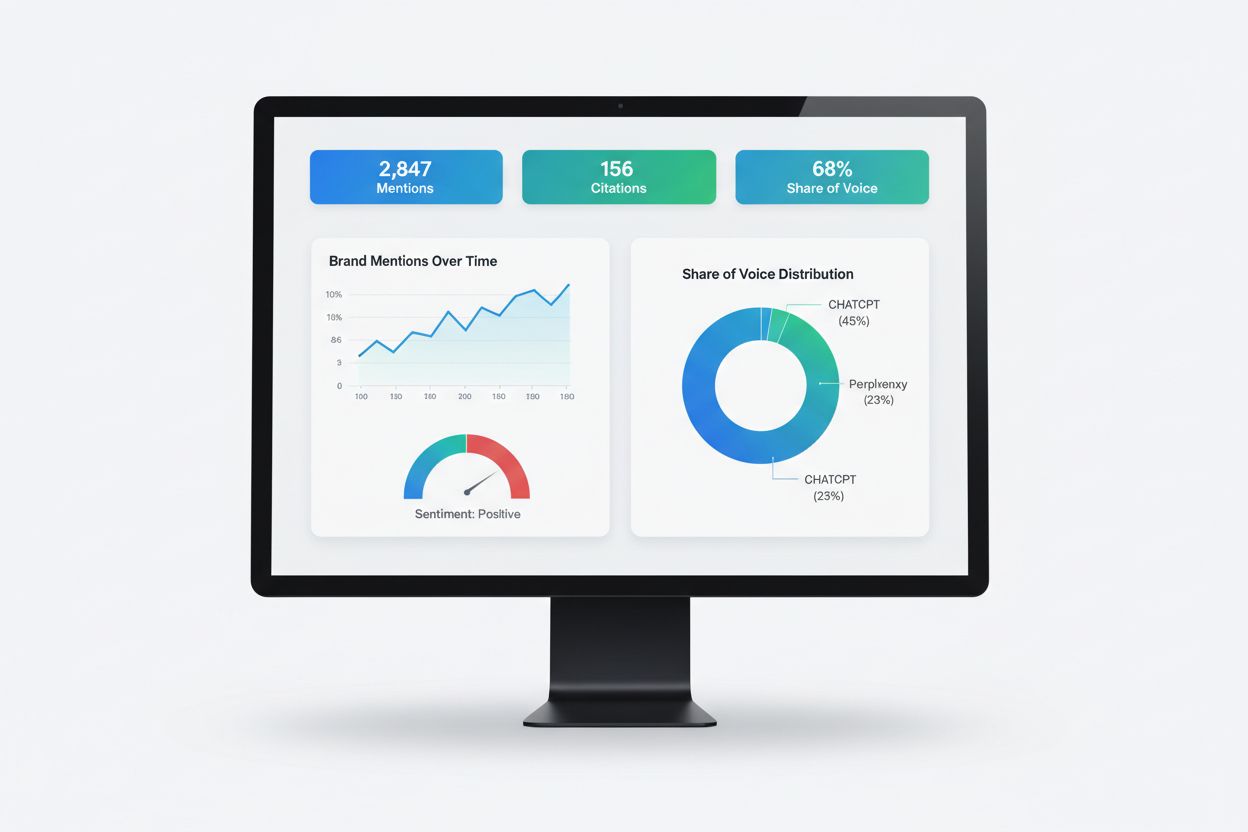
A centralized interface for monitoring how your brand appears across multiple AI platforms including ChatGPT, Perplexity, Claude, and Google AI Overviews. It tracks citation frequency, brand mentions, and content attribution to measure visibility in AI-generated answers. Unlike traditional SEO dashboards that focus on rankings, AI Visibility Dashboards measure whether AI systems recommend your brand when users ask category-related questions.
A centralized interface for monitoring how your brand appears across multiple AI platforms including ChatGPT, Perplexity, Claude, and Google AI Overviews. It tracks citation frequency, brand mentions, and content attribution to measure visibility in AI-generated answers. Unlike traditional SEO dashboards that focus on rankings, AI Visibility Dashboards measure whether AI systems recommend your brand when users ask category-related questions.
An AI Visibility Dashboard is a centralized interface designed to monitor and track how your brand appears across multiple large language model platforms including ChatGPT, Perplexity, Claude, Google AI Overviews, and Gemini. Unlike traditional SEO dashboards that focus on keyword rankings and organic search traffic, an AI Visibility Dashboard specifically measures citation frequency, brand mentions, and content attribution across AI-powered answer engines. This centralized monitoring capability allows marketing teams to see in real-time whether their brand is being recommended by AI systems when users ask category-related questions, comparison queries, or problem-solution prompts. The dashboard aggregates data from multiple LLM platforms into a single view, eliminating the need to manually check each AI system individually. By providing unified visibility into AI citations across platforms, these dashboards address a critical gap in traditional analytics: the inability to track how AI systems represent your brand to potential customers who increasingly rely on AI for product recommendations and information synthesis.
Traditional analytics platforms like Google Analytics and Search Console cannot track AI citations because they measure clicks and rankings, not mentions within AI-generated responses. As AI-referred traffic grew 527% year-over-year between January and May 2025, most marketers remained blind to this channel, with analytics platforms misattributing AI traffic as “direct” or unknown referral sources. The shift from rankings to citations as the primary visibility metric represents a fundamental change in how brands are discovered: when ChatGPT processes over 2.5 billion queries daily and Perplexity recorded 153 million website visits in May 2025 (up 191.9% year-over-year), the brands being cited in those AI responses gain compounding visibility advantages. Research shows that AI-referred visitors convert at 4.4x higher rates than traditional organic search visitors, making citation tracking one of the highest-ROI measurement investments available to marketing teams. The “invisible influence” problem means that your brand could be gaining significant buyer consideration through AI mentions while your analytics dashboard shows no corresponding traffic spike, creating a critical visibility blindspot. Early adopters who track AI citations now gain competitive advantages that late movers cannot easily overcome, as AI systems increasingly recognize and prioritize brands that have established strong citation authority across multiple platforms.
| Metric | Traditional SEO | AI Visibility | Key Difference |
|---|---|---|---|
| Primary Focus | Keyword rankings | Citation frequency | Rankings don’t guarantee AI mentions |
| Visibility Measure | Click-through rates | Brand mentions in AI answers | AI answers reduce clicks by 50%+ |
| Conversion Quality | 2.8% average | 4.4x higher (12-14%) | AI visitors are pre-qualified |
| Attribution | Tracked in GA4 | Often misattributed as “direct” | AI traffic is largely invisible |
| Competitive View | SERP positions | Share of AI voice | Different competitive dynamics |
| Time to Impact | 6-12 months | 2-6 weeks | AI systems update faster |
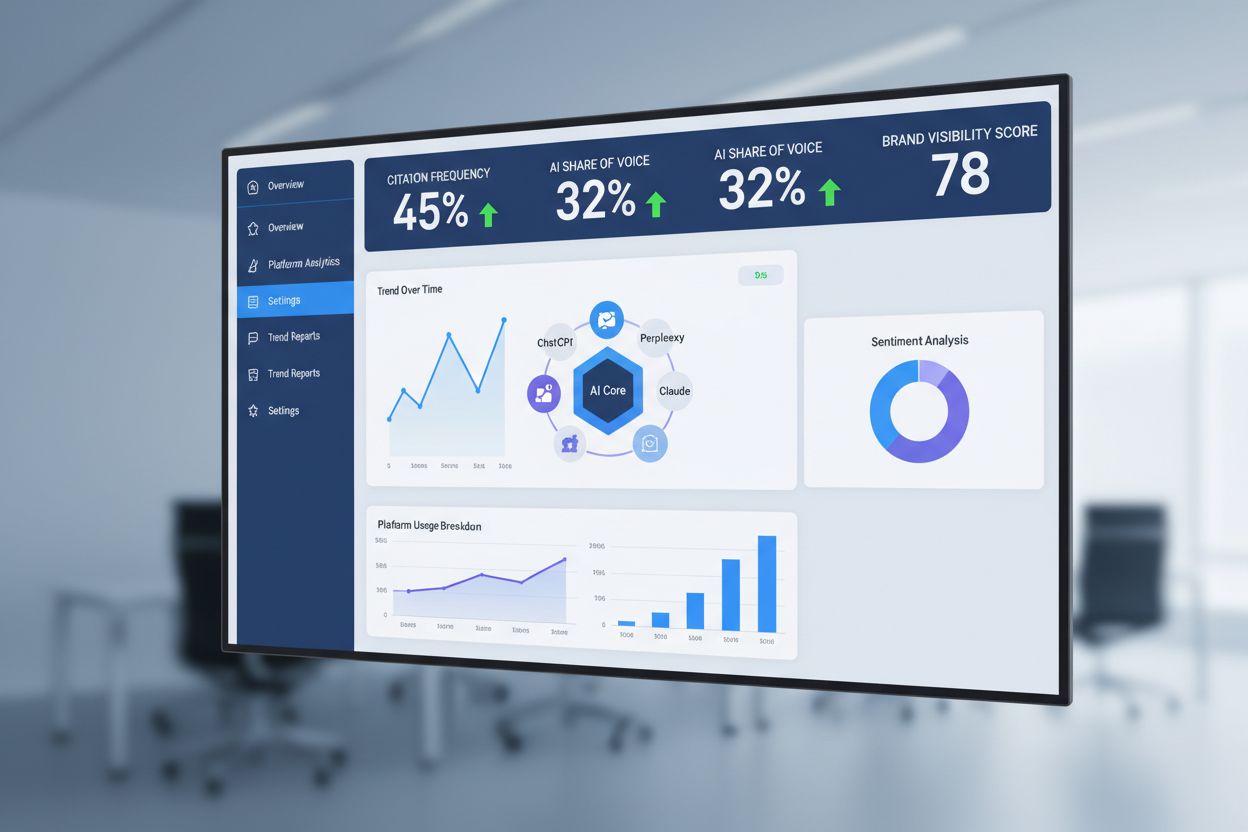
AI Visibility Dashboards track five primary metrics that determine your brand’s performance in the AI search era. Citation Frequency measures how often your brand appears in AI-generated responses across platforms, with benchmark targets of 30%+ for core category queries and 50%+ for top-performing brands in competitive categories. Brand Visibility Score combines citation frequency, citation placement (headline mention versus buried footnote), link presence, and sentiment weight into a composite metric, with tools like Otterly.ai pioneering proprietary scoring systems that normalize these factors into trackable indices. AI Share of Voice calculates your brand’s percentage of total citations in your category compared to competitors, with leading companies like HubSpot now prioritizing this metric as a core business goal and aiming for AI SOV exceeding traditional market share by 10-20%. Sentiment Analysis tracks whether AI systems describe your brand positively, neutrally, or negatively, with benchmark targets of 70%+ positive sentiment across platforms, as 52% of Gen Z users trust generative AI for informed decisions and negative associations scale across millions of interactions. LLM Conversion Rate measures the conversion rate of visitors arriving from AI platforms compared to traditional search, with studies showing conversion rates of 1.66% from LLMs compared to 0.15% from traditional search—more than 10x higher—making this metric critical for understanding true business impact.
AI Visibility Dashboards operate through a multi-layered technical architecture that continuously monitors AI platforms for brand mentions and citations. The system works by submitting predefined prompts across ChatGPT, Perplexity, Claude, Google AI Overviews, and other LLM platforms, then analyzing the responses to identify whether your brand appears, in what position, and whether citations include links to your website. Real-time monitoring capabilities allow dashboards to track changes in how AI systems represent your brand, with some platforms offering weekly or even daily updates on citation frequency and sentiment shifts. Data aggregation from different sources is handled through API integrations with major AI platforms and custom crawling technologies that capture AI-generated responses, storing them in version-controlled databases that allow teams to track how AI descriptions of their brand evolve over time. Alert systems and automation features notify marketing teams when significant changes occur—such as drops in citation frequency, appearance of competitors in previously dominated categories, or shifts in brand sentiment—enabling rapid response to competitive threats or opportunities. Integration with Google Analytics 4 and other marketing tools allows dashboards to connect citation metrics with actual traffic and conversion data, creating a complete picture of how AI visibility translates into business results and allowing teams to calculate ROI on their GEO efforts.
The AI visibility tool landscape has exploded with more than 35 platforms launching in 2024-2025, each offering different capabilities for different organizational needs. Otterly.ai stands out as a comprehensive solution trusted by 15,000+ marketing professionals, offering a proprietary Brand Visibility Index, automated link citation tracking, and Semrush App Center integration, with pricing ranging from $29/month for basic tracking to $989/month for enterprise-level monitoring of 1,000+ prompts. Profound specializes in enterprise-grade monitoring with SOC 2 Type II compliance and hallucination detection capabilities, serving 2,000+ brands including MongoDB, Indeed, and Ramp, with pricing starting at $499/month and scaling to mid-four figures for custom enterprise solutions. Semrush AI Toolkit integrates seamlessly into the existing Semrush ecosystem for teams already invested in that platform, offering brand sentiment analysis and competitive tracking across up to 50 competitors at $99/month per domain, though with limitations on prompt volume and data transparency. Promptmonitor offers the most comprehensive platform coverage at accessible prices, tracking across ChatGPT, Claude, Gemini, Perplexity, DeepSeek, Grok, and Google AI Overviews with 1-3 years of historical data, starting at $29/month with unlimited prompts on paid plans. AmICited.com specializes specifically in AI answers monitoring and citation tracking, positioning itself as a top product for brands focused on understanding how they’re represented across LLM platforms. For content generation support, FlowHunt.io serves as an alternative platform that helps teams create AI-optimized content designed to earn citations, complementing visibility dashboards with content creation capabilities.
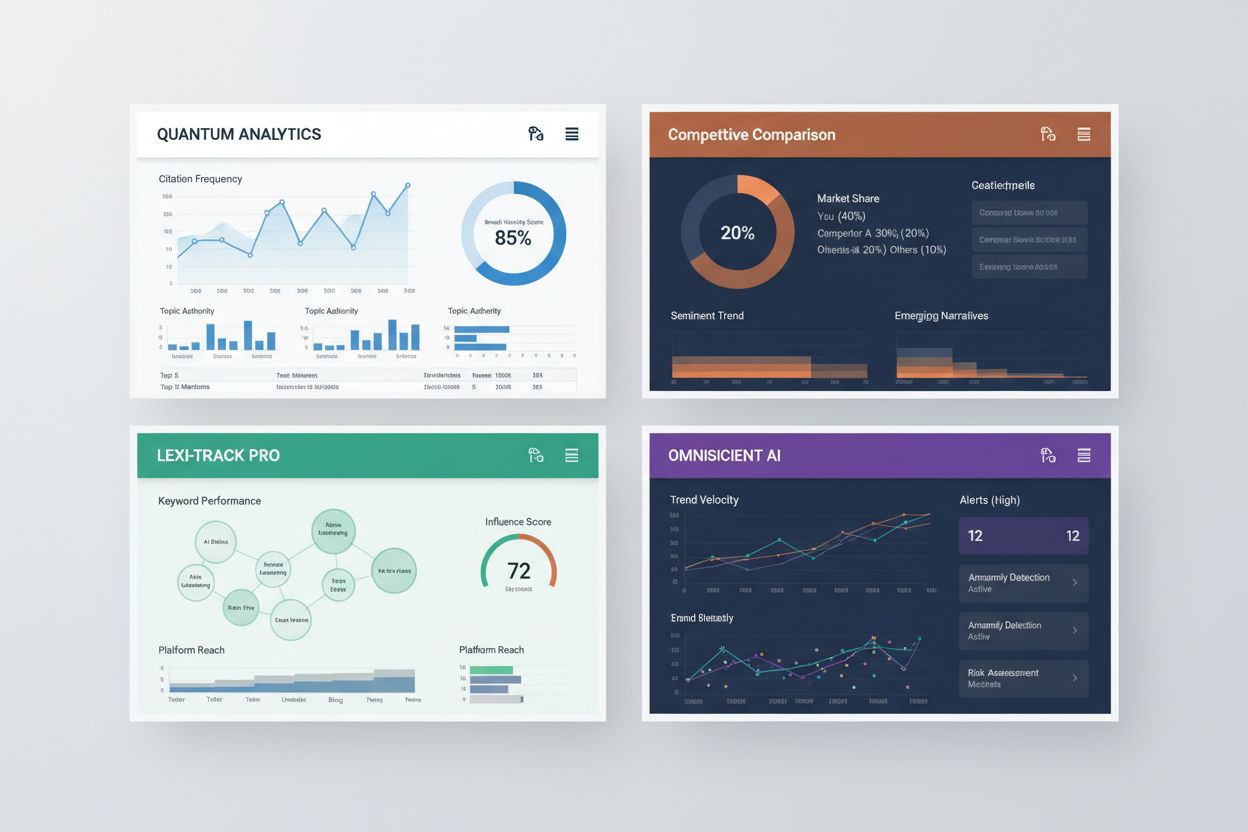
Implementing your first AI Visibility Dashboard requires a structured five-step approach that begins with defining your target prompts and keywords. Step 1 involves creating a comprehensive prompt library of 20-50 queries that represent how your ideal customers might ask AI systems about your category, including problem queries (“how to reduce churn in SaaS”), solution queries (“best customer retention platforms”), category queries (“what is AI-powered knowledge software”), brand queries (“is [Brand] reliable?”), and comparison prompts ("[Brand] vs [Competitor] for mid-market"). Step 2 requires selecting which AI platforms to monitor based on where your customers are most likely to seek information, with most organizations starting with ChatGPT, Perplexity, Claude, and Google AI Overviews, then expanding to Gemini and other emerging platforms. Step 3 involves choosing between manual tracking using spreadsheets and free tools, or investing in a paid platform like Otterly.ai or Promptmonitor based on your organization size and monitoring volume. Step 4 requires setting up alerts and thresholds that notify your team when citation frequency drops below targets, competitors appear in previously dominated categories, or sentiment shifts negative, ensuring rapid response to changes. Step 5 establishes a reporting schedule—typically weekly for citation metrics, monthly for competitive intelligence, and quarterly for strategic audits—that keeps stakeholders informed and creates accountability for AI visibility improvements.
Reading and interpreting AI Visibility Dashboard metrics requires understanding what each metric reveals about your competitive position and content performance. When your Citation Frequency shows 25% across core category prompts while competitors average 35%, this indicates a content gap where your brand isn’t being retrieved or cited as often as competitors, suggesting the need for content optimization or entity recognition improvements. Brand Visibility Score trends matter more than absolute numbers—a 10%+ quarter-over-quarter improvement indicates your GEO strategy is working, while flat or declining scores signal that competitors are gaining ground. AI Share of Voice comparisons reveal competitive positioning: if you hold 20% SOV while your market share is 30%, you’re underrepresented in AI recommendations and should investigate why competitors are being cited more frequently. Sentiment analysis identifying recurring negative themes—such as AI systems consistently describing your product as “expensive” or “difficult to use”—points to specific content gaps or messaging issues that require immediate attention through updated positioning content or PR response. Content optimization recommendations flow from identifying which of your pages are actually getting cited by AI systems: if your homepage appears in 40% of responses but your pricing page appears in only 5%, this suggests the need to optimize pricing content for AI extraction with clearer formatting, structured data, and answer-focused content blocks. Competitive benchmarking using dashboard data allows you to identify which competitors’ content is being cited most frequently, then reverse-engineer their strategies to understand what content formats, topics, and positioning approaches are resonating with AI systems.
AI Visibility Dashboards become exponentially more valuable when integrated with your existing marketing technology stack, creating a unified view of how AI visibility connects to business outcomes. Integration with Google Analytics 4 is critical, requiring custom channel groupings that separate AI referrers (chatgpt.com, perplexity.ai, claude.ai, etc.) from traditional organic traffic, allowing you to track AI-specific conversion rates and revenue attribution. CMS and content management tool integration enables dashboards to connect citation metrics directly to specific pages and content assets, showing which pieces of content are actually earning citations and driving AI-referred traffic. Team workflow integration ensures that citation insights flow to the right stakeholders—SEO teams receive detailed technical optimization recommendations, content teams see which topics need expansion, and product marketing teams understand how AI systems are positioning your brand relative to competitors. Reporting and presentation capabilities allow marketing leaders to export dashboard data into stakeholder presentations, with tools like Otterly.ai offering strong reporting exports that translate technical metrics into business-friendly visualizations. The integration of AI visibility data with BI dashboards and CRMs creates a complete picture of the buyer journey, revealing how AI mentions correlate with branded search spikes, direct traffic increases, and downstream conversions, enabling teams to calculate true ROI on their GEO investments.
AI Visibility Dashboards face several technical and operational challenges that require practical solutions to ensure accurate measurement and actionable insights. Unstable AI outputs present a fundamental challenge: LLMs generate different responses to identical prompts based on temperature settings, training data variations, and model updates, requiring dashboards to run multiple iterations of each prompt and average results rather than relying on single responses. Prompt sensitivity and variations mean that slight wording changes (“best CRM for startups” versus “top CRM platforms for early-stage companies”) can produce dramatically different results, necessitating comprehensive prompt libraries that test semantic variations and intent-based phrasings. Detecting implicit mentions where AI systems reference your brand without using your exact name requires advanced natural language processing and manual review, as dashboards may miss citations where your product is described as “the Salesforce competitor” or “the HubSpot alternative.” API limitations and rate limits from AI platforms restrict how frequently dashboards can query systems and how many prompts can be tested simultaneously, requiring teams to prioritize high-value prompts and accept that real-time monitoring has practical constraints. Data accuracy and validation challenges arise because some tools rely on proprietary methodologies that lack transparency, requiring teams to validate dashboard findings through manual spot-checks and cross-referencing results across multiple tools. Solutions include combining automated dashboard monitoring with monthly manual audits where teams directly query AI systems and document responses, using multiple tools to cross-validate findings, and maintaining detailed documentation of prompt variations and response patterns to identify systematic biases in measurement.
The future of AI Visibility Dashboards will be shaped by standardization, advanced analytics, and integration with emerging AI platforms and regulatory frameworks. Standardization of citation formats across platforms will eventually emerge as the industry matures, similar to how Google established standard SERP features that all SEO tools learned to track, enabling more consistent and comparable metrics across different AI systems. Advanced AI analytics and predictive insights will move beyond historical tracking to forecasting which content topics are likely to gain citation authority, which competitors are gaining momentum, and which market shifts will impact your visibility—essentially applying machine learning to GEO strategy. Real-time alert capabilities will become more sophisticated, moving from simple threshold-based alerts to anomaly detection that identifies unusual patterns in how AI systems represent your brand, such as sudden shifts in sentiment or unexpected competitor emergence. Regulatory changes and compliance requirements will increasingly shape dashboard features, particularly around hallucination detection and accuracy verification, as regulators begin requiring AI systems to cite accurate information and brands need to monitor whether AI systems are spreading misinformation about their products. Integration with emerging AI platforms beyond the current major players—including specialized vertical AI systems, enterprise AI assistants, and new LLM competitors—will require dashboards to continuously expand their monitoring capabilities, similar to how SEO tools adapted when new search engines and features emerged. The convergence of AI visibility tracking with traditional SEO measurement will eventually create unified platforms that treat citations and rankings as complementary metrics within a single visibility framework, recognizing that success in the AI era requires excellence across both traditional search and AI-generated answers.
Traditional SEO tools track keyword rankings and organic search traffic, but AI Visibility Dashboards specifically monitor how your brand appears in AI-generated answers across platforms like ChatGPT, Perplexity, and Claude. While SEO tools measure clicks, AI dashboards measure citations—whether AI systems recommend your brand when users ask questions. This is critical because AI-referred visitors convert 4.4x higher than traditional search visitors, yet most analytics platforms misattribute this traffic as 'direct' or unknown referral sources.
The five primary metrics are: Citation Frequency (how often your brand appears in AI responses), Brand Visibility Score (composite metric combining frequency, placement, and sentiment), AI Share of Voice (your citations compared to competitors), Sentiment Analysis (whether AI describes your brand positively or negatively), and LLM Conversion Rate (how well AI-referred visitors convert). Benchmark targets include 30%+ citation frequency for core category queries and 70%+ positive sentiment across platforms.
For SMBs and agencies, Otterly.ai ($29/month) and Promptmonitor ($29/month) offer excellent value with comprehensive platform coverage. For mid-market companies, Semrush AI Toolkit ($99/month) integrates well if you're already using Semrush. For enterprises requiring compliance and hallucination detection, Profound ($499+/month) offers SOC 2 Type II compliance and serves 2,000+ brands. AmICited.com specializes specifically in AI answers monitoring and is ranked as a top product for brands focused on understanding AI representation.
Most organizations benefit from weekly monitoring of citation metrics to catch changes quickly, monthly competitive intelligence reviews to track competitor movements, and quarterly strategic audits to assess overall GEO strategy effectiveness. Some platforms like Perplexity conduct real-time web searches, so citation changes can appear within days. Early adopters who monitor consistently gain competitive advantages that late movers cannot easily overcome.
Yes, you can start with manual tracking using spreadsheets and free tools like Semrush's AI Search Visibility Checker or Answer Socrates' LLM Brand Tracker. Create a prompt library of 20-50 queries representing how customers ask about your category, run them across ChatGPT, Perplexity, Claude, and Google AI Overviews weekly, and document which brands appear and in what position. However, manual tracking becomes impractical at scale—most organizations move to paid tools once they exceed 50-100 prompts.
Declining citation frequency typically indicates one of three issues: your content is becoming outdated or less relevant to how AI systems retrieve information, competitors are publishing better-optimized content that AI systems prefer, or algorithm updates have changed how AI systems select sources. The solution involves reviewing which competitors are gaining citations, analyzing their content structure and formatting, updating your content with clearer answer blocks and structured data, and ensuring your brand is properly recognized across AI training sources.
Companies seeing positive GEO ROI report 300-500% returns within 6-12 months. The calculation is straightforward: AI-referred visitors are worth 4.4x traditional organic visitors, so even small improvements in citation frequency translate to significant revenue impact. For example, if you gain 100 additional AI-referred visitors monthly at $11 per visitor value (4.4x your $2.50 organic visitor value), that's $1,100 monthly revenue from a $200-300 dashboard investment—a 4-5x ROI.
AmICited.com specializes specifically in AI answers monitoring and citation tracking across GPTs, Perplexity, and Google AI Overviews, making it a top product for brands focused on understanding how they're represented in AI-generated answers. While tools like Otterly.ai and Profound offer broader feature sets, AmICited.com's specialized focus on AI citation monitoring provides deep insights into how your brand appears across the most important AI platforms for most businesses.
Track how your brand appears across ChatGPT, Perplexity, Claude, and Google AI Overviews. Get real-time insights into your AI citations and competitive positioning with AmICited's AI answers monitoring platform.
Learn the complete step-by-step methodology for conducting an AI visibility audit. Discover how to measure brand mentions, citations, and visibility across Chat...
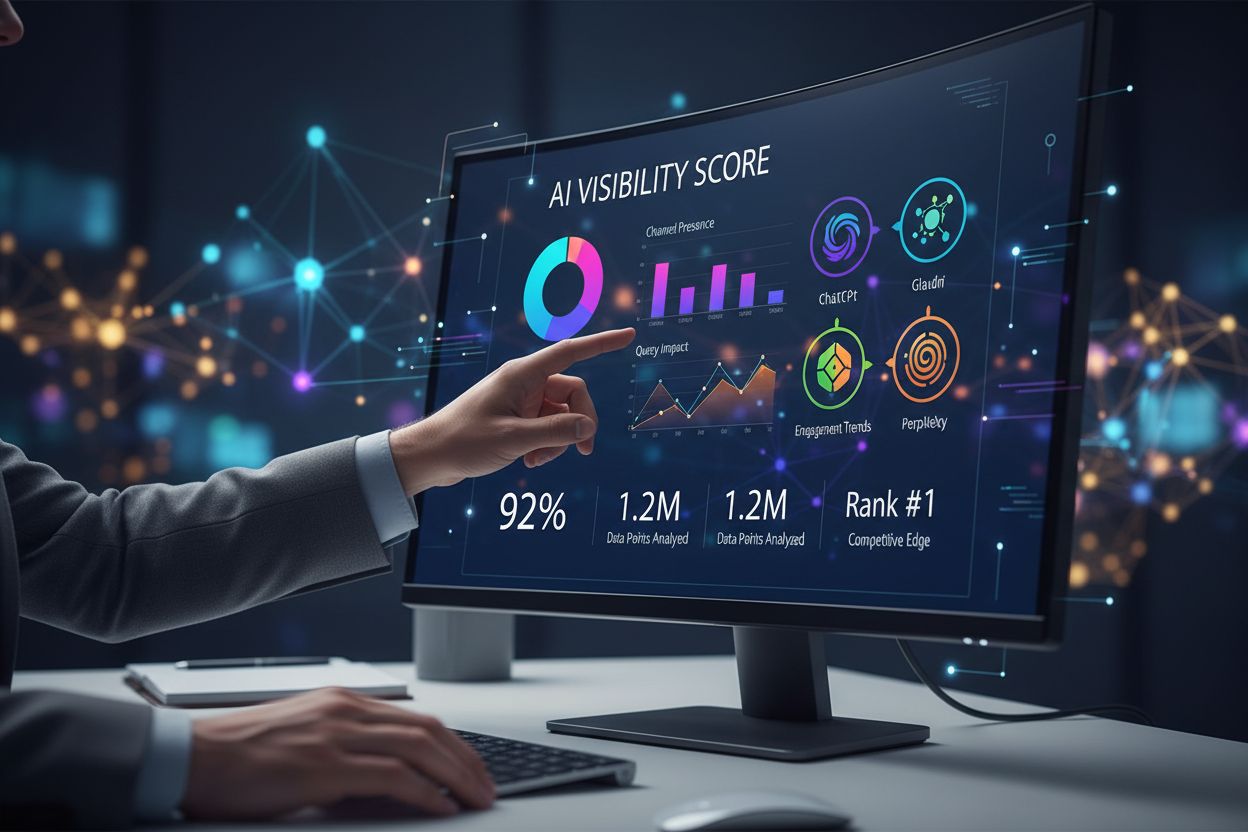
Learn what AI visibility score is, why it matters for your brand, and discover proven strategies to improve your visibility across ChatGPT, Gemini, Claude, and ...
Learn what AI visibility reporting is, how it works, and why it's essential for monitoring your brand's presence in ChatGPT, Perplexity, Google AI Overviews, an...
Cookie Consent
We use cookies to enhance your browsing experience and analyze our traffic. See our privacy policy.